Tavia Acquisition Corp. and Vita Inclinata Technologies, Inc. have taken an important step toward bringing Vita Inclinata into the public market.
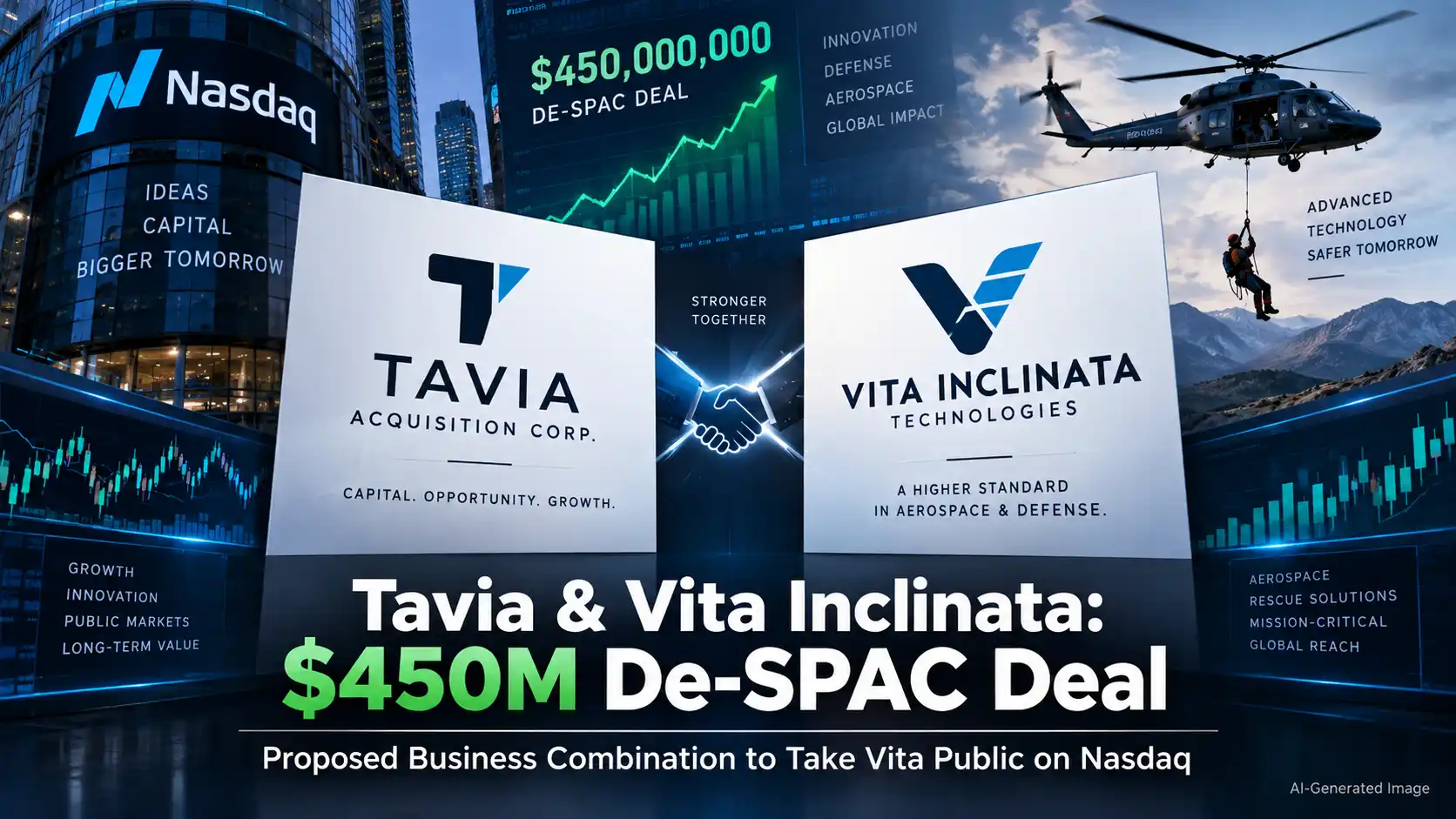
On July 13, 2026, the two companies announced that they had signed a non-binding Letter of Intent (LOI) for a proposed business combination. If the transaction is completed, Vita Inclinata would become a publicly traded company through a de-SPAC transaction on Nasdaq.
The proposed transaction gives Vita Inclinata a pre-money enterprise value of approximately $450 million, assuming Vita successfully completes a pending strategic acquisition in the defense and industrials market.
However, investors should understand that this is not yet a completed merger or acquisition. The LOI is non-binding, and the companies still need to complete due diligence, negotiate and sign a definitive agreement, obtain required approvals and satisfy other closing conditions.
The original announcement said the definitive agreement was expected within about 30 days and that closing was targeted for the fourth quarter of 2026. As of the latest public filings available, the transaction remains at the proposed business-combination/LOI stage rather than being a completed deal.
Key Deal Details
| Deal Detail | Information |
| Acquirer / SPAC | Tavia Acquisition Corp. |
| Target | Vita Inclinata Technologies, Inc. |
| Deal Type | Proposed Business Combination / De-SPAC |
| Announcement Date | July 13, 2026 |
| Status | Non-binding LOI |
| Proposed Vita Enterprise Value | Approximately $450 million |
| Public Market | Nasdaq |
| Tavia Ticker | TAVI |
| Expected Closing | Q4 2026, subject to conditions |
| Exclusivity Period | 45 days |
| Definitive Agreement | Not yet confirmed in the original announcement |
| Strategic Area | Aerospace, defense, industrial safety and related technologies |
The $450 million valuation is an important point, but it is not the same as a final purchase price. The valuation was specifically described as a pre-money enterprise value and is conditional on Vita completing its pending strategic acquisition.
Tavia Acquisition Corp. Company Introduction
Tavia Acquisition Corp. is a Special Purpose Acquisition Company (SPAC) listed on Nasdaq under the ticker TAVI.
Unlike a traditional operating company, a SPAC is created primarily to raise money through an IPO and then find a private company with which to complete a business combination.
Tavia was incorporated in 2024 and completed its IPO in December 2024. According to its SEC filing, it sold 10 million units at $10 per unit, generating gross proceeds of approximately $100 million.
The company had not yet generated operating revenue because its main purpose was to identify a suitable target for a business combination.
That makes the Vita transaction particularly important for Tavia: the SPAC now has a potential target that could transform it from a cash-and-securities vehicle into a company associated with an operating technology business.
Vita Inclinata Technologies Company Introduction
Vita Inclinata Technologies is a technology company focused on improving safety, precision and operational performance in demanding environments.
The company has developed technologies particularly relevant to aerospace, defense, rescue and industrial applications.
Vita’s product ecosystem includes technologies such as the Vita Rescue System and Vita Load Navigator, which are designed to improve helicopter rescue and aerial load-handling operations. The company says its technologies have been deployed with organizations including CAL FIRE and the National Guard.
The company has positioned itself around a broader ecosystem of safety-focused and performance-driven technologies rather than being only a single-product business.
What Exactly Is the Tavia–Vita Transaction?
At first glance, the announcement may look like a normal acquisition.
It is actually more accurately described as a de-SPAC business combination.
In a traditional acquisition, a larger company generally purchases another company.
In a de-SPAC transaction, a publicly traded SPAC combines with a private company. After the transaction, the private company effectively gets access to the public market without following the traditional IPO route.
In this case:
Tavia Acquisition Corp. + Vita Inclinata Technologies → Proposed Public Vita Business
If completed, Vita would become publicly traded through the transaction.
The companies announced that the proposed business combination would take Vita public on Nasdaq.
Why Is Vita Going Public Through a SPAC?
There are several possible strategic reasons.
1. Faster Access to Public Capital
Going public can provide a company with access to a much larger pool of investors.
For Vita, this could help finance:
- Product development
- Manufacturing expansion
- Defense and industrial opportunities
- Acquisitions
- International expansion
- Research and development
Vita’s CEO Caleb Carr said access to public markets could strengthen the company’s ability to invest in innovation, expand its portfolio and pursue new opportunities.
2. Expansion in Defense and Industrial Markets
One of the most interesting aspects of this transaction is the company’s planned expansion beyond its existing products.
The $450 million valuation assumes Vita successfully completes a pending strategic acquisition in the defense and industrials market.
This means investors should watch that separate acquisition carefully.
If completed, it could expand Vita’s technology portfolio and potentially make the combined public company more diversified.
Vita’s Rescue Technology
One of Vita’s most notable areas is helicopter rescue technology.
Traditional helicopter hoisting operations can be difficult because the person being rescued or the load being lifted can swing and rotate under the helicopter.
Vita’s technology is designed to help control this movement.
The basic idea is simple:
Better control → safer operation → greater precision during rescue and aerial lifting
This has potential applications in:
- Search and rescue
- Military operations
- Disaster response
- Firefighting
- Offshore operations
- Heavy aerial lifting
Vita’s technology therefore sits at the intersection of aerospace, defense and safety technology.
Vita Load Navigator and Industrial Applications
Vita has also developed technology for aerial load handling.
Moving large equipment using helicopters can be complicated because suspended loads can rotate or become difficult to control.
Technology that improves stability and positioning can potentially reduce operational risk and improve efficiency.
This gives Vita an opportunity to address markets beyond emergency rescue.
That is strategically important because a broader customer base can make the business less dependent on one particular application.
The $450 Million Valuation Explained
The proposed transaction values Vita at approximately $450 million pre-money enterprise value, subject to the stated condition regarding its pending strategic acquisition.
It is important not to interpret this as:
“Tavia is paying Vita $450 million in cash.”
That is not what has been announced.
The transaction is a business combination involving a SPAC, and the final structure, ownership percentages, financing and other economic terms would need to be established in the definitive agreement and subsequent SEC filings.
Therefore, the $450 million figure should currently be treated as the announced proposed valuation, not a completed acquisition price.
45-Day Exclusivity Period
Tavia and Vita agreed to a 45-day exclusivity period.
During this period, the companies intended to conduct due diligence and negotiate a definitive Business Combination Agreement.
Due diligence is important because Tavia needs to examine Vita’s:
- Financial statements
- Contracts
- Intellectual property
- Customers
- Liabilities
- Legal matters
- Operations
- Future business plans
The process helps determine whether the proposed transaction terms remain appropriate.
Institutional Investment Is Another Important Factor
Tavia and Vita also said they were engaging with institutional investors and strategic partners for initial non-binding investment indications.
Firm commitments were expected to be announced alongside the signing of a definitive agreement.
This is important because SPAC transactions often require additional financing to support the combined company’s growth.
Therefore, investors should watch for future announcements regarding:
- PIPE or other private financing
- Institutional investors
- Strategic investors
- Cash available at closing
- Redemption levels
- Final ownership structure
These details can significantly change the economics of a SPAC transaction.
What Happens Next?
The transaction has several important stages ahead.
Step 1: Due Diligence
Tavia and Vita examine each other’s financial and legal information.
Step 2: Definitive Agreement
The parties must negotiate and sign a legally binding Business Combination Agreement.
Step 3: Financing
Any required institutional or strategic financing would need to be finalized.
Step 4: SEC Filing
If a definitive agreement is signed, the parties expect to prepare a registration statement, including a proxy statement/prospectus, for filing with the SEC.
Step 5: Shareholder Approval
Tavia shareholders would receive information about the transaction and, where required, vote on the proposed combination.
Step 6: Regulatory and Closing Conditions
The companies must satisfy applicable regulatory and other customary closing conditions.
Step 7: Completion
Only after these conditions are satisfied can the transaction close and Vita become a publicly traded business through the proposed structure.
Why This Deal Could Be Important for Vita
The biggest benefit for Vita could be access to public capital markets.
Vita is operating in industries where technology development, certification, manufacturing and sales expansion can require significant capital.
A public listing could potentially provide the company with:
- Greater access to capital
- Increased visibility
- Publicly traded shares
- Currency for future acquisitions
- More opportunities to expand its technology portfolio
This could be especially useful if Vita wants to become a broader defense and industrial technology platform.
Why This Deal Could Be Important for Tavia
For Tavia, the transaction could finally give the SPAC an operating business.
Before identifying Vita, Tavia’s primary activity was searching for a suitable business-combination target. Its SEC filing states that it had not generated operating revenue from business operations.
Vita gives Tavia a potential path into the aerospace, defense and industrial technology markets.
If the transaction closes successfully, Tavia shareholders would effectively gain exposure to the combined Vita business rather than simply owning a SPAC searching for a target.
Potential Growth Opportunities
The combined company could potentially benefit from several long-term trends.
Defense Technology
Governments are increasingly investing in advanced technologies that can improve military safety and operational efficiency.
Autonomous and Advanced Systems
Vita’s technology portfolio is connected to increasingly automated and precision-focused aerial operations.
Search and Rescue
Natural disasters, firefighting and emergency-response operations create demand for safer and more efficient rescue systems.
Industrial Aerial Operations
Helicopter-based lifting and transportation remain important in industries where conventional ground transportation is difficult.
Strategic Acquisitions
The planned defense and industrial acquisition could give Vita additional technology and customers.
Key Risks Investors Should Watch
The proposed transaction also carries significant risks.
1. The Deal Is Not Final
This is the most important point.
The current LOI is non-binding. The SEC filing specifically states that there is no assurance that a definitive agreement will be reached or that the transaction will ultimately close.
2. $450 Million Is Not a Final Deal Price
The announced valuation is subject to conditions and could change when the definitive agreement is negotiated.
3. Financing Risk
The companies are still seeking investment indications from institutional and strategic investors.
Actual financing commitments could affect the final transaction structure.
4. SPAC Shareholder Redemptions
SPAC shareholders can sometimes redeem their shares rather than participate in the completed transaction.
High redemptions can reduce the cash available to the combined company.
5. Defense and Aerospace Certification
Companies operating in defense and aerospace markets often face regulatory, certification and procurement requirements.
Delays in contracts or certifications could affect growth.
6. Acquisition Execution Risk
The $450 million valuation assumes completion of Vita’s pending strategic acquisition.
Failure or delay in that acquisition could affect the proposed transaction.
What Investors Should Watch Next
For investors following TAVI, Vita and the proposed transaction, these developments will be particularly important:
- Definitive Business Combination Agreement
- Final transaction valuation
- Ownership percentage of existing Vita shareholders
- Institutional/PIPE financing commitments
- Details of Vita’s pending defense and industrial acquisition
- SEC registration statement
- Tavia shareholder vote
- SPAC redemption levels
- Expected closing date
- Final Nasdaq ticker and corporate structure
These details will provide a much clearer picture of the actual economics of the transaction.
Outcome
The Tavia–Vita transaction is interesting because it combines a public-market vehicle with a specialized aerospace and defense technology company.
For Vita, the deal could provide the capital and public-market visibility needed to expand its technology portfolio and pursue larger defense and industrial opportunities.
For Tavia, Vita provides an operating business with exposure to aerospace, defense, rescue and industrial safety technologies.
However, investors should avoid treating the announcement as a completed acquisition.
As of the latest available public information, the transaction is still based on the July 13, 2026 non-binding LOI. The final outcome depends on due diligence, a definitive agreement, financing, shareholder and regulatory approvals and other closing conditions.
The most important upcoming catalyst will therefore be the definitive Business Combination Agreement. Once that agreement is filed, investors will be able to assess the final valuation, ownership structure, financing and expected post-merger company in much greater detail.
Bottom Line
Tavia Acquisition Corp. is not yet acquiring Vita Inclinata in a completed transaction. Instead, the two companies have agreed to pursue a proposed de-SPAC business combination that could value Vita at approximately $450 million and take the company public on Nasdaq.
If completed, the transaction could give Vita access to public capital while giving Tavia a technology-focused operating business in the aerospace, defense and industrial safety markets.
For now, however, the deal should be viewed as a proposed transaction rather than a completed merger.