Almost every important activity on the internet depends on cryptography in some way. When we use online banking, make a credit-card payment, log in to a website, send a confidential email, or exchange data with a company server, cryptographic technologies help protect that information.
However, a new technology could create a major challenge for some of today’s digital security systems: quantum computing.
Quantum computers are not yet capable of replacing conventional computers or breaking today’s major encryption systems at scale. However, if sufficiently powerful and fault-tolerant quantum computers are developed in the future, they could threaten some widely used public-key cryptographic systems.
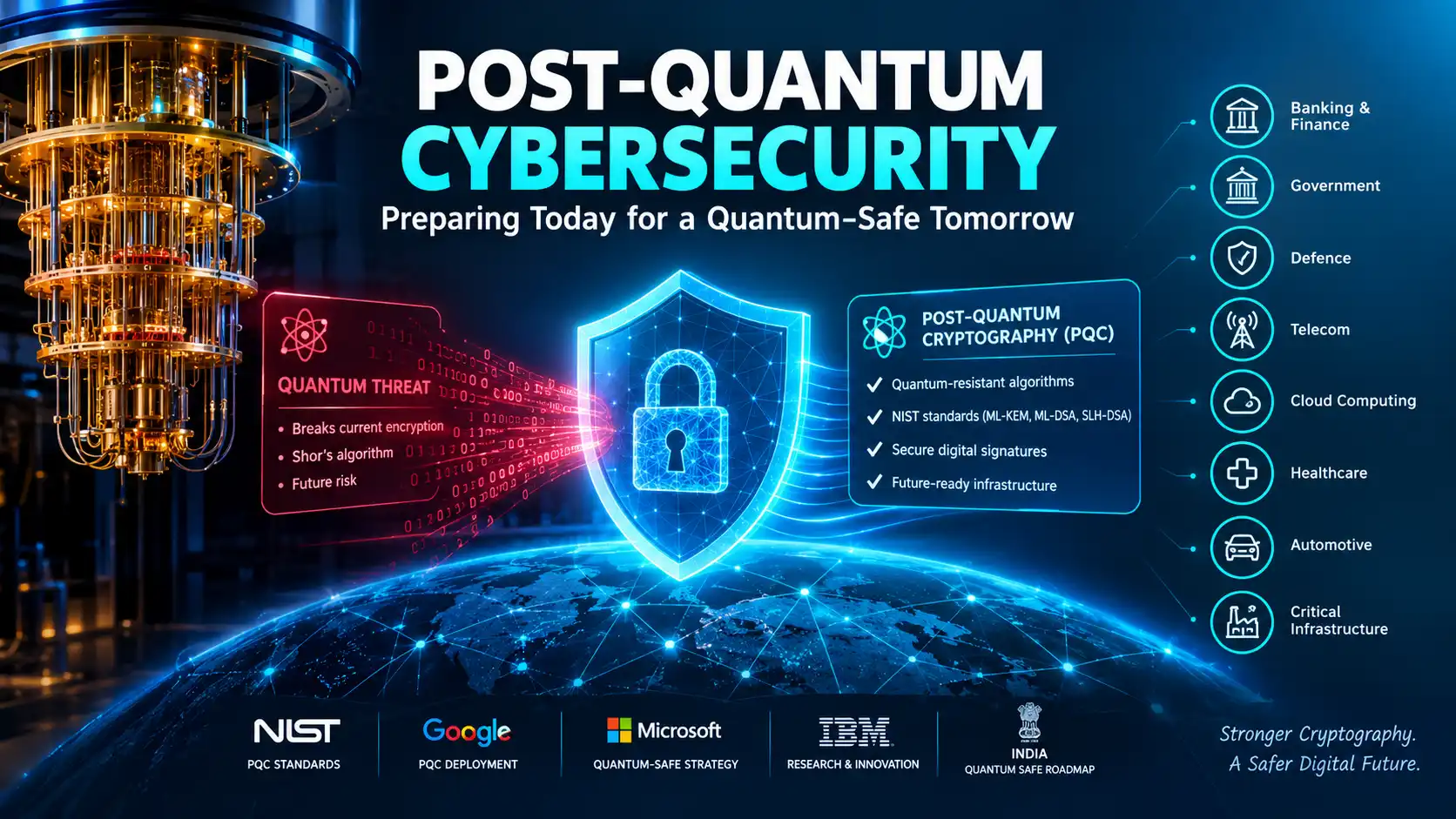
This is why governments, technology companies, cybersecurity firms, and researchers are working on Post-Quantum Cryptography (PQC) and the broader field of Post-Quantum Cybersecurity.
In simple terms, the goal is:
To prepare today’s digital security systems so that they can remain secure even when powerful quantum computers become available.
What Is Post-Quantum Cybersecurity?
Post-Quantum Cybersecurity is not a single software product or technology. It is a broader cybersecurity approach in which organizations prepare their encryption, digital signatures, certificates, authentication systems, and other security infrastructure for the potential threat posed by quantum computers.
One of its most important components is Post-Quantum Cryptography (PQC).
PQC refers to cryptographic algorithms designed to run on conventional computers while being resistant to attacks from future quantum computers.
In simple words:
The objective is not to fight a quantum computer with another quantum computer. Instead, it is to use cryptographic methods that remain difficult for quantum computers to break.
Why Could Quantum Computers Threaten Today’s Encryption?
Many digital security systems depend on mathematical problems that are extremely difficult for conventional computers to solve.
For example, public-key cryptography uses technologies such as RSA and Elliptic Curve Cryptography (ECC) across many digital systems.
For a conventional computer, reversing the underlying mathematical problem can require an impractical amount of time.
A sufficiently powerful quantum computer, however, could use quantum algorithms such as Shor’s algorithm to solve certain mathematical problems much more efficiently.
This is the fundamental reason cybersecurity researchers are preparing for the quantum threat.
Importantly, today’s quantum computers cannot simply break RSA or ECC at internet scale. The concern is the possibility of future quantum computers becoming powerful enough to do so.
A Simple Example
Imagine that you have installed a very strong digital lock.
With today’s conventional computers, breaking that lock would take so long that an attack would not be practically useful.
Now imagine that a future quantum computer becomes powerful enough to solve the mathematical problem behind that lock much faster.
The same lock could then become vulnerable.
Therefore, the cybersecurity industry does not want to wait until that happens.
The idea is:
Develop and deploy stronger, quantum-resistant locks before powerful quantum computers arrive.
That is the basic concept behind Post-Quantum Cryptography.
What Is “Harvest Now, Decrypt Later”?
One of the most important concerns surrounding quantum security is that the threat is not necessarily limited to the future.
An attacker could capture encrypted information today and store it for later.
The attacker may not be able to decrypt that information today. But if sufficiently powerful quantum computers become available in the future, the attacker could potentially try to decrypt the stored data.
This strategy is commonly known as:
Harvest Now, Decrypt Later (HNDL).
Example
Imagine that a government agency, defence organization, bank, or company is sending highly confidential information over an encrypted connection.
An attacker secretly captures that encrypted traffic and stores it.
Today, the attacker may not be able to use the data.
But if the encryption becomes vulnerable to future quantum computers, the stored information could become valuable years later.
This is particularly important for information that must remain confidential for decades, such as defence information, government records, financial information, intellectual property, and some healthcare or genetic data.
Quantum Security Is Not Only About Encryption
Post-quantum migration is much broader than simply replacing an encryption algorithm.
The quantum threat can affect several components of digital security, including:
- Encryption
- Digital signatures
- Digital certificates
- Authentication
- Secure websites
- VPNs
- Cloud security
- Software signing
- Device authentication
- Government communications
- Financial infrastructure
- IoT devices
- Critical infrastructure
This is why PQC migration can become a major technology and engineering project.
What Post-Quantum Standards Has NIST Developed?
One of the most important organizations in this field is the U.S. National Institute of Standards and Technology (NIST).
After years of international research and evaluation, NIST finalized its first major post-quantum cryptography standards in 2024.
Three important standards are:
1. ML-KEM
ML-KEM — Module-Lattice-Based Key-Encapsulation Mechanism
ML-KEM is designed for secure key establishment between parties.
A simple example is when two systems need to establish a shared secret key before starting a secure communication session.
ML-KEM provides a quantum-resistant approach for that key-establishment process.
2. ML-DSA
ML-DSA — Module-Lattice-Based Digital Signature Algorithm
ML-DSA is designed for digital signatures.
Digital signatures help verify that a message, document, or software package actually came from a trusted source and has not been modified.
For example, when a software company releases an update, a digital signature can help a device verify that the update is genuine.
In the future, such trust mechanisms will also need to withstand potential quantum attacks.
3. SLH-DSA
SLH-DSA — Stateless Hash-Based Digital Signature Algorithm
SLH-DSA is another approach for quantum-resistant digital signatures.
It is based on a different mathematical foundation from the lattice-based algorithms used by ML-DSA.
Having different mathematical approaches is useful because it provides diversity within the post-quantum cryptography ecosystem.
NIST has finalized ML-KEM, ML-DSA, and SLH-DSA as standards that organizations can implement as part of their quantum-readiness programs.
Does This Mean RSA and ECC Will Disappear Immediately?
No.
This is an important point.
PQC migration does not mean that every existing encryption system will suddenly be switched off.
The real challenge is the enormous amount of existing infrastructure that already depends on cryptography.
Websites, applications, servers, smartphones, cloud platforms, financial systems, network equipment, vehicles, industrial machines, and IoT devices may all use cryptographic algorithms.
In many cases, organizations may not even know exactly where every cryptographic algorithm is being used.
Therefore, the transition will take years.
This process is often described as cryptographic migration.
What Is Crypto-Agility?
Another important concept in post-quantum security is:
Crypto-agility.
Crypto-agility means designing systems so that cryptographic algorithms can be replaced or upgraded without rebuilding the entire system.
Example
Imagine that a company’s software has an encryption algorithm deeply embedded throughout its code.
If that algorithm needs to be replaced, the company may have to redesign major parts of the software.
A crypto-agile system is designed differently.
The cryptographic component can be replaced more easily when new standards or security requirements emerge.
Therefore, future cybersecurity will require not only secure systems but also:
Systems that can adapt to new cryptographic threats.
What Is Google Doing?
Google has been researching quantum-resistant cryptography for years and has been moving toward practical deployment.
Google Cloud has been working to integrate post-quantum technologies into its infrastructure and customer-facing services.
One important approach is the use of hybrid cryptography, where traditional cryptographic mechanisms and post-quantum mechanisms can be used together during the transition.
Google has also worked on supporting NIST-standardized ML-KEM in its infrastructure.
This demonstrates an important shift:
Post-quantum cryptography is moving from academic research toward real-world infrastructure deployment.
Microsoft’s Quantum-Safe Strategy
Microsoft is also working on the transition to quantum-safe security.
The company’s approach covers areas such as:
Network Security
Protecting communications as data moves across networks.
Data at Rest
Preparing stored data and systems for future cryptographic requirements.
Digital Trust
Updating certificates, software signing, identity systems, and authentication mechanisms.
One of the biggest challenges Microsoft and other large technology companies face is discovering where cryptography is actually being used across complex technology environments.
A large organization may have thousands of applications, servers, devices, APIs, cloud services, and third-party systems.
Finding every cryptographic dependency is therefore a major part of the migration process.
IBM and Other Technology Companies
Companies working on quantum computing are also naturally involved in quantum-safe cybersecurity.
IBM, for example, is working across both quantum computing and quantum-safe cryptography.
At the same time, cloud providers, cybersecurity companies, semiconductor manufacturers, network equipment companies, and software vendors are working to make their products compatible with post-quantum standards.
The reason is straightforward.
When quantum computers become more powerful, changing encryption software alone will not be enough.
The entire technology stack may need to become quantum-resilient.
Why Is the U.S. Government Moving So Quickly?
The U.S. government considers the quantum threat particularly important for national security.
NIST has developed post-quantum cryptographic standards, while the U.S. National Security Agency (NSA) has established additional guidance for National Security Systems.
In October 2026, the NSA announced new measures requiring new commercial National Security Systems to support quantum-resistant algorithms from 2027, with legacy systems that do not support quantum-resistant algorithms targeted for phase-out by 2030.
These deadlines demonstrate that post-quantum security is becoming part of government infrastructure planning and technology procurement, rather than remaining only a research topic.
What Is India Doing?
India is also preparing for the quantum-security transition.
The Department of Science and Technology has developed a Quantum Safe Ecosystem in India roadmap under the country’s National Quantum Mission.
The roadmap includes targets to make:
Critical Information Infrastructure quantum-resilient by 2029
and promote:
Enterprise-wide Post-Quantum Cryptography adoption by 2033.
This could have major implications for banking, telecommunications, defence, government systems, digital identity, and other critical infrastructure.
An Interesting Development from C-DOT
India’s Centre for Development of Telematics (C-DOT) has also been working on tools for the post-quantum transition.
In 2026, C-DOT signed an agreement with Synergy Quantum India to develop an automated tool that can help identify cryptographic algorithms being used inside devices and systems and determine which algorithms may be vulnerable to future quantum attacks.
Consider a large company with:
- 10,000 computers
- 2,000 servers
- 500 network devices
- Thousands of IoT devices
The organization may not have a complete inventory of all the cryptographic algorithms used across those systems.
An automated discovery tool could help create that inventory.
This is important because:
You cannot effectively migrate cryptography if you do not know where your existing cryptography is being used.
PQC and Quantum Key Distribution Are Not the Same
This is a common source of confusion.
Post-Quantum Cryptography and Quantum Key Distribution (QKD) are different technologies.
Post-Quantum Cryptography
PQC uses mathematical algorithms that can run on conventional computers and are designed to resist attacks from quantum computers.
Quantum Key Distribution
QKD uses principles of quantum physics to distribute cryptographic keys between parties.
In simple terms:
PQC = mathematical/software-based security approach
while
QKD = quantum-physics-based communication technology
QKD continues to be researched and deployed in certain areas, but it has different infrastructure requirements and limitations.
For broad internet-scale migration, PQC is generally considered a more practical software-based approach because it can be integrated into existing digital infrastructure.
Which Industries Will Be Most Affected?
Post-quantum cybersecurity could eventually affect almost every digital industry, but some sectors face particularly important risks.
Banking and Financial Services
Banks manage highly sensitive financial information, payment systems, customer identities, and long-term records.
Government
Government agencies hold sensitive citizen, administrative, intelligence, and national-security information.
Defence
Some defence information may need to remain confidential for decades, making long-term encryption security particularly important.
Telecommunications
5G and future 6G networks will carry enormous amounts of encrypted communication.
Cloud Computing
Cloud providers need to manage cryptographic infrastructure across millions of applications, customers, and services.
Healthcare
Medical records and genetic information can remain sensitive for many years.
Automotive
Connected and autonomous vehicles increasingly depend on secure software updates, vehicle authentication, cloud connectivity, and vehicle-to-everything communication.
Industrial Infrastructure
Power grids, factories, pipelines, transport systems, and other critical infrastructure are becoming increasingly connected.
Why Could PQC Matter for Autonomous Vehicles?
This is particularly interesting for the future of electric and autonomous vehicles.
A future autonomous vehicle will not simply be a mechanical machine.
It could depend on:
- Cloud connectivity
- Over-the-air software updates
- V2X communication
- Autonomous driving software
- Digital certificates
- Vehicle identity
- Charging networks
- Fleet-management systems
If an attacker compromises vehicle authentication or software-update mechanisms, the consequences could go beyond ordinary data theft.
Therefore, quantum-resistant security could become an important part of the long-term cybersecurity architecture for connected and autonomous vehicles.
A New Market for Cybersecurity Companies
The post-quantum transition could also create a significant new technology market.
Organizations may need:
- Cryptographic inventory tools
- PQC migration software
- Quantum-safe VPNs
- Quantum-safe TLS
- Quantum-resistant certificates
- Secure identity systems
- Hardware security modules
- PQC-enabled network equipment
- Crypto-agility platforms
- Quantum-safe cloud infrastructure
Therefore, Post-Quantum Cybersecurity is not only a security challenge.
It could also become a large technology and cybersecurity market.
What Is the Biggest Challenge?
The biggest challenge may not be building a quantum computer.
It may be:
Replacing and upgrading the world’s existing cryptographic infrastructure.
Cryptography can be hidden in many parts of an organization:
Application
↓
Server
↓
Network
↓
Database
↓
Cloud
↓
Certificate system
↓
Hardware
↓
IoT devices
If an organization does not know where cryptography is being used, migrating to post-quantum standards becomes much more difficult.
Should Every Company Adopt PQC Immediately?
Not every company needs to replace every cryptographic system immediately.
However, organizations with sensitive or long-lived data should begin preparing.
A sensible migration strategy could start with:
1. Build a Cryptographic Inventory
Identify which systems use which cryptographic algorithms.
2. Assess the Risk
Determine which systems and data are most sensitive.
3. Identify Long-Lived Data
Find information that may need to remain confidential for 10, 20, or even 30 years.
4. Improve Crypto-Agility
Make future cryptographic upgrades easier.
5. Test PQC
Test post-quantum algorithms with existing applications and infrastructure.
6. Create a Migration Roadmap
Prioritize high-risk systems first instead of attempting to replace everything simultaneously.
What Is Hybrid Cryptography?
During the migration period, organizations may use a hybrid cryptographic approach.
This means combining a traditional cryptographic mechanism with a post-quantum mechanism.
Example
A secure connection could use an existing elliptic-curve mechanism together with an ML-KEM-based key exchange.
The organization does not necessarily have to remove the existing mechanism overnight.
Instead, both approaches can be used during the transition.
This can help organizations gradually move toward quantum-resistant security while maintaining compatibility with existing infrastructure.
Is Post-Quantum Cryptography 100% Unbreakable?
No.
It would be incorrect to describe any cryptographic technology as permanently unbreakable.
PQC algorithms are designed and evaluated to resist known classical and quantum attacks, but cryptographic research is continuously evolving.
A useful example came from the broader post-quantum research community in 2026, when an AI model helped researchers identify a vulnerability in HAWK, a lattice-based digital-signature candidate.
HAWK was not one of NIST’s finalized standards.
The finding therefore does not mean that NIST’s ML-KEM or ML-DSA standards were broken.
Instead, it demonstrates an important point:
Post-quantum cryptography itself requires continuous research, testing, auditing, and security analysis.
What Does the Future of PQC Look Like?
Over the coming years, the focus of Post-Quantum Cybersecurity will move beyond simply developing new algorithms.
The progression could look like this:
PQC Algorithms
↓
Quantum-Safe Software
↓
Quantum-Safe Networks
↓
Quantum-Safe Cloud
↓
Quantum-Safe Hardware
↓
Quantum-Safe Identity
↓
Quantum-Safe Critical Infrastructure
↓
Quantum-Resilient Digital Economy
Post-Quantum Cybersecurity in 2026
The current landscape can be summarized as follows:
| Area | Current Situation |
| PQC research | Rapidly advancing |
| NIST standards | Finalized |
| ML-KEM | Ready for implementation |
| ML-DSA | Ready for implementation |
| SLH-DSA | Ready for implementation |
| PQC migration and deployment underway | |
| Microsoft | Accelerating its quantum-safe transition |
| U.S. National Security Systems | 2027/2030 migration milestones |
| India | 2029 critical-infrastructure and 2033 enterprise targets |
| QKD | Research and deployment continue as a separate approach |
| Crypto-agility | Becoming increasingly important |
| Enterprise migration | Early but accelerating |
| Quantum computer threat | Future risk; exact arrival date remains uncertain |
Outcome
Post-Quantum Cybersecurity should not be viewed simply as “encryption that protects us from future quantum computers.”
It could become a much broader technology transition that changes the digital trust architecture of the internet.
Some cryptographic systems considered secure against today’s conventional computers could become vulnerable to sufficiently powerful quantum computers in the future. This is why NIST has already finalized quantum-resistant standards, while governments and technology companies are beginning their migration efforts.
Companies such as Google, Microsoft, IBM, and major cybersecurity and cloud providers are working on quantum-safe infrastructure and migration strategies. The U.S. government has established specific timelines for national-security systems, while India has created its own quantum-safe roadmap with targets for critical infrastructure and enterprise adoption.
The most important point is that organizations should not wait until powerful quantum computers actually arrive.
For data that needs to remain secure for many years, quantum-safe preparation needs to begin well in advance.
This is why Post-Quantum Cybersecurity could become an important technology transition for cybersecurity, cloud computing, banking, telecommunications, defence, autonomous vehicles, healthcare, and critical infrastructure over the coming decade.