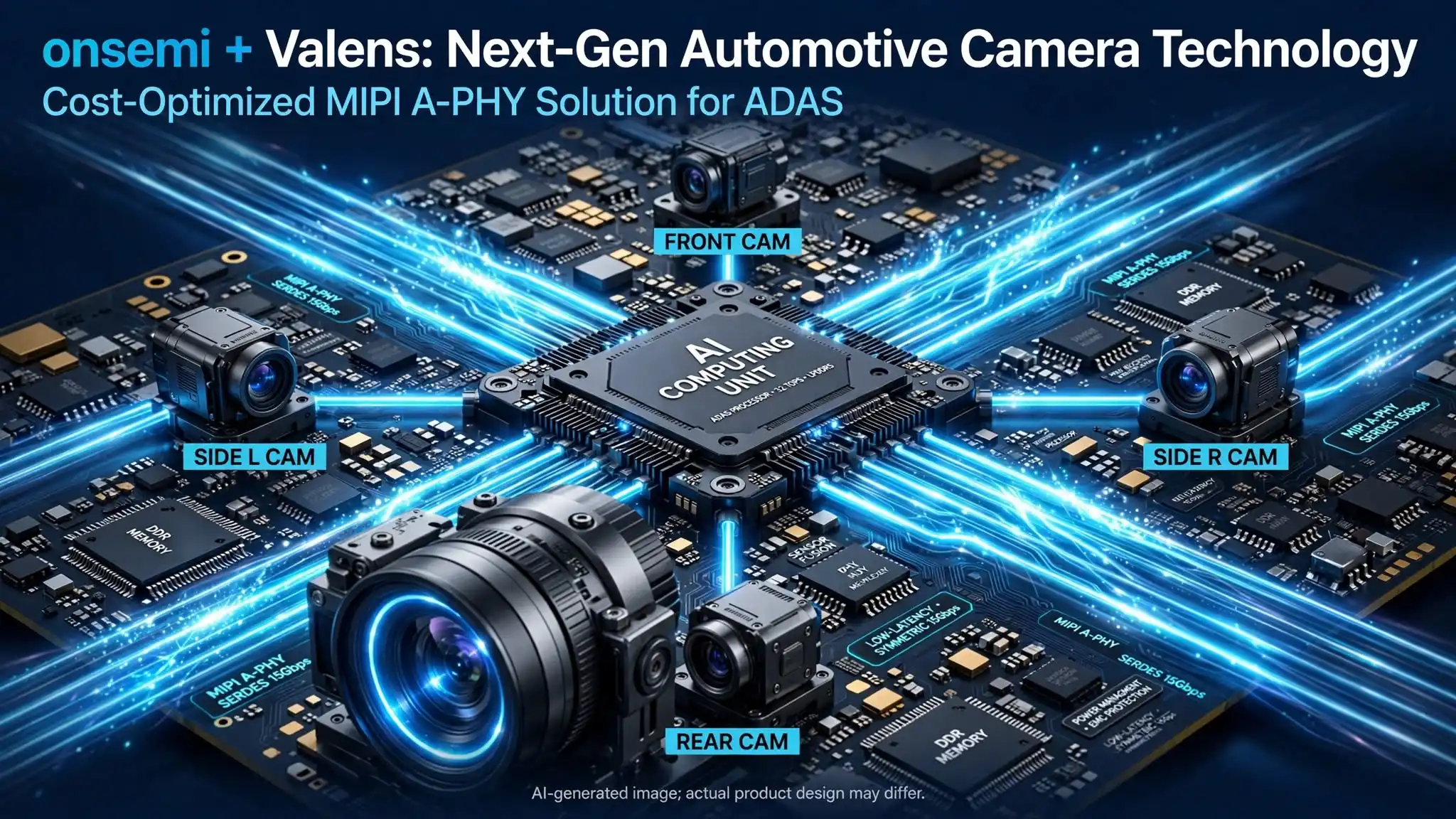
Modern vehicles are using more cameras than ever before. Cameras are now an important part of Advanced Driver Assistance Systems (ADAS), autonomous driving, parking systems, surround-view monitoring, driver monitoring and in-cabin safety.
However, adding more cameras to a vehicle also increases the cost and complexity of the camera system. Each camera traditionally needs several components to capture, process and transmit high-speed image data to the vehicle’s central computing system.
To address this challenge, onsemi and Valens Semiconductor are collaborating to develop a cost-optimized automotive camera solution based on the MIPI A-PHY standard. The companies are targeting high-volume automotive cameras with around 3-megapixel resolution, with the goal of simplifying camera architecture, reducing component count and making advanced camera systems easier to deploy in mainstream vehicles.
The collaboration was announced on September 22, 2026, and was subsequently highlighted by automotive technology publications in early October.
What Are onsemi and Valens Semiconductor?
onsemi
onsemi is a semiconductor company that develops technologies used in automotive, industrial and other electronic applications. In the automotive sector, the company has a strong focus on image sensors and intelligent sensing technologies.
Its automotive imaging technologies are used for applications where vehicles need to understand their surroundings through cameras and other sensors.
Valens Semiconductor
Valens Semiconductor develops high-speed connectivity chipsets. The company is particularly involved in MIPI A-PHY, a standard designed for high-speed connectivity between automotive cameras, sensors, displays and central computing systems.
Valens’ VA7000 family, for example, provides MIPI A-PHY-compliant connectivity for cameras, radar and LiDAR applications. Its automotive implementations can support multi-gigabit data transmission over automotive wiring.
The two companies therefore bring complementary technologies to this collaboration:
- onsemi → Image sensors
- Valens → High-speed automotive connectivity
- Combined goal → A simpler automotive camera architecture
What Have onsemi and Valens Announced?
The companies plan to collaborate on a cost-optimized integrated sensor solution targeting high-volume automotive camera applications.
The key idea is to integrate MIPI A-PHY connectivity directly into an onsemi image sensor.
The initial target is approximately 3-megapixel automotive camera applications. According to the companies, most automotive image sensors currently target the 1–3MP range, making 3MP an important segment for mainstream vehicles.
This is important because the technology is not being designed only for expensive premium autonomous vehicles. The broader objective is to make A-PHY-based camera architecture practical for high-volume vehicle platforms.
What Is MIPI A-PHY?
To understand this development, it is useful to first understand the problem that A-PHY is designed to solve.
A vehicle camera continuously generates large amounts of image data. That data has to travel from the camera, often located at the front, rear, sides or inside the cabin, to another electronic control unit or central computer.
Traditional systems often require additional components to convert and transmit this data over the vehicle’s wiring.
MIPI A-PHY is a standardized automotive physical-layer connectivity technology designed for high-speed, long-reach transmission of sensor and display data.
In simple terms, think of A-PHY as a common high-speed communication pathway that allows automotive cameras and other sensors to send large amounts of data through the vehicle.
Valens’ existing A-PHY chipsets support cameras as well as radar and LiDAR applications, with multi-gigabit connectivity and support for automotive-grade requirements.
What Is the Problem With Traditional Automotive Cameras?
A conventional automotive camera can contain an image sensor plus a separate serializer and other supporting components.
The image sensor captures the image, while the serializer prepares the data for high-speed transmission through the vehicle.
This approach works, but when a vehicle uses many cameras, the additional components can increase:
- Hardware cost
- PCB size
- Power consumption
- Thermal load
- Camera-module complexity
- Wiring complexity
- Manufacturing requirements
Imagine a vehicle using eight, ten or even more cameras. Even a small amount of additional hardware in each camera can become significant when multiplied across the entire vehicle.
This is becoming increasingly important as modern vehicles add more cameras for ADAS and automated driving.
How Can the New Solution Simplify the Camera?
The proposed solution aims to integrate A-PHY connectivity directly into the image sensor.
That means the traditional combination of:
Image Sensor + Separate Serializer
could move toward:
Integrated Image Sensor + A-PHY Connectivity
This is sometimes described as a move toward a single-chip camera architecture.
Valens says this approach can eliminate the need for a standalone serializer and reduce the number of components required inside the camera module.
In simple words, instead of using multiple important chips to perform separate functions, more of those functions can be combined into one device.
Why Is 3MP Important?
The collaboration is specifically targeting 3-megapixel automotive cameras.
At first, 3MP may not sound particularly high compared with consumer smartphone cameras. But automotive cameras have different requirements.
They must operate reliably in:
- Bright sunlight
- Darkness
- Rain
- Temperature changes
- Vehicle vibration
- Electromagnetic interference
- Long operating cycles
The companies say the majority of automotive image sensors currently target the 1–3MP range. Therefore, a cost-optimized 3MP solution could address a large existing market rather than focusing only on premium high-resolution systems.
This is one of the most important points in the announcement.
The objective is not simply to create a higher-resolution camera. It is to make advanced connectivity more affordable for a large number of vehicles.
What Are the Expected Benefits?
1. Lower Camera Cost
Removing a separate serializer and associated components can reduce the bill of materials.
For automakers, even a small saving per camera can become significant when a vehicle uses multiple cameras and production volumes are high.
2. Fewer Components
A simplified architecture can reduce the number of active components inside the camera.
This can make the overall design easier for automotive suppliers to manufacture and integrate.
3. Smaller Camera Modules
Fewer components can also help reduce the physical size of camera modules.
Smaller modules can provide automakers with more flexibility when positioning cameras around a vehicle.
4. Lower Power and Thermal Load
Fewer active components can potentially reduce power consumption and heat generation inside the camera module.
This becomes increasingly useful as vehicles add more sensors and cameras.
5. Easier A-PHY Adoption
The companies are also trying to make it easier for OEMs and Tier-1 suppliers to move toward the MIPI A-PHY ecosystem.
A standardized approach can provide manufacturers with greater supplier choice rather than forcing them to rely on a proprietary connectivity solution.
Valens specifically highlighted supplier choice as one of the benefits of a standardized A-PHY ecosystem.
Where Could These Cameras Be Used?
The technology could potentially support several automotive camera applications.
ADAS Cameras
ADAS systems use cameras to identify lanes, vehicles, pedestrians, road signs and other objects.
A more cost-efficient camera architecture could help manufacturers increase the number of cameras used in vehicles.
Surround-View Cameras
Multiple cameras can provide a 360-degree view around the vehicle.
These systems are useful for parking, low-speed manoeuvring and driver assistance.
Driver Monitoring
Cameras inside the cabin can monitor the driver for attention, fatigue and other safety-related conditions.
Interior Sensing
Cameras can also be used to monitor passengers and the vehicle cabin.
Autonomous Driving
Autonomous vehicles require large amounts of sensor data.
Cameras are one of the most important sources of environmental information, so efficient transmission of camera data becomes increasingly important as autonomous-driving systems become more sophisticated.
The companies’ technology is therefore relevant to the broader development of ADAS and autonomous vehicles, although this collaboration itself is a camera/connectivity technology development rather than a new autonomous vehicle launch.
How Is This Different From Just Adding a Better Camera?
This is an important distinction.
The development is not primarily about increasing camera resolution.
Instead, the focus is on changing how the camera is designed and how its data is transmitted.
The industry is moving toward cameras that can deliver more useful information while keeping the total vehicle system affordable.
For example:
Traditional approach
Camera sensor → Serializer → Vehicle wiring → Central processing
Integrated A-PHY approach
Image sensor + A-PHY → Vehicle wiring → Central processing
The second architecture can potentially reduce components and simplify the camera module.
Why Is This Important for Future Autonomous Vehicles?
Autonomous driving requires a vehicle to continuously understand its surroundings.
That means vehicles need large amounts of sensor data from cameras, radar and LiDAR.
As the number of sensors increases, the vehicle’s electrical and electronic architecture also becomes more complicated.
This creates a major engineering challenge:
How can vehicles add more sensors without making the entire system excessively expensive and complex?
Integrated A-PHY camera technology is one potential answer.
Instead of simply adding more hardware, manufacturers can try to make each camera smaller, simpler and more cost-efficient.
Valens has already demonstrated A-PHY-based automotive camera implementations. For example, its VA7000 technology has been used with QHD front and rear cameras that can transmit video over relatively simple UTP or low-cost coaxial connections.
What Does This Mean for EVs?
The technology is not limited to electric vehicles.
It can be used in:
- Petrol vehicles
- Hybrid vehicles
- Plug-in hybrids
- Electric vehicles
- Autonomous vehicles
- Commercial vehicles
However, it could become particularly relevant to future EVs because many EV manufacturers are moving toward software-defined vehicle architectures with centralized computing and increasing numbers of cameras and sensors.
So, this technology should be classified as:
Automotive Technology → Camera / Connectivity / ADAS
rather than simply an EV technology.
The Bigger Industry Trend: From Multi-Chip Cameras to Single-Chip Cameras
The onsemi-Valens collaboration is part of a broader trend in automotive imaging.
Valens has highlighted the emergence of image sensors with built-in MIPI A-PHY connectivity. According to Valens, Sony’s IMX828 represents an early commercial example of an automotive image sensor with integrated A-PHY connectivity.
This suggests that automotive camera development is gradually moving toward greater integration.
The long-term direction could look like this:
More cameras → More data → More connectivity requirements
but simultaneously:
More integration → Fewer components → Lower cost and smaller modules
This balance could become increasingly important as vehicles move toward higher levels of automation.
What Does This Mean for Automakers and Tier-1 Suppliers?
For automakers, the biggest attraction could be system-level cost and complexity reduction.
For Tier-1 suppliers, integrated A-PHY sensors could simplify camera module development.
For semiconductor companies, the growth of camera-based ADAS and autonomous driving creates a growing market for:
- Image sensors
- Connectivity chips
- Automotive processors
- AI accelerators
- Radar processors
- LiDAR processors
- Sensor fusion systems
Therefore, this collaboration is not just about one camera component. It is part of the larger transition toward centralized and software-defined vehicle electronics.
Is the Technology Ready for Mass Production?
This is where readers should be careful.
The September 22 announcement describes a collaboration to develop the cost-optimized integrated solution. It does not mean that every automaker has already adopted the new sensor or that mass-market vehicles are already using this specific jointly developed product.
Therefore, it is better to describe the technology as:
“under development / planned integrated solution”
rather than calling it a mass-production automotive camera that is already available across vehicles.
This distinction is important when reporting technology news.
Why This Collaboration Matters
The most interesting part of the announcement is not simply the partnership between two semiconductor companies.
The bigger story is the industry’s attempt to make advanced vehicle vision more affordable.
Premium autonomous vehicles can use expensive cameras and complex electronics, but the long-term growth of ADAS depends on bringing useful sensing capabilities into a much larger number of mainstream vehicles.
A cost-optimized 3MP A-PHY solution could therefore target a much larger market than an extremely high-end autonomous-driving sensor.
At the same time, integrated connectivity can reduce the physical complexity of each camera.
If this approach becomes widely adopted, it could help automakers deploy more cameras without proportionally increasing hardware cost and complexity.
What Could Happen Next?
The next important developments to watch are:
- Prototype development of the integrated 3MP sensor.
- Automotive qualification and validation.
- Adoption by Tier-1 suppliers.
- Potential design wins with vehicle manufacturers.
- Integration into future ADAS camera modules.
- Expansion of A-PHY into more cameras and sensors.
- Increasing use of centralized vehicle computing.
The actual commercial impact will depend on whether OEMs and Tier-1 suppliers adopt the technology at production scale.
Source: valens newroom