Quantum teleportation is an advanced scientific process that researchers are studying around the world. In science-fiction films, teleportation often means that a person disappears from one place and instantly appears somewhere else. In real science, however, quantum teleportation does not transport a person or physical object. It transfers the quantum state of a system to another quantum system.
This technology could become important for quantum computers, secure communication and future quantum networks. The process relies on quantum entanglement, quantum measurement and ordinary classical communication. Researchers have demonstrated quantum teleportation in laboratory experiments, but this does not mean that human teleportation is close to becoming possible.
What Is Quantum Teleportation?
Quantum teleportation is a process in which the unknown quantum state of one quantum system is transferred to another quantum system at a different location. The process uses quantum entanglement and classical communication.
To understand it, first consider information in an ordinary computer. A classical bit has a value of 0 or 1. A quantum computer uses quantum bits, called qubits. A qubit can exist in a quantum superposition of 0 and 1, following the laws of quantum mechanics.
Imagine that a scientist has a qubit whose unknown state must be transferred to another quantum computer. A quantum teleportation protocol can transfer that state to a qubit at the receiving end without physically sending the original qubit there.
The quantum state is transferred, not the particle or object itself. The protocol also does not create an independent perfect copy of the original unknown state; the original state is consumed during the process.
What Is Quantum Entanglement?
Quantum entanglement is a phenomenon in which two or more quantum systems share a joint state that cannot be fully described as independent states. Entanglement is a key resource for quantum teleportation.
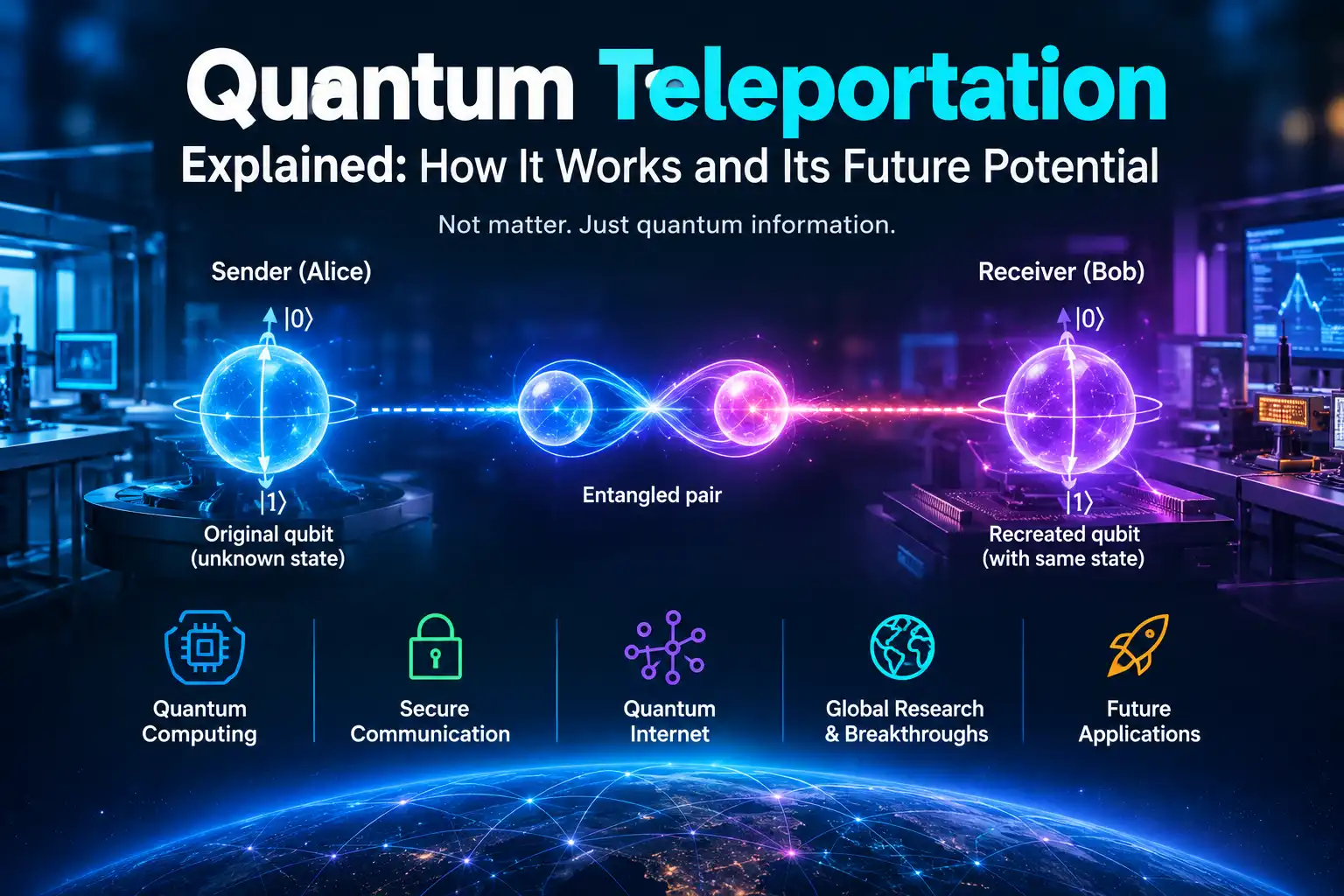
For example, Alice and Bob may each hold one qubit from an entangled pair. Alice keeps hers in one laboratory while Bob keeps his in another. Alice also has a third qubit whose state she wants to transfer. The entangled pair provides the quantum resource needed for the protocol.
Entanglement does not allow Alice to send a message instantly. Bob still needs the results of Alice’s measurement, which must be sent through a normal classical communication channel.
How Does Quantum Teleportation Work?
- Step 1: The original quantum state: Alice has a qubit in an unknown quantum state that she wants to transfer to Bob.
- Step 2: An entangled pair: Alice and Bob already share an entangled pair, with one qubit held by each person.
- Step 3: Measurement: Alice performs quantum operations on her original qubit and her half of the entangled pair, then measures them. The result corresponds to two classical bits.
- Step 4: Classical communication: Alice sends those two classical bits to Bob over an ordinary communication channel, such as a fibre-optic link.
- Step 5: State transfer: Bob uses the received bits to choose a correction operation on his qubit. Under ideal conditions, his qubit then has the original quantum state.
This is the basic quantum teleportation protocol. It requires entanglement, measurement and classical communication.
An Easy Example
Imagine two advanced quantum computers: Computer A in India and Computer B in Europe. Computer A has a qubit in a quantum state that is needed by Computer B.
In ordinary computing, data can usually be read and copied before transmission. An unknown quantum state cannot generally be measured to extract all its information and then recreated perfectly. Quantum teleportation provides another route:
- The computers establish or share an entangled pair of qubits.
- Computer A performs the required quantum operations and measurement.
- Computer A sends the measurement result—two classical bits—to Computer B.
- Computer B applies the correction indicated by those bits.
- In the ideal case, Computer B’s qubit now represents the original quantum state.
The quantum state can therefore be transferred without physically shipping the original qubit from India to Europe. The entangled resource must still be distributed beforehand, and the classical message takes time to arrive. Real systems also experience noise and technical errors.
Quantum Teleportation vs. Science-Fiction Teleportation
| Feature | Quantum teleportation | Science-fiction teleportation |
| What is transferred? | A quantum state or information | A whole person or object |
| Does matter move? | No; the protocol transfers a state | Yes, in fictional depictions |
| Scientific status | Demonstrated in laboratory experiments | No established method for teleporting humans |
| Main potential use | Quantum computing and communication | Fictional transport |
Although the same word is used, these are very different concepts. Quantum teleportation should not be described as the first practical step toward teleporting a human.
Which Countries and Organisations Are Researching It?
Germany and European research groups
Researchers at institutions including Paderborn University and partner groups in Europe have investigated photon-state teleportation involving separate quantum-dot emitters. This work explores ways to connect quantum devices that do not rely on a single shared photon source.
Italy
Italian research groups, including teams associated with Sapienza University of Rome, have collaborated on quantum optics and photon-teleportation experiments with European partners.
United States
US universities and laboratories are developing quantum communication links and network components. In July 2026, Northwestern University researchers reported an experiment transmitting entangled photons over a 24.4-kilometre fibre link alongside high-capacity conventional internet traffic. This is a quantum-networking result, not by itself a demonstration of quantum teleportation.
China
China has conducted satellite-based quantum communication experiments. In 2017, a landmark study associated with the Micius satellite reported quantum teleportation from a ground station to a satellite, showing one approach to extending quantum experiments over long distances.
Technology companies
IBM and Microsoft develop quantum-computing hardware, software and educational resources that explain quantum teleportation as a fundamental protocol. However, being active in quantum computing does not automatically mean that a company has performed a specific teleportation experiment.
Important Research Developments in 2025–2026
November 2025: Teleportation between separate quantum-dot photon sources
Researchers in Germany and Italy reported quantum-state teleportation between photons emitted by separate quantum dots. The experiment used a 270-metre free-space optical link and reported a teleportation fidelity of 82 ± 1%.
Why it matters: scalable quantum networks will need to connect different quantum emitters and devices, rather than relying on a single source. This work explores one part of that challenge.
Research paper: https://www.nature.com/articles/s41467-025-65911-9
May 2026: Microwave quantum teleportation across a thermal network
Researchers associated with the Technical University of Munich and the Walther-Meißner-Institut reported teleportation of quantum coherent states across a thermal microwave channel linking two separate dilution refrigerators. The study was published in Physical Review Letters on 4 May 2026.
The reported fidelity was 72.3 ± 0.5% at 1 K and 59.9 ± 2.5% at 4 K. These results help researchers understand how to connect microwave-based quantum systems while managing noise and temperature-related challenges.
Research paper: https://doi.org/10.1103/n8j9-63mz
July 2026: Quantum networking over existing internet fibre
Northwestern University researchers reported a 24.4-kilometre fibre experiment in which entangled photons were transmitted alongside ordinary high-capacity internet traffic. The reported entanglement fidelity was above 94%. This is relevant to quantum-network infrastructure, but should not be confused with a direct demonstration of quantum teleportation.
Research news: https://news.northwestern.edu/stories/2026/07/quantum-internet-leaves-the-lab
Together, these experiments show that the field has moved beyond theory alone. However, laboratory demonstrations are not yet equivalent to a large-scale commercial quantum internet.
Where Could Quantum Teleportation Be Used in the Future?
Quantum internet
Quantum teleportation could help transfer quantum states between distant nodes in a future quantum network. It may become one of the techniques used to connect separate quantum devices.
Distributed quantum computing
Different quantum processors may eventually work together. Teleportation and entanglement could help coordinate quantum operations across connected devices, although practical designs must overcome substantial hardware and networking challenges.
Quantum security and communication
Teleportation may be part of future quantum communication architectures. It is not a complete encryption system by itself; authentication, protocol design and other security measures remain important.
Quantum sensors and scientific instruments
Techniques for sharing quantum states and entanglement may be useful in future precision-measurement systems and connected quantum instruments. Not every quantum-sensing application will require teleportation.
The Biggest Limitations
- Entanglement distribution: A usable entangled resource must be established between the sender and receiver.
- Noise and photon loss: Fibre, free-space and microwave channels can introduce errors that damage quantum states.
- Limited fidelity: In real experiments, the output may not perfectly match the target state. Fidelity measures how closely the output matches the intended state.
- Classical communication: The receiver needs the sender’s measurement results, so quantum teleportation cannot be used to send information faster than light.
- Scaling: Turning a laboratory experiment into a reliable long-distance network is a separate engineering challenge.
- No teleportation of matter: Transferring a quantum state does not provide a way to move or reconstruct a person or physical object.
Could Humans Be Teleported in the Future?
At present, there is no demonstrated technology for teleporting a human being. A human body contains roughly 10²⁷ atoms, and transferring one qubit’s state is nowhere near enough to transport or reconstruct a living person. The biological structure, physical matter and processes involved make the problem fundamentally different from quantum-state teleportation.
Quantum mechanics also prohibits perfect copying of an arbitrary unknown quantum state. Therefore, the science-fiction idea of scanning a person, sending a complete copy and rebuilding them elsewhere is not a direct extension of quantum teleportation. There is no sound scientific basis for giving a timeline for human teleportation.
What May Happen Next?
- Develop more reliable sources of entanglement.
- Improve quantum-state transfer over fibre and free-space links.
- Connect different quantum computers and quantum devices.
- Reduce photon loss, thermal noise and other sources of error.
- Develop quantum repeaters and network relays.
- Integrate quantum-network components with existing communication infrastructure.
These directions are consistent with published experiments and quantum-network research goals. However, the date when widespread commercial deployment may occur cannot yet be predicted confidently.
Conclusion
Quantum teleportation is a fascinating technology grounded in modern physics. Its real purpose is not to transport people or objects, but to transfer the quantum state of one system to another using entanglement and classical communication.
Experiments involving photons from separate quantum dots in 2025, microwave teleportation in 2026 and practical quantum-network links show meaningful progress. Challenges remain, including noise, fidelity, entanglement distribution and scalability.
In the long term, quantum teleportation could become an important building block for the quantum internet and distributed quantum computing. It may change how future quantum devices communicate, even if human teleportation remains science fiction.
Sources
- IBM Quantum Learning — Quantum information and entanglement
https://learning.quantum.ibm.com/course/basics-of-quantum-information/entanglement-in-action - Microsoft Quantum — Quantum teleportation explained
https://quantum.microsoft.com/en-us/insights/education/concepts/quantum-teleportation - Nature Communications — 2025 photon teleportation research
https://www.nature.com/articles/s41467-025-65911-9 - Physical Review Letters — 2026 microwave teleportation experiment
https://doi.org/10.1103/n8j9-63mz - Northwestern University — 2026 quantum networking experiment
https://news.northwestern.edu/stories/2026/07/quantum-internet-leaves-the-lab