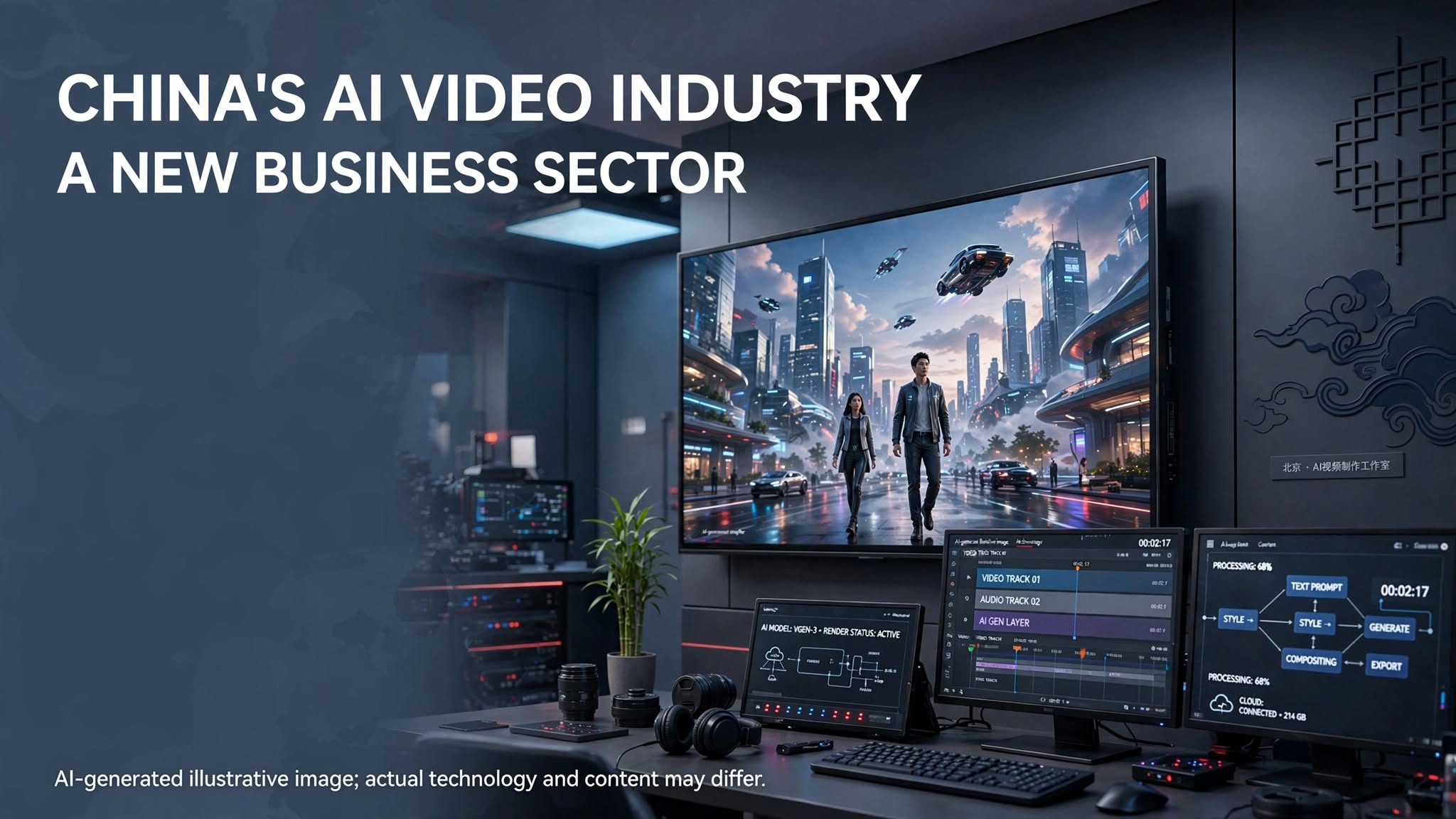
Artificial intelligence is changing the way videos, advertisements, short films and entertainment content are produced. China is now becoming one of the biggest markets where this change is happening quickly.
In the past, creating a professional video usually required actors, cameras, locations, lighting, a production team and a large amount of editing work. AI can now reduce the need for some of these traditional steps.
This is helping Chinese creators and companies produce videos faster and at a much lower cost.
The change is particularly visible in China’s fast-growing micro-drama industry. These are short drama series mainly watched on mobile phones. According to China’s National Radio and Television Administration, China’s micro-drama market was worth more than 100 billion yuan ($14.97 billion) in 2025 and had more than 800 million viewers. In the first eight months of 2026, about 430,000 micro-dramas were released, and more than 90% used AI technologies in their production.
This is why China is increasingly treating AI video not simply as a new technology, but as a new commercial industry.
Key Highlights
| Key Detail | Information |
| Main market | AI-generated video and micro-dramas |
| China micro-drama market | More than 100 billion yuan in 2025 |
| Viewers | More than 800 million |
| Micro-dramas released in Jan–Aug 2026 | About 430,000 |
| AI usage | More than 90% |
| Major AI video company | Kuaishou’s Kling AI |
| Kling AI Q2 2026 revenue | More than RMB 850 million |
| Major business hubs | Shenzhen, Shanghai and Beijing |
| Main opportunity | Faster and cheaper video production |
| Main challenges | Oversupply, copyright, quality and rights protection |
What Is AI Video?
AI video means using artificial intelligence to create or change video content.
A person can give an AI system a written instruction, such as:
“Create a scene of a futuristic city at night with electric cars moving through the streets.”
The AI system can then create a video based on that description.
Modern AI video tools can also help with:
- Creating characters
- Creating backgrounds
- Making short video scenes
- Changing existing videos
- Creating digital characters
- Creating voices and dialogue
- Adding visual effects
- Producing advertisements
- Creating different versions of the same content
This does not mean traditional filmmaking has disappeared.
Instead, AI is becoming another tool that filmmakers, advertising companies and content creators can use to reduce production time and cost.
Why Is China’s AI Video Industry Growing So Quickly?
There are several reasons behind China’s rapid growth.
1. Large Video Audience
China already has a huge online-video market.
Millions of people watch short videos and micro-dramas every day. This gives AI-generated content a ready-made audience.
2. Lower Production Costs
AI can reduce the need for expensive locations, large crews and repeated filming.
This is particularly useful for small production companies that cannot afford the budget of a traditional film studio.
3. Better AI Technology
AI video models are improving quickly.
They are becoming better at generating realistic characters, environments, movement and cinematic scenes.
4. Government Support
Chinese cities are actively trying to attract AI companies and creators.
Shenzhen, Shanghai and Beijing are among the cities supporting AI-related film and video businesses. Reuters reported that AI filmmakers are receiving approaches from cities and industrial parks across China that want them to establish businesses there.
AI Is Making Video Production Cheaper
One of the biggest changes is the cost of production.
According to reporting on China’s AI video industry, the cost of producing AI short dramas has fallen sharply. Some production estimates that were previously around thousands of yuan per minute have fallen to only a few hundred yuan per minute for certain AI-produced content.
This does not mean every professional film can now be produced for a few hundred yuan per minute. The actual cost depends on the quality, AI tools, human workers, editing and other requirements.
However, the direction is important.
Traditional production may require:
Actors + Camera + Location + Lighting + Crew + Editing
AI-assisted production can potentially reduce some of these requirements:
Script + AI tools + Computing power + Human editing
The human role is still important, particularly for storytelling, creative decisions and quality control.
But the cost structure is changing.
Kuaishou’s Kling AI Shows the Business Potential
One of the clearest examples of AI video becoming a real business is Kling AI, developed by Chinese technology company Kuaishou Technology.
Kuaishou reported that Kling AI generated more than RMB 850 million in revenue during the second quarter of 2026.
The company said this represented more than 200% year-over-year growth. Kuaishou also said Kling AI continued to expand internationally.
This is an important development.
It shows that AI video is moving through several stages:
AI research → AI product → paid service → commercial business
Kling AI is not simply a technology demonstration. It is generating significant revenue for its parent company.
Kuaishou has also integrated AI into its broader video and livestreaming ecosystem. During Q2 2026, users sent more than 6 million AI-generated gifts on its platform.
This means AI can potentially generate money through several different activities, including subscriptions, content creation, advertising, digital characters and entertainment features.
Shanghai Is Building an AI Video Ecosystem
Shanghai is taking a more organised approach to AI-powered micro-dramas.
In May 2026, the Shanghai government introduced measures covering AI micro-drama production, computing power, data resources, public services, talent and international distribution.
The city plans to support companies with access to:
- AI computing power
- Cloud-based AI models
- Data resources
- AI tools
- Copyright services
- Financing support
- Marketing
- Industry services
Shanghai is also developing AI micro-drama clusters in Xuhui, Yangpu and Minhang.
The important point is that Shanghai is not only trying to attract AI companies.
It is trying to build an entire ecosystem around them.
That includes:
AI companies → creators → production studios → platforms → advertisers → distributors → international markets
This can make the industry more sustainable over time.
China Wants to Take AI Video to Global Markets
Another interesting part of China’s strategy is international distribution.
Shanghai’s policy specifically supports overseas distribution of micro-dramas and plans to connect producers with international markets and platforms.
This could become an important business opportunity.
For example, a Chinese AI-produced drama could potentially be adapted for different markets by changing:
- Language
- Voice
- Subtitles
- Characters
- Cultural references
- Advertising
- Story presentation
AI can make this process faster.
Instead of creating a completely new production for every country, companies may be able to adapt existing content for multiple markets.
This could help Chinese entertainment companies expand internationally.
AI Video Is Not Only About Short Videos
Many people think AI video means social-media clips.
The business opportunity is much larger.
1. Micro-Dramas
This is currently one of the most important areas.
AI can help create large amounts of short-form entertainment content quickly.
2. Movies
AI is also entering film production.
Chinese filmmakers are experimenting with AI-generated scenes, characters and visual effects.
3. Advertising
Companies can create product advertisements without building an expensive physical set for every campaign.
4. E-Commerce
AI-generated presenters and digital characters can demonstrate products or communicate with customers.
5. Digital Characters
Companies can create virtual characters that appear repeatedly in videos, advertising and entertainment.
6. Education
AI-generated videos could also be used for training, tutorials and educational content.
This means the potential market is much bigger than entertainment alone.
The Biggest Problem: Too Much Content
There is, however, a major problem.
AI makes video production cheaper, but that does not mean people will watch every video.
Reuters reported that around 221,900 new AI shows were launched on Douyin during the first half of 2026, while only about 1,055 received more than 100 million views, according to DataEye.
This shows the difference between creating content and creating successful content.
If everyone can produce videos cheaply, the market can quickly become crowded.
The future competition may therefore not be about:
“Who can create a video?”
Instead, it may become:
“Who can create a video that people actually want to watch?”
Storytelling, characters, originality and distribution could become more important than simply having access to an AI video generator.
Copyright and Face Rights Are Also Important
Another major challenge is copyright.
AI systems can generate characters, voices and images that may resemble real people or existing creative works.
This creates questions such as:
- Who owns an AI-generated character?
- Can a person’s face be used without permission?
- Can an actor’s voice be copied?
- Who owns AI-generated content?
- Can copyrighted material be used to train AI systems?
China is already strengthening rules around AI-generated content.
The country’s rules require relevant AI-generated content to be identified through visible or technical labels.
Chinese authorities are also focusing on whether creators have permission to use a person’s likeness or voice in AI-generated productions.
For businesses, this means legal compliance could become an important part of AI video production.
Why AI Video Could Become a Large Business
The AI video industry could create opportunities for many different types of companies.
| Business | How AI Video Can Help |
| AI companies | Sell video-generation tools |
| Cloud companies | Provide computing power |
| Chip companies | Supply AI processing hardware |
| Film studios | Reduce production costs |
| Streaming platforms | Produce more content |
| Advertising companies | Create campaigns faster |
| E-commerce companies | Create product videos |
| Creators | Produce content with smaller teams |
| Digital-avatar companies | Build virtual presenters |
| Distributors | Take content to international markets |
This is why AI video should not be viewed only as an entertainment story.
It can also become a technology, advertising, cloud computing and digital-commerce story.
What Could Happen Next?
China’s AI video industry is still developing, but several trends are becoming visible.
Better Quality
AI models are likely to become better at creating realistic movement, consistent characters and longer scenes.
Lower Costs
As technology improves, the cost of creating certain types of videos could fall further.
More Business Use
Companies are likely to use AI video for advertising, training, product demonstrations and social media.
More International Content
Chinese companies may increasingly use AI to adapt local content for overseas audiences.
More Regulation
As the industry becomes larger, copyright, AI labelling, face rights, voice rights and content quality will receive more attention.
What Does This Mean for Traditional Filmmaking?
AI is unlikely to completely replace traditional filmmaking in the near term.
A big-budget film still needs strong storytelling, human direction, acting, production design and quality control.
Instead, the industry could move toward a mixed model:
Traditional filmmaking + AI-assisted production + fully AI-generated content
For example, a filmmaker may use real actors but AI for backgrounds and special effects.
Another studio may use AI for most scenes but keep human writers, directors and editors.
A small creator may produce an entire short drama using AI tools.
So the future may not be about AI versus humans.
It could be about humans using AI to produce content more efficiently.
Conclusion
China’s AI video industry is moving from experimentation toward commercialisation.
The combination of a huge online audience, cheaper production, rapidly improving AI models and government support is helping create a new business ecosystem.
The growth of Kling AI is an important example. Its parent company Kuaishou reported more than RMB 850 million of Kling AI revenue in Q2 2026, showing that AI video generation can already become a meaningful commercial business.
At the same time, China’s micro-drama market provides a large testing ground. More than 800 million people have watched micro-dramas, while about 430,000 micro-dramas were released in the first eight months of 2026. More than 90% used AI technologies, according to China’s broadcasting regulator.
But the industry also faces important challenges. The huge amount of AI-generated content could create oversupply, while copyright, quality, face rights and voice rights remain important issues.
The bigger story is therefore not simply that China is making AI videos.
The bigger story is that China is building an ecosystem where AI models, creators, film studios, streaming platforms, cloud computing, advertising and international distribution can work together.
If this ecosystem continues to grow, AI video could become one of the important commercial applications of generative AI—similar to how AI assistants, image generation and AI coding tools are becoming businesses today.