Autonomous Vehicle Technology is expanding beyond passenger cars, robotaxis and self-driving trucks. One of the next major industries expected to benefit from this technology is the global logistics and shipping industry, particularly large seaports and container terminals.
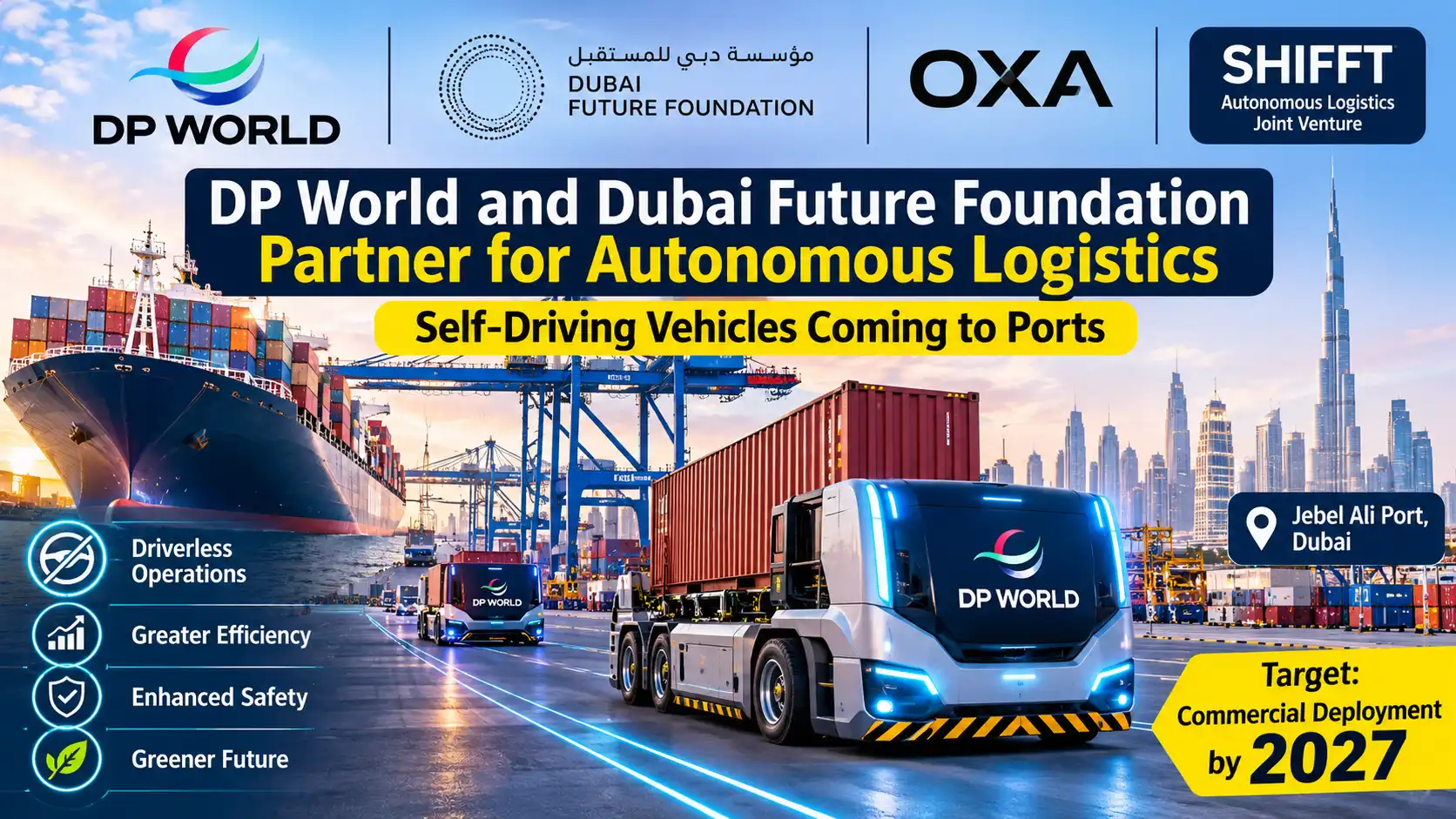
In an important development, UAE-based global ports and logistics company DP World has partnered with Dubai Future Foundation (DFF) to accelerate the development and deployment of autonomous logistics technology. Under this partnership, DP World has become the first strategic partner of SHIFFT, an autonomous logistics joint venture established by Dubai Future Foundation and British autonomous vehicle technology company Oxa.
The project will initially focus on Jebel Ali Port in Dubai, where autonomous vehicles and intelligent logistics systems will be developed and introduced into port operations.
The objective is not limited to testing a few driverless vehicles. The broader plan is to develop an integrated autonomous logistics system that can improve container transportation, fleet management, traffic coordination and operational efficiency.
If the project proves successful, the technology could potentially be expanded to other ports and terminals across DP World’s global network.
Deal Highlights
| Particulars | Details |
| Partnership Companies | DP World and Dubai Future Foundation |
| Technology Partner | Oxa (United Kingdom) |
| Joint Venture | SHIFFT |
| Announcement Date | November 6, 2026 |
| Country | United Arab Emirates |
| Initial Project Location | Jebel Ali Port, Dubai |
| Industry | Autonomous Technology and Logistics |
| Main Focus | Autonomous Vehicles and Intelligent Logistics |
| Key Technologies | Autonomous Driving, Fleet Management, Digital Twin and Intelligent Routing |
| DP World’s Role | First Strategic Partner of SHIFFT |
| Commercial Deployment Target | Before the end of 2027 in Dubai |
| Project Status | Partnership Announced; Development and Deployment Planned |
What Is DP World and How Large Is Its Logistics Business?
DP World is a major global supply chain and logistics company headquartered in Dubai, United Arab Emirates. The company operates across several industries, including seaports, container terminals, freight forwarding, warehousing and international trade infrastructure.
Ports play an important role in international trade because they connect manufacturers, suppliers and customers across different countries.
For example, when an Indian company imports electronic products from China, the products may arrive in large shipping containers. Once the ship reaches an Indian port, cranes unload the containers. Special vehicles transport them to designated storage areas before trucks carry them to their final destinations.
This entire process requires coordination between cranes, vehicles, workers and logistics management systems.
DP World manages these types of operations across its international network. At Jebel Ali Port alone, the company has more than 900 vehicles involved in moving containers and cargo within the terminal.
Managing such a large number of vehicles efficiently is challenging. Autonomous technology could help improve coordination, reduce unnecessary vehicle movements and make cargo transportation more efficient.
What Is Dubai Future Foundation?
Dubai Future Foundation (DFF) is an organisation established to support innovation, research and the development of future technologies in Dubai.
It works with government organisations, private companies and technology developers to explore and introduce innovations in areas such as:
- Artificial Intelligence
- Robotics and Automation
- Autonomous Mobility
- Future Industries
- Advanced Technologies
The organisation focuses not only on researching new technologies but also on helping businesses test and apply them in real-world environments.
Its partnership with Oxa to establish SHIFFT is part of this broader objective. By bringing DP World into the project, the initiative gains access to an operational port environment where autonomous logistics technology can be developed and evaluated.
What Does Oxa Do?
Oxa is a British technology company specialising in autonomous vehicle software and industrial mobility solutions.
Unlike companies primarily focused on self-driving passenger cars, Oxa concentrates on making industrial and commercial vehicles autonomous.
Its technology can be integrated into suitable existing industrial vehicles, potentially reducing the need for businesses to replace their entire vehicle fleets.
Oxa’s technology platform includes three important components:
Oxa Ware: This provides modular autonomy hardware that can be installed in compatible vehicles.
Oxa Driver: This is the autonomous driving software responsible for enabling vehicles to operate without continuous human driving instructions.
Oxa Hub: This is a cloud-based platform designed to monitor, manage and coordinate autonomous vehicle fleets.
Together, these technologies can help industrial businesses introduce autonomous vehicles into their existing operations.
What Is SHIFFT and Why Was It Established?
SHIFFT is an autonomous logistics joint venture established in August 2026 by Dubai Future Foundation and Oxa.
Its main objective is to develop autonomous mobility and intelligent logistics solutions for industrial environments, particularly:
- Seaports
- Airports
- Industrial zones
- Warehouses
- Large logistics facilities
Operating autonomous vehicles in industrial environments is different from testing them on empty roads.
For example, a busy port contains heavy vehicles, container cranes, workers, moving cargo and changing traffic conditions. Autonomous vehicles must be capable of operating safely in such environments.
SHIFFT aims to address these challenges by combining autonomous driving software, fleet management, intelligent routing and operational intelligence.
The initiative is part of Dubai’s Research, Development and Innovation programme.
Its first phase focuses on ports and airports, with the first scalable commercial deployment targeted in Dubai before the end of 2027.
What Will the DP World and Dubai Future Foundation Partnership Achieve?
Under the partnership announced on November 6, 2026, DP World has become the first strategic partner of SHIFFT.
The three organisations will contribute different capabilities to the project.
| Organisation | Main Responsibilities |
| DP World | Port infrastructure, real-world logistics operations, operational expertise and vehicle deployment environment |
| Dubai Future Foundation | Research, development, innovation and technology ecosystem |
| Oxa | Autonomous driving software, hardware integration and fleet management technology |
DP World will provide access to its operational environment and practical logistics experience.
Dubai Future Foundation will support the innovation ecosystem, while Oxa will contribute the autonomous vehicle technology.
The initial focus will be Jebel Ali Port in Dubai.
If the technology performs successfully, it could potentially be introduced at other ports and terminals within DP World’s international network.
How Will Autonomous Vehicles Be Used at Jebel Ali Port?
Jebel Ali Port is one of Dubai’s major maritime facilities and an important centre for international shipping and container transportation.
Large container ships arrive at the port carrying goods from different parts of the world. Once the containers are unloaded, they must be transported to designated storage areas before being moved to trucks or other transportation systems.
A typical container movement process involves several stages:
- A quay crane unloads a container from a ship.
- A terminal vehicle or specialised tractor carries the container.
- The vehicle transports it to the designated container yard.
- The container is placed in its assigned storage location.
- When required, it is transported towards the terminal gate for onward delivery.
At present, many of these movements depend on human-operated industrial vehicles.
Under the new partnership, autonomous technology will be developed and integrated into these logistics operations.
For example, an autonomous terminal vehicle could receive a transportation assignment, travel along an approved route, avoid obstacles and deliver a container to its designated location.
However, this does not mean that all vehicles at Jebel Ali Port will immediately become driverless. The technology will need to go through integration, testing and safety validation before wider commercial deployment.
Key Technologies Being Developed Under the Partnership
The project is not limited to autonomous driving. It aims to combine several technologies to create a more intelligent logistics system.
A. Autonomous Driving Technology
Autonomous driving technology allows vehicles to operate without continuous human driving instructions.
Vehicles must be able to follow designated routes, recognise obstacles, adjust their speed and respond to changing surroundings.
For example, if another vehicle suddenly enters their path, the autonomous system should be able to slow down or stop when necessary.
This capability is particularly important in busy ports where several heavy vehicles operate simultaneously.
B. Vehicle Integration
Vehicle integration involves installing autonomous hardware and software into compatible existing industrial vehicles.
For example, DP World already operates hundreds of vehicles at Jebel Ali Port.
Instead of replacing every vehicle with a newly manufactured autonomous model, suitable existing vehicles could potentially be upgraded with autonomous technology.
This approach could provide an opportunity to reduce the cost of introducing automation, although the actual integration cost and savings have not been disclosed.
C. Fleet Management and Orchestration
Fleet management means monitoring and coordinating multiple vehicles through a central system.
Imagine a container terminal operating 100 autonomous vehicles.
A central management platform could monitor:
- The location of each vehicle.
- Which container it is transporting.
- Its current operational status.
- Its next assigned task.
- The most suitable route for its movement.
This could help prevent unnecessary trips, reduce idle time and improve coordination between vehicles.
D. Intelligent Routing and Traffic Management
Large ports often experience considerable vehicle movement throughout the day.
If vehicles operate without proper coordination, traffic congestion and accident risks can increase.
Intelligent routing systems can help select suitable routes based on vehicle locations and traffic conditions.
For example, if one route becomes congested, the system could direct another vehicle through an alternative route.
This could help improve the movement of containers within the port.
E. Digital Twin Technology
Digital Twin technology creates a virtual digital representation of a real-world facility, machine or operation.
For example, a digital model of Jebel Ali Port could include roads, container yards, cranes, vehicles and other infrastructure.
This virtual environment can help businesses understand operations, simulate different scenarios and identify possible problems before making changes in the real world.
Suppose a company wants to introduce additional autonomous vehicles into a particular section of the port.
It could first simulate the expected vehicle movements in the digital model to understand whether the additional traffic could create congestion.
This can support better operational planning.
F. Situational Intelligence and Operational Optimisation
Situational intelligence involves understanding the surrounding environment and operational conditions.
The system can consider information such as vehicle locations, traffic conditions, workload and operational performance.
This information can help improve decisions related to vehicle allocation, routes and logistics planning.
By combining these technologies, SHIFFT aims to develop an integrated autonomous logistics platform for large industrial environments.
What Benefits Could DP World Gain?
The partnership could provide several long-term advantages for DP World’s global logistics business.
1. Faster Container Movement
Better coordination between autonomous vehicles could help reduce unnecessary delays in transporting containers from ships to storage areas and other destinations.
2. Better Fleet Utilisation
Centralised fleet management could improve the use of available vehicles and reduce unnecessary movements and idle time.
3. Improved Operational Safety
Ports contain heavy machinery, trucks and workers operating in the same environment. Autonomous systems and safety monitoring could help reduce operational risks.
4. Higher Operational Efficiency
Intelligent routing and digital simulation could help improve logistics planning and make container transportation more organised.
5. Global Expansion Opportunities
If the technology proves successful at Jebel Ali Port, DP World could explore introducing similar solutions at other ports and terminals in its international network.
These are potential benefits rather than confirmed performance improvements. The company has not announced specific percentages for productivity gains or cost reductions.
What Could Be the Impact on Employees and Jobs?
The introduction of autonomous logistics technology raises an important question: Will driverless vehicles reduce employment opportunities at ports?
The impact could be mixed.
Currently, port operations depend on workers who drive industrial vehicles, move containers, operate machinery and coordinate cargo transportation.
As autonomous technology becomes more common, some traditional driving responsibilities could decrease.
However, new opportunities could emerge in areas such as:
- Autonomous vehicle monitoring.
- Fleet management.
- Robotics maintenance.
- Software operations.
- Technology integration.
- Safety management.
DP World has also highlighted the importance of workforce transformation and developing future-ready skills.
This means employees will need to adapt to changing operational requirements through training and exposure to new technologies.
The long-term impact will depend on how quickly autonomous systems are introduced and how companies manage the transition.
Could This Technology Be Used at Other Ports Around the World?
One of the most important aspects of this partnership is DP World’s international presence.
The company operates a global network of more than 60 ports and terminals.
If autonomous logistics technology performs successfully at Jebel Ali Port, it could create opportunities for expansion across other facilities.
Potential applications include:
- Moving containers from ships to storage yards.
- Transporting cargo within container terminals.
- Moving goods between different terminal sections.
- Transporting containers towards port gates.
- Handling materials in industrial zones and warehouses.
The technology could also attract interest from other international port operators looking to modernise their logistics infrastructure.
However, DP World has not yet announced specific countries or ports for the next deployment phase. The global network represents a potential expansion opportunity, not a confirmed rollout across all locations.
What Could Be the Impact on the Global Logistics Industry?
International trade continues to depend heavily on efficient shipping and logistics infrastructure.
As global cargo volumes grow, ports need to handle more containers while maintaining operational efficiency and safety.
Traditional logistics operations often depend on human drivers and manual coordination. This can create challenges involving traffic, vehicle availability and transportation delays.
Autonomous logistics technology offers a new approach to addressing these challenges.
The DP World partnership could help establish a model in which autonomous vehicles, fleet management, digital twins and operational intelligence work together.
If this model proves commercially successful, other international ports and logistics companies may consider adopting similar technologies.
In the future, autonomous logistics could become increasingly important in shipping, warehousing, industrial transportation and global supply chain management.
What Challenges Could Affect the Project?
Although autonomous logistics offers significant opportunities, implementing the technology in real-world ports will not be easy.
1. Safety Requirements
Heavy machinery, workers, trucks and autonomous vehicles must operate together. Maintaining safe distances and preventing collisions will be essential.
2. Existing Infrastructure
Integrating autonomous technology into older vehicles and existing port infrastructure could require technical modifications and additional investment.
3. Cybersecurity
Autonomous vehicles and fleet management platforms rely on connected software systems. Protecting these systems against cyberattacks will be important.
4. Implementation Costs
Autonomous hardware, software, sensors, connectivity and maintenance could require substantial investment. The project-specific costs have not yet been disclosed.
5. Workforce Adaptation
Employees will need training to work with autonomous vehicles and new digital logistics systems.
Addressing these challenges will be essential for the long-term success of the project.
Conclusion
The partnership between DP World and Dubai Future Foundation represents an important development in the adoption of autonomous technology within the global logistics industry.
Under this initiative, DP World will contribute its port infrastructure and operational expertise, while Dubai Future Foundation and Oxa will support the development and implementation of autonomous logistics solutions.
The initial focus will be Jebel Ali Port, where technologies such as autonomous driving, fleet management, intelligent routing and digital twins will be explored to improve container transportation and port operations.
The most important aspect of this project is that its objective goes beyond introducing driverless vehicles. It aims to create a more intelligent and automated logistics environment in which vehicles, infrastructure and management systems work together.
However, the project is still in its development and deployment phase. Its actual success will depend on whether the technology can operate safely, reliably and economically in busy port environments.
If the commercial model succeeds in Dubai, it could create opportunities for autonomous logistics technology to expand into major ports and industrial facilities across the world.
Sources: Oxa – DP World and Dubai Future Foundation Autonomous Logistics Partnership | Dubai Media Office – Launch of Autonomous Logistics Future Lab / SHIFFT | Oxa – SHIFFT Joint Venture Launch