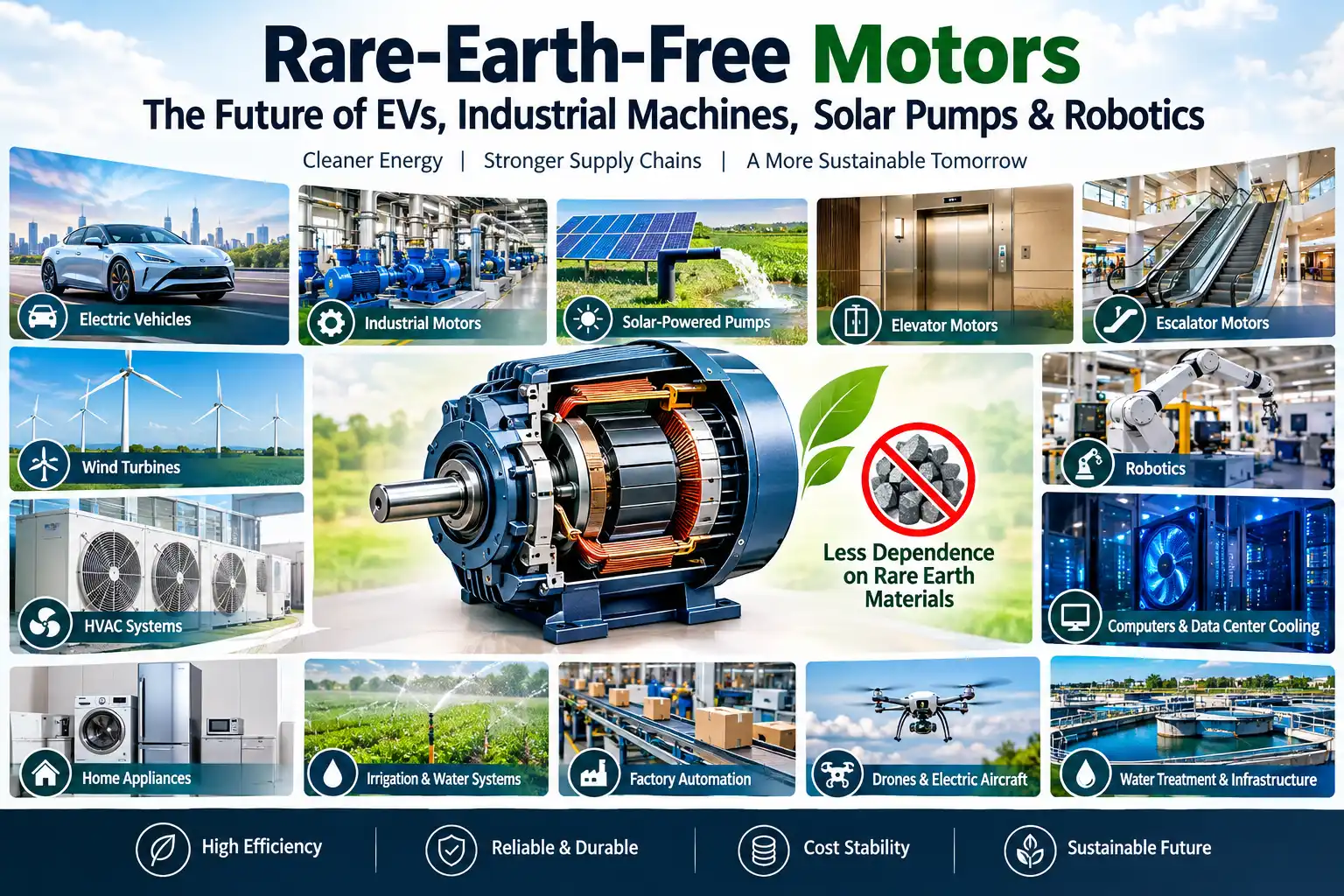
When people talk about the future of electric motors, electric vehicles are usually the first application that comes to mind. But the importance of motor technology goes far beyond cars.
Electric motors are used in industrial machines, pumps, fans, air-conditioning systems, elevators, escalators, robotics, home appliances, electric two-wheelers, drones, wind turbines and many other systems. Even computers and other electronic devices can contain small motors in components such as cooling fans and certain mechanical systems.
Many of today’s high-performance motors use rare-earth permanent magnets, particularly neodymium-based magnets. These magnets can help motors achieve high power and efficiency from a relatively compact size. However, dependence on rare-earth materials creates supply-chain and cost challenges.
This is driving research into rare-earth-free and rare-earth-reduced motor technologies.
The important point is that this research is not simply about finding a new motor for EVs. The broader goal is to develop motors that can deliver the required power, efficiency, reliability and size without depending heavily on rare-earth permanent magnets.
Researchers and companies in countries including India, Japan and the United States are exploring technologies such as synchronous reluctance motors, switched reluctance motors, induction motors, externally excited motors and ferrite-based motor designs.
If these technologies become commercially competitive, they could eventually find applications across several industries—from EVs and industrial equipment to pumps, elevators, wind turbines and other electrically powered machines.
What Is a Rare-Earth-Free Motor?
First, it is important to understand why rare-earth materials are used in some motors.
A common Permanent Magnet Synchronous Motor (PMSM) uses permanent magnets inside its rotor. These magnets create a magnetic field that interacts with the magnetic field generated by the stator.
The basic process is:
Electricity → Motor → Rotation → Mechanical Work
In an EV, that mechanical work turns the wheels.
In an industrial machine, the same principle could rotate a pump, fan, compressor or conveyor.
In an elevator, it can move the elevator system.
In a wind turbine, the process works in the opposite direction: mechanical rotation from the wind turbine is converted into electricity by a generator.
Many high-performance permanent-magnet motors use neodymium-iron-boron (NdFeB) magnets.
A rare-earth-free motor tries to reduce or eliminate this dependence.
However, “rare-earth-free” does not necessarily mean “completely magnet-free.”
Some designs use ferrite magnets, which are not rare-earth magnets. Other designs use no permanent magnets and instead generate magnetic fields through electromagnetic excitation or reluctance principles.
Why Is the World Looking for Alternatives to Rare-Earth Motors?
The biggest reason is supply-chain security.
Rare-earth materials are used in many modern technologies, including electric motors, wind turbines, electronics and other advanced equipment.
As demand for electric motors increases, manufacturers are looking for ways to reduce their exposure to critical-material supply risks.
India is one example.
According to Indian government estimates, annual demand for rare-earth permanent magnets for EVs and other two-, three- and four-wheelers could reach around 3,250 tonnes by 2030. Additional demand is expected from industrial motors and wind turbines. India also has gaps in the processing and manufacturing chain needed to produce finished high-performance magnets domestically.
India has therefore taken two parallel approaches:
Build domestic rare-earth magnet manufacturing
and
Develop motor technologies that require little or no rare-earth material.
The government approved a ₹7,280 crore scheme for domestic production of sintered rare-earth permanent magnets, while research programs are also supporting alternative motor technologies.
This shows why motor technology is becoming a strategic issue for several industries, not just automobiles.
How Can a Motor Work Without Rare-Earth Magnets?
There is no single solution.
Researchers are developing several different motor architectures.
1. Synchronous Reluctance Motors
A Synchronous Reluctance Motor (SynRM) can operate without relying on powerful permanent rare-earth magnets.
The rotor is designed with special magnetic paths. Magnetic flux naturally prefers the path with lower magnetic reluctance, and this creates the force that makes the rotor rotate.
In simple language:
The rotor is designed so that the magnetic field naturally pulls it into the most favorable position.
This approach can eliminate the need for conventional rare-earth permanent magnets.
Japanese automotive supplier Astemo has developed a rare-earth-free BEV motor using a synchronous-reluctance approach. The company says its main-drive motor achieved 180 kW of output.
The same basic motor principles can potentially be adapted for other applications where efficiency, reliability and material availability are important.
2. Switched Reluctance Motors
Another important technology is the Switched Reluctance Motor (SRM).
An SRM does not need permanent magnets in its rotor.
Instead, electronic controllers switch the stator coils on and off in a controlled sequence. This creates a changing magnetic field that pulls the rotor around.
The basic idea is:
Electronic switching → Magnetic field → Rotor movement → Mechanical output
One major advantage is the relatively simple and robust rotor design.
This can make SRMs interesting for applications where durability, high-speed operation or material availability are important.
However, SRMs also have challenges.
They can produce:
- Noise
- Vibration
- Torque ripple
- Additional control complexity
The U.S. Department of Energy identifies these issues as important challenges for SRM technology.
Researchers are therefore working on better rotor designs, control algorithms and noise-reduction techniques.
3. Induction Motors
Induction motors are another rare-earth-free option.
They do not require permanent magnets and have been used in industrial applications for many years.
This makes them particularly interesting for:
- Pumps
- Fans
- Compressors
- Industrial machinery
- Conveyors
- HVAC systems
- Some electric vehicles
The technology is mature, but researchers continue to improve its efficiency, power density and control.
The U.S. Department of Energy lists induction motors among the important non-permanent-magnet motor technologies being considered for future applications.
4. Externally Excited or Wound-Field Motors
Another approach is to create the magnetic field using electrical current instead of permanent magnets.
These motors can control the strength of the magnetic field electronically.
This creates an interesting possibility:
The motor’s magnetic field can be adjusted according to operating conditions.
The U.S. Department of Energy has supported research into non-permanent-magnet and wound-field motor technologies to reduce dependence on critical materials.
Such technologies could potentially be useful in applications requiring variable operating conditions and high levels of control.
5. Ferrite-Magnet Motors
A motor does not have to be completely magnet-free to avoid rare-earth materials.
Ferrite magnets are another option.
Unlike neodymium magnets, ferrite magnets do not depend on rare-earth elements.
The challenge is that ferrite magnets generally provide lower magnetic performance than high-performance rare-earth magnets.
Therefore, engineers need to redesign the motor to achieve the required power and efficiency.
Astemo is working on a rare-earth-free design that combines ferrite magnets with a magnet-free synchronous-reluctance motor.
This kind of hybrid approach could become useful where manufacturers want to reduce rare-earth dependence without completely abandoning magnetic motor technology.
Rare-Earth-Free Motors Are Not Only for EVs
This is one of the most important points about this technology.
Electric motors are used almost everywhere electricity needs to be converted into mechanical movement.
Therefore, the potential market for rare-earth-free motors is much larger than electric cars.
Let’s look at some possible applications.
1. Electric Vehicles
EVs are currently one of the most visible applications.
Electric cars, electric motorcycles, scooters and commercial EVs require traction motors capable of providing:
- High torque
- High efficiency
- High power density
- Reliable operation
- Wide speed range
Rare-earth-free designs could eventually be used in some EV categories if they achieve competitive performance and cost.
India’s NITK Surathkal is already working on rare-earth-magnet-free EV motor technologies under the government’s MAHA-EV Mission.
But EVs are only one part of the opportunity.
2. BLDC Motors
Brushless DC (BLDC) motors are widely used in modern equipment because they are compact, efficient and electronically controlled.
They are found in applications such as:
- Electric scooters
- Drones
- Fans
- Pumps
- Air conditioners
- Robotics
- Small appliances
- Computer cooling systems
- Industrial equipment
Many BLDC motors use permanent magnets, often including rare-earth magnets.
This creates an opportunity for researchers to develop rare-earth-free BLDC alternatives or alternative motor architectures for applications where their performance can meet the required specifications.
The challenge is that replacing a high-performance permanent magnet can affect torque, size, efficiency and control requirements.
Therefore, future rare-earth-free BLDC systems may require changes not only to the motor but also to the controller and overall system design.
3. Industrial Motors
This could potentially become one of the largest application areas.
Factories use motors for almost everything:
- Pumps
- Fans
- Compressors
- Conveyor belts
- Machine tools
- Material handling
- Cooling systems
- Production equipment
- Robotics
- Processing machinery
Industrial motors operate for thousands of hours, sometimes continuously.
That means even a small improvement in efficiency can become significant when multiplied across millions of machines.
For such applications, manufacturers may value:
Efficiency + reliability + long operating life + material availability
more than extremely high power density.
This could create opportunities for induction motors, synchronous-reluctance motors and switched-reluctance motors.
4. Solar-Powered Water Pumps
Solar-powered pumps are another interesting application.
A typical system is:
Solar panels → Controller → Motor → Water Pump
These systems are used for:
- Agriculture
- Irrigation
- Rural water supply
- Livestock
- Water distribution
If rare-earth-free motors can deliver sufficient efficiency and reliability at competitive prices, they could become useful in solar pumping systems.
This is especially relevant for countries that want to expand solar-powered agricultural equipment while reducing dependence on critical imported materials.
5. Elevators
Elevator systems require motors that can provide controlled movement, high reliability and frequent starting and stopping.
Modern elevator systems often use efficient gearless or permanent-magnet motor technologies.
This makes elevators an interesting area for research into alternative motor architectures.
A future rare-earth-free elevator motor could potentially reduce dependence on rare-earth magnets while maintaining the torque and control needed for vertical transportation.
However, elevator applications have strict safety and reliability requirements.
Therefore, a new motor technology would need extensive testing and certification before large-scale adoption.
6. Escalator Motors
Escalators operate for long periods in places such as:
- Shopping malls
- Airports
- Railway stations
- Metro systems
- Commercial buildings
Their motors need to be reliable and efficient because they may operate for many hours every day.
Rare-earth-free industrial motor technologies could potentially be adapted for such applications.
Here, the key advantage would not necessarily be maximum power density.
Instead, manufacturers could focus on:
Reliability + efficiency + low maintenance + material security.
7. Fans and HVAC Systems
Motors are everywhere in heating, ventilation and air-conditioning systems.
Examples include:
- Air-conditioner fans
- Industrial ventilation
- Data-center cooling
- Building HVAC
- Refrigeration systems
- Exhaust fans
Modern HVAC systems increasingly use electronically controlled motors because variable-speed operation can save energy.
Rare-earth-free motor technologies could eventually become relevant in this market if they can deliver similar efficiency and controllability.
8. Smartphones and Computers
This application needs a little clarification.
Rare-earth-free motors would not replace the processors or main electronics inside smartphones and computers.
However, these devices and their supporting systems can contain small motor-driven components.
For example:
- Cooling fans
- Small pumps in advanced cooling systems
- Mechanical actuators
- Storage-device components
- Other miniature motion systems
Computers and especially AI data centers are becoming increasingly dependent on cooling infrastructure.
As data-center power consumption increases, efficient cooling systems are becoming more important.
Therefore, rare-earth-free motor technology could potentially find applications in fans, pumps and cooling equipment used around computing infrastructure, even though the computer’s processor itself does not use a motor.
9. Robotics
Robots require many motors.
A humanoid robot may have dozens of motor-driven joints and actuators.
Industrial robots also depend heavily on motors for:
- Arm movement
- Joint control
- Positioning
- Gripping
- Automated production
This makes robotics another potentially important application.
If manufacturers can reduce rare-earth dependence while maintaining precise torque and control, rare-earth-free motors could become useful in future robotic systems.
However, robotics often demands extremely high power density and precision, so performance requirements will vary depending on the robot.
10. Drones and Small Electric Aircraft
Drones commonly use compact, high-speed motors.
The major requirements include:
- Low weight
- High power-to-weight ratio
- Efficiency
- High-speed operation
This makes them technically challenging for some rare-earth-free designs.
However, continued improvements in motor materials, magnetic designs and controllers could potentially make rare-earth-free solutions more attractive for certain drone categories in the future.
11. Wind Turbines
Wind turbines are particularly important because they are another major user of powerful generators.
The system works in reverse:
Wind → Turbine Rotation → Generator → Electricity
Some modern wind turbines use permanent-magnet generators, including designs that rely on rare-earth magnets.
This creates a second major renewable-energy application for rare-earth-free technology.
Researchers are therefore investigating alternative generator designs that can reduce or eliminate rare-earth magnet requirements.
This could become strategically important as countries build more wind-power capacity.
12. Pumps and Water Infrastructure
Large numbers of motors are used in water systems.
Examples include:
- Water treatment plants
- Sewage treatment
- Municipal pumping
- Industrial water systems
- Irrigation
- Desalination
These motors can operate continuously.
If a motor is even slightly more efficient, the energy savings can become significant over many years.
This makes motor efficiency a major consideration in large-scale water infrastructure.
13. Factory Automation
Modern factories are becoming increasingly automated.
Motors control:
- Conveyor systems
- Robotic arms
- Automated guided vehicles
- Machine tools
- Packaging equipment
- Sorting systems
- Pumps and compressors
Rare-earth-free motors could eventually become another component of this industrial automation ecosystem.
14. Household Appliances
Motors are also found in many household products.
Examples include:
- Washing machines
- Refrigerators
- Air conditioners
- Vacuum cleaners
- Fans
- Kitchen appliances
- Water pumps
Some appliances already use highly efficient electronically controlled motors.
Future motor designs could provide manufacturers with additional options for reducing rare-earth material use.
Which Countries and Companies Are Working on This Technology?
Research is taking place across multiple regions.
India
India is actively supporting rare-earth-free motor research.
NITK Surathkal
NITK’s Centre for System Design is working on:
- Rare-earth-magnet-free axial-flux synchronous motors
- Radial-flux switched-reluctance motors
- Motor controllers
The project has received approximately ₹10.33 crore under the MAHA-EV Mission.
NITK has also developed and tested SRM prototypes for applications including electric rickshaws and electric bicycles.
Vimag Labs
Bengaluru-based Vimag Labs is developing a Virtual Magnet Synchronous Motor (VMSM).
The company says its technology creates the required magnetic behavior through electrical and control techniques rather than depending on conventional permanent rare-earth magnets.
In 2026, the company announced its fifth Indian patent and said it was working on pilot projects involving two-wheelers and passenger vehicles.
These pilots should not be interpreted as mass-market commercialization. The technology remains in development and pilot stages based on the publicly available information.
Japan: Astemo
Japan’s Astemo is developing one of the more notable industrial examples.
The company has developed a rare-earth-free BEV motor using a combination of synchronous-reluctance technology and rare-earth-free magnets.
Astemo says its main-drive motor achieved 180 kW of output.
The company is also researching cooling technologies because thermal management becomes especially important when engineers redesign the motor architecture.
United States: Department of Energy Research
The U.S. Department of Energy has supported multiple projects aimed at reducing dependence on rare-earth permanent magnets.
One example is CorePower Magnetics, which has received DOE support for a rare-earth-free axial-flux motor using advanced magnetic materials and flux-switching technology.
The project has a reported total value of approximately $1.2 million, including about $958,722 in DOE funding.
The broader U.S. research effort includes:
- Non-permanent-magnet motors
- Advanced magnetic materials
- New motor architectures
- Improved efficiency
- Better thermal management
- Advanced controls
China and Other Research Communities
China and researchers in other countries are also studying alternatives to rare-earth permanent-magnet motors.
Research areas include:
- Synchronous-reluctance motors
- Switched-reluctance motors
- Externally excited motors
- Induction motors
- Ferrite-assisted motors
- Hybrid motor architectures
- Advanced magnetic materials
A 2026 engineering review covering rare-earth-free and rare-earth-reduced traction motor technologies identifies several of these architectures as active research directions.
The important point is that there is no single global replacement technology yet.
Different industries may eventually choose different motor architectures.
What Are the Biggest Advantages?
Reduced Dependence on Rare-Earth Materials
This is the most obvious benefit.
Manufacturers could potentially reduce their exposure to shortages, export restrictions or price volatility involving critical materials.
Potentially Lower Material Risk
Using ferrite magnets or magnet-free designs could diversify the materials used in motors.
High-Temperature Potential
Some magnet-free architectures can avoid certain permanent-magnet demagnetization concerns.
Long-Term Supply-Chain Security
For countries building large manufacturing industries, reducing dependence on imported critical materials can become strategically important.
More Design Options
Instead of depending on one dominant motor architecture, manufacturers could choose among:
PMSM + SynRM + SRM + induction + wound-field + ferrite-based designs
depending on the application.
What Are the Challenges?
Rare-earth-free does not automatically mean better.
There are several technical challenges.
Power Density
Rare-earth magnets are extremely powerful.
Replacing them while maintaining the same output in a similarly small motor can be difficult.
Efficiency
A motor must convert electricity into mechanical power efficiently.
If efficiency falls significantly, the technology may not be attractive for applications where energy consumption is critical.
Noise and Vibration
This is a particular issue for some switched-reluctance designs.
Heat
Alternative motor architectures may require different cooling strategies.
Control Electronics
Some designs require sophisticated controllers and power electronics.
Size and Weight
A rare-earth-free motor may need a different physical design to achieve the same performance.
Manufacturing Cost
The motor itself may be cheaper in materials but more expensive to manufacture.
Therefore, the complete system cost matters more than the price of one material.
Could One Motor Technology Replace All Others?
Probably not.
Different applications have different requirements.
For example:
A wind turbine needs a large, highly reliable generator.
An elevator needs controlled torque and high reliability.
A computer cooling fan needs compact size and efficient operation.
An industrial pump may operate continuously for thousands of hours.
An EV needs high power density and a wide operating range.
A humanoid robot needs precise torque and compact actuators.
Therefore, the future could involve several motor technologies rather than one universal replacement.
What Could the Future Motor Industry Look Like?
A possible future motor ecosystem could look like this:
| Application | Potential Technologies |
| EVs | SynRM, SRM, ferrite-assisted, wound-field and advanced PMSM |
| Electric two-wheelers | BLDC alternatives, SRM and other compact motor designs |
| Industrial machines | Induction, SynRM and SRM |
| Solar pumps | Induction, SRM and other efficient motor designs |
| Elevators | SynRM, wound-field and other high-efficiency motors |
| Escalators | Industrial-grade induction, SynRM or SRM |
| HVAC | Efficient electronically controlled motors |
| Robotics | High-precision reluctance and electronically excited motors |
| Drones | Lightweight high-power motor architectures |
| Wind turbines | Alternative generator designs |
| Data-center cooling | Efficient fan and pump motors |
| Home appliances | Magnet-reduced or alternative electronically controlled motors |
This is not a prediction of which technology will dominate. The final choice will depend on efficiency, cost, reliability, size, application requirements and manufacturing economics.
The Next Stage of Research
The future of motor research is not simply about removing rare-earth magnets.
Researchers are trying to optimize several factors at the same time:
Efficiency + Power Density + Cost + Reliability + Thermal Performance + Noise + Material Availability
This is why research is moving into areas such as:
- Advanced ferrite materials
- Nanocrystalline magnetic materials
- Iron-nitride magnets
- Better reluctance designs
- Advanced cooling
- AI-assisted motor design
- High-speed motors
- Improved power electronics
- Better control algorithms
- New manufacturing techniques
A 2026 engineering review highlights several of these motor architectures and research directions.
Why This Technology Could Be Important for India
For India, rare-earth-free motors could have importance beyond the EV industry.
India uses motors across:
- Agriculture
- Water pumping
- Manufacturing
- Construction
- Rail and metro infrastructure
- Elevators
- HVAC
- Renewable energy
- Consumer appliances
- Electric mobility
At the same time, India is working to build domestic capabilities in critical materials and advanced manufacturing.
This creates an interesting opportunity.
Instead of focusing only on:
“How can India produce more rare-earth magnets?”
the country can also ask:
“Where can we design products that do not need rare-earth magnets in the first place?”
The government is already supporting both approaches through rare-earth magnet manufacturing initiatives and research into alternative EV motor technologies.
Conclusion
Rare-earth-free motors are often discussed as an EV technology, but their potential is much broader.
The same basic challenge—how to produce efficient mechanical power without relying heavily on rare-earth permanent magnets—exists across many industries.
In the future, alternative motor technologies could potentially be used in:
EVs, BLDC applications, industrial machines, solar pumps, elevators, escalators, HVAC systems, robotics, drones, wind turbines, water infrastructure, data-center cooling and household appliances.
Japan’s Astemo has demonstrated a 180 kW rare-earth-free motor, India is funding research into magnet-free synchronous and switched-reluctance motors, Bengaluru-based Vimag Labs is developing its Virtual Magnet Synchronous Motor approach, and U.S. government-backed programs are supporting new motor architectures and magnetic materials.
However, the technology still faces major challenges, particularly around power density, efficiency, noise, vibration, cooling, control systems and manufacturing cost.
The future may therefore not be a simple shift from permanent-magnet motors to one new technology.
Instead, we could see a much broader motor landscape where different applications use different solutions.
The key question for the coming years will be:
Can engineers build motors that deliver the performance of today’s high-end permanent-magnet designs while using far fewer or no rare-earth materials?
If they can, the impact could extend far beyond electric cars—and potentially change how many machines around the world are powered.