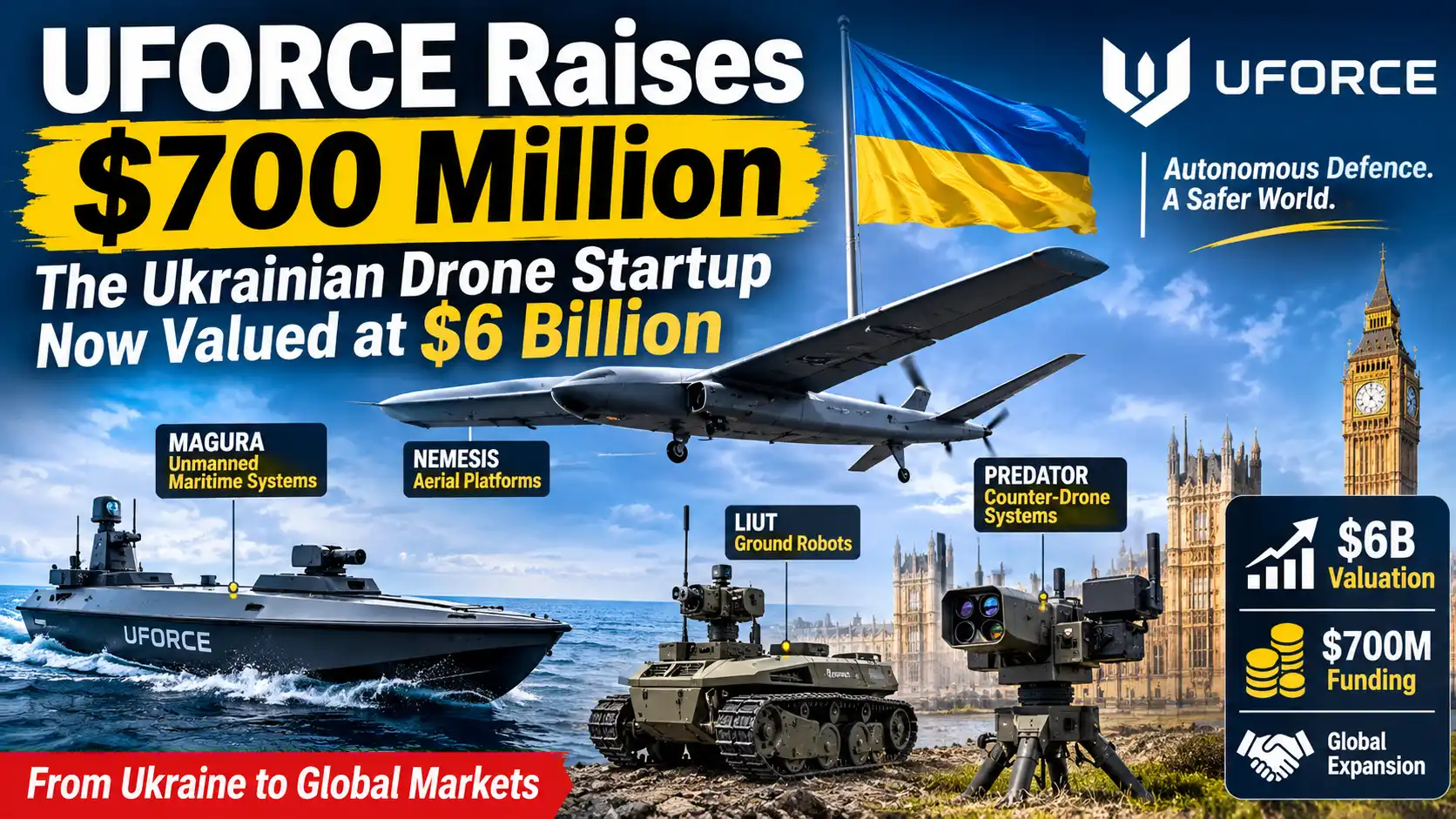
UFORCE has raised $700 million in a Series A funding round, marking a major milestone in the global defence technology industry. Announced on November 12, 2026, the investment values the company at approximately $6 billion. The funding round was co-led by US investment firm Valor Equity Partners and the UK’s government-backed National Wealth Fund, with participation from the U.S.-Ukraine Reconstruction Investment Fund and several international investors.
One of UFORCE’s key strengths is its experience in developing technology under real-world battlefield conditions in Ukraine. The company now plans to expand its manufacturing capabilities beyond Ukraine into the United States, the United Kingdom and other allied markets. With this investment, UFORCE aims to increase production, strengthen its international presence and become a major player in the rapidly evolving autonomous defence industry.
What Is UFORCE?
UFORCE is a Ukrainian-founded and UK-headquartered defence technology company. Its headquarters are in London, while its major operational hubs are located in Kyiv and Washington, DC.
The company focuses on developing unmanned platforms, robotics, AI software and defence command systems.
An unmanned platform is a vehicle or system that does not require a person to be physically present inside it to operate. Depending on its capabilities, it can be remotely controlled or perform certain tasks autonomously.
For example, an unmanned maritime vessel can conduct surveillance without carrying a crew. Similarly, an aerial drone can fly without an onboard pilot, while a ground robotic vehicle can perform tasks in dangerous environments.
UFORCE is developing solutions across all three areas within a single defence technology ecosystem.
| Company Details | Information |
| Company | UFORCE |
| Founded In | Ukraine |
| Headquarters | London, United Kingdom |
| Major Operational Hubs | Kyiv, Washington, DC |
| CEO | Oleg Rogynskyy |
| Industry | Defence Technology, AI and Robotics |
| Main Product Families | MAGURA, NEMESIS, LIUT, PREDATOR |
| Business Model | Unmanned Systems and AI Software |
| Latest Funding | $700 Million Series A |
| Company Valuation | $6 Billion |
UFORCE is led by CEO Oleg Rogynskyy, who previously founded enterprise AI company People.ai. His experience in artificial intelligence and technology businesses is relevant to UFORCE’s software and autonomous systems strategy.
How Did UFORCE Raise $700 Million?
On November 12, 2026, UFORCE announced that it had raised $700 million in a Series A funding round. Following the investment, the company reached an estimated valuation of $6 billion.
One notable aspect of this funding round is the participation of both private venture capital firms and government-backed investment institutions. It highlights how autonomous defence technology is becoming an important area not only for startups and private investors but also for governments seeking to strengthen national security and domestic industrial capabilities.
Funding Details
| Funding Information | Details |
| Funding Round | Series A |
| Amount Raised | $700 Million |
| Company Valuation | $6 Billion |
| Announcement Date | November 12, 2026 |
| Lead Investor | Valor Equity Partners |
| Co-Lead Investor | UK National Wealth Fund |
| Government Investor | U.S.-Ukraine Reconstruction Investment Fund |
Other participating investors included Menlo Ventures, Xantium and Hiro Capital. Existing investors such as Shield Capital, Ballistic Ventures, Lakestar and Squadra Ventures also participated.
It is important to distinguish between the two financial figures. The $700 million represents the new capital raised by the company, while $6 billion represents its estimated valuation following the funding round.
UFORCE’s Major Products and Technologies
UFORCE’s business strategy is not limited to a single type of drone. The company develops unmanned defence systems for three major operating environments: air, sea and land.
MAGURA – Unmanned Maritime Systems
MAGURA is UFORCE’s family of unmanned surface vessels (USVs). These are robotic boats designed to operate on the water without carrying a crew.
They can be used for maritime surveillance and defence-related operations. MAGURA attracted international attention through its reported use in Ukraine’s Black Sea operations.
NEMESIS – Unmanned Aerial Systems
NEMESIS is the company’s family of unmanned aerial platforms. It includes heavy UAV systems and platforms designed for different military applications.
According to the company, its NEMESIS Class 1 platforms have completed more than 300,000 combat flights and have been adopted by over 100 military units.
LIUT – Ground Robotic Platforms
LIUT is UFORCE’s family of unmanned ground vehicles (UGVs). These robotic vehicles operate on land and are designed to support tasks in environments where the direct presence of personnel may be dangerous.
PREDATOR – Counter-Drone Systems
PREDATOR is the company’s family of counter-UAS turret systems. These products are associated with defence against unmanned aerial threats.
As small drones become increasingly important in modern conflicts, counter-drone systems are also becoming an important part of defence infrastructure.
UFORCE is also developing its own Command-and-Control software to connect and coordinate different unmanned platforms within an integrated network.
How Will UFORCE Use the $700 Million Funding?
UFORCE plans to use the investment to expand manufacturing capacity, develop new products and establish production facilities in different countries.
The company does not want to depend entirely on manufacturing operations in Ukraine. Instead, it aims to develop manufacturing partnerships and supply networks across the United States, Europe, Asia-Pacific and the Middle East.
The main investment priorities include:
| Investment Area | Planned Purpose |
| Manufacturing Expansion | Increase production capacity across multiple countries |
| Research and Development | Develop new autonomous defence systems |
| AI and Software | Improve C2 software and unmanned system capabilities |
| Ukraine Operations | Support R&D, employees and production in Ukraine |
| Global Partnerships | Work with local manufacturers and defence companies |
Manufacturing across multiple countries could help the company maintain production continuity. If operations are disrupted in one location, facilities in other regions may help maintain supply.
The strategy is particularly important for defence businesses, where production reliability and supply-chain resilience are essential.
£113 Million UK Government Investment and New Jobs
An important part of the funding announcement is UFORCE’s expansion in the United Kingdom.
The UK’s government-backed National Wealth Fund has invested approximately £113 million in the company.
The investment will support the expansion of engineering, software development, training and advanced manufacturing activities in Britain.
According to the UK government’s announcement:
- The expansion is expected to create hundreds of highly skilled jobs.
- Local manufacturing suppliers will gain new business opportunities.
- The company aims to source more than 70% of the content of its UK-built unmanned boats from British suppliers.
- Apprenticeship opportunities will also be developed in collaboration with universities and colleges.
During the announcement, UK Defence Secretary Wes Streeting visited the aircraft carrier HMS Prince of Wales to see a demonstration of UFORCE’s MAGURA MV7 unmanned vessel. During the demonstration, he remotely piloted the vessel from more than 1,500 miles away.
The demonstration highlighted the company’s remote-operation capabilities and the potential of unmanned maritime technology.
This investment could benefit not only UFORCE but also the UK’s wider manufacturing and engineering ecosystem.
Manufacturing Partnership in the United States
UFORCE also plans to expand its manufacturing and business operations in the United States.
For this purpose, the company has partnered with US manufacturing company ReconCraft.
The partnership is intended to increase US production of MAGURA unmanned surface vessels.
This is significant because the United States and several European countries are increasing their investments in maritime security, coastal surveillance and naval defence technologies.
Local manufacturing could help UFORCE access the American defence market more effectively. It may also create opportunities for US suppliers and manufacturing businesses.
How the Ukraine War Is Changing the Defence Technology Industry
UFORCE’s development cannot be fully understood without considering the war between Russia and Ukraine.
The conflict has demonstrated how unmanned technology can influence modern military operations.
Traditionally, military strength was largely associated with large warships, fighter aircraft and expensive defence equipment. However, smaller unmanned drones and robotic systems are increasingly playing important roles.
For example, unmanned surface vessels can be used in maritime operations where deploying conventional naval vessels may be more expensive or risky.
Similarly, aerial drones can support surveillance and other military activities without requiring an onboard pilot.
UFORCE claims that its MAGURA systems have contributed to the destruction of more than a dozen Russian warships in the Black Sea. The company has also reported extensive battlefield deployment of its NEMESIS platforms.
These figures should be understood as company-reported claims rather than independently verified figures in every instance.
The wider lesson is that modern defence technology is increasingly moving towards unmanned platforms, robotics and software-based coordination.
What Are the Global Market Opportunities for UFORCE?
The autonomous defence technology market could become increasingly important in the coming years.
Several factors are supporting this growth.
Defence Modernisation: Countries in the United States, Europe and Asia are investing in modern military capabilities, including unmanned systems.
Maritime Security: Unmanned vessels could become increasingly useful for monitoring maritime borders, ports and important shipping routes.
AI and Robotics: Advances in AI and robotics are improving automation and remote-operation capabilities in defence systems.
Local Manufacturing: Many countries want to reduce their dependence on foreign defence supply chains. UFORCE’s strategy of establishing manufacturing operations in different countries could address this requirement.
UFORCE CEO Oleg Rogynskyy has also highlighted production capacity as a major challenge in the defence industry. According to him, many countries have defence budgets available, but suppliers often struggle to manufacture equipment in sufficient quantities.
This creates a potential opportunity for companies capable of scaling manufacturing quickly.
Major Challenges Facing UFORCE
Despite raising $700 million and achieving a valuation of $6 billion, UFORCE faces several challenges.
| Challenge | Potential Impact |
| Global Competition | Competition from established defence companies and startups |
| Manufacturing Costs | High costs of expanding production across countries |
| Government Regulations | Complex defence export rules and regulatory approvals |
| Technology Reliability | Maintaining system performance in difficult environments |
| Supply Chain | Ensuring a consistent supply of electronics and components |
The company will also need to secure new government contracts and long-term commercial partnerships in different countries.
Raising a large amount of capital is an important achievement, but long-term success will depend on how effectively the company converts that investment into production, revenue and sustainable business growth.
Can UFORCE Become a Global Defence Technology Leader?
UFORCE’s $700 million Series A funding round represents a significant investment in the future of autonomous defence technology.
Its $6 billion valuation reflects investor interest in unmanned systems, AI and robotics-based defence solutions.
One of the company’s biggest strengths is its diversified product portfolio. Rather than focusing only on aerial drones, UFORCE develops maritime vessels, ground robotic systems, counter-drone technology and the software required to coordinate these platforms.
The participation of the UK’s National Wealth Fund and American investors could help the company expand its manufacturing network and strengthen its international business operations.
However, its long-term success will depend on how quickly it can increase production, secure new defence contracts and adapt its products to the requirements of different countries.
If UFORCE successfully executes its expansion strategy, it could become one of the major companies in the global autonomous defence and robotics industry.
Sources: UFORCE – $700 Million Funding Announcement | UK Government – UFORCE’s £113 Million Investment and UK Expansion | UK National Wealth Fund – Investment Announcement | PR Newswire – Funding Round Details