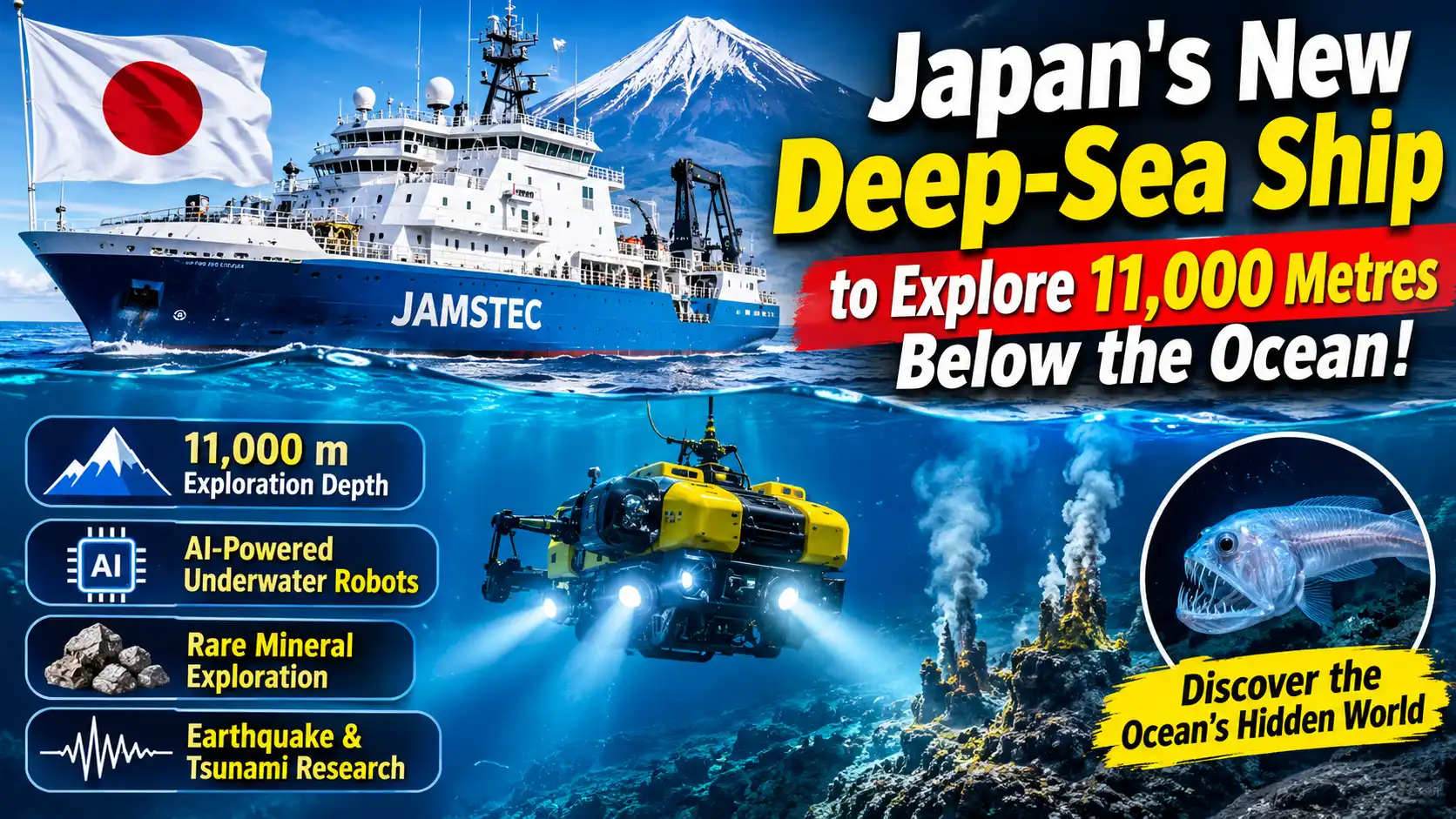
Imagine a world nearly 11 kilometres beneath the ocean’s surface, where sunlight never reaches, water pressure is more than 1,000 times greater than at sea level, and human beings cannot survive without specially designed submarines. This mysterious underwater world contains rare minerals, unknown marine species and geological secrets that scientists have yet to fully understand.
Japan is now preparing to explore this hidden world with a new generation of advanced ocean research technology. The country plans to build a sophisticated Ultra-Deep-Sea Exploration Mother Ship capable of carrying, launching and recovering multiple underwater robots, autonomous underwater vehicles and human-operated submersibles.
One of the most exciting aspects of this project is the development of AI-powered underwater exploration systems designed to reach depths of approximately 11,000 meters.
Japan aims to make the new research vessel operational by 2031. Its main objectives include exploring rare mineral resources, studying underwater earthquakes and discovering previously unknown marine life.
The project could become an important milestone in Japan’s ocean research capabilities and long-term economic security.
Why Is Japan Building a New Deep-Sea Exploration Ship?
According to a report published by Japanese media outlet Yomiuri on October 28, 2026, Japan is planning to build a new research vessel dedicated to ultra-deep-sea exploration.
The new ship is expected to replace Japan Agency for Marine-Earth Science and Technology (JAMSTEC)’s existing research support vessel, Yokosuka.
Yokosuka entered service in 1990 and has played an important role in supporting deep-sea research missions. One of its major responsibilities has been transporting and supporting Japan’s famous human-operated submersible, Shinkai 6500.
However, after more than 35 years of operation, the vessel’s equipment and infrastructure have become outdated. Maintaining its machinery, pipelines and other critical systems is also becoming increasingly difficult.
Japan believes that replacing the ageing vessel is necessary to maintain its position in advanced ocean research.
According to the Japan’s ministry, nearly half of Japan’s Exclusive Economic Zone (EEZ) consists of ocean areas deeper than 4,000 meters. This makes deep-sea research particularly important for the country’s scientific development and future economic opportunities.
Key Details of Japan’s New Mother Ship
The new vessel will not simply function as a transportation ship for submarines. It is being planned as an integrated deep-sea research platform capable of supporting multiple underwater exploration systems.
| Key Information | Details |
| Country | Japan |
| Project | Ultra-Deep-Sea Exploration Mother Ship |
| Development and operating organisation | JAMSTEC |
| Existing vessel to be replaced | Yokosuka |
| Target construction start | FY2027 |
| Planned construction period | FY2027–FY2030 |
| Expected operational year | 2031 |
| Maximum exploration depth | Approximately 11,000 meters |
| Key technologies | AI, AUV, ROV and deep-sea robotics |
| Main objectives | Mineral exploration, scientific research and disaster research |
What Is the AI Technology That Can Explore 11,000 Meters Below the Ocean?
One of the most interesting aspects of this project is the development of AI-powered underwater exploration technology.
As an underwater vehicle travels deeper, water pressure increases dramatically. At approximately 11,000 meters, the pressure can reach around 1,100 times the atmospheric pressure at sea level.
Ordinary underwater robots cannot operate safely under these conditions. Special pressure-resistant structures, sensors, navigation systems and communication equipment are required.
Japan wants to develop autonomous underwater exploration systems capable of operating in these extreme environments without requiring a human pilot.
AI could support several important functions:
- Identifying underwater surroundings and recognising geographical features.
- Analysing photographs and images of the ocean floor.
- Helping identify potential mineral deposits.
- Adjusting exploration routes according to changing underwater conditions.
- Assisting scientists in identifying and collecting important samples.
Communication is another major challenge. GPS and conventional mobile networks do not work normally underwater. Special communication technologies, such as acoustic communication, are therefore necessary.
JAMSTEC and Japanese government research documents identify autonomous operations, underwater communication and full-depth exploration capabilities as important areas of technological development.
An important distinction: The 11,000-meter exploration capability should not be confused with a human-operated submarine. Japan’s plan places significant emphasis on unmanned exploration systems for these extreme depths. Its existing Shinkai 6500 human-operated submersible has a maximum operating depth of 6,500 meters.
How Will One Mother Ship Operate Multiple Underwater Robots?
Traditional research vessels often face limitations when launching, recovering and operating different types of underwater vehicles during the same mission.
Japan’s new vessel is being designed to improve these capabilities. The objective is to support several exploration systems within a single research mission.
Three important types of underwater technology will play a major role.
A. AUV – Autonomous Underwater Vehicle
An Autonomous Underwater Vehicle, or AUV, is an underwater robot that can operate without a human pilot directly controlling it.
Scientists can provide it with a mission before deployment. It can then travel underwater and collect information such as:
- Ocean-floor images.
- Water depth.
- Temperature measurements.
- Geological information.
- Seafloor mapping data.
With advanced AI capabilities, future AUVs could become better at navigating complicated underwater environments and making certain decisions independently.
B. ROV – Remotely Operated Vehicle
An ROV is an underwater robot controlled by an operator aboard a research vessel. It can be equipped with cameras, lighting systems, robotic arms and scientific instruments.
ROVs are particularly useful for inspecting specific underwater locations, collecting rock samples and installing scientific equipment. Unlike autonomous vehicles, they remain connected to their operators through specialised communication systems, commonly using a tether.
C. HOV – Human-Occupied Vehicle
A Human-Occupied Vehicle is a submarine designed to carry people underwater. Scientists and pilots can travel inside it to directly observe the deep-sea environment and conduct research.
Japan’s Shinkai 6500 is an example of this type of submersible. The new mother ship is expected to support the deployment and recovery of different underwater systems.
For example, scientists could first use an AUV to map a particular ocean-floor region. They could then deploy an ROV to examine a specific location and, if necessary, use a human-operated submersible for direct observation.
This integrated approach could allow researchers to collect significantly more information during a single expedition.
What Rare Minerals Will Japan Explore Beneath the Ocean?
A major objective of Japan’s deep-sea research programme is to investigate important mineral resources located beneath the ocean.
Demand for critical minerals is increasing because of the expansion of electric vehicles, batteries, smartphones, computers, renewable energy systems and semiconductor manufacturing.
Several valuable mineral resources exist in deep-sea environments.
1. Rare Earth Elements (REEs)
Rare earth elements are used in electric vehicle motors, wind turbines, electronics and advanced industrial equipment.
Japan considers these materials strategically important because it relies on international suppliers for several critical minerals.
2. Polymetallic Nodules
These are small, rock-like formations found on the ocean floor.
They can contain several valuable metals, including:
- Manganese.
- Nickel.
- Copper.
- Cobalt.
These materials are used in batteries, electrical equipment and industrial manufacturing.
3. Cobalt-Rich Crusts
Cobalt-rich crusts develop on the surfaces of underwater mountains and rocks. They can contain cobalt, nickel and other valuable metals that are important for advanced manufacturing.
4. Hydrothermal Minerals
In certain underwater locations, hot mineral-rich fluids emerge from the ocean floor. These environments can produce deposits containing copper, zinc and other industrial metals. Japan wants to investigate the presence, formation and potential industrial applications of these resources.
However, this does not mean that the new vessel will immediately begin commercial deep-sea mining. Its primary purpose is exploration, mapping and scientific sample collection to determine what resources exist and whether their future extraction could be economically practical.
How Could This Technology Help Earthquake and Tsunami Research?
Japan is one of the countries most exposed to major earthquakes and tsunamis. Several important tectonic plate boundaries and deep ocean trenches are located around the country. Underwater geological movements in these regions can sometimes trigger powerful earthquakes and tsunamis.
One major challenge is that studying underwater fault lines, geological structures and changes in the ocean floor is extremely difficult.
The new exploration platform could help scientists investigate these areas in greater detail.
For example, researchers could use AUVs to create high-resolution maps of specific underwater regions. ROVs and other sampling systems could then collect rock and sediment samples for further analysis.
This information could help scientists understand:
- How underwater geological structures change.
- What happened to the ocean floor during previous earthquakes.
- How underwater landslides develop.
- How submarine volcanoes become active.
- How earthquake and tsunami risk assessments can be improved.
It is important to understand that this technology will not predict the exact date and time of a future earthquake. Instead, it could improve the scientific information used in disaster-risk assessment and monitoring systems.
Why Is AI Becoming Important in Deep-Sea Exploration?
Human beings cannot easily work for extended periods at extreme ocean depths. High pressure, low temperatures and limited communication make underwater operations extremely challenging.
This is why AI and autonomous underwater robots could play an increasingly important role in future ocean exploration.
Imagine that a scientific team wants to investigate a mineral deposit located 10,000 meters below the ocean surface.
In a conventional research mission, scientists may first need to identify the region and then conduct several separate inspections using specialised equipment.
An AI-equipped underwater robot could make parts of this process more automated.
It could analyse images of the ocean floor, identify potentially interesting locations and provide useful information to scientists for further investigation.
AI may also help with route planning, object recognition and processing large volumes of underwater data.
However, AI will not completely replace human scientists. Expert decisions, complicated sample collection and mission safety will continue to require human supervision.
Japan’s proposed exploration platform places importance on AI, automation and underwater communication as key technological areas.
Deep-Sea Exploration Competition Between Japan, China and the United States
Deep-sea exploration is no longer limited to scientific research. It is increasingly connected to economic security, critical minerals and advanced technology competition between countries.
China
China has developed a full-ocean-depth human-occupied submersible called Fendouzhe.
It can reach depths of approximately 11,000 meters and has already supported scientific research and sample collection in some of the deepest parts of the world’s oceans.
United States
The United States also has government and private research organisations working on deep-sea exploration.
These organisations are developing human-operated submersibles, autonomous underwater vehicles and advanced robotic exploration systems.
What Challenges Could the Project Face?
Developing such an advanced deep-sea exploration platform will not be easy.
1. Extreme Water Pressure
At depths of 11,000 meters, equipment may face pressure approximately 1,100 times greater than atmospheric pressure at sea level.
Special materials, pressure-resistant components and carefully engineered structures will be essential.
2. Underwater Communication
GPS and conventional radio signals do not work normally underwater.
Acoustic communication is one of the important alternatives, but it has limited data-transfer speeds and other technical restrictions.
This could make remote control and real-time data transmission challenging.
3. AI Reliability
Unexpected conditions can occur in deep-sea environments.
Autonomous robots must be capable of making reliable decisions, responding to emergencies and operating safely even when communication with the research vessel is limited.
4. Environmental Protection
Deep-sea ecosystems are extremely delicate.Exploration and future mining activities could disturb marine organisms and underwater habitats.
Therefore, environmental monitoring and conservation must remain important parts of the research programme.
5. Construction and Operating Costs
Developing a specialised research ship, underwater robots, laboratories and advanced scientific equipment requires substantial investment.
Long-term maintenance and operating expenses will also be important considerations.
What Does This Project Mean for Business and Future Technology?
Japan’s new deep-sea exploration project could create opportunities across several advanced technology industries.
| Industry | Potential Opportunities |
| Robotics | Advanced underwater robots |
| Artificial Intelligence | Autonomous exploration systems |
| Semiconductor | Advanced sensors and electronic components |
| Shipbuilding | Specialised research vessels |
| Critical Minerals | Mineral mapping and sampling |
| Biotechnology | Research into deep-sea organisms |
| Ocean Data | Seafloor mapping and scientific data services |
Companies involved in underwater robotics, advanced sensors, navigation systems and autonomous technologies could benefit from the development of this industry.
If Japan successfully develops these systems, their applications could eventually extend beyond scientific research.
Potential future applications include:
- Inspection of underwater infrastructure.
- Monitoring of marine environments.
- Offshore energy infrastructure inspection.
- Underwater geological surveys.
- Advanced ocean mapping.
This means that deep-sea exploration could become an important technology market in the coming decades.
Outcome
Japan’s proposed Ultra-Deep-Sea Exploration Mother Ship represents an important development in the future of ocean exploration.
Its biggest advantage could be the ability to operate multiple types of underwater exploration systems from a single research vessel.
By combining AI-powered autonomous robots, remotely operated vehicles and human-operated submersibles, scientists could investigate parts of the ocean that remain extremely difficult to access.
The development of unmanned exploration systems capable of reaching approximately 11,000 meters is particularly significant.
These systems could help researchers discover rare minerals, study unknown marine organisms, investigate geological structures and understand natural events occurring deep beneath the ocean.
However, the project’s actual success will depend on how effectively Japan develops the vessel and its associated exploration technologies by the targeted operational year of 2031.
Overall, the future technology race is no longer limited to outer space. The deepest parts of the ocean are also becoming an important frontier for science, industry, natural resources and economic security.
Sources: Japan MEXT – Minister’s Press Conference (Official Announcement) | JAMSTEC – Deep-Sea Research Vehicles JAMSTEC – New Research Vessel Presentation