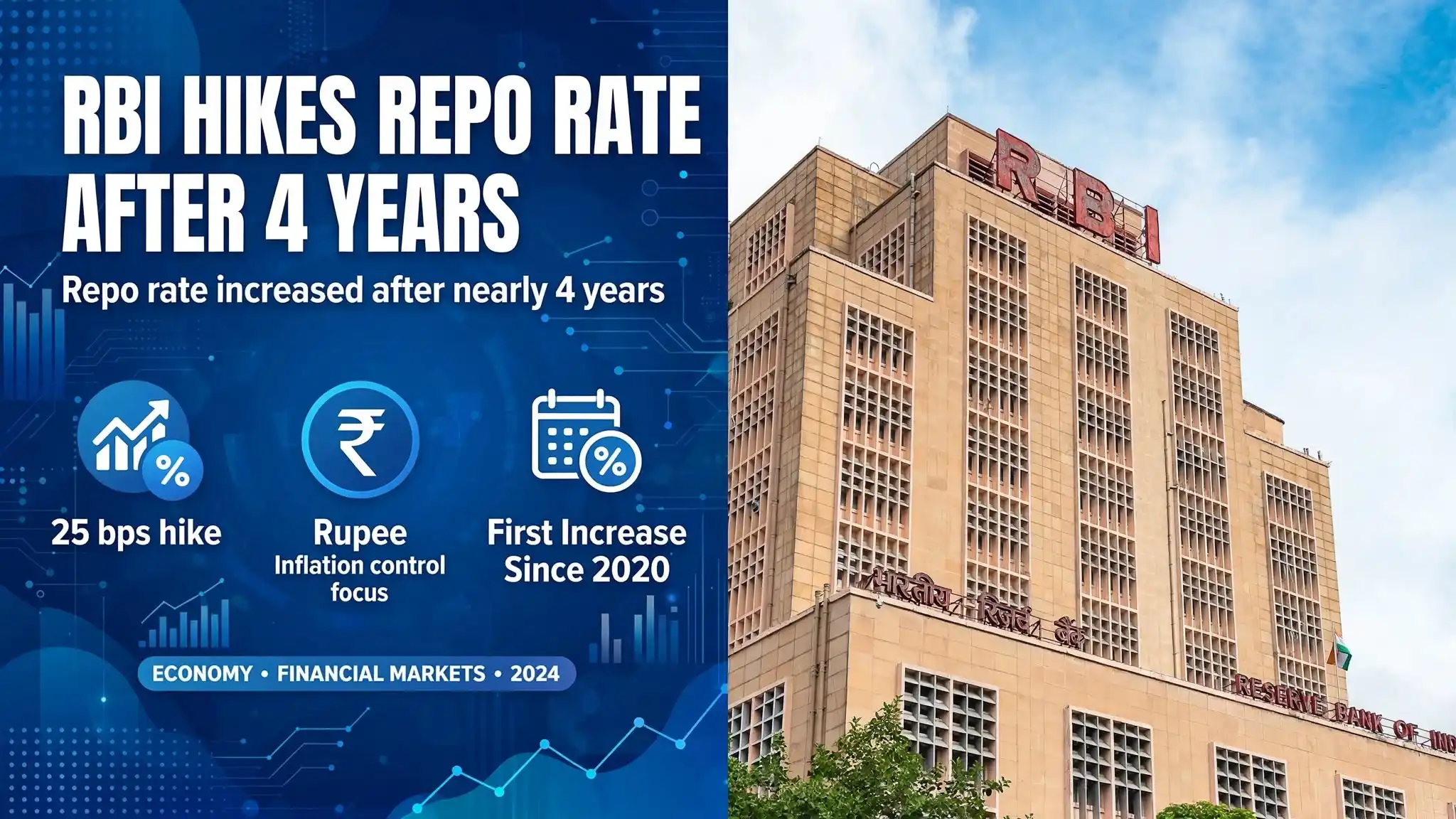
India’s monetary policy has taken an important turn. On October 7, 2026, the Reserve Bank of India (RBI) increased the repo rate by 25 basis points, from 5.25% to 5.50%. This is the first repo-rate hike since February 2023, making it the first increase in nearly four years.
The decision comes at a time when India’s economic growth remains strong, but inflation risks are rising. Higher crude oil prices, geopolitical tensions, a weaker rupee and broader price pressures have made the inflation outlook more challenging.
At the same time, the RBI has changed its policy stance from “neutral” to “calibrated tightening”, which is an important signal for financial markets, banks, businesses and borrowers.
RBI Repo Rate Hike: Key Details at a Glance
| Key Detail | Latest Decision |
| Central Bank | Reserve Bank of India (RBI) |
| Policy Meeting | October 5–7, 2026 |
| Repo Rate Before | 5.25% |
| New Repo Rate | 5.50% |
| Rate Increase | 25 basis points |
| Previous Rate Hike | February 2023 |
| Policy Stance | Calibrated Tightening |
| Earlier Stance | Neutral |
| FY27 GDP Growth Forecast | 7.1% |
| FY27 Inflation Forecast | 5.2% |
| Rate Hike Vote | Unanimous |
| Stance Vote | 4 members for tightening, 2 for neutral |
The rate increase was unanimously supported by the six-member Monetary Policy Committee (MPC).
What Is the Repo Rate?
The repo rate is the interest rate at which the RBI lends short-term money to commercial banks.
In simple terms, when the RBI increases the repo rate, borrowing money generally becomes more expensive for banks. Banks can then pass some of this higher cost to customers through higher lending rates.
For example, if a person has a floating-rate home loan, car loan or personal loan, a change in the lending rate can eventually affect the EMI or the overall interest paid.
On the other hand, higher interest rates can also make bank deposits and other interest-bearing savings products more attractive.
Why Did RBI Increase the Repo Rate?
The biggest reason is rising inflation risks.
India’s retail inflation increased to 4.82% in August 2026, moving above the RBI’s medium-term 4% target for the third consecutive month.
The RBI is particularly concerned because inflationary pressure is no longer limited to only a few food items. Higher energy prices and broader price pressures could make inflation more persistent.
1. Higher Crude Oil Prices
Crude oil is extremely important for the Indian economy because India imports a large portion of its crude oil requirement.
When international oil prices rise:
- Petrol and diesel can become more expensive
- Transportation costs can increase
- Production costs can rise
- Logistics become more expensive
- Companies may face pressure on margins
- Consumer prices can eventually increase
The current geopolitical situation and higher energy prices have therefore created an additional inflation risk.
2. Inflation Is Moving Above the RBI’s Target
The RBI’s medium-term inflation target is 4%, with a tolerance band of 2% to 6%.
August inflation at 4.82% was still within the tolerance band, but it was above the central bank’s preferred 4% target.
This is important because the RBI does not want temporary inflation to become a long-term expectation among consumers and businesses.
If people and companies start expecting prices to rise continuously, businesses may increase prices and workers may demand higher wages. This can make inflation more difficult to control.
3. The Indian Economy Is Still Growing Strongly
Normally, a central bank may hesitate to increase interest rates when economic growth is weak.
But India’s current situation is different.
The RBI has actually raised its FY27 real GDP growth forecast to 7.1% from 6.7%. The economy therefore has some room to absorb moderately higher borrowing costs.
India’s April-June quarter GDP growth was also reported at 7.8%, stronger than the RBI’s earlier expectation.
This combination of strong growth and rising inflation gives the RBI more flexibility to focus on price stability.
RBI Raises Inflation Forecast Too
Another important part of the latest policy is the change in the inflation forecast.
The RBI has raised its FY27 inflation projection to 5.2%, compared with the previous forecast of around 5%.
This tells us that the central bank expects inflationary pressure to remain higher than previously anticipated.
According to the RBI’s latest projections, inflation is expected to remain particularly elevated in the coming quarters.
What Does “Calibrated Tightening” Mean?
This is one of the most important messages from the latest RBI policy.
Previously, the RBI’s policy stance was “neutral.”
Now it has moved to “calibrated tightening.”
In simple language, this means the RBI is becoming more focused on controlling inflation and is keeping the possibility of further rate increases open.
However, it does not mean that the RBI has already decided to raise rates repeatedly.
Governor Sanjay Malhotra indicated that future decisions will depend on inflation, growth and other economic data. Reuters described the new stance as a more data-dependent approach rather than a predetermined series of hikes.
The change in stance was supported by four MPC members, while two preferred to retain the neutral stance.
Will RBI Increase Interest Rates Again?
The latest decision does not guarantee another rate hike.
However, the change to calibrated tightening means that another increase remains possible if inflation continues to rise.
Economists quoted by Reuters have suggested that additional increases could come if oil prices remain elevated and inflationary pressures broaden. Some analysts expect further tightening over the coming months, although the exact size and timing will depend on economic data.
Therefore, investors should not assume that the October hike is necessarily the end of the cycle.
The RBI could:
Raise rates again → if inflation gets worse
Keep rates unchanged → if inflation starts cooling
Change its stance later → if economic conditions improve significantly
The next steps will largely depend on inflation, oil prices, the rupee, global interest rates and domestic economic growth.
What Does the Rate Hike Mean for Home Loan Borrowers?
For borrowers, the most immediate concern is the cost of loans.
If banks increase their lending rates following the RBI hike, borrowers with floating-rate loans could see their interest burden increase.
This can affect:
- Home loans
- Car loans
- Personal loans
- Business loans
- Working-capital loans
For example, suppose someone has a floating-rate home loan. If the bank’s lending rate increases, the borrower may either face a higher EMI or a longer repayment period, depending on the bank’s policy.
However, the actual impact will vary from bank to bank and depends on the loan’s benchmark and reset mechanism.
Indian Express also noted that the rate increase can affect borrowing costs for home, personal and vehicle loans.
What Does It Mean for Banks?
The impact on banks is more complicated.
Higher interest rates can increase lending rates, which can potentially improve interest income on new loans.
However, there is another side.
If borrowing becomes expensive, demand for new loans can slow down. Some borrowers may also face greater repayment pressure.
Therefore, banks have to balance:
Higher lending rates + potentially higher interest income
against
Lower credit demand + higher repayment pressure on borrowers
The overall impact will depend on how long the higher-rate environment continues.
What Does It Mean for Businesses?
Businesses also need to pay attention to the rate hike.
Companies regularly borrow money for:
- New factories
- Machinery
- Expansion
- Working capital
- Infrastructure
- Acquisitions
- Inventory
If borrowing costs rise, the cost of financing these activities can increase.
For highly leveraged companies, this can put pressure on profits.
On the other hand, companies with strong cash balances and low debt may be less affected.
This means investors may increasingly differentiate between companies with strong balance sheets and companies carrying high levels of debt.
Impact on Stock Market
Interest-rate increases can create mixed reactions in the stock market.
Higher interest rates can put pressure on stock valuations because future corporate cash flows become less attractive when bond yields and borrowing costs rise.
Growth-oriented sectors can be particularly sensitive because their valuations often depend on expectations of strong future earnings.
However, the stock market does not react only to the repo rate.
Investors will also consider:
- India’s GDP growth
- Corporate earnings
- Inflation
- Crude oil prices
- Rupee movement
- Foreign investment
- Global interest rates
Therefore, a 25-basis-point hike does not automatically mean that the stock market will fall.
What Does It Mean for the Rupee?
Interest rates can also influence the Indian rupee.
Higher domestic interest rates can make Indian financial assets relatively more attractive to some investors, potentially supporting capital inflows.
But the currency also depends heavily on crude oil prices, the US dollar, global interest rates and foreign portfolio investment.
The rupee has remained under pressure, so the RBI is also watching currency-market conditions closely.
Why Didn’t RBI Increase the Reserve Ratio?
The RBI chose not to use a reserve-ratio increase as an additional tool to absorb liquidity.
Instead, it has been using measures such as bond sales and foreign-exchange swaps to manage liquidity conditions.
Governor Sanjay Malhotra indicated that a reserve-ratio increase was not the preferred option at this stage.
This is important because the RBI is trying to manage inflation and liquidity without unnecessarily creating additional stress for the banking system.
What Could Happen to FD and Deposit Rates?
For savers, higher interest rates can have a more positive side.
If banks raise deposit rates in response to changing monetary conditions, fixed deposits and other savings products could become more attractive.
However, banks do not necessarily increase deposit rates immediately or by the same amount as lending rates.
So depositors should compare actual bank rates rather than assuming that every bank will increase FD rates by 25 basis points.
Why This RBI Decision Is Important for India
This decision is important because it marks a shift in India’s monetary-policy environment.
During the previous rate-cut cycle, the RBI was focused more on supporting economic activity and reducing borrowing costs.
Now the priority is moving toward controlling inflation while maintaining economic growth.
The RBI is therefore trying to maintain a balance:
Too little tightening: Inflation could become more persistent.
Too much tightening: Borrowing could become expensive and economic activity could slow.
The challenge for the central bank is to find the right balance between these two risks.
What Should Investors Watch Next?
After the October rate hike, investors should closely monitor five major indicators.
1. Retail Inflation
If CPI inflation continues to rise, pressure on the RBI to tighten policy could increase.
2. Crude Oil Prices
India imports crude oil, so a prolonged increase in oil prices could create additional inflationary pressure.
3. GDP Growth
Strong economic growth gives the RBI more room to keep monetary policy relatively tight.
4. Rupee Movement
A weaker rupee can increase the domestic cost of imported commodities, especially crude oil.
5. Global Central Banks
Decisions by the US Federal Reserve, Bank of Japan and other major central banks can influence global capital flows and India’s currency and bond markets.
What Does This Rate Hike Tell Us?
The RBI’s 25-basis-point rate increase is more than just a small change in the repo rate. It signals a change in monetary-policy direction.
India’s economy is currently strong enough for the RBI to tolerate somewhat higher borrowing costs, while inflation has become a bigger concern because of energy prices and broader price pressures.
The shift from neutral to calibrated tightening is particularly important because it keeps the door open for further action.
For borrowers, this could mean higher borrowing costs. For savers, deposit rates could become relatively more attractive. For businesses, financing costs may rise, while investors will need to pay closer attention to debt levels, earnings and interest-rate sensitivity.
At the same time, the RBI has raised its FY27 growth forecast to 7.1%, showing that it does not currently see higher interest rates as incompatible with strong economic expansion.
The key question now is not simply whether the RBI will raise rates again. The bigger question is how inflation, crude oil prices, the rupee and economic growth develop over the next few months.
If inflation remains elevated, the RBI may continue with calibrated tightening. If price pressures ease, the central bank could pause and assess the impact of the October move.
For India’s economy, therefore, the October 2026 policy decision could mark the beginning of a new phase in which inflation control once again becomes a major focus of monetary policy.