One of the biggest challenges for electric vehicles (EVs) is not only driving range but also the time and infrastructure required to recharge the battery. When an EV travels long distances, the driver normally has to stop at a charging station and connect the vehicle to a charger. For electric trucks and other commercial vehicles, this can be an even bigger problem because they need to remain on the road for long periods.
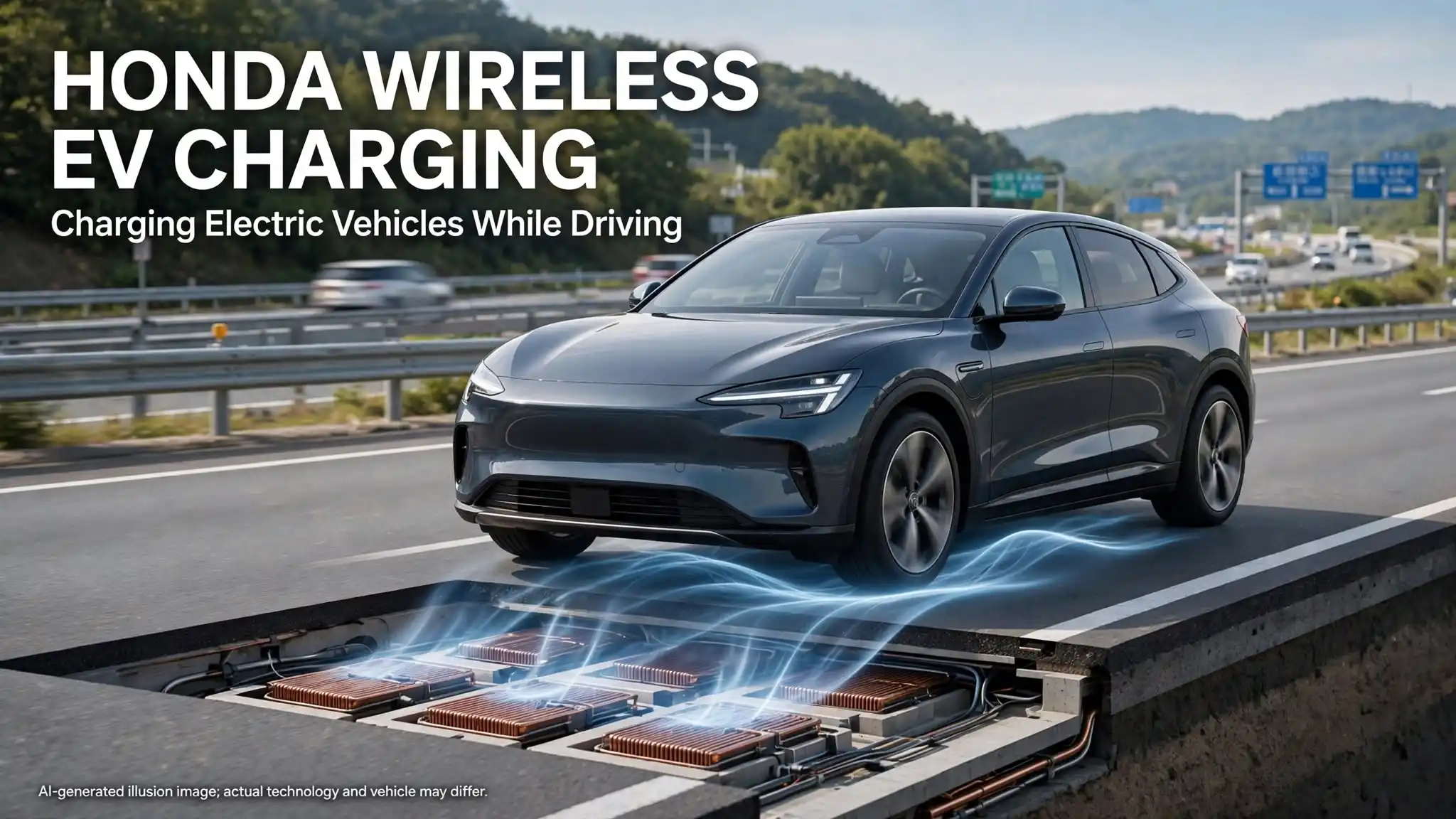
Honda is now working on a technology that could change the way EVs are charged in the future. The company has developed a Dynamic Wireless Power Transfer (DWPT) system that can transfer electricity wirelessly to an EV while it is moving. In simple terms, parts of a road could act like a wireless charging system, allowing compatible EVs to receive electricity without stopping at a conventional charging station.
Honda developed this technology together with Taisei Corporation and Taisei Rotec Corporation. The companies plan to conduct a demonstration on a public road in Japan from FY2027, which begins in April 2027.
What Is Honda’s Wireless In-Motion Charging Technology?
In simple terms, Honda is trying to turn selected sections of a road into a wireless charging system for electric vehicles.
Today’s conventional EV charging process is:
EV → Charging Station → Cable → Battery
Honda’s proposed system changes this concept to:
Road Infrastructure → Wireless Power Transfer → Moving EV → Battery
Special power-transmitting units are installed inside the road. A compatible EV has a receiving unit underneath the vehicle. When the vehicle passes over the charging section, electricity can be transferred wirelessly from the road to the vehicle.
Honda calls this technology Dynamic Wireless Power Transfer (DWPT).
How Does the Technology Work?
The system has three important parts.
1. Ground DC Power Supply
Electricity first needs to reach the charging infrastructure installed along the road.
Taisei Corporation is developing the DC power supply system that will provide electricity to the embedded charging equipment.
2. Charging Units Embedded in the Road
Special Ground Assembly (GA) units are installed inside the road pavement.
These units are responsible for transmitting electricity to the vehicle.
Honda has developed a configuration that integrates the inverter and coil into a single DWPT unit. According to Honda, this was a notable publicly disclosed configuration as of the end of September 2026.
3. Receiving Unit on the Vehicle
A compatible EV is equipped with a Vehicle Assembly (VA) unit.
When the vehicle passes over the charging section, electricity can be transferred between the road and vehicle through magnetic coupling.
The driver therefore does not need to plug in a charging cable.
What Does Magnetic Wireless Charging Mean?
The system is based on the principle of magnetic coupling.
A transmitter coil inside the road and a receiver coil installed on the vehicle create an electromagnetic field between them. This allows electrical energy to move from the road to the vehicle without a physical cable connection.
The concept is somewhat similar to wireless smartphone charging, but the engineering challenge is much greater.
A smartphone charger works with:
- A stationary device
- A very small distance
- Relatively low power
Honda’s system is designed for:
- A moving vehicle
- A larger distance between components
- High-power energy transfer
- Potential use with heavy commercial vehicles
This makes the technology considerably more complicated than ordinary wireless charging.
Also Read: Electreon Lite DOT: Wireless EV Charging Technology Explained
Why Is Honda Developing This Technology?
Honda’s main objective is to make EV charging more convenient.
Today, an EV has to stop to recharge. If the vehicle can receive electricity while driving, the number of charging stops could potentially be reduced.
This could be particularly useful for vehicles that:
- Travel long distances every day
- Operate on fixed routes
- Spend many hours on the road
- Carry heavy loads
- Cannot afford long charging stops
This is why Honda is particularly interested in potential applications in logistics and transportation.
Why Could This Technology Be Important for Electric Trucks?
This could be one of the most important applications of Honda’s technology.
For passenger EVs, charging infrastructure is important, but electric trucks face an even bigger challenge.
Imagine a heavy electric truck traveling hundreds of kilometers.
With conventional charging:
Truck stops → Freight operation stops → Battery charges → Journey continues
With wireless charging sections on the road:
Truck continues driving → Receives electricity from the road → Battery receives additional energy
Honda and its partners have developed road structures and GA units with large commercial vehicles in mind, including vehicles with a gross vehicle weight of around 20 tonnes.
If this technology becomes practical, it could be particularly useful for long-distance freight transportation.
How Powerful Could the Wireless Charging System Be?
Honda and its partners plan to verify the performance of high-power wireless charging of up to 150 kW in future testing.
This is important because Honda is not focusing only on low-power charging for small passenger vehicles. The technology is also being evaluated for large commercial EVs.
However, there is an important distinction.
150 kW is a target for performance verification and future testing, not a guarantee that every future charging road will provide 150 kW to every vehicle.
The actual performance in real-world conditions will need to be demonstrated.
Has Honda Already Tested the Technology on Public Roads?
The technology is currently in the development and validation stage.
Honda, Taisei and Taisei Rotec have already conducted experiments on the T-FIELD/SATTE test roadway.
These tests have been used to evaluate the wireless power-transfer system, pavement structure and construction methods.
The next major step is testing the technology in a real public-road environment.
When Will Honda Demonstrate It on Public Roads?
Honda plans to conduct a public-road demonstration from FY2027.
Japan’s FY2027 begins on April 1, 2027.
Honda and its partners are also participating in the Tateyama Project, which involves a planned demonstration of DWPT technology on the Tateyama Expressway in Chiba by NEXCO East.
This means the development timeline can broadly be understood as:
2026 → Technology development and testing
Late 2026 → Further testing and preparation
FY2027 onward → Public-road demonstration
Future → Potential commercial deployment
Therefore, it would be incorrect to describe Honda’s system in 2026 as an already commercially available wireless charging highway.
What Is the Biggest Challenge of Installing It on Roads?
Wireless charging sounds simple, but putting charging equipment inside a road creates major engineering challenges.
The road has to:
- Support cars, buses and heavy trucks
- Handle rain and changing weather conditions
- Operate reliably for many years
- Remain compatible with road maintenance
- Transfer electricity to vehicles moving at speed
- Maintain electrical and electromagnetic safety
Honda and its partners are researching these issues as part of the development program.
Road Durability Is Also Critical
If charging equipment is installed inside the road, thousands or even millions of vehicles could pass over it.
Heavy trucks could put particularly large loads on the road surface.
Therefore, the embedded charging units and pavement structure must be strong enough for long-term use.
Honda’s planned testing includes durability evaluation equivalent to 1 million wheel loads to assess how the system performs under repeated heavy traffic.
This shows that the project is not simply about wireless electricity transfer. It combines:
EV technology + electrical infrastructure + road engineering.
Could the Technology Be Installed in Existing Roads?
One interesting objective of Honda’s development is to make installation compatible with existing pavement.
The GA unit is being designed for installation by milling and embedding it into the road surface.
If this approach proves practical, future charging infrastructure could potentially be added to selected existing roads rather than requiring every charging road to be completely rebuilt from scratch.
However, the cost and practicality of large-scale deployment still need to be demonstrated.
What Are the Major Benefits?
1. Fewer Charging Stops
If EVs can receive electricity while driving, they may not need to stop as frequently at charging stations.
2. Easier Long-Distance EV Travel
Wireless charging sections on highways could make long-distance EV travel more practical.
3. Potentially Smaller Batteries
If vehicles regularly receive energy from the road, some applications could potentially require smaller batteries.
However, this remains a potential future benefit rather than something Honda has confirmed for all future EVs.
4. Benefits for Commercial EV Fleets
Trucks, buses and delivery vehicles often operate on predictable routes.
Installing wireless charging infrastructure along these routes could be more practical than attempting to install it across every road.
5. Support for Wider EV Adoption
Charging infrastructure remains an important factor in EV adoption. Dynamic charging could eventually help reduce some of the limitations associated with conventional charging.
What Are the Challenges?
The technology is promising, but turning it into a widespread charging network will not be easy.
Infrastructure Cost
Installing charging equipment, power systems and electrical infrastructure inside roads could require significant investment.
Maintenance
If the road or charging equipment is damaged, repairing embedded electrical components could be more complicated than maintaining conventional roads.
Energy Efficiency
Wireless power transfer can involve energy losses. The system’s real-world efficiency will have to be demonstrated under high-speed and high-power conditions.
Vehicle Compatibility
Not every EV will automatically be able to use a wireless charging road. Vehicles will need compatible receiving hardware.
Standardization
If different manufacturers use different wireless charging technologies, industry-wide standards will be necessary.
Electromagnetic Safety
High-power wireless energy transfer requires careful evaluation of electromagnetic fields and safety.
Honda plans to conduct additional safety evaluations as the project moves toward public-road demonstrations.
Will This Technology Solve the EV Range Problem?
Not completely.
This is an important point.
Dynamic wireless charging could reduce the impact of range limitations, but it would not eliminate the need for batteries or conventional charging.
When an EV leaves a wireless charging road, it still needs enough stored energy to continue driving.
The future EV charging ecosystem could therefore look more like:
Home Charging + Fast Charging Stations + Wireless Charging Roads
These technologies could complement one another rather than completely replace each other.
Why Is This Technology Strategically Important for Honda?
Honda is not only developing electric vehicles. The company is also exploring the infrastructure needed to support an electric mobility ecosystem.
Honda has been expanding its EV charging activities in Japan, and wireless dynamic charging could become another part of its long-term charging strategy.
The most interesting point is that Honda is not looking only at passenger vehicles.
Large electric trucks and commercial fleets could become some of the earliest practical applications.
These vehicles travel predictable routes and can benefit significantly if charging can take place without stopping.
Which Companies Are Working on the Project?
The project involves three main companies:
| Company | Main Role |
| Honda R&D | Development of the vehicle and road-side wireless power-transfer system |
| Taisei Corporation | Development of the DC power supply system |
| Taisei Rotec | Road construction and pavement technology |
| Honda + Taisei + Taisei Rotec | Pavement, durability, DC distribution and wireless charging tests |
The project therefore combines automotive engineering, electrical infrastructure and road construction expertise.
What Could Be the Future of This Technology?
If public-road demonstrations are successful, the technology could first be used in areas where vehicles follow predictable routes.
Potential applications could include:
Electric trucks → Logistics highways → Electric buses → Delivery fleets → Taxi and fleet corridors
Passenger EVs could potentially become a later application.
However, before large-scale deployment, the technology will need to prove itself in several areas:
- Cost
- Reliability
- Charging efficiency
- Safety
- Durability
- Infrastructure economics
- Compatibility with different EVs
Could This Be a Game Changer for EVs?
Honda’s wireless in-motion charging technology has game-changing potential, but it has not yet proven itself as a commercial game changer.
Most of today’s EV industry is focused on improving battery capacity, increasing charging speed and building more fast-charging stations.
Honda is exploring a different approach:
Instead of only making the battery bigger, make the road part of the charging infrastructure.
If highways can eventually provide electricity to moving EVs, the concept of long-distance electric transportation could change significantly.
The biggest impact could potentially come from electric trucks and commercial fleets, where charging downtime is particularly costly.
However, as of 2026, Honda’s technology is still in the development and demonstration stage. Public-road testing is planned from FY2027, and the results will determine whether the system can work economically and reliably under real-world traffic conditions.
Therefore, Honda’s wireless in-motion charging system should not yet be viewed as a replacement for conventional EV charging. Instead, it is a potential new model for future EV charging infrastructure that could complement home charging and fast-charging networks.
If Honda can successfully prove that EVs can receive significant amounts of electricity safely and efficiently while moving, roads themselves could become an important part of the future electric mobility ecosystem.
Source: Honda