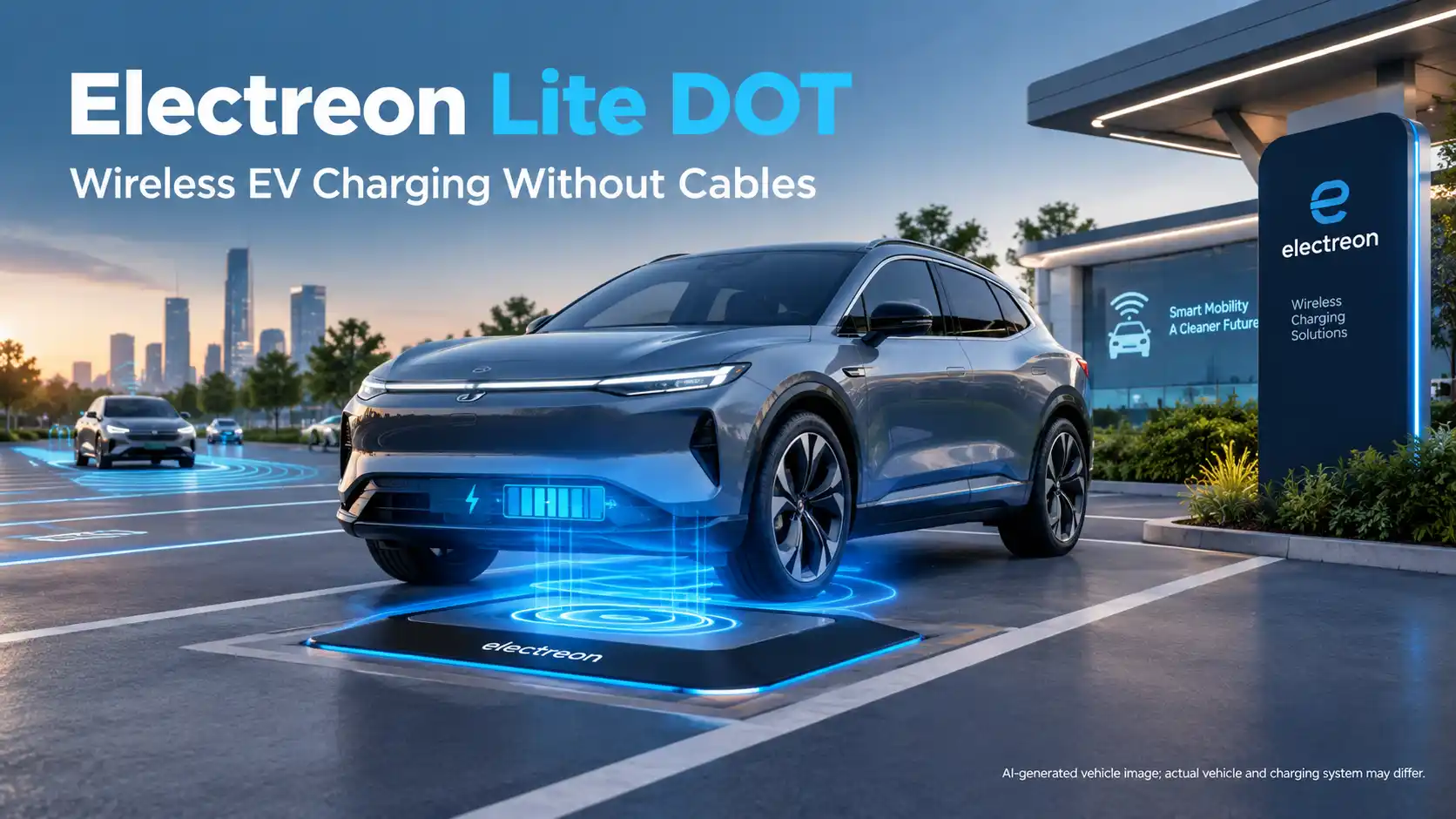
As electric vehicles (EVs) become more common, charging infrastructure is also evolving. Today, most EV drivers need to park at a charging station and physically connect a cable to the vehicle. Wireless EV charging technology aims to make this process more convenient by allowing an EV to charge without a traditional charging cable.
The basic idea is similar to wireless charging for a smartphone. A charging pad transfers electrical energy to a receiver installed underneath the vehicle. When a compatible EV is positioned over the charging pad, the system can transfer power to the vehicle’s battery without the driver plugging in a cable.
One of the latest developments in this area is Electreon’s Lite DOT, a stationary wireless charging system designed for passenger EVs and light commercial vehicles. Electreon says Lite DOT can provide up to 11 kW of wireless charging and is designed for above-ground installation without major excavation. The company showcased the technology around IAA Transportation 2026.
What Is Wireless EV Charging?
Wireless EV charging, also known as wireless power transfer, allows electricity to move from a charging system to an EV without a physical charging cable connecting the two.
The concept can be compared with a wireless smartphone charger.
Conventional EV Charging
Charging station → Cable → Vehicle → Battery
Wireless EV Charging
Charging pad → Electromagnetic power transfer → Vehicle receiver → Battery
The charging pad is installed on or near the parking surface, while a compatible receiver is installed underneath the EV.
When the vehicle is correctly positioned, the system transfers electrical energy wirelessly.
What Is Electreon’s Lite DOT?
Lite DOT is Electreon’s stationary wireless EV charging system.
The company designed it for applications where vehicles remain parked for a relatively long period, including homes, workplaces, parking facilities and commercial fleet locations.
According to Electreon, Lite DOT offers:
- Up to 11 kW wireless charging
- Above-ground installation
- No major digging or trenching
- Support for passenger EVs and light commercial vehicles
- Automatic charging
- Fleet and commercial parking applications
- Compatibility with vehicles equipped with the required wireless receiver
Electreon says the system is intended to make charging easier by removing the need to manually connect a charging cable.
However, Lite DOT is not yet commercially available, and Electreon says availability will be announced later.
How Does Wireless EV Charging Work?
Wireless EV charging requires several important components.
1. Charging Pad
A charging pad is installed in the parking area. It creates the electromagnetic field required for wireless energy transfer.
2. Vehicle Receiver
A compatible receiver is installed underneath the EV.
The receiver captures the energy from the charging pad and converts it into electrical power that can be delivered to the vehicle’s charging system.
3. Power and Control Equipment
The charging system also requires equipment that controls power delivery and communication between the vehicle and charging infrastructure.
4. Software
Software can monitor charging activity, system status and other operational information.
In simple terms:
Park the vehicle → System detects the vehicle → Wireless power transfer begins → Battery charges
The driver does not need to manually connect a cable.
What Does 11 kW Wireless Charging Mean?
Electreon’s Lite DOT is designed to provide up to 11 kW of wireless charging power.
This is not primarily designed to compete with the highest-power DC fast chargers that can charge an EV much faster.
Instead, the technology can be useful when a vehicle remains parked for a longer period.
For example:
- Overnight at home
- During working hours
- At a fleet depot
- At commercial parking facilities
- While delivery vehicles are waiting between trips
This makes wireless charging more about convenience and automation than simply maximizing charging speed.
Electreon says Lite DOT can achieve up to 90% efficiency under specified operating conditions.
Why Is a Physical Cable Not Required?
Wireless EV charging uses electromagnetic power transfer rather than a physical cable between the charging equipment and the vehicle.
The charging pad generates an electromagnetic field. A receiver mounted underneath the EV captures this energy and converts it into usable electrical power.
This is broadly similar to the principle used by wireless smartphone chargers, although EV charging systems operate at much higher power levels and require vehicle-scale hardware and safety controls.
Does the Vehicle Need to Be Parked Perfectly?
Vehicle positioning is an important consideration for wireless charging.
If the receiver underneath the vehicle is too far from the charging pad, power transfer can become less effective.
Modern wireless charging systems therefore use alignment technologies and are designed to provide some tolerance for imperfect parking.
Electreon says Lite DOT is designed with alignment tolerance, meaning the driver does not necessarily need to position the vehicle with millimeter-level precision.
This could become particularly important for autonomous vehicles, which could automatically position themselves over a charging pad.
Why Could Wireless Charging Be Important for Autonomous Vehicles?
Wireless charging becomes particularly interesting when combined with autonomous driving.
Consider a future robotaxi.
After dropping off a passenger, the autonomous EV could travel to a charging facility and park over a wireless charging pad.
The process could look like this:
Autonomous EV
↓
Automatically parks over charging pad
↓
Charging system detects vehicle
↓
Wireless charging starts
↓
Battery reaches required level
↓
Vehicle returns to operation
With conventional charging, an autonomous vehicle would potentially need a robotic mechanism to physically connect the charging cable.
Wireless charging could eliminate that step.
This makes the technology potentially useful for:
- Robotaxis
- Autonomous delivery vehicles
- Autonomous shuttle fleets
- Commercial EV fleets
- Future driverless logistics vehicles
Wireless Charging Is Not Limited to Parking
Wireless charging can also be used in a more advanced way known as dynamic wireless charging.
Instead of charging only when an EV is parked, wireless charging equipment can be installed beneath selected sections of a road.
An EV could then receive power while travelling over those sections.
Static Wireless Charging
Vehicle parked → Wireless pad → Battery charges
Dynamic Wireless Charging
Vehicle moving → Road-based charging system → Energy transferred to vehicle
Electreon has been developing both stationary and dynamic wireless charging technologies.
Dynamic charging could potentially reduce the need for long charging stops, but it requires substantially more infrastructure and investment than a conventional charging station.
Therefore, stationary wireless charging is currently a simpler application for everyday parking and fleet use.
Major Benefits of Wireless EV Charging
1. No Manual Cable Connection: Drivers do not have to take a cable out, connect it to the vehicle and disconnect it after charging.
2. More Convenient Charging: If an EV regularly parks in the same location, charging could happen automatically whenever the vehicle is parked.
3. Potentially Useful for Autonomous Vehicles: Driverless vehicles could charge without requiring a person or a separate robotic arm to plug in a cable.
4. Useful for Commercial Fleets: Delivery vans, taxis and other fleet vehicles often spend significant amounts of time parked. Wireless charging could use these periods to automatically replenish the battery.
5. Reduced Cable Handling: Wireless systems can reduce the need for drivers to handle heavy charging cables, particularly in commercial applications.
6. Flexible Installation: Electreon says Lite DOT is designed for above-ground installation and does not require major excavation or trenching.
Challenges Facing Wireless EV Charging
Despite its potential, wireless EV charging still faces several challenges.
Vehicle Compatibility
Not every EV currently supports wireless charging.
A compatible receiver and vehicle-side hardware are required.
Infrastructure Cost
Wireless charging infrastructure can require specialized charging pads, power electronics and vehicle receivers.
The overall cost needs to be competitive with conventional charging infrastructure for large-scale adoption.
Standardization
Different manufacturers need compatible systems and standards.
Industry standards are therefore important for ensuring that vehicles and charging infrastructure can work together reliably.
Charging Speed
An 11 kW wireless system can be useful for overnight or workplace charging, but it is not equivalent to the highest-power DC fast-charging systems.
Commercial Availability
New technologies must move from demonstrations and pilot projects to reliable mass-market products.
In the case of Lite DOT, Electreon has not yet announced commercial availability.
What Is the SAE J2954 Wireless Charging Standard?
Standardization is one of the most important factors in the development of wireless EV charging.
SAE J2954 is an industry standard covering wireless power transfer for light-duty plug-in and electric vehicles.
The standard addresses areas including:
- Interoperability
- Electromagnetic compatibility
- Electromagnetic field exposure
- Safety
- Performance
- Testing
- Vehicle-to-charger alignment
SAE’s J2954 specification includes wireless charging levels within its defined scope, with the current specification covering systems up to 11 kVA.
Standards such as J2954 can help create greater compatibility between vehicles and charging systems from different manufacturers.
Wireless Charging at IAA Transportation 2026
Wireless EV charging was also part of the broader electrification and charging-infrastructure discussion surrounding IAA Transportation 2026 in Hannover.
The event brought together companies working on electric vehicles, charging infrastructure, autonomous driving and commercial transportation technologies.
Electreon showcased its wireless charging technology and discussed applications ranging from stationary charging to more advanced charging concepts for commercial fleets.
This is significant because the future of EV charging is not limited to passenger cars. Commercial fleets and logistics vehicles could become important users of automated charging systems.
What Does Wireless Charging Mean for the EV Industry?
Wireless charging is not simply about removing a cable.
Its larger goal is to make EV charging more automated and integrated into everyday vehicle use.
Today, an EV owner has to think:
“I need to charge my car.”
A future wireless system could make charging almost invisible:
“I parked my car, and it automatically started charging.”
That difference could improve the convenience of EV ownership, especially for people who regularly park their vehicles in locations equipped with wireless charging.
Wireless Charging and the Future of Autonomous EVs
The combination of EVs, autonomous driving and wireless charging could create a new type of transportation infrastructure.
For example:
Autonomous EV
→ Automatically parks at charging location
→ Wireless charging starts
→ Battery reaches required level
→ Vehicle leaves automatically
→ Returns to passenger or fleet service
In such a system, human involvement in the charging process could be significantly reduced.
This is why wireless charging should not be viewed only as an EV charging technology. It could also become part of the infrastructure supporting future autonomous mobility.
Conclusion
Wireless EV charging is still developing, but the technology is moving beyond laboratory concepts toward practical applications.
Electreon’s Lite DOT is one example of this development. The stationary system is designed to provide up to 11 kW of wireless charging for compatible passenger EVs and light commercial vehicles. Electreon says it can be installed above ground without major excavation and can provide up to 90% efficiency under specified conditions.
However, wireless charging still faces challenges, including vehicle compatibility, infrastructure costs, standardization and commercial-scale deployment.
The technology could eventually develop across three major areas:
Stationary wireless charging → Automated fleet charging → Dynamic road charging
As autonomous EVs become more capable, automated charging could become increasingly important. Wireless charging therefore has the potential to make EV charging not only more convenient, but also more automated and integrated with the future of autonomous transportation.
Source: This article is based on Electreon’s official Lite DOT and IAA Transportation materials, SAE J2954 information and September 2026 industry reporting. Company-reported performance figures and future-use claims should be understood as company statements rather than independent test results. prnewswire