The autonomous-driving industry is entering a new phase in which artificial intelligence (AI), powerful onboard computers and advanced safety systems are being combined to help vehicles navigate complex real-world roads.
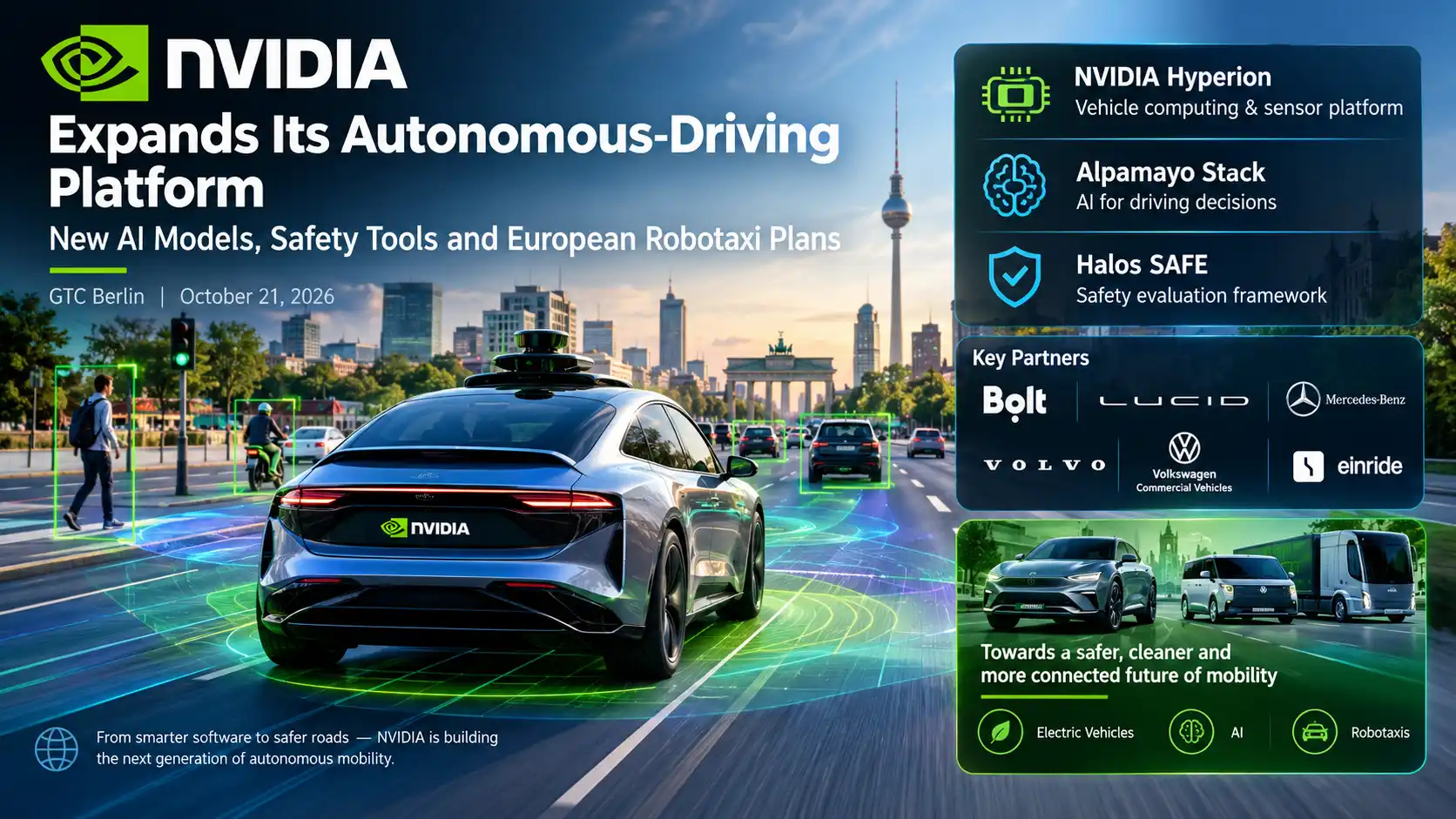
On October 21, 2026, NVIDIA announced a major expansion of its autonomous-driving technology platform at GTC Berlin, Germany.
The announcement includes new AI models, a safety-evaluation framework and expanded partnerships with automotive manufacturers and mobility companies. Partners such as Bolt, Lucid, Mercedes-Benz, Volvo Cars and Volkswagen Commercial Vehicles are exploring applications ranging from advanced driver assistance to Level 4 autonomous vehicles and robotaxis.
One of the most important developments is Bolt’s plan to begin collecting real-world driving data in Madrid in 2027, subject to regulatory approval, using future Lucid vehicles equipped with NVIDIA technology. These plans show how NVIDIA is positioning itself as a technology provider for the next generation of intelligent vehicles rather than simply a chip manufacturer.
Deal and Announcement Snapshot
| Detail | Information |
| Company | NVIDIA Corporation |
| Announcement date | October 21, 2026 |
| Event | GTC Berlin |
| Main technology platform | NVIDIA Hyperion |
| Autonomous-driving software | NVIDIA Alpamayo Stack |
| Safety framework | NVIDIA Halos SAFE |
| Key partners | Bolt, Lucid, Mercedes-Benz, Volvo Cars, Volkswagen Commercial Vehicles and Einride |
| Major planned milestone | Madrid real-world driving data collection in 2027 |
What Has NVIDIA Announced?
NVIDIA’s announcement covers three major areas: autonomous-driving computing, AI development tools and safety validation.
NVIDIA Hyperion: The computing platform
Hyperion provides a common computing and sensor architecture for autonomous vehicles. It is designed to help automakers integrate onboard computing, sensors and driving software into vehicles. It can support different manufacturers and autonomous-driving systems, reducing the need to develop an entirely separate technical architecture for every vehicle programme.
Alpamayo Stack: AI for driving decisions
Alpamayo Stack combines reasoning-based AI with conventional perception and motion-planning software. The aim is to help autonomous vehicles interpret complicated traffic situations, assess possible actions and plan appropriate movements while using additional safety mechanisms.
Halos SAFE: Testing autonomous-driving safety
NVIDIA introduced Halos SAFE, short for Safety Assurance Framework for Evaluation. It connects simulation, software and hardware testing, on-road evaluation and fleet monitoring to help developers produce measurable, traceable evidence about how their systems perform.
These technologies address different problems. Hyperion provides the vehicle-computing foundation, Alpamayo helps power the driving software, and Halos SAFE supports safety evaluation. They are complementary parts of NVIDIA’s broader autonomous-driving ecosystem.
NVIDIA Introduces Alpamayo 2 Edge AI Model
One of the key technical announcements is Alpamayo 2 Edge, a reasoning model with 2 billion parameters designed for in-vehicle autonomous-driving applications.
According to NVIDIA, it is optimized for the NVIDIA DRIVE AGX Thor computing platform and designed to run at 10 Hz for scene understanding and motion planning.
How does it work?
Imagine an autonomous car approaching a busy intersection. A pedestrian is standing near a crossing, a motorcycle is approaching from the side and the traffic signal is changing. The vehicle needs to do more than identify objects in a camera image. It must estimate what those objects might do, assess the available space and choose a safe movement.
- Scene understanding: AI analyses camera and other available sensor information to interpret the road, vehicles, pedestrians and surrounding conditions.
- Reasoning and planning: The driving system evaluates possible actions and develops a suitable driving plan.
- Vehicle control: The broader autonomous-driving system uses the resulting plan to control acceleration, braking and steering, subject to its safety architecture.
The model is intended to help with the first two stages. It does not independently guarantee that a vehicle can drive safely in every situation.
Why is this important?
Traditional automated-driving systems often depend on multiple components working together, including object detection, prediction and motion planning. Reasoning-based AI may help systems handle unfamiliar or complicated situations more effectively. However, improved reasoning does not eliminate the need for extensive testing. Performance depends on the complete vehicle system, its sensors, software, operating conditions and safety validation.
Halos SAFE: A New Approach to Autonomous-Vehicle Safety
A self-driving vehicle must demonstrate that it can operate safely across a wide range of road conditions. Testing it only on a few familiar roads is not sufficient. For example, a vehicle may perform well on a sunny highway but face difficulties in heavy rain, construction zones, unusual road markings or unpredictable pedestrian movements.
NVIDIA’s Halos SAFE framework is intended to make the evaluation process more systematic. It combines:
- Simulation: Testing virtual driving scenarios before exposing a vehicle to them on public roads.
- Software-in-the-loop testing: Evaluating driving software in a simulated technical environment.
- Hardware-in-the-loop testing: Testing vehicle computing hardware alongside simulated inputs and conditions.
- On-road testing: Checking how the system performs in real traffic.
- Fleet monitoring: Analysing performance after vehicles enter testing or deployment programmes.
The framework aims to link these activities through defined scenarios, tests and performance criteria so developers can build traceable safety evidence. NVIDIA also identified dSPACE, IVEX and TÜV Rheinland as collaborators on evaluation workflows. Other participants in the broader Halos SAFE ecosystem include JLR, Mercedes-Benz, Volvo Cars, AVL, Foretellix and Synopsys.
Important distinction: Halos SAFE is a safety-evaluation framework, not an automatic certification that every vehicle using NVIDIA technology is safe or approved for driverless operation.
Bolt and Lucid Plan a European Robotaxi Programme
One of the most significant commercial developments concerns the partnership between Bolt, Lucid and NVIDIA.
Lucid: The vehicle platform
Lucid Group develops premium electric vehicles. Future Lucid vehicles are intended to provide the vehicle platform for Bolt’s planned autonomous ride-hailing programme using NVIDIA technology.
Bolt: The mobility and fleet platform
Bolt will contribute ride-hailing operations, fleet management and local market expertise. It will work with NVIDIA to adapt the driving software for European roads and integrate it into vehicles from multiple manufacturers.
What is the timeline?
- 2027: Bolt plans to begin collecting real-world driving data in Madrid, subject to regulatory approval.
- Future European deployment: Germany is identified as a priority market, with France also named as a key market in Bolt’s announcement.
- Long-term ambition: The programme lays the groundwork for at least 25,000 Level 4-capable future Lucid vehicles equipped with NVIDIA Hyperion. Bolt separately targets 100,000 autonomous vehicles on its platform across Europe and the wider UNECE region by 2035.
These are programme plans and targets, not evidence that 25,000 driverless vehicles have already been manufactured or deployed.
How could this service work?
A customer could request a ride through an app. A fleet operator would assign an available robotaxi, which would navigate the permitted route using its onboard autonomous-driving system. The operator would manage fleet availability, customer bookings and service operations. The exact operating conditions, driverless permissions and rollout schedule would depend on vehicle readiness and regulatory approval.
Mercedes-Benz, Volvo and Volkswagen Expand Their Programmes
Mercedes-Benz
Mercedes-Benz is extending its collaboration with NVIDIA to support the development of Level 3 and Level 4 capabilities. NVIDIA also said that MB.DRIVE ASSIST PRO, developed with NVIDIA, was expected to receive approval for urban point-to-point driver assistance in Germany. This driver-assistance system should not be confused with a fully driverless Level 4 robotaxi.
Volvo Cars
Volvo is adopting Hyperion and Alpamayo Stack alongside NVIDIA’s safety technologies. The objective is to combine Volvo’s vehicle safety engineering with AI-driven automated driving for future vehicles.
Volkswagen Commercial Vehicles
Volkswagen is presenting its autonomous ID. Buzz AD vehicle platform with Hyperion. The shared computing and sensor architecture is intended to simplify integration and validation for different autonomous-driving systems.
Einride
Einride is developing its next-generation autonomous freight-driving system using Hyperion, Halos, Alpamayo and NVIDIA Cosmos technologies. The application focuses on autonomous goods transportation rather than passenger robotaxis.
The range of partners is important because it shows that autonomous-driving technology is being developed for passenger cars, ride-hailing fleets, commercial vehicles and freight transportation.
Other AI Tools Announced by NVIDIA
| Technology | Purpose |
| AlpaJudge | Evaluates driving explanations and helps identify weak training annotations. |
| Foundation4D | Supports labelling multicamera video without requiring lidar input for that labelling workflow. |
| Cosmos 3 Nano variants | Expand synthetic-data generation and closed-loop simulation for driving scenarios. |
| Cosmos Data Factory | Helps turn driving video and vehicle signals into curated, searchable and labelled datasets. |
| Alpamayo Agentic Factory | A development blueprint connecting data preparation, model post-training and simulation evaluation; expected in early 2027. |
| NVIDIA NIM microservices | Provide optimised inference deployment for specified AI models and scene-processing workflows. |
Why does synthetic data matter?
Autonomous vehicles need to learn from many driving situations, including rare events that may be dangerous or difficult to collect in real life.
For example, developers might need to test how a vehicle responds to an unexpected obstacle emerging from behind a parked van. Simulation and synthetic data can help create many variations of this event, allowing engineers to examine the system’s responses. Synthetic scenarios complement real-world testing; they do not replace it.
What Are Level 3 and Level 4 Autonomous Vehicles?
| Feature | Level 3 automation | Level 4 automation |
| Driving task | Vehicle can drive under defined conditions | Vehicle can drive under defined conditions |
| Human responsibility | Driver must be able to respond to a takeover request | No human driver is required within the system’s defined operating conditions |
| Operating range | Restricted to supported conditions | Restricted to a defined operational design domain |
| Typical application | Advanced automated driving on supported roads | Driverless robotaxis or specified autonomous transport services |
Level 4 does not mean a vehicle can drive anywhere, in every weather condition, on every road. Its capabilities remain bounded by its approved or designed operating conditions. This is why safety validation, vehicle integration and regulatory approval are essential to the commercial rollout of autonomous transportation.
Challenges NVIDIA and Its Partners Still Need to Overcome
- Safety: Systems must respond reliably to pedestrians, unpredictable drivers, roadworks and unusual situations.
- Regulatory approval: Rules and permission requirements differ between countries and sometimes between cities.
- Cost: Sensors, computing hardware, testing and maintenance can make autonomous vehicles more expensive than conventional cars.
- Software reliability: An AI model’s performance in a demonstration does not prove that the complete vehicle can handle every real-world scenario.
- Public trust: Passengers and regulators need credible evidence that vehicles can operate safely and respond appropriately when something goes wrong.
- Commercial viability: Robotaxi businesses must show that vehicle utilisation and operating revenue can justify the cost of running and maintaining the fleet.
NVIDIA’s new development and evaluation tools address some of these technical challenges, but they cannot independently resolve every regulatory, operational or commercial issue.
Conclusion
NVIDIA’s October 21, 2026 announcement at GTC Berlin represents a broad expansion of its autonomous-driving ecosystem. Hyperion provides a common computing and sensor architecture, Alpamayo Stack supports AI-based driving software, and Halos SAFE aims to make safety evaluation more systematic. New models and development tools are intended to help partners train, test and deploy autonomous-driving systems.
The planned Bolt–Lucid programme is a particularly notable development, with real-world driving-data collection in Madrid targeted for 2027, subject to regulatory approval. However, the announcement should be understood as a combination of technology releases, partnerships and future deployment plans—not as proof that large-scale driverless operations are already available across Europe.
For the automotive industry, the bigger story is the growing integration of AI, electric vehicles, automated driving and mobility services.
Source: Nvidia news, globenewswire,