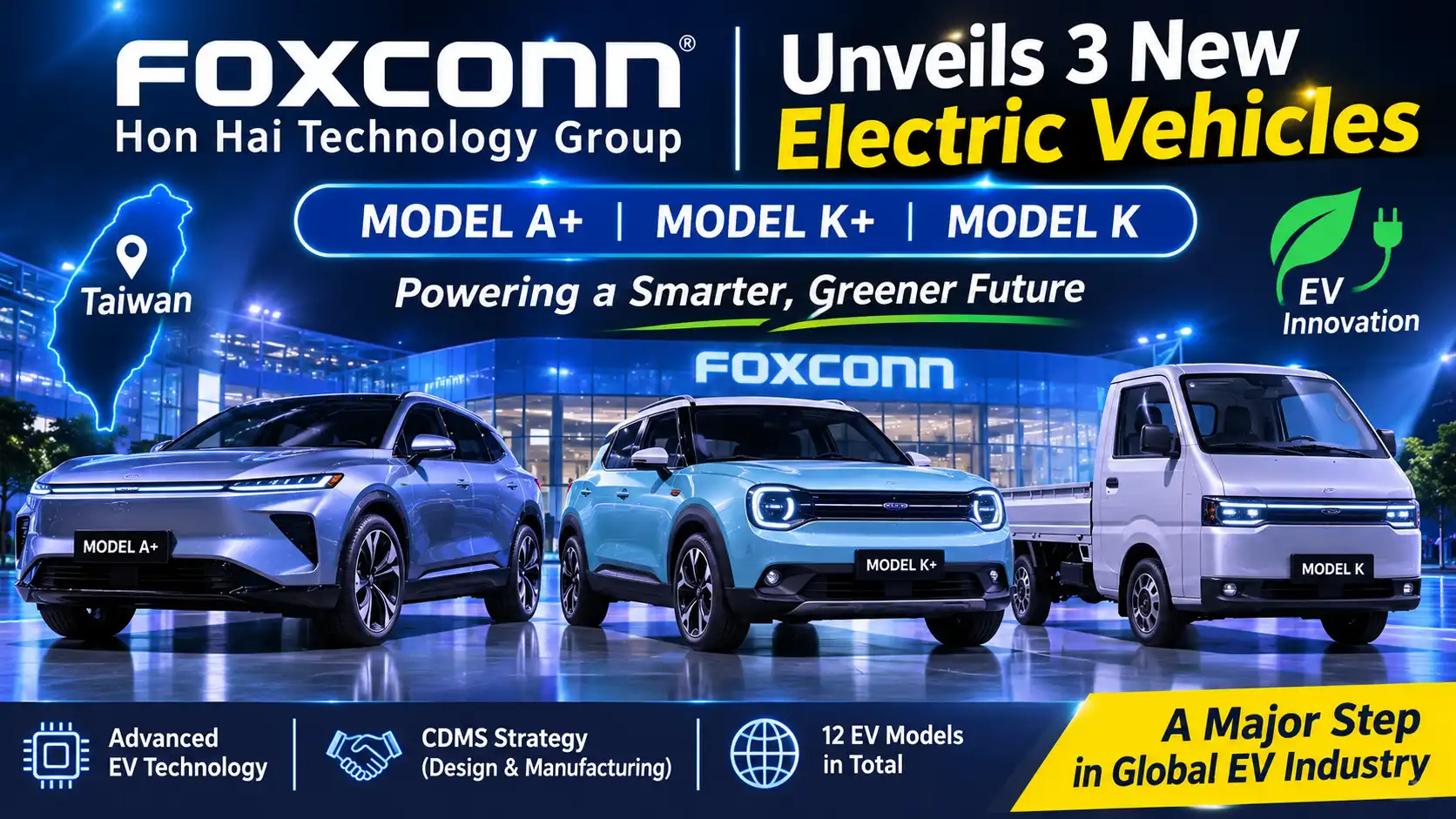
Foxconn, one of the world’s leading electronics manufacturing companies, is expanding its business into the electric vehicle (EV) industry. The company aims to become more than an electronics manufacturer by providing electric vehicle design, engineering and manufacturing services to other automobile companies.
On October 30, 2026, Foxconn introduced three new electric vehicle reference models at its HHTD26 technology event. The models are named MODEL A+, MODEL K+ and MODEL K.
Each vehicle has been designed for a different market segment. MODEL A+ is a B-segment SUV, MODEL K+ is a lifestyle-focused electric SUV, while MODEL K is a compact electric commercial truck.
The announcement is important because Foxconn is strengthening its position as a potential manufacturing and technology partner for global automobile companies. Instead of focusing only on selling vehicles under its own brand, the company wants to help other manufacturers develop and produce electric vehicles.
Let’s understand these three models, their technologies and what Foxconn’s latest announcement means for the global EV industry.
Introduction to Foxconn
Foxconn, officially known as Hon Hai Technology Group, is a Taiwanese technology and electronics manufacturing company founded in 1974.
It is one of the world’s largest electronics contract manufacturers and plays an important role in the global supply chain for major technology companies, including Apple.
Foxconn manufactures electronic products and components for several international brands. Over the years, the company has also started expanding into new technology sectors.
Its major business areas include:
- Electric Vehicles (EVs)
- Battery Technology
- Automotive Electronics
- Artificial Intelligence and Smart Manufacturing
- Electric Vehicle Platforms
- Electric Buses and Commercial Vehicles
Foxconn’s strategy is different from that of traditional automobile manufacturers. Rather than depending entirely on selling vehicles under its own brand, it wants to provide EV technology and manufacturing services to other automotive companies.
This approach could help automobile manufacturers enter the EV market without developing every technology and manufacturing facility from scratch.
What Did Foxconn Announce at HHTD26?
Foxconn organized its annual technology event, Hon Hai Tech Day 2026 (HHTD26), in Taipei, Taiwan.
During the event, the company introduced three new electric vehicle reference models:
- MODEL A+ – B-Segment SUV
- MODEL K+ – Lifestyle Electric SUV
- MODEL K – Compact Electric Truck
These vehicles have been developed for different customer requirements and market segments.
With the introduction of these three models, Foxconn’s electric vehicle reference portfolio has expanded to a total of 12 models.
It is important to understand that these are reference vehicles, not necessarily production-ready vehicles available for public purchase. Foxconn uses such models to demonstrate its vehicle design, engineering and manufacturing capabilities to potential automotive partners.
MODEL A+ – Premium Electric SUV
Foxconn’s first new model is the MODEL A+, which belongs to the B-Segment SUV category.
B-Segment SUVs are generally compact vehicles that offer a combination of passenger space, practical design and SUV-like functionality.
The MODEL A+ has been developed for customers looking for a premium design and a more flexible interior space.
Key Features of MODEL A+
1. In-Wheel Motor Technology
One of the important technologies associated with the MODEL A+ is In-Wheel Motor Technology.
In conventional electric vehicles, the electric motor is generally installed near the vehicle’s axle or elsewhere within the drivetrain.
However, in an in-wheel motor system, the electric motor is installed directly inside the wheel.
This technology can offer several potential advantages:
- Reduced need for conventional drivetrain components.
- More flexibility in vehicle design.
- Independent control of individual wheels.
- Opportunities to improve the use of interior space.
However, Foxconn has not yet disclosed the motor power, performance figures or actual efficiency specifications of this model.
2. Selectable EEA Technology
The MODEL A+ also features Selectable EEA technology.
EEA stands for Electrical and Electronic Architecture.
In simple terms, EEA refers to the way different electronic systems inside a vehicle are connected and communicate with each other.
These systems include:
- Battery management systems
- Electric motor controllers
- Sensors
- Digital displays
- Electronic control units
- Driver assistance systems
Selectable EEA allows greater flexibility in configuring the vehicle’s electronic architecture according to customer requirements.
For example, an automobile manufacturer using Foxconn’s platform may be able to integrate its preferred electronic systems and features into the vehicle.
3. Emergency and Outdoor Applications
Another interesting aspect of the MODEL A+ is its focus on flexible interior space and backup power capabilities.
Foxconn has highlighted its potential usefulness in different situations, including:
- Emergency situations such as floods.
- Temporary accommodation.
- Camping and outdoor activities.
- Backup electricity for outdoor applications.
For example, people visiting remote camping locations may benefit from a vehicle capable of supplying electricity to external devices.
However, Foxconn has not yet disclosed specific technical figures such as backup power capacity or flood-wading depth.
MODEL K+ – Affordable Lifestyle Electric SUV
Foxconn’s second model is the MODEL K+, an electric SUV designed around lifestyle requirements and younger customers.
Its design takes inspiration from Japan’s City Pop culture of the 1970s and 1980s.
City Pop was a popular Japanese music and cultural movement known for its distinctive visual style and urban lifestyle influences.
Foxconn has attempted to combine this retro-inspired design approach with modern electric vehicle technology.
Key Features of MODEL K+
1. Youth-Focused Design
The MODEL K+ has been designed to offer a different appearance compared with conventional SUVs.
The company wants to attract customers who prefer distinctive vehicle styling and personalized design options.
Its exterior and interior can be customized according to different customer requirements.
2. In-Wheel Motor Technology
Like the MODEL A+, the MODEL K+ also incorporates In-Wheel Motor Technology.
This technology could provide more flexibility in vehicle packaging and drivetrain design.
It may also allow different automobile manufacturers to develop their own vehicle designs using the same underlying platform.
3. Customizable Driving Range
Another important feature of the MODEL K+ is the possibility of customizing its driving range according to different market requirements.
For example:
- One manufacturer may develop a version primarily intended for city driving.
- Another manufacturer may prefer a longer-range version for customers who frequently travel longer distances.
4. Opportunities for Other Automobile Manufacturers
The MODEL K+ is not necessarily intended to be sold only under Foxconn’s own brand.
The company wants other automobile manufacturers to use its platform to develop their own electric SUVs.
For example, an automotive company could use the MODEL K+ platform as a foundation, then introduce its own branding, interior design and customer-focused features.
This approach could reduce the time and resources required to develop a completely new EV platform.
MODEL K – Compact Electric Commercial Truck
Foxconn’s third model is the MODEL K, a compact electric commercial truck designed primarily for transportation and business applications.
One of its most interesting characteristics is its focus on Japan’s Kei-class truck segment.
What Is a Kei Truck?
In Japan, Kei vehicles are small automobiles designed to meet specific size and engine regulations.
Kei trucks are particularly popular among small businesses, farmers and delivery operators because of their compact dimensions and practical cargo-carrying capabilities.
Foxconn has designed the MODEL K with similar market requirements in mind.
Key Features of MODEL K
1. Last-Mile Delivery Applications
One of the major potential applications of the MODEL K is last-mile delivery.
Last-mile delivery refers to transporting products from a warehouse or distribution center to the final customer.
Examples include:
- Grocery deliveries
- Parcel and courier services
- Deliveries for small businesses
- Urban commercial transportation
Because of its compact design, the MODEL K could be suitable for operating in crowded urban areas and narrow streets.
2. Lower Loading Height
Foxconn has highlighted the MODEL K’s lower cargo-bed height.
This feature can make it easier for drivers and delivery workers to load and unload goods.
For example, businesses that transport packages or other materials several times a day could benefit from a lower loading platform.
3. Longer Cargo Bed
The company has also focused on providing a longer cargo bed.
A longer cargo area could help businesses carry more goods while maintaining a relatively compact vehicle design.
4. Canopy-Ready Design
The MODEL K also features a canopy-ready design.
A canopy is a protective covering installed over the cargo area of a truck.
It can help protect goods from sunlight, rain and other environmental conditions.
Businesses could install suitable coverings depending on their transportation requirements.
5. Potentially Lower Operating Costs
Since the MODEL K is an electric commercial vehicle, it does not require a conventional petrol or diesel engine.
This could reduce fuel expenses compared with traditional commercial trucks.
Electric motors also contain fewer moving mechanical components than conventional internal combustion engines, which may help reduce certain maintenance requirements.
However, actual savings will depend on electricity prices, battery costs, vehicle usage and maintenance expenses.
Foxconn sees potential applications for this model among small businesses, municipalities and government organizations.
What Is Foxconn’s CDMS Strategy?
One of the most important reasons behind Foxconn’s latest EV announcement is its CDMS strategy.
CDMS stands for Contract Design and Manufacturing Services.
In simple terms, it means that Foxconn can help another company design and manufacture products instead of that company developing the entire production system independently.
The same concept can be applied to electric vehicles.
Suppose a new automobile company wants to introduce an electric SUV but does not have its own EV platform, engineering infrastructure or manufacturing facilities.
It may partner with Foxconn to obtain assistance with several aspects of vehicle development.
Foxconn could potentially provide:
- Electric vehicle design and engineering.
- EV platforms and underlying technologies.
- Battery and motor integration support.
- Electronic systems and vehicle architecture.
- Manufacturing and production services.
For example, an automobile company could use a Foxconn EV platform to develop its own electric SUV.
The manufacturer could then customize the vehicle according to its brand identity, preferred features and target customers.
This business model could reduce the need for the automobile company to develop every EV technology independently.
Foxconn would operate as a technology and manufacturing partner, while the automotive company could focus on branding, distribution and customer relationships.
This is a major part of Foxconn’s long-term electric vehicle strategy.
Foxconn Now Has 12 EV Reference Models
Following the introduction of MODEL A+, MODEL K+ and MODEL K, Foxconn’s electric vehicle reference portfolio has expanded to 12 models.
| Model | Vehicle Category |
| MODEL T | Large Electric Bus |
| MODEL C | Passenger SUV |
| MODEL E | Luxury Sedan |
| MODEL B | Crossover SUV |
| MODEL V | Electric Truck |
| MODEL N | Cargo Van |
| MODEL D | LMUV |
| MODEL U | Midi-Bus |
| MODEL A | Modular B-Segment Vehicle |
| MODEL A+ | B-Segment SUV |
| MODEL K+ | Lifestyle SUV |
| MODEL K | Compact Electric Truck |
This portfolio demonstrates that Foxconn is not focusing exclusively on passenger electric cars.
The company is also developing solutions for buses, trucks, vans and smaller commercial vehicles.
By offering different vehicle platforms, Foxconn could potentially serve several segments of the global electric mobility market.
Battery and Other EV Technologies Showcased at HHTD26
At HHTD26, Foxconn also demonstrated technologies related to its wider electric mobility ecosystem.
The event was not limited to the presentation of three new vehicle models.
The company highlighted several areas of its EV technology development.
1. Battery Technology
Foxconn showcased capabilities related to battery materials, battery cells and battery packs.
These technologies are important because batteries are among the most expensive and essential components of an electric vehicle.
Developing capabilities across different stages of the battery supply chain could help Foxconn strengthen its position in the EV industry.
2. Battery Management System (BMS)
A Battery Management System is an electronic system that monitors and manages the performance of an EV battery.
It helps monitor important parameters such as:
- Battery voltage
- Temperature
- Charging and discharging
- Battery operating conditions
A properly designed BMS can help improve battery safety, reliability and performance.
3. Electrical and Electronic Architecture
Foxconn also highlighted its Electrical and Electronic Architecture technologies.
Modern electric vehicles contain numerous electronic components, sensors and control systems.
A well-designed architecture allows these systems to communicate and operate together efficiently.
This technology is becoming increasingly important as vehicles incorporate more software, connectivity and advanced driver assistance features.
4. E2W and E3W Powertrains
Foxconn also showcased powertrain technologies for electric two-wheelers (E2W) and electric three-wheelers (E3W).
This indicates that the company’s electric mobility ambitions extend beyond passenger cars and larger commercial vehicles.
Smaller electric vehicles could provide additional opportunities in markets where two-wheelers and three-wheelers play an important role in daily transportation.
How Could Foxconn’s EV Strategy Benefit Other Automobile Companies?
Foxconn’s strategy could introduce new opportunities for automobile manufacturers looking to enter or expand in the electric vehicle market.
Developing an electric vehicle independently requires significant investment in engineering, batteries, motors, software and manufacturing infrastructure.
A company such as Foxconn could help reduce some of these development requirements by providing existing technologies and manufacturing capabilities.
Potential benefits include:
1. Reduced Development Time
Automobile companies could use existing EV platforms instead of developing every component from the beginning.
2. Lower Initial Investment
Using an established technology and manufacturing partner could reduce the need for certain infrastructure investments.
3. Customization Opportunities
Different manufacturers could customize vehicles according to their branding and target customers.
4. Manufacturing Support
Foxconn’s manufacturing experience could help automobile companies establish production capabilities.
5. Expansion Across Different Vehicle Segments
Manufacturers could potentially use Foxconn’s platforms to develop SUVs, trucks, buses and delivery vehicles.
However, these benefits will depend on actual partnerships, commercial agreements and the successful implementation of Foxconn’s manufacturing strategy.
What Challenges Could Foxconn Face in the EV Industry?
Although Foxconn has extensive electronics manufacturing experience, the automobile industry has different requirements.
The company will need to overcome several challenges before establishing a strong position in the global EV market.
1. Building Partnerships with Automobile Companies
Foxconn needs automobile manufacturers willing to adopt its EV platforms and enter into large-scale production agreements.
Introducing reference vehicles alone will not guarantee commercial success.
2. Production and Quality Control
Vehicle safety is extremely important.
Foxconn will need to maintain high standards across battery systems, braking components, software, electronics and other vehicle technologies.
3. Competition
The EV manufacturing industry already includes several established automobile manufacturers and technology companies.
Foxconn will need to demonstrate competitive technology, manufacturing efficiency and pricing.
4. Commercial Success
The real test will be whether these reference models lead to actual manufacturing contracts and commercially successful vehicles.
5. Production Timelines
As of October 31, 2026, Foxconn has not announced confirmed commercial production dates, retail prices or customer delivery schedules for these three models.
Therefore, their actual market availability remains uncertain.
What Could Be the Future of Foxconn’s New EV Models?
Foxconn’s three new models target different opportunities in the electric mobility market.
- MODEL A+: Could provide a platform for premium B-segment electric SUVs.
- MODEL K+: Could support the development of lifestyle-focused electric SUVs.
- MODEL K: Could find applications in commercial transportation and last-mile delivery.
MODEL K is particularly interesting because electric commercial vehicles could be useful for businesses that operate vehicles regularly.
If Foxconn can offer competitive manufacturing costs, reliable technology and practical vehicle platforms, it could attract more automotive companies.
However, the long-term success of these models will depend on commercial partnerships, production capabilities and actual market demand.
Conclusion
Foxconn’s introduction of MODEL A+, MODEL K+ and MODEL K represents another important step in the company’s electric vehicle strategy.
Through these three models, Foxconn has demonstrated its interest in different EV segments, including lifestyle SUVs, premium compact SUVs and commercial electric trucks.
The most important aspect of this announcement is not simply that Foxconn has introduced three new electric vehicles. It is that the company is attempting to strengthen its position as a global EV design and manufacturing partner.
If Foxconn successfully secures major automotive manufacturing contracts through its CDMS business model, it could become an increasingly important participant in the global electric vehicle supply chain.
The next important developments to watch will be production agreements, manufacturing timelines, customer partnerships and the commercial launch of vehicles based on these platforms.
Research Note: The three models are reference vehicles, not confirmed commercially launched production vehicles. As of October 31, 2026, specific retail prices, battery capacities, driving ranges and production dates have not been officially disclosed.
Disclaimer: This article is intended for informational and educational purposes only. It does not constitute investment advice or a recommendation to buy or sell any stock.
Source: Foxconn press