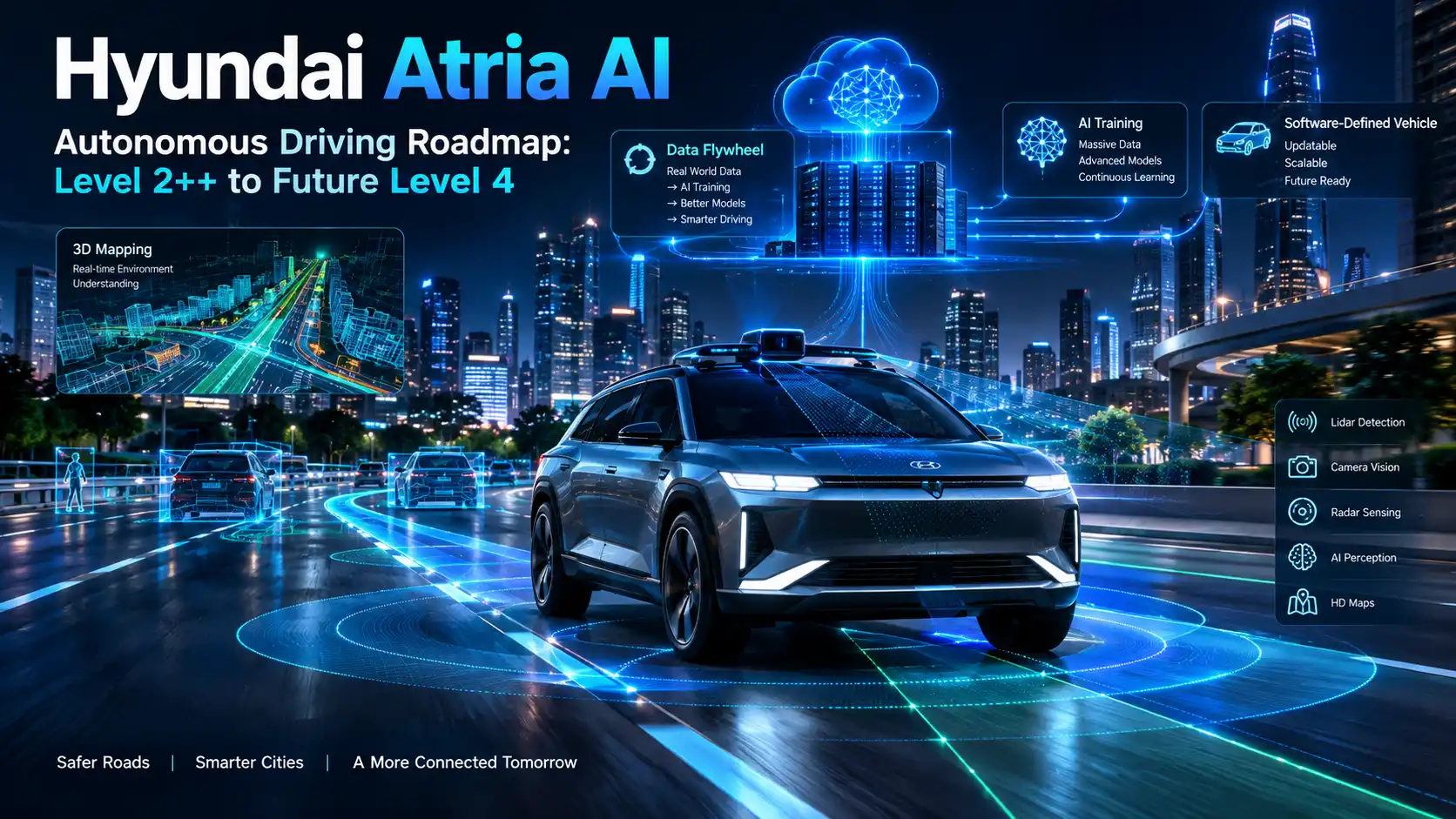
The race for autonomous driving is no longer only about sensors, cameras, and computing power. One of the most important factors is now how effectively a company can collect real-world driving data, use that data to train AI, and deploy improved software in vehicles.
Hyundai Motor Group is moving in this direction with Atria AI, its proprietary autonomous-driving technology.
In September 2026, Hyundai Motor Group provided more details about its autonomous-driving roadmap. The company said it is working with NVIDIA to bring Level 2+ and Level 2++ autonomous-driving systems to production vehicles from 2028. At the same time, Hyundai is developing its own Atria AI technology.
According to Hyundai, the target is to introduce Atria AI-powered Level 2++ production vehicles in the second half of 2029. The company plans to develop the technology further and eventually extend it toward higher levels of autonomous driving.
What Is Atria AI?
Atria AI is Hyundai Motor Group’s proprietary autonomous-driving AI technology, being developed by the Group’s Advanced Vehicle Platform Division together with its software company 42dot.
In simple terms, Atria AI is designed to help a vehicle understand its surroundings, interpret different road situations, and make driving decisions using AI.
In September 2026, Hyundai demonstrated an Atria AI-equipped Software-Defined Vehicle (SDV) testbed. According to the company, the vehicle demonstrated autonomous driving in complex urban traffic without driver intervention during the demonstration.
However, this does not mean Hyundai’s consumer vehicles are already fully driverless. Level 2++ systems still require the driver to supervise the vehicle.
Why Is Hyundai Developing Atria AI?
Autonomous driving requires much more than a powerful AI model.
A vehicle has to deal with thousands of different situations, such as:
- Pedestrians suddenly entering the road
- Construction zones
- Different road conditions
- Unexpected lane changes
- Parked vehicles
- Narrow roads
- Bad weather
- Heavy urban traffic
- Emergency situations
The more real-world driving situations an AI system can learn from, the more opportunities there are to improve its training and validation.
Hyundai is using a Data Flywheel strategy to support this process.
What Is Hyundai’s Data Flywheel?
The Data Flywheel can be understood as a continuous learning cycle.
The basic process is:
Vehicle Data → AI Training → Testing & Validation → Better AI → Vehicle Deployment → New Data
In this system, driving data is collected from vehicles. That data can be used to train AI models. The improved models are then tested and validated before being deployed. Once the technology is used in vehicles, new real-world data can feed back into the development process.
This creates a continuous improvement cycle.
Hyundai said in September 2026 that its Data Flywheel is now in full operation and is becoming a central part of its autonomous-driving development strategy.
Why Is Hyundai’s Large Vehicle Fleet Important?
Hyundai Motor Group says Hyundai and Kia together sell more than 7 million vehicles annually and operate across approximately 190 countries and regions.
Such a large global vehicle footprint could provide a significant source of real-world driving information for autonomous-driving development.
However, this does not mean every vehicle sold by Hyundai and Kia automatically becomes an autonomous-driving data-collection vehicle. Instead, Hyundai is developing systems to identify, collect, and analyse useful driving situations for AI development.
Hard Example Mining: Teaching AI Difficult Situations
Another important part of Hyundai’s Data Flywheel is Hard Example Mining.
The goal is to identify driving situations that are particularly difficult for an autonomous system to understand.
For example, an AI system may have difficulty interpreting an unusual road situation. Such an example can then become valuable training data for future AI models.
This approach can help autonomous systems learn not only from normal driving situations but also from unusual and difficult scenarios.
What Is the Continuous Training Pipeline?
Autonomous-driving AI cannot simply be trained once and then considered permanently complete.
Road environments, traffic patterns, vehicles, and driving situations constantly change.
Hyundai’s Continuous Training Pipeline is designed to bring new data from real-world driving and validation back into the AI development process.
The goal is to make AI development a continuous process in which models can be improved using new information and driving situations.
Virtual Validation for Difficult Driving Situations
Testing every autonomous-driving scenario on public roads is not practical or safe.
For this reason, Hyundai is also using virtual validation technologies.
According to Hyundai, real-world driving data can be reconstructed in 3D environments. This allows difficult or potentially dangerous situations to be recreated virtually and used for testing.
For example, a complex traffic situation can be recreated in a simulated environment to test how an autonomous-driving system responds.
This can reduce the need to reproduce every difficult situation on public roads.
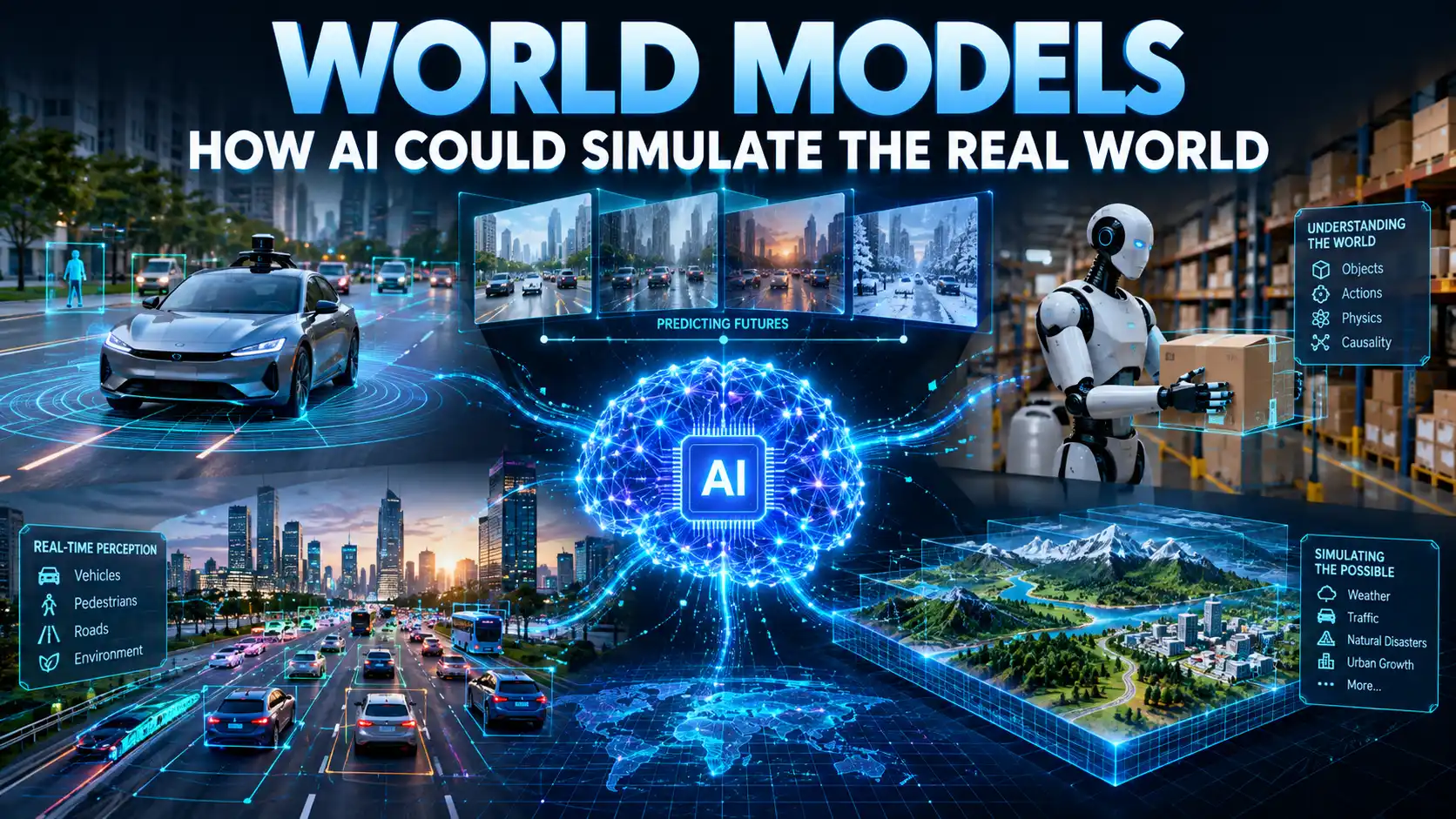
Also Read : World Models: The Next Big AI Technology and How It Could Understand the Real World
Atria AI and Vision-Language-Action Technology
Another interesting area of Hyundai’s autonomous-driving research is Vision-Language-Action (VLA) technology.
Traditional autonomous-driving systems mainly use cameras, sensors, and AI models to detect and interpret the surrounding environment.
VLA technology combines visual information with language-based reasoning.
Hyundai’s software company 42dot is researching this approach to help autonomous systems better understand and reason about complicated situations.
According to Hyundai, VLA research is also being used to address edge cases—unusual situations that are difficult for autonomous systems to handle. The company is developing end-to-end autonomous-driving and VLA models in parallel.
Hyundai’s Autonomous Driving Roadmap
Hyundai has now provided a clearer timeline for its autonomous-driving development.
| Timeline | Technology / Target |
| 2026 | Continued Atria AI and autonomous-driving development; preparation for a real-world Level 4 pilot in Gwangju |
| H1 2028 | Target for NVIDIA-based Level 2+ production vehicles |
| H2 2028 | Target for NVIDIA-based Level 2++ production vehicles |
| H2 2029 | Target for Atria AI-powered Level 2++ production vehicles |
| Future | Expansion of Atria AI toward higher levels of autonomous driving, including Level 4 |
These production milestones were included in Hyundai Motor Group’s September 2026 announcement.
Why Is NVIDIA Important to Hyundai’s 2028 Strategy?
Hyundai is not attempting to immediately bring its entire autonomous-driving technology stack to production on its own.
Instead, the company is following a dual-track strategy.
On one track, Hyundai is working with NVIDIA and plans to use NVIDIA’s autonomous-driving technology ecosystem to introduce Level 2+ and Level 2++ systems into production vehicles.
On the second track, Hyundai is developing and increasingly internalising its own proprietary Atria AI technology.
In March 2026, Hyundai Motor, Kia, and NVIDIA expanded their strategic partnership for scalable autonomous-driving architecture covering technologies from Level 2 to Level 4.
This approach could allow Hyundai to accelerate the introduction of advanced driver-assistance technology while continuing to develop its own AI platform for future vehicles.
Why Is 2029 Important for Atria AI?
The second half of 2029 is an important milestone in Hyundai’s roadmap.
The company has set a target to introduce Atria AI-powered Level 2++ production vehicles during this period.
This means Atria AI is not being positioned only as a research project. Hyundai is working toward using the technology in production vehicles.
However, it is important to understand that this does not mean Hyundai plans to launch a fully driverless Level 4 passenger vehicle in 2029.
The announced 2029 production milestone is specifically for Level 2++.
What Is the Difference Between Level 2++, Level 3 and Level 4?
Understanding autonomous-driving levels is important when looking at Hyundai’s roadmap.
Level 2+
The vehicle can assist with several driving functions, including steering, acceleration, and braking. However, the driver must continue to monitor the road and supervise the system.
Level 2++
Level 2++ represents a more advanced form of assisted driving. The vehicle can manage more complex driving tasks, but the driver remains responsible for supervising the system.
Level 3
Under certain defined conditions, the system can take responsibility for the driving task. The driver may be allowed to stop actively controlling the vehicle, subject to the system and regulatory conditions.
Level 4
The vehicle can operate without human driving intervention within defined operating conditions or areas.
Therefore, Hyundai’s 2029 Atria AI Level 2++ target and its longer-term Level 4 ambition should be viewed as separate milestones.
Why Is the Gwangju Level 4 Pilot Important?
Hyundai Motor Group has announced plans for a real-world Level 4 autonomous-driving pilot in Gwangju, South Korea.
The company has said that it aims to begin the pilot by the end of 2026, in cooperation with South Korea’s Ministry of Land, Infrastructure and Transport.
One of the key purposes of the pilot is to collect large-scale real-world validation data.
This is important because developing higher levels of autonomous driving requires extensive real-world testing and validation.
The Potential Advantage of Hyundai’s Global Vehicle Fleet
Hyundai’s large global vehicle footprint could become an important part of its autonomous-driving strategy.
If appropriate data can be collected from production vehicles, the company could gain information from different:
- Countries
- Roads
- Weather conditions
- Traffic patterns
- Driving behaviours
- Urban environments
This could support the training and validation of Atria AI and other autonomous-driving systems.
Hyundai’s Data Flywheel strategy is designed around this connection between vehicles, data, AI development, and deployment.
Hyundai’s AI Data Center Is Also Important
Hyundai Motor is also developing infrastructure to support its longer-term autonomous-driving and AI strategy.
The company has announced plans for the Saemangeum AI Data Center.
According to Hyundai, the facility is planned to come online in 2029 and is expected to have a capacity of 100 megawatts and more than 50,000 GPUs.
The facility is intended to support Hyundai’s AI development and processing requirements, including data generated from its global vehicle fleet.
How Could Atria AI Affect Hyundai EVs?
Atria AI could become part of Hyundai’s broader Software-Defined Vehicle (SDV) strategy.
The role of software in modern vehicles is growing rapidly. Future vehicles are expected to rely more heavily on software updates, AI models, connected services, and computing platforms.
This means vehicle capabilities could increasingly be improved through software rather than relying only on traditional hardware changes.
Hyundai is already working to connect vehicle data, AI development, software and over-the-air updates into a continuous development cycle.
As a result, future Hyundai and Kia EVs could see greater integration of AI-powered driving and autonomous-driving functions.
Major Challenges for Atria AI
Atria AI has an ambitious roadmap, but autonomous driving still faces several major challenges.
1. Edge Cases
Roads constantly produce unusual situations that may not have been included in an AI system’s previous training data.
2. Safety Validation
An autonomous system cannot simply perform well in normal conditions. It must meet very high safety and validation requirements.
3. Regulation
Autonomous-driving regulations differ between countries and regions. A technology approved in one market may require additional testing or certification elsewhere.
4. Computing Requirements
Advanced AI models require powerful computing hardware, which can increase vehicle costs and energy requirements.
5. Data Management
Processing large amounts of vehicle data requires significant infrastructure for collection, storage, processing, security, and model training.
6. Driver Understanding
For Level 2+ and Level 2++ systems, the driver remains an important part of the safety system. Drivers therefore need to understand what the technology can and cannot do.
How Should Hyundai’s Strategy Be Understood?
Hyundai’s current strategy can broadly be understood through three stages.
First — Accelerating Production with NVIDIA
Hyundai plans to use NVIDIA-based Level 2+ and Level 2++ systems to accelerate the introduction of advanced driving technologies into production vehicles from 2028.
Second — Developing Atria AI
At the same time, Hyundai and 42dot are developing the company’s proprietary Atria AI technology.
Third — Continuous Improvement Through the Data Flywheel
Data from production vehicles and pilot programs can be used to train, test, and improve AI models.
The most important part of the strategy is therefore not only the Atria AI model itself. It is the entire ecosystem connecting:
Vehicle Fleet + Data + AI Training + Validation + Deployment
If Hyundai can successfully connect these elements, it could create a continuous development cycle for its autonomous-driving technology.
Outcome
Hyundai Motor Group is approaching autonomous driving as a broader technology ecosystem rather than simply another vehicle feature.
The company’s strategy combines AI, software-defined vehicles, real-world driving data, NVIDIA computing, Atria AI, virtual validation, and continuous training.
The target for NVIDIA-based Level 2+ and Level 2++ production systems in 2028 and the Atria AI-powered Level 2++ production vehicle target for the second half of 2029 are important milestones in Hyundai’s roadmap.
At the same time, the planned Gwangju Level 4 pilot indicates that Hyundai is also working toward higher levels of autonomous driving.
However, the distinction between these technologies is important: Hyundai’s announced Atria AI production milestone for 2029 is Level 2++, not a fully driverless Level 4 vehicle.
The longer-term direction is clear: Hyundai is attempting to build an autonomous-driving ecosystem in which vehicles generate real-world data, AI learns from that data, improved software is validated and deployed, and the process continues with new driving data.
Source: Hyundai Motor Group official announcements, September 2026.