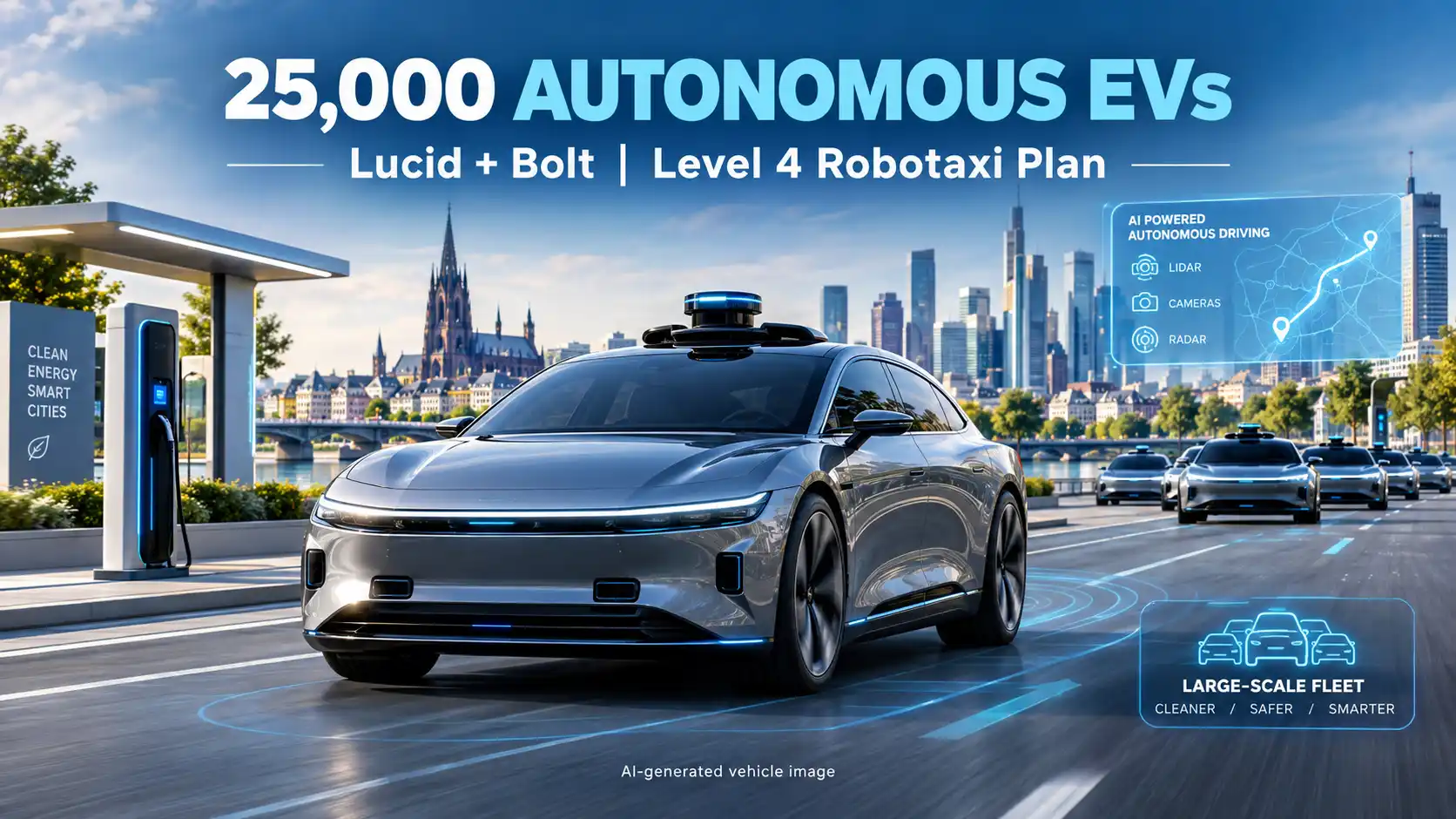
The European autonomous-vehicle market is entering a new phase as Lucid Group and Bolt have announced a strategic partnership to develop and deploy autonomous electric vehicles across Europe.
Under the partnership announced on September 17, 2026, Bolt aims to deploy at least 25,000 fully autonomous Lucid vehicles across multiple European cities and countries. The vehicles will be based on Lucid’s upcoming Midsize platform and are being developed for SAE Level 4 autonomous driving. The planned vehicles are expected to use NVIDIA Hyperion, an autonomous-driving platform designed for Level 4 applications.
Lucid and Bolt Partnership: Key Details
| Key Detail | Information |
| Announcement Date | September 17, 2026 |
| Companies | Lucid Group and Bolt |
| Planned Fleet | At least 25,000 autonomous vehicles |
| Market | Europe |
| Vehicle Platform | Lucid Midsize platform |
| Autonomy Target | SAE Level 4 |
| Autonomous Technology | NVIDIA Hyperion expected |
| Fleet Operator | Bolt |
| Fleet Ownership | Bolt intends to own and operate the fleet |
| Target Cities | Multiple European cities and countries |
| Long-Term Bolt Goal | 100,000 autonomous vehicles by 2035 |
The 25,000-vehicle figure comes directly from the companies’ announcement.
What Is the Lucid–Bolt Deal Actually About?
At a basic level, the partnership brings together three important parts of a robotaxi business.
Lucid will provide the electric-vehicle platform and its technology related to software-defined vehicles, ADAS and autonomy.
Bolt brings its ride-hailing platform, European operating experience, customer network, city relationships and data.
The two companies plan to work together from the vehicle-development stage, rather than simply taking an existing Lucid EV and adding autonomous-driving equipment later.
This is important because a robotaxi needs more than just an autonomous-driving system. The vehicle, software, sensors, fleet-management system, charging infrastructure, customer app and local regulations all need to work together.
Why Lucid’s Midsize Platform Is Important
The planned autonomous vehicles will be built around Lucid’s upcoming Midsize platform.
Lucid has been developing this platform as a more accessible and higher-volume vehicle architecture compared with its existing premium models. The company has identified Lucid Cosmos and Lucid Earth as the first two models planned for the platform.
Lucid is also developing the platform with autonomous applications in mind. In 2025, the company announced plans to use NVIDIA technology in future midsize vehicles as part of its path toward Level 4 autonomy.
This gives Lucid another potential business opportunity beyond selling EVs to individual consumers: selling or operating vehicles for autonomous mobility services.
What Does SAE Level 4 Mean?
Level 4 autonomy is significantly different from today’s normal driver-assistance systems.
At Level 2, the vehicle can assist with steering, acceleration and braking, but the human driver remains responsible for monitoring the road.
At Level 4, the autonomous system can perform the complete driving task within a defined operating environment or operating conditions without requiring a human to take over.
That means a Level 4 robotaxi could potentially transport passengers without a human driver in areas where the service has been approved and the system is designed to operate.
However, Level 4 does not mean that the vehicle can drive anywhere in every weather condition or on every road. Its operational area and conditions can be limited.
Lucid and Bolt specifically say their planned platform is being designed for SAE Level 4 autonomous mobility.
NVIDIA Hyperion Will Provide the Technology Foundation
One of the most important technical elements of this project is NVIDIA Hyperion.
NVIDIA describes Hyperion as a production-ready reference architecture for robotaxis and Level 4 autonomous vehicles. It combines high-performance computing with a standardized sensor architecture and autonomous-driving software.
Depending on the Hyperion generation/configuration, the platform can combine technologies such as:
- Cameras
- Radar
- LiDAR
- Ultrasonic sensors
- In-cabin sensors
- High-performance AI computing
NVIDIA says its latest Hyperion architecture is designed to support applications ranging from advanced driver assistance to Level 4 autonomous driving.
For Lucid and Bolt, this could reduce some of the complexity involved in developing a complete autonomous-driving computing architecture from scratch.
What Will Bolt Do?
Bolt will have a much bigger role than simply providing the ride-hailing application.
Its Bolt Autonomous Driving Solutions division will participate in:
- Vehicle requirements
- Autonomous-driving integration
- Safety requirements
- Rider experience
- Fleet infrastructure
- Operating systems
- City partnerships
- Commercial deployment
Bolt also intends to own and operate the autonomous fleet.
This means the project is being structured more like a complete autonomous mobility business rather than simply a vehicle supply agreement.
Bolt’s Bigger Goal: 100,000 Autonomous Vehicles
The 25,000 Lucid vehicles are part of a much larger ambition from Bolt.
Bolt wants to have 100,000 autonomous vehicles on its platform by 2035.
The 25,000-vehicle Lucid target therefore represents a potential quarter of that long-term target if the full planned deployment eventually happens.
But it is important to understand that 100,000 is also a long-term target, not an existing fleet.
Why Europe Is Important for Autonomous Vehicles
Europe could become an important autonomous-mobility market, but it also presents a different regulatory environment from the United States and China.
Autonomous vehicles need approval not only at the technology level but also under national and regional rules governing road safety, vehicle operation, data and passenger services.
Bolt says its strategy is specifically focused on adapting autonomous mobility to European roads and regulatory requirements. The company plans to work with autonomous-driving technology partners, regulators and policymakers as the service develops.
Reuters also reported that Bolt’s CEO highlighted Europe’s stricter safety regulation as an important challenge for scaling autonomous vehicles.
How a Lucid-Bolt Robotaxi Could Work
The basic process could look like this:
Passenger opens Bolt app
↓
Requests an autonomous ride
↓
Bolt assigns a Lucid autonomous EV
↓
Vehicle navigates using sensors + AI computing
↓
Passenger reaches destination without a human driver
Behind the scenes, Bolt would need to manage the fleet, charging, maintenance, software updates, customer support and city-level operations.
This is why the partnership involves both vehicle development and mobility infrastructure.
Is This Already a Confirmed 25,000-Car Order?
This is one of the most important points for readers.
No—not in the conventional sense of a completed vehicle purchase order.
The companies announced a partnership under which Bolt aims to deploy at least 25,000 autonomous Lucid vehicles.
Reuters reported that the companies had not disclosed a timetable for achieving the target or the size of the investment. TechCrunch also reported that Bolt had not placed an order for the vehicles at the time of its report.
When Could These Robotaxis Enter Service?
The companies have not announced a specific commercial deployment date for the 25,000-vehicle European fleet.
This is particularly important because the vehicles will be based on Lucid’s upcoming Midsize architecture.
Lucid has already identified the Midsize platform as a key part of its future growth and autonomy strategy, but development and regulatory approval still have to happen before a large-scale European robotaxi fleet can operate commercially.
So the 25,000-vehicle figure should currently be treated as a future deployment target.
Lucid’s Broader Robotaxi Strategy
The Bolt partnership is not Lucid’s only autonomous-mobility project.
Lucid is also working with Uber and autonomous-driving company Nuro on robotaxi applications. Lucid’s filings say Uber and designated fleet operators have committed to purchase a minimum of 25,000 Midsize-platform vehicles modified for robotaxi use under a separate agreement, with production of those Midsize Plus vehicles targeted for late 2028.
This shows that Lucid is trying to develop multiple commercial channels for autonomous vehicles, rather than depending only on private consumer EV sales.
What Makes This Partnership Different?
The interesting part of the Lucid-Bolt announcement is that it combines three businesses:
1. Electric Vehicles
Lucid supplies the EV platform and vehicle technology.
2. Autonomous Driving
The vehicles are being designed around a Level 4 autonomous-driving architecture, with NVIDIA Hyperion expected to provide the technological foundation.
3. Ride-Hailing
Bolt provides the customer-facing mobility platform and plans to operate the fleet.
Together, these could create a complete EV + AI + Robotaxi business model.
Major Challenges Ahead
The 25,000-vehicle target is ambitious, and several challenges must be solved before it can become a large commercial fleet.
Regulatory Approval
European countries may have different requirements for autonomous vehicles and commercial passenger services.
Autonomous Driving Safety
Level 4 systems need to operate reliably in complex real-world situations, including traffic, pedestrians, cyclists, road construction and changing weather.
Vehicle Production
Lucid will need to produce vehicles at much greater scale than its current production levels if a fleet of this size is eventually deployed.
Charging Infrastructure
A large robotaxi fleet will consume significant amounts of electricity and will require efficient charging and fleet-management infrastructure.
Software Development
Autonomous driving requires continuous software development, validation and monitoring.
Fleet Economics
A robotaxi must generate enough revenue per vehicle to cover vehicle cost, charging, maintenance, insurance, software and operating expenses.
These factors will determine how quickly the announced plan can move from development to commercial operation.
What This Means for the EV and Autonomous Vehicle Industry
The Lucid-Bolt partnership shows an important shift in the EV industry.
Electric vehicles are increasingly being developed not only as cars for individual owners, but also as platforms for:
- Robotaxis
- Autonomous delivery
- Fleet services
- Mobility subscriptions
- AI-powered transportation
Lucid’s strategy is particularly interesting because its Midsize platform is being designed to support both consumer vehicles and autonomous commercial applications. Lucid itself has described autonomy and robotaxi partnerships as part of its broader strategy for future revenue growth.
Outcome
The Lucid–Bolt 25,000 autonomous EV plan is significant because it combines a premium EV manufacturer with one of Europe’s major shared-mobility platforms.
The technology plan is also notable: Lucid Midsize platform + Level 4 autonomy + NVIDIA Hyperion + Bolt’s ride-hailing infrastructure.
However, the most important distinction is between plan and deployment. As of the September 17, 2026 announcement, there is no announced timetable for putting all 25,000 vehicles into service, and the companies have not disclosed the investment amount.
If successfully executed, the project could give Lucid a significant new route into the European robotaxi market while helping Bolt build toward its longer-term goal of 100,000 autonomous vehicles by 2035. But the actual scale and timing will depend on vehicle development, manufacturing, autonomous-driving validation and European regulatory approvals.
Sources
- Lucid official announcement: Lucid Group — Lucid and Bolt Partnership
- Bolt Autonomous Driving: Bolt Autonomous Solutions
- NVIDIA Hyperion: NVIDIA DRIVE Hyperion
- Reuters: Reuters — Lucid and Bolt robotaxi partnership