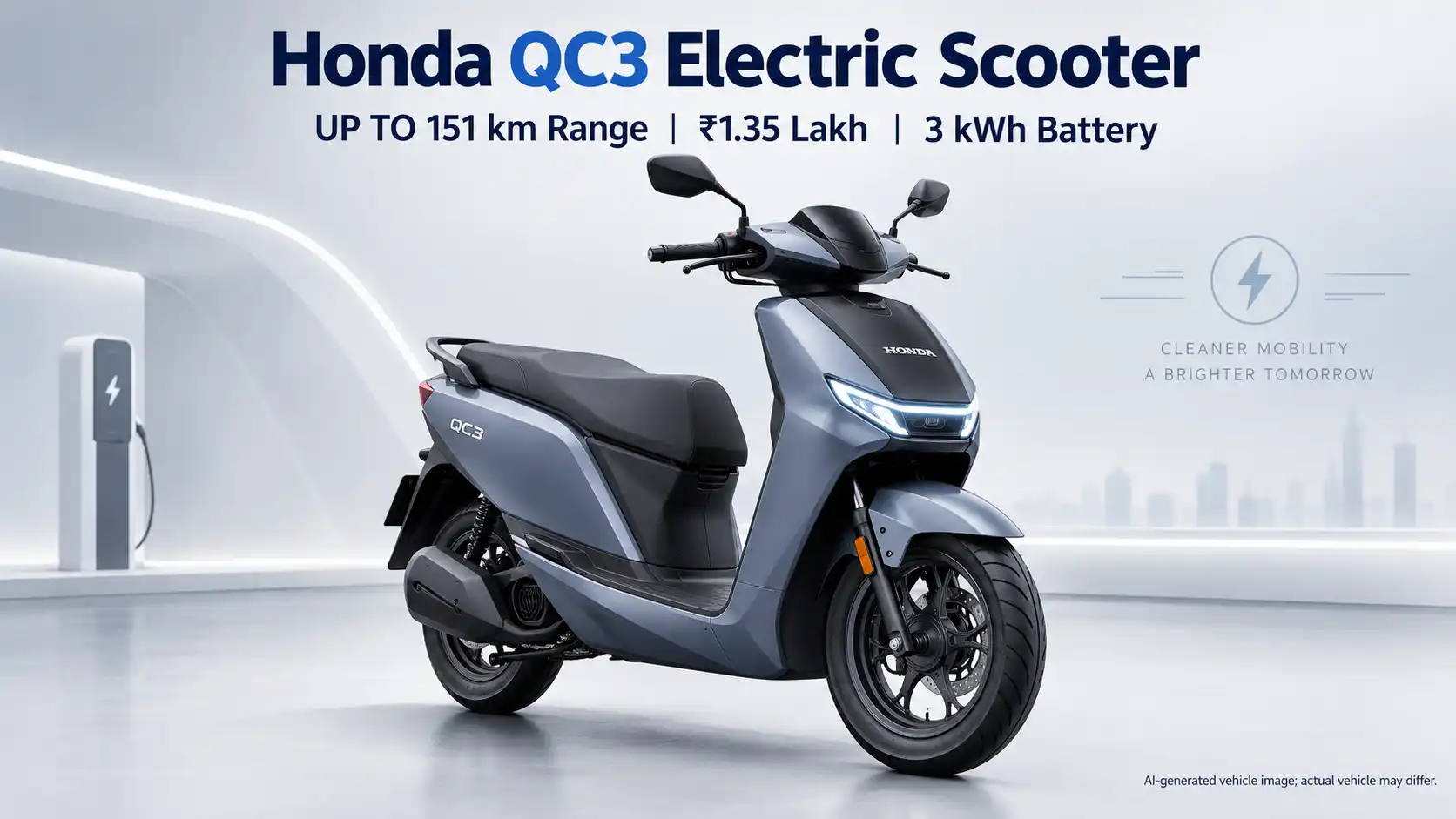
Honda Motorcycle & Scooter India (HMSI) has expanded its electric two-wheeler portfolio in India with the launch of the Honda QC3, a new family-focused electric scooter designed mainly for daily urban commuting.
Unlike a performance-focused electric scooter, the QC3 has been developed around everyday usability. Honda is targeting customers who want an electric scooter for commuting, family use, storage and connected features. Honda describes it as a smart family EV.
Honda QC3 Key Highlights
| Key Detail | Honda QC3 |
| Vehicle Type | Electric Scooter |
| Target Use | Family & Daily Urban Commuting |
| Price | ₹1.35 lakh |
| Price Basis | Ex-showroom Delhi |
| Battery | 3 kWh |
| Claimed Range | 151 km IDC |
| 0–80% Charging | Around 2 hours 40 minutes |
| Full Charging | Around 4 hours |
| Under-seat Storage | 32 litres |
| Instrument Cluster | 5-inch TFT |
| Connectivity | Honda RoadSync |
| Navigation | Turn-by-turn navigation |
| Key System | Smart Key |
| Initial Availability | Delhi, Agra, Cuttack, Surat and Kollam |
The launch price and core specifications have been reported consistently across launch coverage, while Honda’s own July announcement confirms the 3 kWh battery, charging time, 32-litre storage and connected-feature package.
Honda QC3 Launched at ₹1.35 Lakh
Honda has launched the QC3 in India at ₹1.35 lakh ex-showroom Delhi.
The scooter will initially be available in five cities — Delhi, Agra, Cuttack, Surat and Kollam through selected Honda RedWing dealerships. Honda plans to expand availability in phases rather than immediately offering the model across the entire country.
This phased rollout is important because customers in other cities may not be able to purchase or test ride the QC3 immediately.
3 kWh Battery and 151 km IDC Range
One of the main highlights of the Honda QC3 is its 3 kWh fixed battery pack.
Honda’s latest published material identifies the QC3 with a 151 km IDC range. IDC, or Indian Driving Cycle, is a standardized testing figure. Real-world range can be different depending on factors such as:
- Riding speed
- Traffic
- Rider and passenger weight
- Acceleration
- Road conditions
- Weather
- Use of electrical features
Therefore, the 151 km figure should be treated as a certified test-cycle figure rather than a guaranteed everyday range.
Why the 3 kWh Battery Matters
The QC3’s battery is considerably larger than the 1.5 kWh battery used in Honda QC1. Honda’s official information for the QC1 lists an 80 km range and 1.5 kWh fixed battery.
This gives the QC3 a substantially higher claimed range and positions it for customers who expect to use their electric scooter for longer daily commuting.
Honda QC3 Charging Time
Honda says the QC3 can charge from 0% to 80% in approximately 2 hours 40 minutes.
A complete charge takes around four hours.
This means the scooter is designed more around convenient daily charging than extremely fast charging. For example, an owner could charge the scooter at home after returning from work and have it ready for the next day’s commute.
32-Litre Under-Seat Storage
Practicality is one of the key areas where Honda is positioning the QC3.
The scooter gets 32 litres of under-seat storage, which is particularly useful for family and daily commuting.
The space can be used for items such as:
- Helmet
- Bags
- Groceries
- Small personal items
- Charging accessories
Honda has specifically highlighted the 32-litre storage capacity as part of the QC3’s family-oriented design.
For an urban electric scooter, this is an important feature because customers often use scooters not only for commuting but also for shopping and family transportation.
5-Inch TFT Display and Honda RoadSync
The QC3 also gets a 5-inch TFT instrument cluster.
The display supports connected functions and works with Honda RoadSync, including turn-by-turn navigation.
This allows Honda to position the QC3 as more than a basic electric commuter. The rider gets access to connected information through the scooter’s digital interface.
Smart Key
The scooter also gets a Smart Key system, adding convenience for everyday use.
Instead of treating the QC3 only as an electric replacement for a conventional scooter, Honda has included features designed around connected and convenient urban mobility.
Family-Focused Electric Scooter
Honda is not positioning the QC3 as a high-performance electric scooter.
Instead, its design direction is centered around family use, comfort, storage and daily commuting.
This is visible from the combination of:
- 3 kWh battery
- 145 km IDC claimed range
- 32-litre storage
- Smart Key
- TFT display
- Connected features
- Navigation
Honda itself describes the QC3 as a smart family EV and a commuter-focused product.
Honda QC3 vs Honda QC1
The QC3 sits above the smaller QC1 in Honda’s electric scooter portfolio.
| Specification | Honda QC3 | Honda QC1 |
| Battery | 3 kWh | 1.5 kWh |
| Claimed Range | 151 km IDC | 80 km |
| Charging to 80% | 2 hr 40 min | 4 hr 30 min |
| Full Charging | Around 4 hr | Around 6 hr 50 min |
| Storage | 32 litres | 26 litres |
| Display | 5-inch TFT | 5-inch LCD |
| Battery Type | Fixed | Fixed |
The QC3 therefore represents a significant step up from the QC1 in battery capacity, claimed range, storage and connected technology. Honda’s official QC1 launch information confirms the older model’s 1.5 kWh battery, 80 km range and charging specifications.
Honda’s Growing Electric Two-Wheeler Portfolio
The QC3 is not Honda’s first electric scooter in India.
Honda’s current electric portfolio includes:
- Activa e:
- QC1
- QC3
Honda introduced the Activa e: and QC1 as its initial electric two-wheeler offerings for India. The QC3 now expands the range toward customers looking for greater range and more practical family-oriented features.
This also shows that Honda is taking a multi-product approach to India’s electric two-wheeler market rather than relying on a single EV model.
Made-in-India Focus and Honda’s EV Strategy
Honda’s July 2026 announcement placed the QC3 within a broader 10-product India portfolio, alongside motorcycles and scooters across petrol, electric and flex-fuel technologies.
Honda said the programme is part of its effort to strengthen local product development, engineering, manufacturing and sourcing capabilities in India.
This is significant for the QC3 because India is not being treated only as a market for imported Honda products. Honda is also increasing localization and using India as an important part of its product and manufacturing strategy.
What Makes Honda QC3 Different?
The QC3’s main focus is not outright performance. Instead, Honda has combined several practical features into one electric scooter.
1. Higher claimed range
The 145 km IDC figure gives it a substantially longer certified range than the QC1.
2. Large storage
The 32-litre under-seat compartment makes the scooter more practical for family use.
3. Connected technology
The 5-inch TFT display, Honda RoadSync and navigation bring smartphone-connected features into the scooter.
4. Familiar Honda brand
Honda already has a large presence in India’s two-wheeler market, which can be relevant for customers considering service and dealership access.
5. Phased rollout
Honda is initially restricting availability to five cities and plans to expand it in phases.
Honda QC3: What Buyers Should Know About the Range
There is one detail worth noting when reporting the QC3.
Honda’s July 24, 2026 announcement initially listed 151 km IDC, while Honda’s later blog material and subsequent launch information refer to 145 km IDC.
For a current launch article, 145 km IDC should be used as the latest published figure, rather than combining both numbers.
This also demonstrates why launch specifications can sometimes change between an initial unveiling and the final market launch.
Overall Analysis
The Honda QC3 represents a move toward a more practical and family-oriented electric scooter from Honda.
Its biggest focus areas are range, storage, charging convenience and connected technology, rather than high-performance riding. The combination of a 3 kWh battery, 145 km IDC claimed range, 32-litre storage and a 5-inch TFT display makes it a clearly differentiated product within Honda’s current EV portfolio.
For Honda, the QC3 is also important because the company is expanding beyond its initial electric offerings and adding another model aimed at everyday Indian commuters.
The next important development will be the phased expansion of QC3 availability across more Indian cities and how Honda develops its wider electric two-wheeler portfolio.
Source: Honda Motorcycle & Scooter India – Official Website
Note: Specifications and availability can change as Honda updates the product and expands the rollout. The 151 km figure above is the current launch-era IDC figure used in Honda’s later product material.