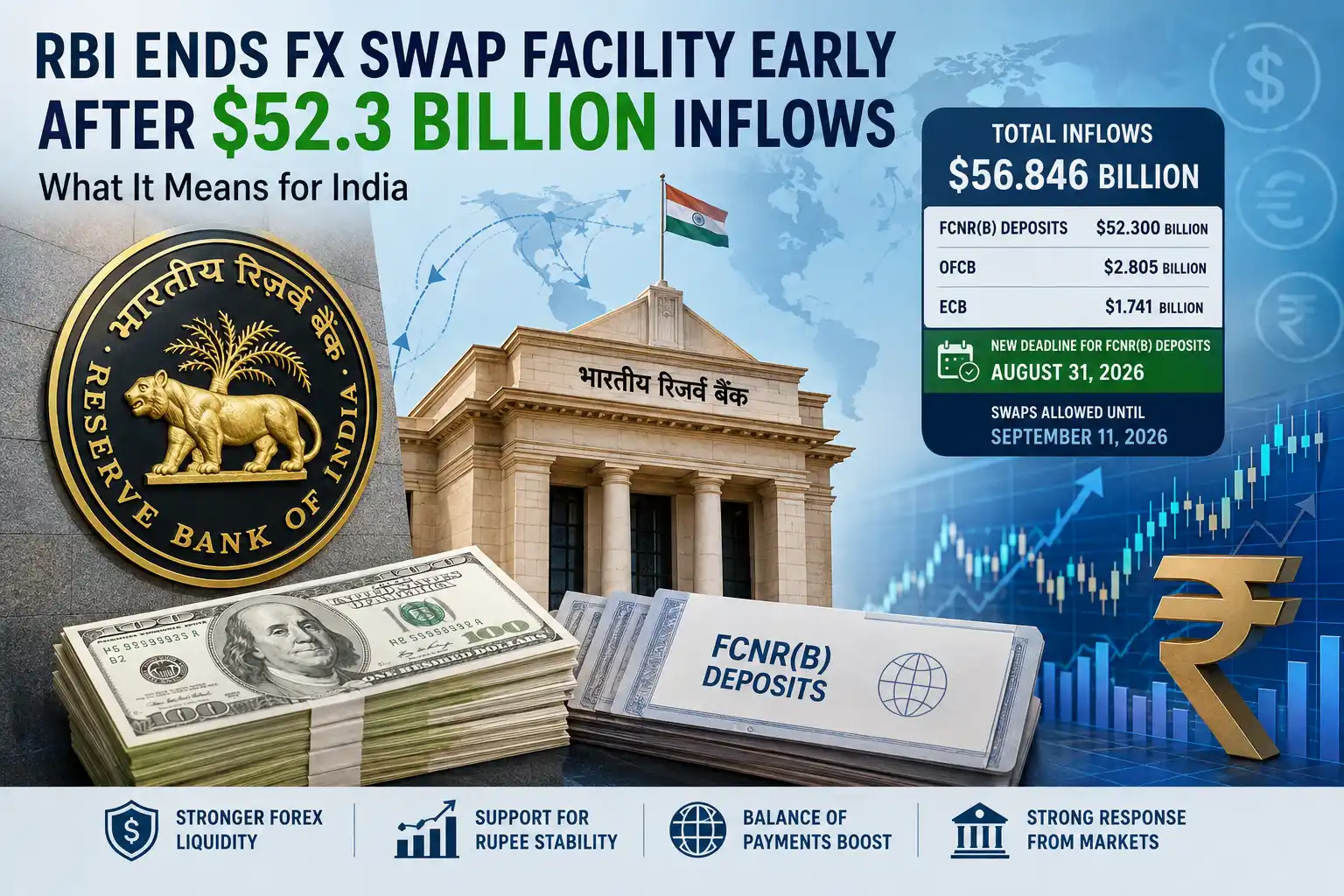
The Reserve Bank of India (RBI) has decided to close its special USD-INR forex swap facility for FCNR(B) deposits one month earlier than originally planned after banks attracted a massive $52.3 billion in foreign-currency deposits between June 8 and August 13, 2026.
The facility was originally scheduled to remain open until September 30, 2026, but the RBI has now moved the deposit mobilisation deadline forward to August 31, 2026. However, banks will still be able to execute the corresponding swaps with the RBI until September 11, 2026.
The decision highlights the stronger-than-expected response to the RBI’s special foreign-exchange measure and comes as India continues to focus on strengthening its external liquidity and foreign-exchange position.
Why Did the RBI Close the FX Swap Facility Early?
The simple reason is that foreign-currency inflows came in much faster and at a much larger scale than expected.
The RBI introduced the special facility in June 2026 to encourage Indian banks to attract more foreign-currency deposits from overseas. The facility provided banks with a relatively attractive mechanism to manage the foreign-exchange risk associated with these inflows.
By August 13, three channels had generated a combined $56.846 billion in foreign-currency inflows:
| Source | Inflow |
| FCNR(B) deposits | $52.300 billion |
| Overseas Foreign Currency Borrowings (OFCBs) | $2.805 billion |
| External Commercial Borrowings (ECBs) | $1.741 billion |
| Total | $56.846 billion |
FCNR(B) deposits alone accounted for roughly 92% of the total inflows.
With the programme already generating such a strong response, the RBI decided that there was less need to keep the FCNR(B) mobilisation window open until the original September deadline.
What Is the FX Swap Facility?
To understand the RBI’s decision, it is important to understand what a forex swap means. A foreign-exchange swap is essentially a transaction in which two parties exchange currencies and agree to reverse the transaction later under predetermined terms. Under this particular RBI facility, banks could attract foreign-currency deposits and use the special swap mechanism to obtain rupee liquidity while managing their currency exposure.
For example, imagine an Indian bank attracts $100 million through FCNR(B) deposits.
The bank now has dollars, but it may need rupee liquidity for its domestic operations. Through the swap arrangement, the bank can exchange the foreign currency with the RBI for rupees and later reverse the transaction under the agreed terms.
In simple terms, the facility made it easier and more attractive for banks to mobilise foreign-currency deposits.
What Are FCNR(B) Deposits?
FCNR(B) stands for Foreign Currency Non-Resident (Bank) deposits. These are deposits that eligible non-resident Indians can maintain with Indian banks in specified foreign currencies.
One important feature is that the deposit remains denominated in a foreign currency rather than Indian rupees.
This means depositors can avoid the same type of exchange-rate exposure that they would face if they converted the money into a rupee-denominated deposit.
FCNR(B) deposits are regulated under the RBI’s foreign-exchange framework.
When Did the RBI Introduce the Facility?
The special USD-INR forex swap facility was introduced on June 8, 2026.
The broader objective was to encourage foreign-currency inflows into India through three channels:
- FCNR(B) deposits
- External Commercial Borrowings (ECBs)
- Overseas Foreign Currency Borrowings (OFCBs)
The measure was designed to strengthen India’s foreign-exchange liquidity and support its overall external position.
Why Is $52.3 Billion Such a Big Number?
This is one of the most important aspects of the story.
Between June 8 and August 13, Indian banks mobilised $52.3 billion through the FCNR(B) route in roughly two months.
For perspective, if we use an illustrative exchange rate of ₹85 per US dollar:
$52.3 billion ≈ ₹4.45 lakh crore
The exact rupee value changes with the exchange rate, but the calculation shows the scale of the inflow. It demonstrates that the special facility generated a very strong response from banks and overseas depositors.
Did the Entire $52.3 Billion Go Into RBI’s Forex Reserves?
No. This distinction is important.
It would be incorrect to say that the entire $52.3 billion was simply added to the RBI’s foreign-exchange reserves.
The $52.3 billion represents FCNR(B) deposits mobilised by banks.
These deposits are banking-system foreign-currency liabilities. The RBI’s foreign-exchange reserves are a separate measure and include foreign-currency assets, gold, SDRs and other reserve components.
However, the broader measures and foreign-currency inflows have helped strengthen India’s external liquidity. India’s forex reserves had crossed $700 billion, reaching around $707 billion by August 7, 2026, according to recent data.
Why Is the RBI’s Decision Positive for India?
1. Stronger Foreign-Currency Liquidity
The inflows increase the availability of foreign currency within India’s financial system.
This is particularly useful when global financial markets are facing volatility and India’s import requirements remain high.
2. Support for the Balance of Payments
Foreign-currency inflows can strengthen India’s external financing position.
A stronger external position provides an additional buffer against global capital-market volatility and sudden pressure on the rupee.
3. Potential Support for the Indian Rupee
Higher foreign-currency inflows can increase the supply of dollars in the foreign-exchange market.
This can help reduce depreciation pressure on the rupee.
However, it does not mean that the rupee will automatically strengthen.
The exchange rate is influenced by several other factors, including:
- Crude oil prices
- US dollar strength
- Foreign portfolio investment
- Imports
- Global interest rates
- Geopolitical risks
Therefore, the $52.3 billion inflow should be viewed as a supportive factor, not a guarantee of rupee appreciation.
Why Didn’t the RBI Keep the Facility Open Until September?
This is perhaps the most interesting question.
If foreign-currency inflows are beneficial, why close the programme early?
The reason is that the RBI’s objective was not to attract unlimited foreign currency. The facility was designed as a targeted policy measure to encourage additional foreign-currency inflows.
Once the programme had generated more than $52 billion in FCNR(B) deposits, the RBI had less reason to continue the special mobilisation window for another month.
Therefore, the early closure can actually be interpreted as a sign that the policy measure achieved its immediate objective faster than expected.
What Happens After August 31?
There are two important dates to remember.
August 31, 2026
This is the new deadline for mobilising eligible FCNR(B) deposits under the special facility.
September 11, 2026
Banks will still have time to execute the relevant swaps with the RBI for FCNR(B) deposits that were mobilised by the August 31 deadline.
So the facility does not simply disappear on August 31. The existing transactions have a separate settlement window.
Are the ECB and OFCB Facilities Also Ending?
No.
This is an important distinction. The RBI has brought forward the deadline specifically for the FCNR(B) deposit mobilisation component.
The facilities related to:
- External Commercial Borrowings (ECB)
- Overseas Foreign Currency Borrowings (OFCB)
will continue until December 31, 2026.
As of August 13:
- OFCB inflows: $2.805 billion
- ECB inflows: $1.741 billion
had been recorded.
What Does This Mean for Indian Banks?
Indian banks have been among the biggest beneficiaries of the special facility.
Higher FCNR(B) deposits give banks access to an additional source of foreign-currency funding. The RBI’s swap mechanism also helped banks manage the currency risk associated with these deposits.
However, once the special facility closes, banks will no longer have access to the same special incentive for mobilising new FCNR(B) deposits.
They will therefore have to rely on normal market conditions and existing regulatory mechanisms.
What Does It Mean for NRI Depositors?
The decision is also relevant for non-resident Indian depositors. Eligible deposits mobilised under the scheme by the August 31 deadline can continue to receive the benefits associated with the facility, subject to the applicable conditions.
After August 31, new FCNR(B) deposits will no longer qualify for this particular special swap arrangement. This could influence the rates and incentives banks offer to attract new foreign-currency deposits.
Impact on India’s Forex Reserves
The RBI’s decision comes at a time when India’s foreign-exchange reserves have already strengthened significantly.
India’s reserves reached approximately $707 billion by August 7, 2026. The country had added roughly $40 billion to its reserves over a period of around six weeks.
However, it is important not to attribute the entire increase to FCNR(B) deposits.
India’s forex reserves are influenced by several factors, including:
- Foreign-currency assets
- Gold reserves
- SDR holdings
- IMF reserve position
- Foreign investment flows
- RBI intervention in the forex market
- Other external transactions
Will the Decision Strengthen the Indian Rupee?
The policy is supportive of rupee stability, but it does not guarantee a stronger rupee. The additional dollar inflows can help increase dollar availability in the domestic market.
However, India also has substantial demand for dollars because of imports, particularly:
- Crude oil
- Gold
- Electronics
- Machinery
- Industrial commodities
Geopolitical developments and global oil prices can also quickly change the demand-supply balance.
Therefore, the RBI will continue to monitor the rupee rather than targeting a specific exchange-rate level.
Why Is the Facility Particularly Important Right Now?
The timing of the inflows is important.
India is a major crude-oil importer. If international oil prices rise sharply, Indian companies need more dollars to pay for imports. That can put additional pressure on the rupee.
In such an environment, strong foreign-currency inflows provide an additional external buffer.
The FCNR(B) inflows therefore strengthen India’s ability to deal with periods of higher external financing pressure.
Is the RBI’s Decision a Policy Success?
Overall, yes.
The RBI introduced the special facility on June 8 and received a significantly stronger response than the numbers might initially have suggested.
By August 13:
- FCNR(B): $52.3 billion
- OFCB: $2.805 billion
- ECB: $1.741 billion
- Total: $56.846 billion
had been mobilised through the three channels.
The fact that the RBI has decided to close the FCNR(B) mobilisation window a month early suggests that the facility has largely achieved its immediate objective.
But There Is Also a Risk
Foreign-currency deposits should not be viewed as simply “free dollars” for India.
FCNR(B) deposits are liabilities of Indian banks.
Eventually, banks have to meet their obligations to depositors when the deposits mature.
Therefore, banks need to properly manage:
- Foreign-currency liabilities
- Currency risk
- Hedging costs
- Liquidity
- Maturity mismatches
The RBI’s swap mechanism is important precisely because it helps banks manage these risks.
Overall Impact on India
| Factor | Impact |
| Foreign-currency liquidity | 🟢 Positive |
| Balance of Payments | 🟢 Positive |
| Banking-system FX funding | 🟢 Positive |
| Forex reserves | 🟢 Supportive |
| Rupee stability | 🟢 Supportive, but not guaranteed |
| NRI deposits | 🟢 Strong response |
| RBI policy effectiveness | 🟢 Positive |
| New FCNR(B) inflows after Aug. 31 | 🔴 Special facility unavailable |
| Bank FX liabilities | 🟡 Need careful management |
What Should Markets Watch Next?
The next few months will be important for understanding the full impact of the RBI’s move.
Investors and analysts will watch:
- India’s forex reserves — whether they continue to rise.
- USD/INR — whether the additional inflows reduce pressure on the rupee.
- FCNR(B) deposits — how the deposit trend changes after August 31.
- ECB and OFCB inflows — how much additional foreign currency enters through these channels until December.
- Crude oil prices — higher oil prices could increase India’s dollar requirements.
- Global interest rates — especially US monetary policy and dollar movements.
- Banking-system liquidity — how banks manage the additional foreign-currency liabilities.
Outcome
The RBI’s decision on August 14, 2026, to end the special FCNR(B) forex swap facility earlier than planned is not a sign of a financial emergency. Instead, it reflects the unusually strong response to a policy measure designed to attract foreign-currency inflows.
Between June 8 and August 13, the three channels covered by the facility attracted $56.846 billion, including a remarkable $52.3 billion through FCNR(B) deposits alone.
As a result, the RBI has moved the FCNR(B) mobilisation deadline from September 30 to August 31, 2026. Banks will have until September 11 to execute the corresponding swaps for eligible deposits already mobilised, while the ECB and OFCB facilities will remain available until December 31, 2026.
The bigger message for India’s economy is clear: the RBI successfully attracted a large pool of foreign currency at a time when external liquidity and rupee stability remain important priorities.
The next question is how much of this support will translate into stronger forex reserves, a more stable rupee and improved external-sector resilience over the coming months.
Source: Reserve Bank of India (RBI) — Swap Facility for FCNR(B) Deposits, External Commercial Borrowings and Overseas Foreign Currency Borrowings, June 23, 2026; latest August 2026 updates from Reuters and other financial-market reports.