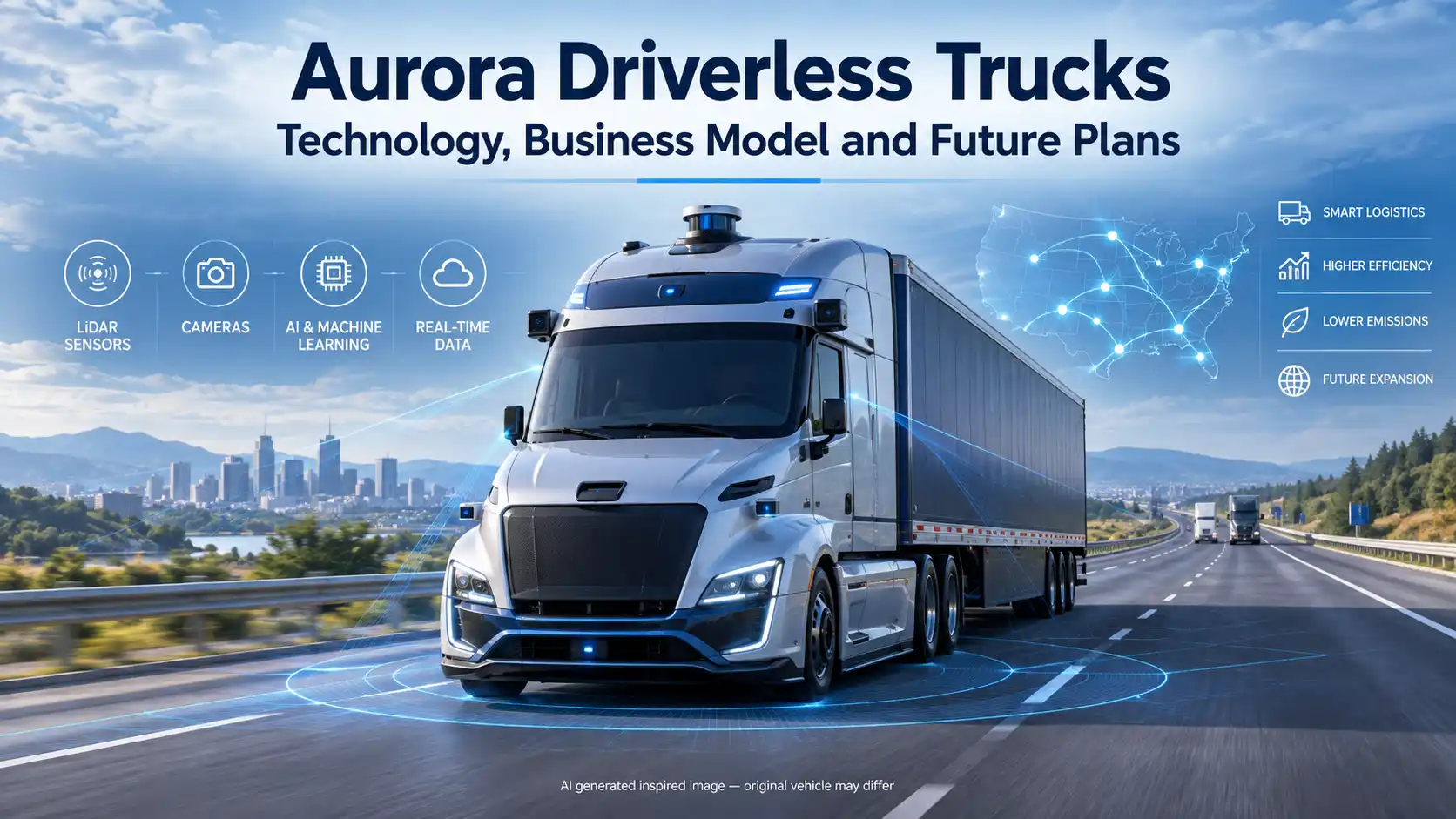
Imagine a large freight truck traveling on a U.S. highway carrying goods from one city to another, but there is no human driver sitting behind the steering wheel. The truck uses sensors, computers and autonomous-driving software to understand the road and operate itself.
This is no longer only a future concept. Aurora Innovation is already working toward commercial driverless trucking in the United States using its autonomous-driving system called Aurora Driver.
On September 23, 2026, Aurora presented its long-term autonomous trucking strategy at its Analyst & Investor Day. The company said it is targeting more than 30,000 driverless trucks by 2030.
Aurora also said its driverless trucks have completed more than 500,000 driverless miles since commercial launch. The company expects to finish 2026 with around 200 driverless trucks and aims to exceed 1,000 by the end of 2027.
This announcement is important because Aurora is trying to move autonomous trucking from limited testing and early commercial operations toward a much larger freight transportation business.
Key Highlights
| Detail | Information |
| Company | Aurora Innovation |
| Main Technology | Aurora Driver |
| Technology Type | Autonomous / Self-Driving System |
| Main Application | Driverless Freight Trucks |
| Current Market | United States |
| Driverless Miles | 500,000+ miles |
| 2026 Target | Around 200 driverless trucks |
| 2027 Target | 1,000+ driverless trucks |
| 2030 Target | 30,000+ driverless trucks |
| 2030 Revenue Target | $5 billion+ annually |
| Target Gross Margin | Around 60% |
| Current Truck Platforms | International LT, Volvo VNL Autonomous |
These figures are based mainly on Aurora’s September 23, 2026 announcement and investor presentation. The future numbers are company targets and projections, not guaranteed results.
What Is Aurora Innovation?
First, it is important to understand the difference between Aurora Innovation and Aurora Driver.
Aurora Innovation is the name of the U.S.-based autonomous vehicle technology company.
The company develops technology that can allow vehicles to operate without a human driver. Its main focus today is commercial autonomous trucking.
The company’s main autonomous-driving technology is called Aurora Driver.
Aurora vs. Aurora Driver
The difference can be explained simply:
Aurora Innovation = Company
Aurora Driver = Autonomous-driving system
Driverless Truck = A truck equipped with Aurora Driver technology
So, it would not be correct to say that “Aurora is an autonomous-driving system.” The more accurate description is:
Aurora Innovation is an autonomous vehicle technology company, and Aurora Driver is its self-driving system.
Aurora says the Aurora Driver is designed to operate across different types of vehicles, including freight trucks and passenger vehicles.
What Is the Aurora Driver?
The Aurora Driver can be thought of as a digital driving system for the vehicle.
A human truck driver continuously observes the road and makes decisions such as:
- Where is the lane?
- Is another vehicle ahead?
- Is there an obstacle?
- When should the truck slow down?
- When should it brake?
- When is it safe to change lanes?
- How should the truck respond to traffic?
The Aurora Driver is designed to perform these types of driving tasks using a combination of software, sensors, computing hardware and artificial intelligence.
The system is designed to understand the vehicle’s surroundings and make driving decisions without requiring a human to continuously control the vehicle.
Aurora describes its technology as a self-driving system designed for commercial applications.
Aurora Is Already Operating Driverless Trucks
One of the most important parts of Aurora’s September 2026 announcement is that the company is not talking only about laboratory testing.
Aurora says its driverless trucks are already operating on commercial freight routes in the United States.
During the September 23 Analyst & Investor Day, Aurora also demonstrated its technology by providing rides in an Aurora Driver-powered truck without a human driver behind the wheel on part of its Dallas-to-Houston commercial route.
Aurora reported that its autonomous system has completed more than 500,000 driverless miles since commercial launch.
This shows that the company is attempting to move its technology beyond testing and into real commercial freight operations.
Aurora’s 30,000+ Driverless Truck Target
The biggest announcement from Aurora’s September 23 event was its long-term fleet expansion plan.
The company expects:
2026
Around 200 driverless trucks by the end of the year.
2027
More than 1,000 driverless trucks.
2030
More than 30,000 driverless trucks.
The jump from hundreds of vehicles to more than 30,000 would represent a major expansion of autonomous trucking.
Aurora’s investor presentation shows this progression as part of its planned commercial scaling strategy.
Why Are 30,000 Driverless Trucks Important?
Today’s autonomous trucking industry is still at an early commercial stage.
A fleet of more than 30,000 autonomous trucks would be very different from running a small number of pilot vehicles.
Aurora believes autonomous trucks could potentially:
- Increase truck utilization
- Provide additional freight capacity
- Reduce dependence on driver availability
- Allow trucks to operate for longer periods
- Improve transportation efficiency
- Reduce some operating costs
Aurora identifies truck utilization, safety, capacity and transportation economics as important potential benefits of autonomous trucking.
However, these are potential benefits described by the company. Actual results will depend on safety performance, regulations, operating costs, customer adoption and other factors.
Where Are Aurora’s Driverless Trucks Operating?
Aurora’s main commercial focus is long-haul freight transportation.
A typical route can involve moving goods between distribution centers or cities, often using major highways.
For example:
Warehouse → Highway → Distribution Center
Aurora has been operating driverless freight services on routes including the Dallas-Houston corridor.
The company said trucks serving customers such as McLane and Werner, among others, were averaging an annualized utilization rate of more than 225,000 miles per truck.
Aurora says this is more than twice the utilization of a traditional truck. This is a company-reported figure and should not be treated as an independent industry measurement.
Why Is Aurora Focusing on Trucking?
Long-haul trucking involves long distances, large freight volumes and long operating hours.
Human drivers remain an important part of the traditional trucking system, but their availability and working-hour requirements can affect how trucks are operated.
Autonomous technology is intended to change this operating model.
If autonomous trucks can operate safely for longer periods, they could potentially:
- Increase vehicle utilization
- Add freight capacity
- Reduce some driver-availability constraints
- Create new logistics operating models
- Improve the efficiency of long-distance freight transportation
Aurora’s strategy is therefore focused heavily on highway freight trucking, rather than immediately trying to solve every type of urban autonomous driving problem.
Aurora’s Two Business Models
Aurora is not planning to depend only on owning and operating its own fleet.
The company is developing two important business models:
1. Transport as a Service — TaaS
Under Transport as a Service, Aurora takes a more direct role in transportation operations.
The basic model can be understood as:
Customer’s freight → Aurora Driver-powered truck → Freight delivery
This model gives Aurora experience with real freight operations, customer requirements, routes and vehicle utilization.
It also allows the company to demonstrate how autonomous trucking can work in commercial transportation.
2. Driver as a Service — DaaS
The second model is Driver as a Service, or DaaS.
This model is particularly important for Aurora’s long-term scaling strategy.
Under DaaS:
Customer owns the truck → Aurora provides autonomous-driving technology
This means Aurora does not necessarily need to purchase and own every truck itself.
Instead, trucking companies can potentially use Aurora’s autonomous-driving system on their own vehicles and pay Aurora for the technology/service.
Aurora describes DaaS as a major growth engine for scaling its autonomous trucking business.
Hirschbach Plans 500 Aurora Driver Trucks
Aurora also highlighted customer demand during its September 23 announcement.
According to Aurora, Hirschbach intends to scale its autonomous fleet to 500 trucks through a Driver as a Service agreement.
Deliveries are expected to begin in 2027.
This is important because Aurora’s 30,000-truck target will require more than its own operations. The company needs logistics customers to adopt autonomous trucks at scale.
Aurora also said it is in discussions with additional customers about potential DaaS agreements.
Which Truck Platforms Use Aurora Driver?
Aurora is following a multi-platform strategy rather than limiting its technology to a single truck model.
The company currently works with platforms including:
- International LT Series
- Volvo VNL Autonomous
Aurora is also working with PACCAR on future autonomy-enabled truck platforms.
This approach is important because Aurora wants its autonomous-driving technology to work across multiple commercial truck platforms.
In simple terms:
Different truck manufacturers → Aurora Driver technology → Autonomous trucks
This could give Aurora more opportunities to expand its technology across the trucking industry.
Why Is Autonomous Truck Hardware Important?
Autonomous driving is not only about software.
A driverless truck needs a combination of:
- Cameras
- Sensors
- Computing hardware
- Autonomous-driving software
- Vehicle controls
- Safety systems
Aurora has also been developing its second-generation commercial hardware.
According to the company, this hardware is designed for approximately one million miles of operating life and is intended to reduce hardware costs by more than half compared with the previous generation.
Aurora also said its manufacturing partner Roush was targeting a production rate of 20 trucks per week in October 2026.
Increasing production capacity will be important if Aurora wants to move from hundreds of trucks to thousands.
Aurora Wants to Expand Routes Faster
Another interesting part of Aurora’s strategy is its effort to reduce the time required to validate new routes.
Before a driverless truck can operate commercially on a new route, the autonomous system needs to be tested and validated for that environment.
Aurora says:
- Its first route took about 6 years
- Its second route took about 6 months
- Its current process takes about 6 weeks
- The company is targeting approximately 6 days in the future
Faster route validation could help Aurora expand its autonomous freight network more quickly.
Safety Is a Critical Part of Driverless Trucking
Safety is one of the most important issues in autonomous trucking.
A driverless truck must deal with:
- Highway traffic
- Sudden braking
- Road construction
- Weather conditions
- Unexpected obstacles
- Other vehicles
- Changes in road conditions
Aurora says it uses a Safety Case approach before deploying its autonomous system without a human driver.
A Safety Case is essentially a structured body of evidence used to demonstrate that an autonomous system can safely perform a specific operation.
Aurora has also said that its safety framework has undergone independent assessment by Edge Case.
This does not mean autonomous trucking has zero risk. It means Aurora has established a formal process for evaluating and validating its system before expanding driverless operations.
Aurora’s 2030 Revenue Target
Aurora’s September 2026 announcement was not only about truck numbers.
The company also outlined financial targets for 2030.
Aurora is targeting:
- More than $5 billion in annual revenue
- Approximately 60% gross margin
The company also expects to reach run-rate gross-margin breakeven during the first half of 2027, when it expects to have around 500 trucks in operation.
Aurora said it expects to achieve positive free cash flow on a run-rate basis by the end of 2028.
These are management targets and projections. They are not guaranteed future financial results.
How Could Aurora Make Money From Driverless Trucks?
Aurora’s business model can be understood through two simple examples.
Traditional TaaS model
Freight customer → Aurora-powered transportation → Delivery → Aurora receives transportation revenue
DaaS model
Customer owns truck → Aurora provides autonomous technology → Customer pays for autonomous service
The second model could potentially allow Aurora to scale its technology without having to own the entire 30,000-truck fleet itself.
This is one reason the DaaS model is important to Aurora’s long-term strategy.
What Challenges Could Aurora Face?
Aurora’s 30,000-truck target depends on several factors.
Regulation
Autonomous trucking regulations can vary between states and markets. Aurora will need the necessary approvals as it expands operations.
Safety
The autonomous system must perform reliably across different traffic, weather and road conditions.
Manufacturing
Moving from hundreds of vehicles to thousands will require significant production and vehicle-integration capacity.
Customer Adoption
Aurora’s long-term fleet target depends heavily on trucking companies adopting autonomous technology.
Cost
Sensors, computing hardware, maintenance, insurance and software all contribute to the total cost of an autonomous truck.
Competition
Aurora is competing in a developing autonomous-driving market that includes other technology companies, truck manufacturers and logistics-focused autonomous systems.
What Happens Next?
Aurora’s immediate focus is commercial scaling.
The company expects to finish 2026 with around 200 driverless trucks.
Its current roadmap is:
2026 → ~200 trucks
2027 → 1,000+ trucks
2030 → 30,000+ trucks
Aurora also plans to add more customers, increase production capacity, expand to additional truck platforms and develop its autonomous-driving hardware and software.
The success of this plan will depend on how quickly Aurora can scale its technology while maintaining safety, meeting regulatory requirements and convincing customers that autonomous trucking makes economic sense.
Is Aurora Only Working on Trucks?
No.
Aurora Driver is designed as an autonomous-driving system that can be used across different vehicle applications.
However, commercial trucking is currently the company’s major commercial focus.
Aurora has described trucking as its first major commercial application and has a broader vision for autonomous mobility in the future.
So, when discussing Aurora in the context of the September 2026 announcement, autonomous trucking is the most relevant focus.
Conclusion
Aurora Innovation is trying to take autonomous trucking into its next stage: large-scale commercial deployment.
The company is using its Aurora Driver autonomous-driving system to power driverless freight trucks in the United States. Aurora says its system has already completed more than 500,000 driverless miles since commercial launch.
Its biggest new target is to have more than 30,000 driverless trucks operating by 2030, compared with around 200 expected by the end of 2026.
Aurora’s strategy is not simply to own thousands of trucks itself. Through its Driver as a Service (DaaS) model, the company wants logistics operators to use Aurora’s autonomous technology on their own fleets.
The company is also targeting more than $5 billion in annual revenue and around 60% gross margin by 2030.
However, these are Aurora’s future targets. Achieving them will depend on several factors, including safety performance, regulatory approvals, manufacturing capacity, customer adoption, competition and the economics of autonomous trucking.
The broader development is clear: Aurora is attempting to move autonomous trucking from limited testing and early commercial operations toward a much larger freight transportation network.
Source: businesswire, aurora tech