India’s electric vehicle (EV) market is growing rapidly. At the same time, electric cars, buses, trucks and two-wheelers are adopting new battery technologies, advanced safety systems, connected features and driver-assistance technologies.
This means that simply manufacturing an EV is not enough. Vehicles and their components also need to be properly tested for safety, performance, battery reliability and regulatory compliance.
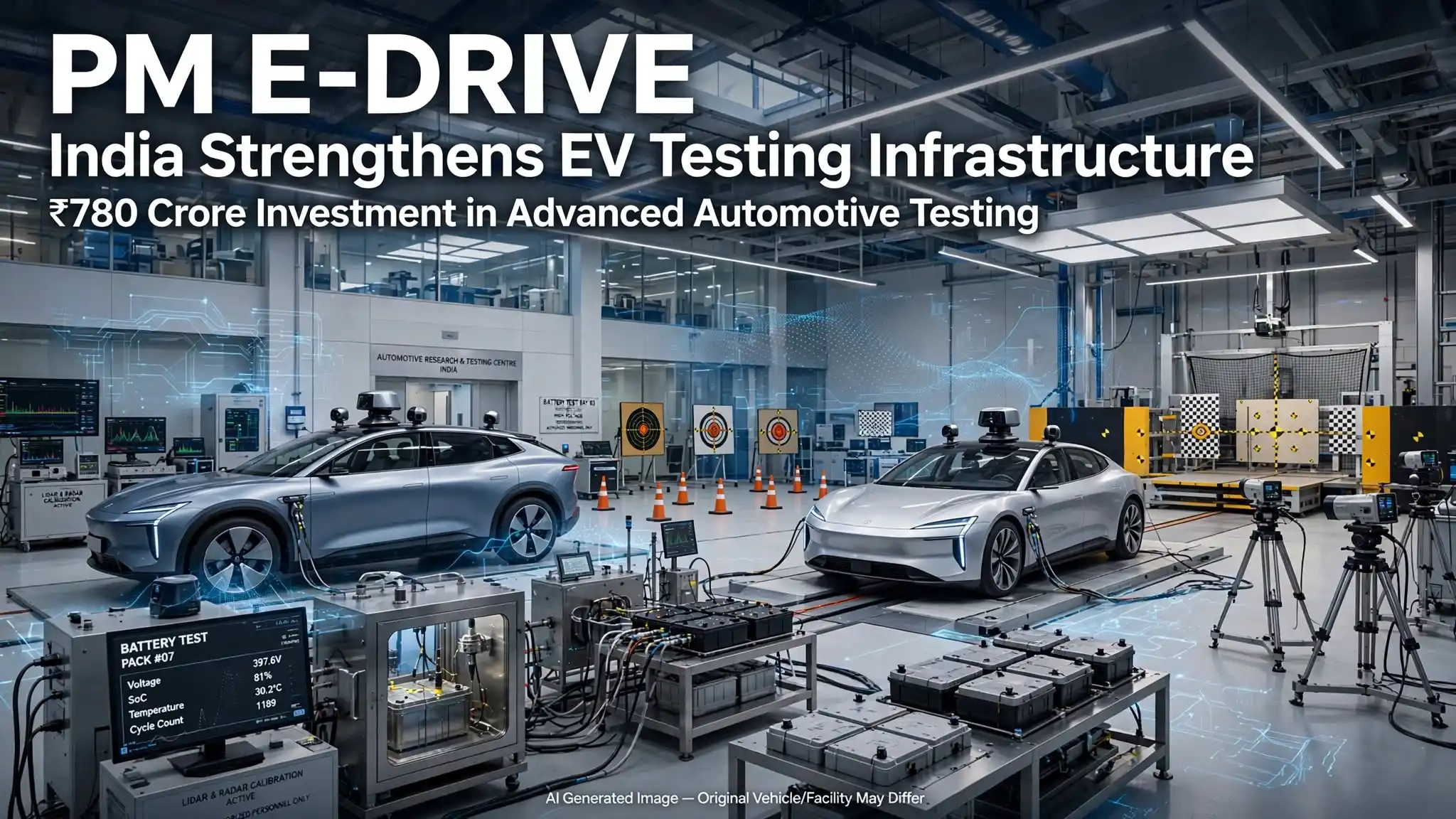
To support this need, the Government of India has allocated ₹780 crore for modernising automotive testing agencies under the PM E-DRIVE (PM Electric Drive Revolution in Innovative Vehicle Enhancement) scheme. The objective is to upgrade India’s vehicle testing infrastructure so that it can handle newer EV and advanced automotive technologies.
On 28 September 2026, the Ministry of Heavy Industries highlighted progress at the Global Automotive Research Centre (GARC) in Oragadam, Chennai, where testing infrastructure is being upgraded under PM E-DRIVE.
This development shows that India’s EV transition is not only about manufacturing more electric vehicles or building charging stations. The country is also working to strengthen the infrastructure required to test and certify these vehicles.
What Is PM E-DRIVE?
PM E-DRIVE is one of India’s major government schemes for promoting electric mobility.
The scheme has a total outlay of ₹10,900 crore. It supports EV adoption while also providing funding for public charging infrastructure and the modernisation of automotive testing agencies.
The testing-agency component has an allocation of ₹780 crore. The PM E-DRIVE scheme has now been extended until 31 March 2028.
This means the government is focusing not only on encouraging people and businesses to use EVs but also on strengthening the infrastructure needed to test the vehicles and technologies entering the market.
Why Does India Need Better EV Testing Infrastructure?
Modern EVs are very different from traditional internal-combustion-engine vehicles.
They use technologies such as:
- High-voltage battery packs
- Battery management systems
- Electric motors
- Power electronics
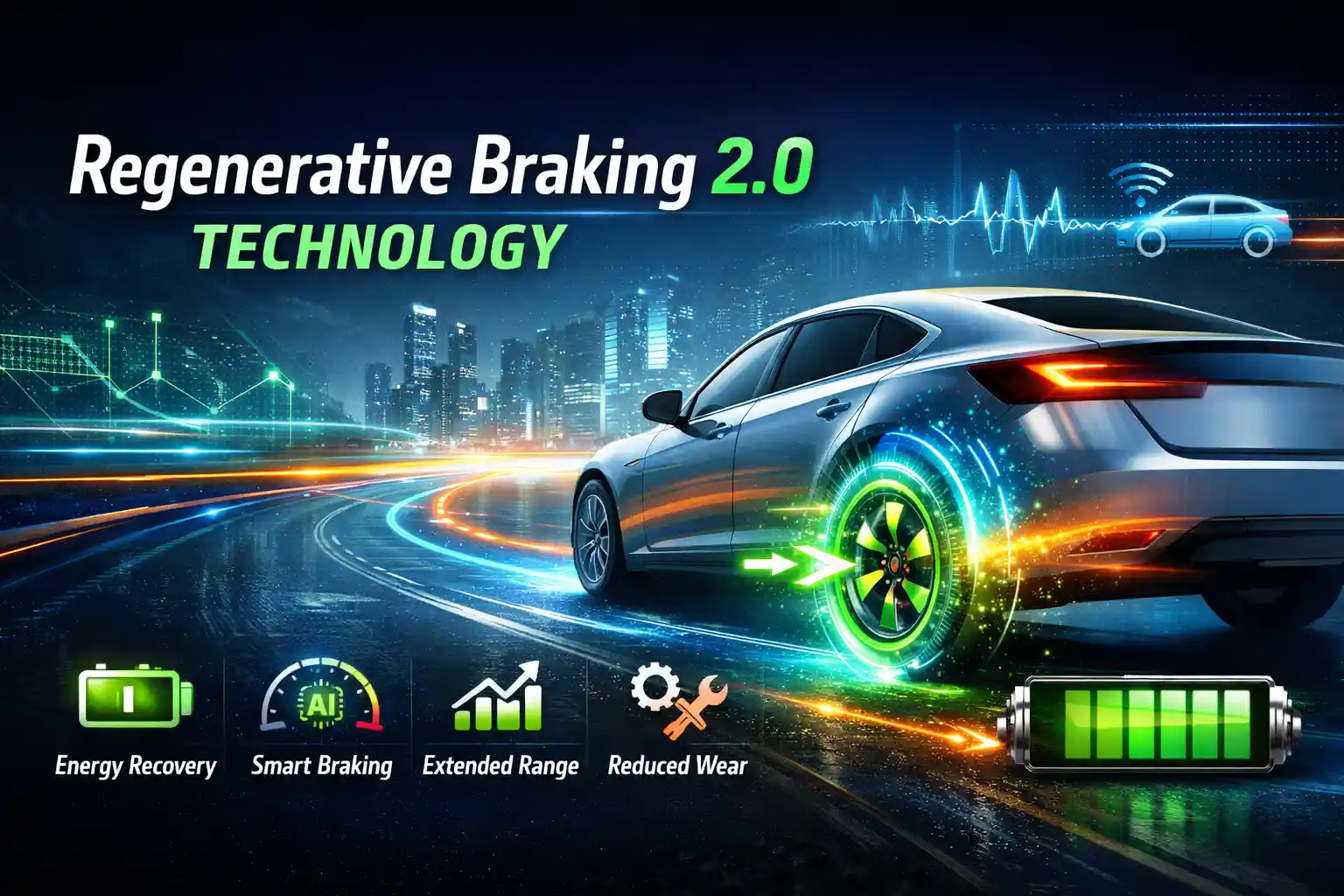
- Regenerative braking
- Advanced Driver Assistance Systems (ADAS)
- Electronic control systems
- Connected vehicle technology
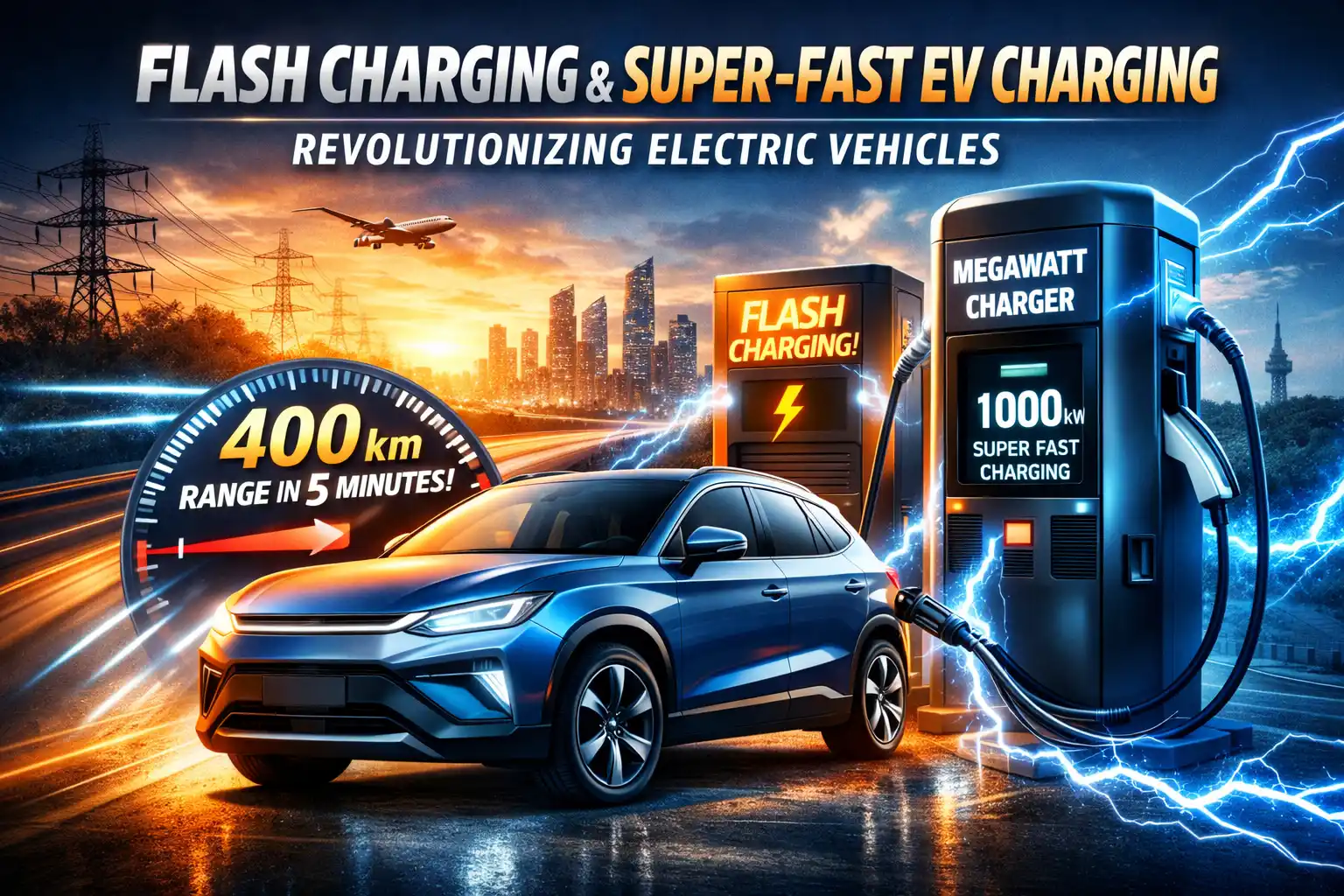
- High-speed charging systems
A technical problem in any of these systems can affect the vehicle’s performance or safety.
Battery safety is particularly important because EV batteries contain a large amount of stored electrical energy and operate under high-voltage conditions.
Therefore, testing batteries, electrical systems, crash safety, electromagnetic compatibility and other components before vehicles enter the market is increasingly important.
Four Major Automotive Testing Agencies
Under PM E-DRIVE, testing infrastructure upgrades involve four major automotive testing agencies:
- ARAI – Automotive Research Association of India, Pune
- iCAT – International Centre for Automotive Technology, Manesar
- GARC – Global Automotive Research Centre, Oragadam, Chennai
- NATRAX – National Automotive Test Tracks, Pithampur, Madhya Pradesh
These agencies play important roles in vehicle testing, certification, homologation and automotive research in India.
Where Will the ₹780 Crore Investment Go?
The PM E-DRIVE scheme provides ₹780 crore for upgrading testing agencies.
According to the Ministry of Heavy Industries’ 2025-26 Annual Report, proposals worth approximately ₹776.29 crore had been prepared for the four testing agencies.
The report also said that 67 tenders worth approximately ₹729.06 crore had been published on the Government e-Marketplace (GeM) for implementation of the upgrades.
This indicates that the testing-infrastructure programme has moved beyond simply announcing a budget allocation and has entered the procurement and implementation stage.
What Is Being Upgraded at GARC?
The Global Automotive Research Centre (GARC) is one of the key facilities being upgraded.
According to the Ministry of Heavy Industries’ update dated 28 September 2026, GARC has been allocated ₹221.13 crore under PM E-DRIVE.
GARC has issued purchase orders for almost all major proposed equipment, and installation of the equipment has also started.
Several important testing capabilities are being developed or upgraded.
1. EV and EV Battery Testing
One of the major areas is testing for electric vehicles and their batteries.
The upgraded facilities include testing according to AIS-156 requirements for EVs and batteries.
This is important because the battery is one of the most critical components of an electric vehicle.
Battery-related problems can affect the safety and reliability of the entire vehicle. Proper testing can therefore help manufacturers verify whether their battery and EV systems meet the required technical and safety requirements.
2. EV EMI/EMC Testing
GARC is also developing EV EMI/EMC testing capability under AIS-004 Part 3 Rev.1.
In simple terms, EMI/EMC testing checks how a vehicle’s electronic systems behave in the presence of electromagnetic interference and whether the vehicle itself creates interference that could affect other electronic systems.
Modern EVs contain a large number of electronic components.
As vehicles become more connected and electronically controlled, electromagnetic compatibility becomes increasingly important.
3. ADAS Testing Facility
Another important area is Advanced Driver Assistance Systems (ADAS) testing.
ADAS includes technologies that assist drivers while operating a vehicle.
Examples include:
- Automatic Emergency Braking
- Forward Collision Warning
- Lane-related assistance systems
- Adaptive Cruise Control
- Other driver-assistance functions
GARC is developing ADAS testing capabilities that include instruments and technologies such as soft targets.
This is particularly relevant as Indian vehicles increasingly adopt advanced driver-assistance technologies.
4. Advanced Crash Testing
GARC is also upgrading its passive-safety testing capabilities.
The upgrades include advanced crash-test equipment, crash-test dummies and dummy calibration equipment.
High-speed and high-resolution imaging systems are also being installed.
According to the Ministry, UHD 4K cameras can record at approximately 750 frames per second, while Full HD recording can reach around 3,000 frames per second.
During a crash test, this type of high-speed recording can help researchers analyse vehicle deformation, occupant movement and airbag deployment in greater detail.
5. Heavy Commercial Vehicle Testing
GARC is also establishing or upgrading facilities for Heavy Commercial Vehicle Testing.
This can become increasingly important as electric mobility expands beyond passenger cars and two-wheelers.
Electric buses and electric trucks are becoming a larger part of the EV ecosystem, and these vehicles require appropriate testing facilities because of their size, weight, battery systems and operating conditions.
6. Powertrain Laboratory Upgrade
The Powertrain Laboratory at GARC is also being upgraded.
In a conventional vehicle, the internal-combustion engine is the main power source. In an EV, the electric motor, battery, inverter and other power-electronics components play major roles.
Therefore, modern laboratories are required to test and analyse new electric powertrain technologies.
7. Automotive Component Testing
Testing is not limited to complete vehicles.
Individual automotive components also need to meet technical and safety requirements.
The GARC upgrade therefore includes stronger capabilities for automotive component testing.
This can benefit both vehicle manufacturers and component suppliers developing technologies for India’s growing EV industry.
How Can Better Testing Infrastructure Help the EV Industry?
The modernisation of testing infrastructure can support India’s EV ecosystem in several ways.
Better Safety Verification
Advanced testing facilities can help manufacturers verify battery, electrical and vehicle safety requirements more effectively.
Technology Development
Automakers and component manufacturers can use advanced facilities to test and validate new technologies.
Certification and Homologation
Modern testing facilities can support India’s vehicle certification and homologation ecosystem.
Support for Advanced Vehicles
As vehicles adopt more ADAS, electronic controls, electric powertrains and connected technologies, their testing requirements also become more sophisticated.
Stronger Domestic Automotive Ecosystem
Expanding India’s testing and research capabilities can strengthen the country’s domestic automotive technology ecosystem.
Why Is ADAS Testing Important for Future Autonomous Vehicles?
The PM E-DRIVE testing investment is not limited to conventional EV technology.
The inclusion of ADAS testing is particularly relevant to India’s future autonomous-vehicle ecosystem.
ADAS and fully autonomous driving are not the same thing. ADAS systems assist the human driver, while autonomous systems are designed to perform more of the driving task.
However, both areas can involve technologies such as:
- Cameras
- Radar
- Sensors
- Electronic control systems
- Software
- Vehicle perception systems
As advanced driver-assistance and autonomous-driving technologies develop in India, testing infrastructure will also need to evolve.
Therefore, the current investment can help create a foundation for testing more advanced automotive technologies in the future.
Testing Infrastructure and Charging Infrastructure Are Different
It is important to understand that testing infrastructure and charging infrastructure serve different purposes.
Under PM E-DRIVE, the government has allocated ₹2,000 crore for public charging infrastructure, while ₹780 crore has been allocated for upgrading testing agencies.
Charging infrastructure is designed to make it easier for EV users to charge their vehicles.
Testing infrastructure, on the other hand, is designed to test vehicles, batteries, components and technologies before or during their entry into the market.
Both are important, but they address different parts of the EV ecosystem.
What Does This Mean for India’s EV Industry?
India’s EV industry is expanding beyond electric cars and two-wheelers.
The country is developing capabilities across:
- EV manufacturing
- Batteries
- Electric powertrains
- Automotive components
- Charging infrastructure
- Vehicle software
- ADAS
- Connected vehicles
- Autonomous-driving technologies
For such an ecosystem, three elements need to develop together:
Manufacturing + Testing + Infrastructure
If vehicle production and technology development grow faster than testing capacity, testing and certification can become a constraint.
The PM E-DRIVE testing component is intended to strengthen this part of the ecosystem.
Does More Testing Infrastructure Automatically Mean Safer EVs?
Not necessarily.
Investment in testing infrastructure does not automatically mean that every EV entering the market will be safer or better.
The actual outcome will depend on several factors, including:
- The strength of applicable testing standards
- Compliance by manufacturers
- The effectiveness of testing procedures
- Implementation of certification requirements
- How efficiently the upgraded facilities are operated
- How widely manufacturers and component companies use these facilities
Therefore, the ₹780 crore allocation is an input, not a final outcome.
Its long-term impact will become clearer as the upgraded facilities become operational and are used for real-world testing, certification and technology development.
Why Is This Important for India’s Long-Term EV Transition?
India is increasingly developing an automotive ecosystem that goes beyond simply importing or selling electric vehicles.
The country is building capabilities in manufacturing, batteries, components, software, charging and advanced automotive technologies.
For this ecosystem to grow sustainably, India needs strong capabilities in:
Manufacturing → Testing → Certification → Market Deployment
Testing infrastructure is therefore an important but less visible part of the EV transition.
Consumers may see a new electric car, a charging station or a new battery technology, but behind those products there is a larger system of engineering, testing and certification.
Conclusion
The ₹780 crore testing-infrastructure component of PM E-DRIVE is aimed at strengthening an important part of India’s EV ecosystem.
As electric vehicles become more advanced, testing requirements are also becoming more complex. Batteries, electric powertrains, electronic systems, ADAS, crash safety and connected technologies all require appropriate testing capabilities.
The upgrades at GARC include EV and battery testing, EMI/EMC testing, ADAS testing, advanced crash testing, heavy commercial vehicle testing, powertrain laboratory upgrades and component testing.
The development is also relevant beyond today’s EVs. As India moves toward more advanced driver-assistance and eventually more automated driving technologies, modern testing infrastructure can become increasingly important.
However, the success of the programme will ultimately depend on how quickly the upgraded facilities become fully operational and how effectively they are used by India’s automotive industry.
In simple terms, PM E-DRIVE is not only helping India build and adopt more electric vehicles. It is also helping build the testing ecosystem needed to develop, verify and certify the next generation of vehicles and automotive technologies in India.
Source: pib