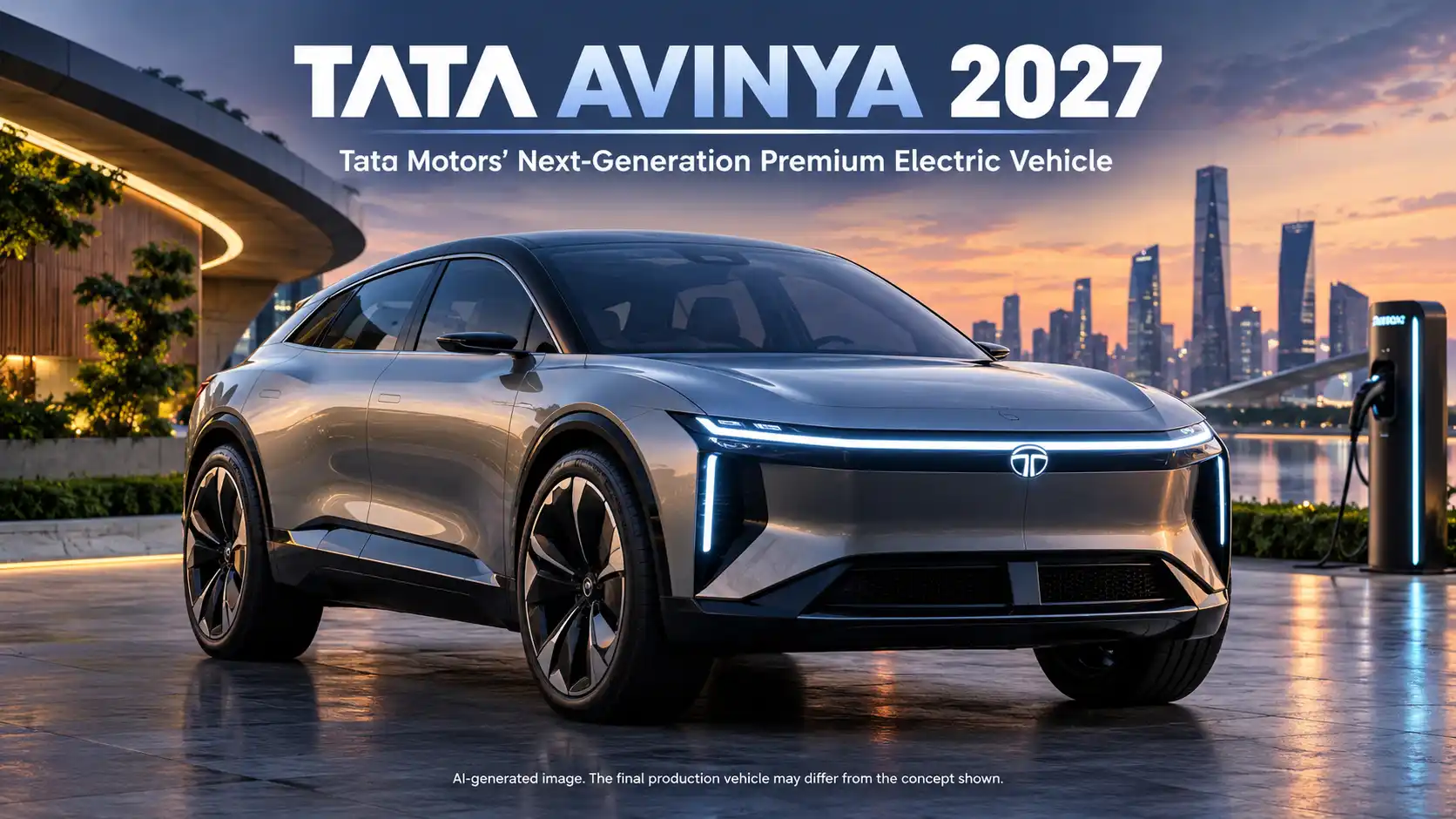
The electric vehicle market in India is entering a new phase. While Tata Motors has already established a strong position with electric models such as the Nexon EV, Punch EV, Curvv EV and Harrier EV, the company is preparing for a much more ambitious step with its Tata Avinya programme.
Avinya is not simply another electric car from Tata Motors. It represents the company’s vision for a next-generation premium electric vehicle family, combining futuristic design, advanced software, fast charging, spacious interiors, connected technology and advanced driver-assistance features.
Tata Motors first unveiled the Avinya concept in April 2022. At the time, the company presented it as a new-generation, pure-electric vehicle based on a dedicated EV architecture. The name “Avinya” comes from a Sanskrit word associated with innovation.
The original concept was designed to show how Tata believed future electric cars could look and feel. Since then, the project has evolved, and its timeline has shifted. Tata is now targeting 2027 for the introduction of the Avinya programme.
The important point is that Avinya should not be viewed only as one car. Tata appears to be developing it as a broader premium EV family, with multiple models potentially arriving over time.
What Is Tata Avinya?
Tata Avinya is a next-generation premium electric vehicle programme from Tata Motors.
Unlike an electric version of an existing petrol or diesel vehicle, the original Avinya concept was designed around the idea of a pure electric architecture.
This approach gives engineers greater freedom to design the vehicle around the battery, electric motors, cabin and software from the beginning.
In simple terms, Tata’s EV portfolio can be viewed broadly like this:
- Punch EV – mass-market electric vehicle
- Nexon EV – mainstream electric SUV
- Curvv EV – premium mainstream EV
- Harrier EV – larger premium EV
- Avinya – next-generation premium EV family
Therefore, Avinya is expected to sit above Tata’s existing mainstream EV portfolio.
When Was the Avinya Concept Introduced?
Tata Motors unveiled the original Avinya concept in April 2022.
At the time, the company described it as a vision for its next generation of electric mobility. Tata’s original plans indicated that an Avinya-based vehicle could reach the market earlier, but the programme subsequently faced changes in its development strategy and timeline.
By 2025, Tata Motors executives indicated that the Avinya programme had moved towards a 2027 launch timeline.
Tata’s current official Avinya information also points towards a 2027 market introduction.
This makes 2027 an important year for Tata’s premium EV strategy.
Is Avinya One Car or an EV Family?
This is one of the most important things to understand about Avinya.
Avinya is increasingly being positioned as more than a single vehicle.
Tata’s long-term strategy is expected to include a family of premium electric vehicles using the Avinya name and design philosophy.
Different body styles could eventually include:
- Crossovers
- SUVs
- Sportback-style vehicles
- Other premium electric body styles
This strategy would allow Tata to use the Avinya technology and design philosophy across multiple vehicles instead of developing an entirely new technology package for every model.
What Is Tata Avinya X?
One of the most important developments in the Avinya programme is the Avinya X.
Tata showcased the Avinya X concept in 2025. Compared with the original 2022 Avinya concept, the Avinya X has a stronger SUV and crossover character.
The vehicle provides a clearer indication of how Tata’s futuristic Avinya design language could be converted into a production-oriented vehicle.
Recent reports suggest that Tata has revised its product roadmap and that the Avinya X is now an important part of the production programme.
This makes Avinya X particularly important for anyone following Tata’s 2027 EV plans.
Why Does the Avinya Design Look Different?
The original Avinya concept was designed to look very different from conventional cars.
It combines characteristics associated with several vehicle categories.
The concept attempted to bring together:
- The compactness of a hatchback
- The practicality of an SUV
- The space of an MPV
- The comfort and styling of a premium vehicle
This resulted in a futuristic crossover-like shape.
The design is also based on clean surfaces and aerodynamic proportions rather than the traditional three-box sedan structure.
Tata has said that the concept’s design was inspired by a catamaran, particularly its sense of stability and open space.
Futuristic Doors and Exterior Design
The original Avinya concept featured dramatic butterfly-style doors.
These doors open upward and outward and were designed primarily to make the concept look futuristic and improve access to the spacious cabin.
However, it is important to remember that a concept vehicle and a production vehicle are not always identical.
Production cars have to meet strict requirements related to:
- Safety
- Cost
- Manufacturing
- Durability
- Practicality
- Regulatory compliance
Therefore, some of the most dramatic concept features may be changed before production.
Interior Designed Around Space and Comfort
The interior is one of the most interesting aspects of the Avinya concept.
Instead of filling the dashboard with multiple conventional screens and physical controls, Tata’s concept focused on a more minimalist and relaxing environment.
The philosophy was essentially:
Less distraction and more comfort.
The cabin was designed to feel open and spacious, helped by the electric vehicle architecture.
EVs can provide greater freedom in cabin packaging because they do not need a large traditional engine and transmission tunnel.
This can create:
- More legroom
- Better passenger space
- A flatter floor
- Greater interior flexibility
The Sky Dome
Another futuristic feature shown on the Avinya concept was its large sky dome.
The objective was to bring more natural light into the cabin and create a feeling of openness.
Large glass areas can make an EV cabin feel significantly larger than its exterior dimensions suggest.
Whether the exact concept-style sky dome reaches production remains uncertain, but the overall focus on a spacious and premium cabin is likely to remain important.
Voice and Connected Technology
Avinya is designed around the idea that future cars will increasingly operate like intelligent connected devices.
Voice interaction is expected to play an important role.
Instead of requiring drivers or passengers to manually operate every function, voice commands could potentially be used for functions such as:
- Navigation
- Climate control
- Entertainment
- Communication
- Vehicle settings
This approach could make the driving experience more convenient while reducing dependence on physical buttons and multiple displays.
AI and Software Could Become Major Features
One of the biggest differences between future EVs and older-generation cars is the importance of software.
Avinya is expected to put greater emphasis on software-defined vehicle technology.
Potential software features could include:
- Intelligent voice assistants
- Connected services
- Over-the-air software updates
- Smart navigation
- Energy management
- Vehicle diagnostics
- Driver-assistance systems
This means that the vehicle could potentially receive software improvements after purchase instead of remaining exactly the same throughout its lifetime.
For Tata Motors, this is an important transition from being primarily an automotive manufacturer to becoming a more software-driven mobility company.
What Is the Gen 3 EV Architecture?
The original Avinya concept was associated with Tata’s Gen 3 pure-electric architecture.
The basic idea behind a dedicated EV architecture is simple.
A conventional petrol or diesel vehicle needs space for:
- Engine
- Transmission
- Fuel tank
- Exhaust system
- Related mechanical components
An EV has a completely different layout.
Its major components include:
- Battery pack
- Electric motors
- Power electronics
- Charging system
This allows engineers to design the cabin and vehicle structure differently.
A dedicated EV architecture can potentially provide better packaging, more cabin space, improved efficiency and greater flexibility for different vehicle sizes.
Tata Has Revised the Platform Strategy
One of the most important developments in the Avinya programme is the change in platform strategy.
The original programme involved Tata’s next-generation EV architecture and links with Jaguar Land Rover’s future EV technology.
However, recent reports indicate that Tata Motors has revised its approach.
Reports suggest that the Avinya programme is now moving towards a platform connected to the Chery-JLR Freelander ecosystem, rather than following the previously discussed JLR EMA-based approach.
The change could help Tata reduce development time and costs while allowing the company to localise and adapt the technology for its own requirements.
This is an important example of how long-term automotive projects can evolve between concept stage and production.
Battery and Range
Tata has not yet revealed all final production specifications of the Avinya.
However, the original concept provided an important charging target.
Tata said the vehicle could potentially add around 500 km of driving range in less than 30 minutes using suitable fast-charging technology.
This should not be interpreted as a confirmed production specification.
Instead, it was part of the original concept’s technology vision.
The final production vehicle’s:
- Battery capacity
- Official range
- Charging speed
- Charging architecture
will need to be confirmed by Tata closer to launch.
Some engineering material has also referenced an approximately 81.4 kWh battery pack concept, but this should not be treated as the confirmed battery specification of the production Avinya.
Will Avinya Have All-Wheel Drive?
The final drivetrain specifications have not yet been completely confirmed.
Depending on the production model, Tata could potentially offer rear-wheel-drive and/or all-wheel-drive configurations.
An AWD version would have advantages such as:
- Better traction
- Improved acceleration
- Greater stability
- Better grip in difficult conditions
However, buyers should wait for Tata’s official production specifications before assuming that a particular drivetrain will be offered.
Will Tata Avinya Be Fully Autonomous?
This is another area where it is important to separate expectations from confirmed information.
Tata has not officially positioned Avinya as a Level 4 or Level 5 fully autonomous vehicle.
However, the original concept included advanced driver-assistance technology as part of the vehicle’s next-generation technology package.
Possible features could include:
- Adaptive cruise control
- Lane assistance
- Automatic emergency braking
- Blind-spot monitoring
- Traffic assistance
These features can make driving safer and easier, but they should not automatically be described as full self-driving.
The exact autonomous and ADAS capabilities will depend on the production model.
Expected Price and Premium Positioning
Avinya is expected to sit significantly above Tata’s mainstream EVs.
Industry reports have suggested a potential starting price above ₹30 lakh, although Tata Motors has not officially announced the final price.
The final price will depend on:
- Battery size
- Vehicle size
- Technology
- Production cost
- Features
- Localisation
- Variant strategy
If Tata successfully positions Avinya in the premium segment, it could become an important competitor to higher-priced electric vehicles from international brands.
Expected Launch Timeline
The current target for the Avinya programme is 2027.
Tata’s official information points towards a 2027 market introduction, while recent industry reporting also supports the 2027 timeline.
The exact launch date, however, should not be considered final until Tata announces it.
The Avinya X is particularly important because recent reports suggest that it could play a major role in the first phase of production.
Therefore, for 2027, the most accurate description is:
Tata Avinya – Planned/Expected 2027
rather than presenting a specific month as confirmed.
Who Could Be Avinya’s Competitors?
The exact competition will depend on the final body style and pricing.
Potential competitors could include premium EVs such as:
- Hyundai Ioniq 5
- Kia EV6
- BMW iX
- Mercedes-Benz electric SUVs
- Volvo electric SUVs
- Other upcoming premium electric vehicles
However, Avinya will not necessarily compete only on battery range or acceleration.
Tata’s broader proposition could be:
Design + Space + Technology + Software + Comfort + Fast Charging + Premium Experience
Why Is Avinya Important for Tata Motors?
Avinya could be strategically important for Tata Motors for several reasons.
First, it can help Tata move further into the premium EV market.
Second, it provides an opportunity to introduce new software and electronic technologies.
Third, it can help Tata develop a broader dedicated EV technology base.
Fourth, a successful premium EV could improve Tata’s brand positioning beyond the mass-market segment.
Most importantly, Avinya could become the foundation for multiple future electric vehicles.
Major Challenges for Avinya
Despite its potential, the Avinya programme also faces several challenges.
Battery Cost
Large batteries can significantly increase vehicle prices.
Charging Infrastructure
Ultra-fast charging is useful only when sufficiently powerful charging stations are available.
Software Quality
Premium customers will expect software to be fast, reliable and easy to use.
Premium Customer Expectations
Customers spending ₹30 lakh or more expect excellent:
- Interior quality
- Performance
- Technology
- Safety
- Comfort
- After-sales service
Competition
By 2027, India’s premium EV market could become much more competitive, with both Indian and international manufacturers introducing new models.
Outcome
Tata Avinya is much more than a futuristic concept car.
It represents Tata Motors’ attempt to move into the next generation of electric mobility, where the vehicle is built around electric power, software, connectivity, intelligent assistance and premium design.
The project has evolved considerably since its original unveiling in 2022. Its launch timeline has moved toward 2027, and Tata’s platform and product strategy have also changed.
The Avinya X is particularly important because it provides a clearer indication of how the original futuristic concept could evolve into a production vehicle.
If Tata manages to deliver competitive range, fast charging, high-quality software, premium interiors and strong ADAS technology at an attractive price, Avinya could become one of the company’s most important EV programmes.
For Indian consumers, the bigger significance is that Avinya could demonstrate that an Indian automaker can compete in the premium electric vehicle segment with a technology-focused product designed for the next generation of mobility.
Tata Avinya: Quick Facts
| Feature | Details |
| Company | Tata Motors / Tata.ev |
| Vehicle Type | Premium Electric Vehicle |
| Programme | Avinya EV Family |
| Original Concept | 2022 |
| Expected Introduction | 2027 |
| Powertrain | Fully Electric |
| Platform Strategy | Next-generation EV architecture; strategy revised |
| Original Charging Target | 500 km range added in under 30 minutes* |
| Battery | Final production specification not confirmed |
| Range | Not officially confirmed |
| ADAS | Expected/Planned |
| Level 4/5 Autonomy | Not officially confirmed |
| Expected Positioning | Premium EV |
| Important Concept | Avinya X |
| Launch Status | Planned/Expected for 2027 |
*The charging figure refers to Tata’s original concept target and should not be considered a confirmed production specification.
Conclusion
The Tata Avinya could become a major milestone in India’s electric vehicle journey. Tata Motors has already built a strong presence in the mainstream EV market, but Avinya is intended to take the company into a more advanced and premium segment.
Its success will ultimately depend on what reaches production—not just the futuristic concept shown at motor shows.
If Tata can combine competitive pricing, long range, fast charging, premium design, advanced software and reliable driver-assistance technology, the Avinya family could become an important part of Tata Motors’ EV strategy from 2027 onward.
In other words, Avinya is not simply Tata’s next electric car; it is a potential preview of what Tata Motors’ next generation of premium electric vehicles could look like.
Source: tatamotors , media reports