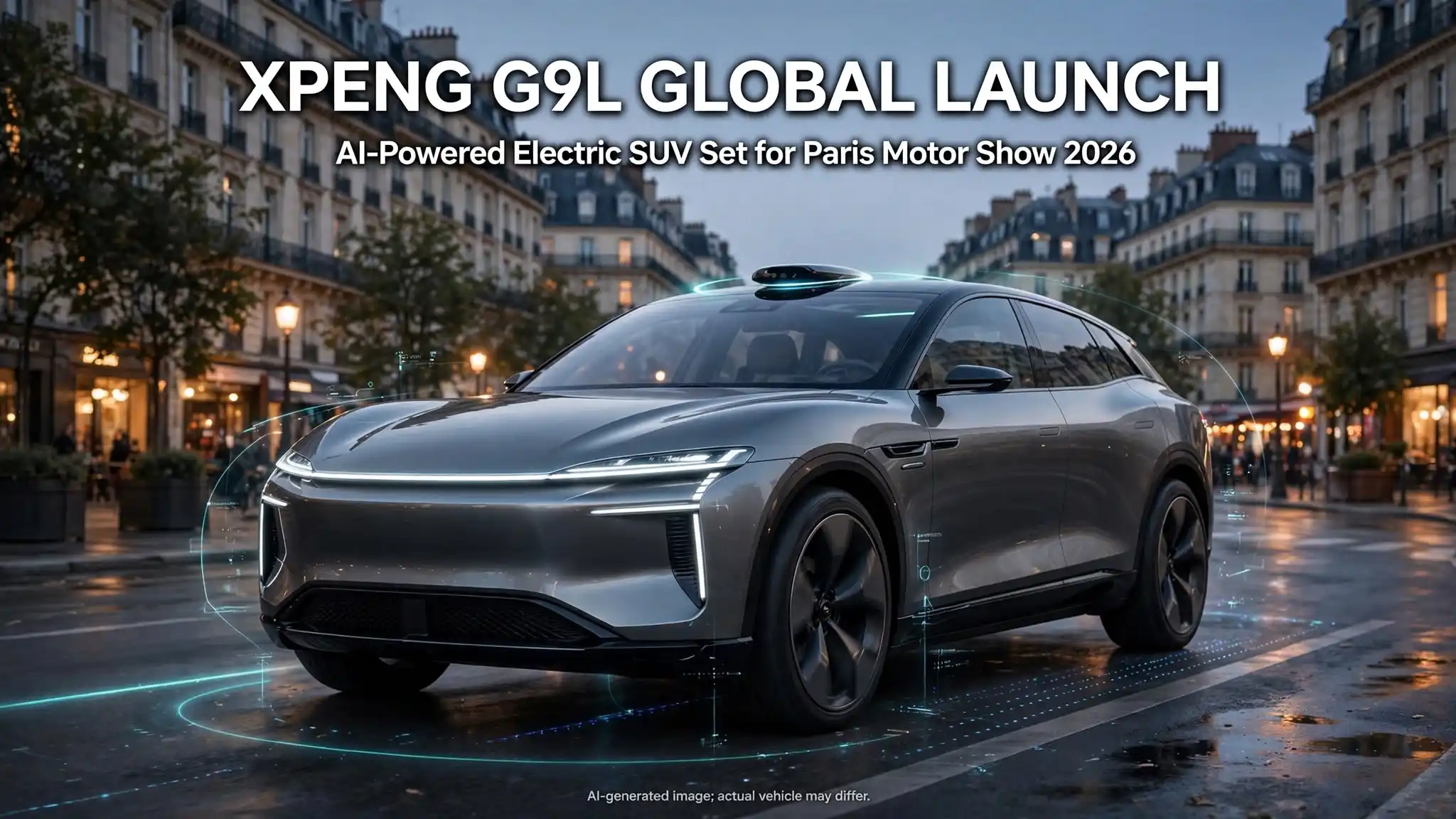
XPENG is preparing to take its latest technology-focused SUV to the global market with the G9L, a new flagship model that combines electric power, extended-range technology, advanced AI and intelligent driving features. The company has already launched the G9L in China and is now preparing for its global launch at the 2026 Paris Motor Show on October 12, 2026.
The G9L is more than a conventional electric SUV for XPENG. The company is positioning it as a Next-Gen AI Flagship SUV, using technologies from its wider Physical AI ecosystem. These include its VLA 2.0 AI model, Turing AI chip technology and intelligent driving systems.
The global launch is also important because XPENG plans to introduce the G9L in 64 global markets, while European production is planned at Magna’s facility in Graz, Austria.
XPENG G9L Global Launch: What Is Happening?
XPENG will officially present the G9L to the global market at the Paris Motor Show from October 12 to October 18, 2026.
The company’s press conference for the G9L is scheduled for October 12 at the XPENG booth in Hall 6. European customers will also be able to see the vehicle, while XPENG plans to open European order books and announce European pricing at the event.
The Paris launch is not the first launch of the G9L. XPENG launched the model in China on September 17, 2026. The company says the vehicle will eventually be introduced in 64 countries and regions.
This makes the Paris event an important step from a China-market launch to a broader global rollout.
What Is the XPENG G9L?
The G9L is a large five-seat flagship SUV developed around three major ideas:
- Electric and extended-range power
- Artificial intelligence and intelligent driving
- Premium comfort and safety
XPENG offers the G9L in both BEV and REEV versions.
BEV means Battery Electric Vehicle, where the vehicle is powered entirely by electricity.
REEV means Range-Extended Electric Vehicle. In this type of vehicle, the wheels are driven electrically, while an engine-generator system can provide additional energy when required.
This gives customers two different approaches: a fully electric version for those who primarily want an EV, and an extended-range version for drivers who want additional flexibility on longer journeys.
Large SUV With a Long Wheelbase
The G9L is designed as a large five-seat SUV rather than a compact family EV.
Its key dimensions include:
| Specification | XPENG G9L |
| Vehicle type | Large SUV |
| Seating | 5 |
| Length | 5,120 mm |
| Wheelbase | 3,100 mm |
| Powertrain | BEV / REEV |
| Maximum claimed pure-electric range | Up to 755 km CLTC |
| Maximum claimed combined range | Up to 1,602 km CLTC |
| Charging architecture | 800V |
| Fast charging | 5C |
| Global markets planned | 64 |
Note: The global launch announcement focused mainly on the G9L’s upcoming European debut, AI technology and international rollout. Some of the specifications were previously disclosed by XPENG during the vehicle’s China launch and pre-sale announcements.
XPENG’s official Chinese specifications list up to 755 km CLTC range for the pure-electric version and up to 1,602 km CLTC combined range for the range-extended version. These are CLTC figures, so real-world range can be different depending on driving conditions, temperature, speed, vehicle configuration and other factors.
800V Platform and Fast Charging
One of the important technologies in the G9L is its 800V electrical architecture.
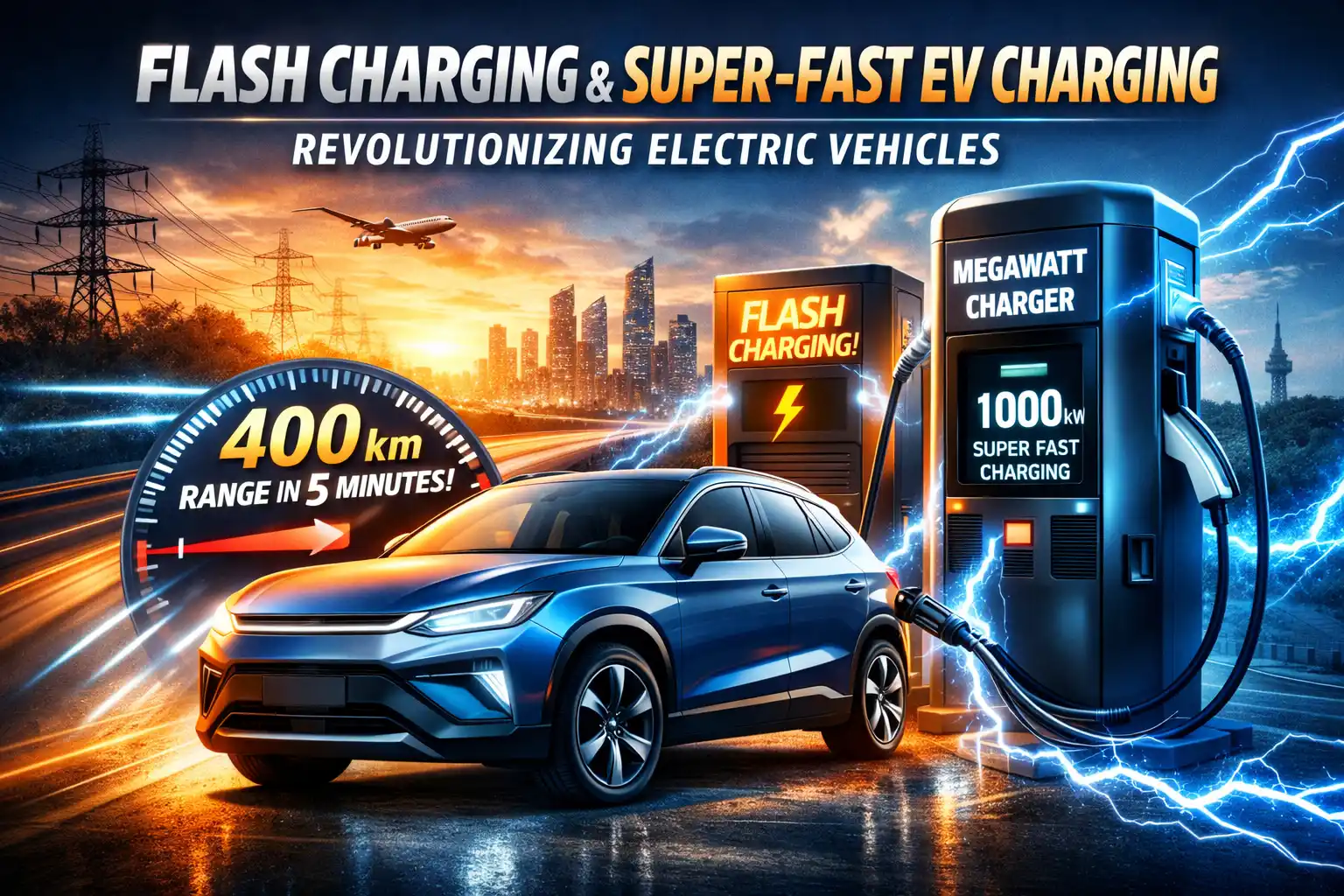
The company says the vehicle uses 5C fast-charging technology. According to XPENG’s Chinese product information, the pure-electric version can add more than 450 km of CLTC range in around nine minutes under the company’s specified charging conditions.
For the range-extended version, XPENG lists more than 300 km of CLTC electric range added in nine minutes.
In simple terms, the purpose of this technology is to reduce charging waiting time.
For an EV owner, faster charging can be particularly useful during long-distance travel, where a short charging stop can add a significant amount of driving range.
The AI Technology Behind the G9L
The most interesting part of the G9L is not simply its battery or size. XPENG is using the vehicle to bring its Physical AI technology into a production vehicle.
The G9L is the first XPENG model to launch with the company’s newer VLA 2.0 system.
VLA stands for Vision-Language-Action. In simple terms, this type of AI is designed to connect what the vehicle sees with its understanding of the environment and the actions required for driving.
XPENG says VLA 2.0 is designed to provide better generalization across different regions and driving environments. This is particularly important for a company trying to take its intelligent-driving technology from China into international markets.
What Is XPENG’s Physical AI?
XPENG is increasingly describing itself as a Physical AI company, rather than only an EV manufacturer.
The basic idea is simple: AI should not only generate information on a computer or smartphone. It should also understand and interact with the physical world.
For XPENG, that includes:
- Smart electric vehicles
- Intelligent driving
- Robotaxis
- Humanoid robots
- Flying-car technology
The company is developing a common technology foundation across these areas.
This is why the G9L is important to XPENG’s strategy. The SUV becomes one of the physical products through which the company’s AI technology reaches ordinary consumers.
Turing AI Chip: The Vehicle’s AI Computing Power
XPENG has also connected the G9L with its Turing AI chip technology.
The company says the same Turing AI chip architecture is used across its AI vehicle and humanoid-robot development.
XPENG’s technology information describes its Turing AI chip as an automotive-grade AI processor with up to 750 TOPS effective computing power, a 40-core processor and support for large AI models.
The important point is that higher onboard computing capability can help vehicles process information from cameras, sensors and AI models more quickly.
However, high computing power by itself does not automatically mean that a vehicle is Level 4 autonomous. Autonomous driving capability depends on the complete combination of hardware, software, AI models, safety systems, validation and regulatory approval.
Is XPENG G9L a Fully Autonomous Level 4 Car?
This is an important distinction.
The G9L is an AI-powered intelligent-driving SUV, but it should not simply be described as a fully autonomous Level 4 passenger vehicle.
XPENG separately operates a Robotaxi program for higher-level autonomous driving.
The company has said that selected L4-level capabilities developed for its Robotaxi program are being brought toward passenger vehicles through its newer AI systems, with regulatory approval in Europe targeted before overseas deliveries of those capabilities.
Therefore, the more accurate description for the G9L is:
AI-powered EV/REEV SUV with advanced intelligent-driving technology, rather than a fully autonomous L4 production car.
Safety and Global Testing
Because XPENG wants to sell the G9L internationally, the company says the SUV was developed around global safety requirements.
XPENG says the G9L completed 192 crash tests across four major testing protocols:
- Euro NCAP
- ANCAP
- C-NCAP
- CIASI
The company says these tests covered more than 110 individual test items.
XPENG also states that the G9L underwent road testing across 26 countries and regions, accumulating more than 6.74 million kilometres of testing.
These figures are company-reported development and testing figures, rather than independent safety-test ratings. Actual Euro NCAP or other market-specific safety ratings should therefore be considered separately when officially published.
From China to Europe: Local Production
Another important part of the G9L story is European production.
XPENG says the G9L will be produced in Guangzhou, China, and Graz, Austria.
The Graz production will be carried out at the Magna facility, where XPENG is already producing other models.
According to XPENG, the G9L will become its fourth model produced in Europe, following the G6, G9 and P7+.
This is important because local production can help an automaker respond more effectively to regional requirements, supply-chain needs and market demand.
It also fits XPENG’s stated strategy of “In Europe, For Europe”, which includes European R&D, local manufacturing and adapting intelligent-driving technology to European roads and regulations.
XPENG and Tesla at the Paris Autonomous Lab
The G9L launch will take place alongside another important autonomous-driving development.
XPENG and Tesla are expected to be the only two automakers participating in the Paris Motor Show’s official Autonomous Lab.
XPENG will use its L03 SUV coupe for the official autonomous-driving experience rather than the G9L itself.
The company says this will be its first large-scale NGP test-ride experience outside China.
This gives European customers and media an opportunity to experience XPENG’s intelligent-driving technology in a real-world environment.
Why the G9L Is Important for XPENG
The G9L is important because it brings together several parts of XPENG’s technology strategy in one vehicle.
The company is trying to move from being known mainly as a Chinese EV manufacturer toward becoming a broader technology company focused on AI, robotics and intelligent mobility.
The G9L combines:
EV technology + range-extender technology + AI + intelligent driving + connected cockpit + high-speed charging + global manufacturing.
This makes the vehicle part of a much larger strategy rather than simply another SUV launch.
China Launch and Pricing
The G9L was officially launched in China on September 17, 2026.
XPENG’s Chinese website lists six configurations across its BEV and range-extended versions. The listed regular prices range from approximately RMB 241,800 to RMB 319,800, depending on the variant.
XPENG also offered limited-time launch pricing and benefits in China.
However, these Chinese prices should not be used as European or Indian prices.
XPENG has specifically said that European order books and European pricing will be announced at the Paris Motor Show.
What Makes the G9L Different?
The G9L’s main difference is the way XPENG combines vehicle technology with AI.
Traditional EV development often focuses on:
Battery → Motor → Range → Charging
The G9L adds another layer:
Battery + Motor + AI Chip + AI Model + Intelligent Driving + Connected Cockpit
This approach is becoming increasingly important as automakers compete not only on driving range and acceleration but also on software and intelligent-driving features.
What Could Happen Next?
The next major milestone is the October 12, 2026 global launch at the Paris Motor Show.
At that event, the most important information for international buyers will be:
- European pricing
- European variants
- Final specifications
- Delivery timeline
- Intelligent-driving features available in Europe
- Local production plans
- Market-by-market rollout
The G9L is planned for 64 global markets, but the exact equipment and intelligent-driving functions can differ between countries because regulations, road conditions and certification requirements are different.
Sources: XPENG Official – G9L Global Launch at Paris Motor Show | XPENG Official – G9L China Launch & Specifications |