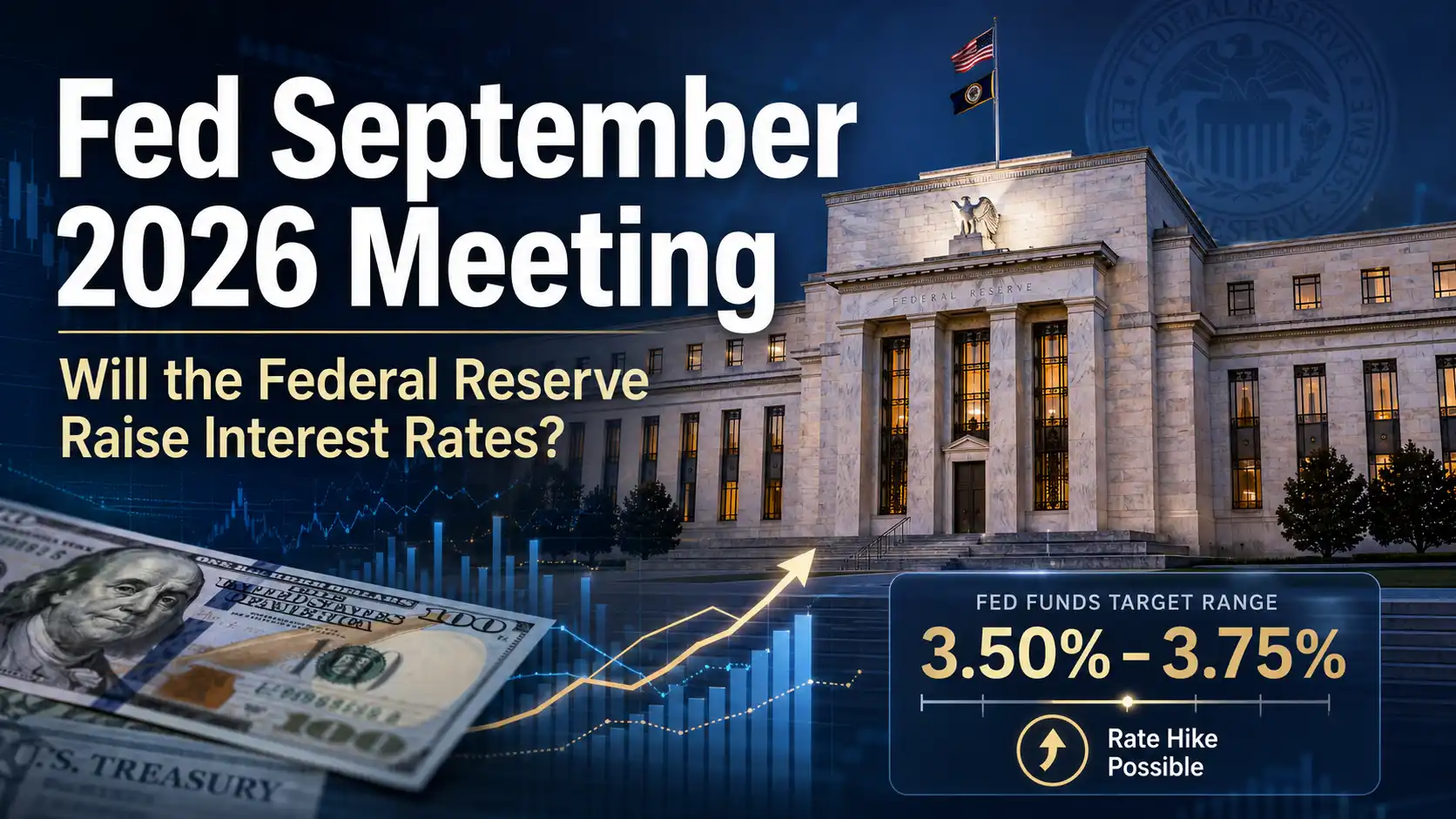
The U.S. Federal Reserve is heading toward one of the most closely watched monetary policy meetings of 2026. The Federal Open Market Committee (FOMC) is scheduled to meet on September 15–16, 2026, and investors will be watching closely to see whether the central bank keeps interest rates unchanged or starts raising them again to control persistent inflation. The meeting is particularly important because it will also include a new Summary of Economic Projections, giving markets a fresh look at policymakers’ expectations for inflation, economic growth, employment and interest rates.
At its previous meeting on July 28–29, the Fed kept the federal funds target range unchanged at 3.50%–3.75%. However, the decision was not unanimous. Three policymakers voted for a 25-basis-point rate increase, producing a 9–3 vote. The August 19 minutes then showed that inflation concerns had intensified and that a larger group of policymakers believed further tightening could become necessary if inflation remained above the Fed’s 2% target.
This has created an unusual situation. The market is not simply asking whether the Fed will cut rates. Instead, the key question has become whether the Fed could raise rates in September.
When Is the September Fed Meeting?
The next FOMC monetary-policy meeting is scheduled for:
September 15–16, 2026
The Federal Reserve’s official calendar confirms these dates. It also marks the September meeting with an asterisk because it is accompanied by a Summary of Economic Projections.
This means investors will receive more than just the interest-rate decision. They will also get updated projections that can provide clues about where Fed policymakers expect interest rates and inflation to move.
The decision will be announced on September 16.
What Is the Fed’s Current Interest Rate?
The Fed’s current federal funds target range is:
3.50%–3.75%
The central bank maintained this range at its July 28–29 meeting. The official statement said inflation remained elevated relative to the Fed’s 2% objective, while economic activity was expanding at a solid pace.
Therefore, the September meeting starts with rates already at 3.50%–3.75%.
The main possibilities are:
- No change: 3.50%–3.75%
- 25-basis-point hike: 3.75%–4.00%
- A rate cut is technically possible, but current inflation concerns make it a less obvious outcome.
Why Has a September Rate Hike Become a Possibility?
The biggest reason is inflation.
The Fed’s official July meeting statement said inflation remained elevated relative to its 2% target. Policymakers also noted that supply shocks, including higher energy prices, had contributed to price increases.
The July meeting minutes released on August 19 provided an even clearer warning.
Three policymakers wanted an immediate 25-basis-point hike in July, while several other officials indicated that additional tightening could become appropriate if inflation failed to move toward the Fed’s 2% target.
This means the possibility of a September hike is not simply a market rumor. It is supported by an actual debate within the FOMC.
The 9–3 Vote Is a Major Signal
The July decision was particularly significant because three officials dissented.
They wanted the Fed to increase interest rates by 25 basis points rather than leave them unchanged.
A three-member dissent is notable because it demonstrates that the committee is becoming more divided over the appropriate response to inflation. Reuters described the three dissenters as the largest unified dissent at a Fed meeting since 2016.
However, it would be wrong to assume that the Fed has already decided to hike in September.
The committee remains data-dependent.
The economic data released between the July and September meetings will be crucial.
Inflation Has Improved, But the Problem Has Not Disappeared
The latest July CPI data provided some relief.
According to the U.S. Bureau of Labor Statistics, consumer prices increased 0.1% in July, while the unemployment rate stood at 4.1%. July payroll employment declined by 23,000.
This softer inflation and weaker employment picture creates an argument against an immediate rate increase.
The Fed therefore faces a difficult balance.
If inflation is still too high, raising rates could help bring demand and price pressures down.
But if the labor market is weakening, another rate increase could put additional pressure on businesses and employment.
Why the Labor Market Matters
The Fed has a dual mandate:
Price stability + maximum employment
This means the central bank cannot focus only on inflation.
The latest BLS data show that the unemployment rate was 4.1% in July, while payroll employment fell by 23,000.
These figures make the September decision more complicated.
If employment data deteriorate significantly before September 16, policymakers could become more reluctant to raise rates.
On the other hand, if inflation remains stubborn while employment stays relatively resilient, the argument for another hike becomes stronger.
What Economic Data Will the Fed Watch Before September 16?
Several important economic reports will arrive before the meeting.
Inflation
The Fed will closely monitor the next inflation readings to determine whether July’s improvement is continuing.
Employment
The labor market will be equally important. The July Job Openings and Labor Turnover Survey is scheduled for release on September 1, providing another indication of labor-market conditions.
Consumer Spending and Economic Growth
The Fed will also assess whether the economy continues to expand at a healthy pace.
If economic activity remains strong while inflation stays elevated, the case for tighter policy becomes stronger.
What About the Fed’s 2% Inflation Target?
The Fed’s long-term inflation objective is 2%.
But inflation has remained above this level for an extended period.
The Fed’s July Monetary Policy Report noted that consumer price inflation had moved higher and remained above the FOMC’s 2% objective. It also highlighted the effects of tariffs and energy-price increases on inflation.
This is important because policymakers do not want inflation expectations to become permanently elevated.
If businesses and consumers start expecting higher prices for a long period, inflation can become harder to control.
Oil Prices Could Complicate the September Decision
Energy prices are another major risk.
Higher oil and energy prices can increase transportation, manufacturing and consumer costs.
The July FOMC statement specifically mentioned supply shocks and energy as factors contributing to elevated inflation.
The geopolitical situation also remains an important source of uncertainty.
Reuters reported on August 24 that investors were watching developments involving Iran and potential U.S. sanctions, while oil prices were also influencing financial markets.
If energy prices rise sharply again, the Fed could face additional inflation pressure just before its September decision.
What Does the Market Expect?
The market is currently uncertain rather than firmly pricing in a September hike.
Reuters reported on August 20 that market pricing put the probability of a September increase at roughly one in three.
On August 24, Reuters reported that markets were looking ahead to upcoming inflation data and Fed Chair Kevin Warsh’s speech, with the September rate decision remaining a major focus.
This is important because market expectations can change quickly after new inflation or employment data.
In other words, today’s probability should not be treated as the final prediction for September 16.
Three Possible Outcomes in September
Scenario 1: Fed Keeps Rates Unchanged
Under this scenario, the federal funds target remains at:
3.50%–3.75%
This could happen if inflation continues to cool and labor-market weakness becomes more visible.
A rate hold would allow the Fed to collect more data before deciding whether additional tightening is necessary.
Scenario 2: Fed Raises Rates by 25 Basis Points
A 25-basis-point increase would move the target range to:
3.75%–4.00%
This could happen if inflation remains significantly above target, energy prices rise again or economic activity remains strong enough to tolerate tighter monetary policy.
The July dissenters already demonstrated support for this option.
Scenario 3: Fed Signals Higher Rates Ahead
The Fed could also leave rates unchanged while delivering a more hawkish message.
For example, policymakers could indicate that another increase would be appropriate if inflation remains persistent.
This would allow the Fed to wait for more data without completely removing the possibility of future tightening.
Why the September Meeting Is More Important Than a Normal Meeting
The September meeting is important for another reason: it is accompanied by the Summary of Economic Projections.
The projections can show how policymakers see:
- Inflation
- Economic growth
- Unemployment
- The appropriate path for interest rates
The market will therefore look beyond the headline rate decision.
Even if the Fed leaves rates unchanged, a more hawkish projection could push Treasury yields and the dollar higher.
A more dovish outlook could have the opposite effect.
What Will Kevin Warsh Do?
Fed Chair Kevin Warsh is also under significant market scrutiny.
Warsh has not provided the type of detailed forward guidance investors were accustomed to receiving from previous Fed leadership. Reuters reported that investors have been questioning whether reduced guidance could increase uncertainty and borrowing costs.
His upcoming Jackson Hole speech on August 28 will therefore be closely watched before the September meeting.
However, Jackson Hole is not an FOMC meeting and no interest-rate decision will be made there.
The actual monetary-policy decision comes on September 16.
How Could a Rate Hike Affect the U.S. Economy?
A higher policy rate generally increases borrowing costs.
This can affect:
- Business loans
- Mortgages
- Consumer credit
- Corporate investment
- Housing demand
- Stock-market valuations
For businesses, higher financing costs can make expansion projects more expensive.
For consumers, higher borrowing costs can reduce spending.
The goal is to slow demand enough to reduce inflation without causing an unnecessarily severe economic slowdown.
Impact on the Stock Market
The September Fed decision could have a significant effect on U.S. equities.
If the Fed Holds Rates
Investors could view a hold positively, especially if the Fed signals that inflation is moving lower.
Growth and technology stocks could benefit because lower expected interest rates support higher valuations.
If the Fed Raises Rates
A rate hike could initially pressure equities, particularly companies with high valuations or heavy financing needs.
Banks and financial companies could react differently depending on the broader yield environment.
The market reaction will ultimately depend not only on the rate decision but also on the Fed’s guidance about future policy.
Impact on the U.S. Dollar
A hawkish Fed generally supports the dollar because higher U.S. interest rates can make dollar-denominated assets more attractive.
However, the dollar’s reaction will depend on how the Fed decision compares with what markets already expected.
If investors already expect a hike, the actual hike may produce a limited reaction.
A surprise hike would likely have a much larger impact.
Impact on Gold
Gold is also sensitive to monetary-policy expectations.
If markets expect higher interest rates and Treasury yields, gold can come under pressure because gold does not generate interest income.
But inflation concerns, geopolitical uncertainty and concerns about government debt can simultaneously increase demand for gold.
That is why the relationship is not always straightforward.
Reuters reported on August 24 that gold had climbed above $4,600 per ounce as investors focused on U.S. inflation data and Warsh’s upcoming speech.
Impact on U.S. Treasury Bonds
Treasury yields will be one of the most important indicators to watch.
A hawkish Fed could push short-term yields higher.
But long-term Treasury yields also depend on inflation expectations, government borrowing and fiscal policy.
Recently, the U.S. Treasury has taken steps to support the longer-dated bond market through larger buybacks, while investors remain concerned about the country’s fiscal position.
This means the bond market could remain volatile even if the Fed keeps its policy rate unchanged.
What Is the Most Likely Outcome?
Based on the information available on August 24, 2026, the September meeting appears to be genuinely uncertain.
The argument for a hike is clear:
- Inflation remains above the Fed’s 2% target.
- Three FOMC members already wanted a hike in July.
- Several officials indicated that further tightening could become necessary.
- Energy-price risks remain significant.
But there are also strong arguments for a hold:
- July inflation data showed some improvement.
- July payroll employment declined.
- The unemployment rate was 4.1%.
- A rate hike could put additional pressure on an already cooling labor market.
Therefore, the most reasonable conclusion is that the September decision will be highly data-dependent.
At present, a 25-basis-point hike is a real possibility, but it should not be presented as the base case with certainty.
Reuters’ latest market reporting put the probability of a September hike at around one-third, illustrating how divided expectations remain.
What Investors Should Watch Before September 16
The most important indicators will be:
1. U.S. inflation data
Will inflation continue to cool?
2. Labor-market data
Will employment weakness become more significant?
3. Energy prices
Could oil prices create another inflation shock?
4. Kevin Warsh’s communication
Will the Fed chair provide any indication about the September decision?
5. Treasury yields
Are bond markets becoming more concerned about inflation and government borrowing?
6. September Summary of Economic Projections
Will Fed officials revise their expectations for inflation and interest rates?
Final Takeaway
The September 15–16, 2026 FOMC meeting is shaping up to be one of the most important Fed meetings of the year.
The Federal Reserve currently has its policy rate at 3.50%–3.75%, but the July meeting exposed significant disagreement among policymakers. Three officials wanted a rate hike, while the August minutes showed that inflation remains a major concern across the committee.
At the same time, softer inflation and weaker employment data are giving policymakers reasons to wait.
That leaves the Fed with a difficult choice:
Raise rates to fight persistent inflation, or hold rates steady to avoid putting additional pressure on economic growth and employment?
The answer will depend heavily on the economic data released before September 16.
For investors, the most important point is that a September rate hike is now a genuine possibility, but it is not yet a certainty.
The next few weeks—especially the inflation and employment reports—could determine whether the Fed maintains its current 3.50%–3.75% range or moves rates toward 3.75%–4.00%.
The September FOMC meeting could therefore become a major turning point for U.S. interest rates, Treasury yields, the dollar, gold and global financial markets.
Source: federalreserve Monetary Policy