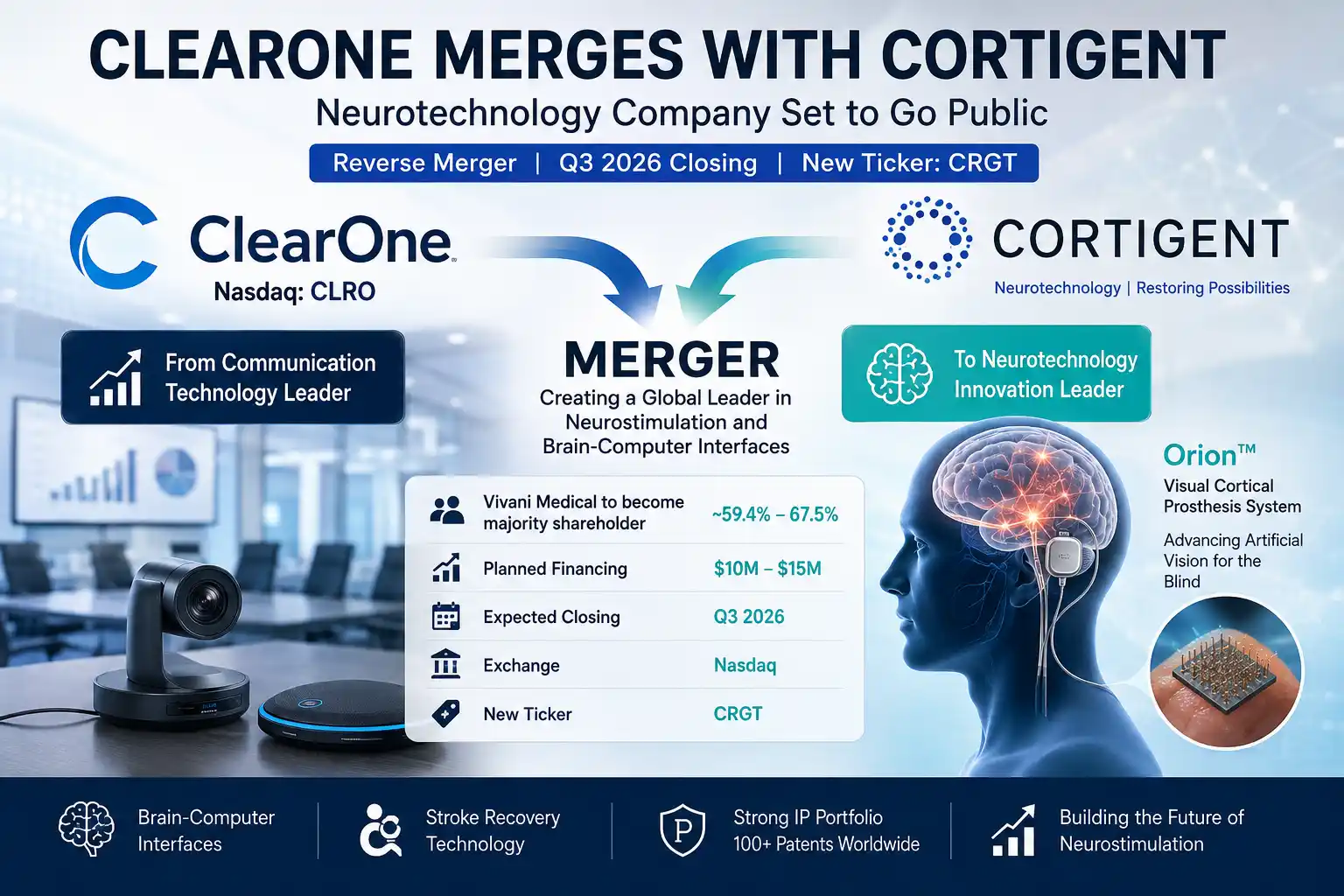
ClearOne, Cortigent and Cortigent’s parent company Vivani Medical entered into a definitive merger agreement on July 1, 2026, with ClearOne publicly announcing the transaction on July 2.
Under the proposed transaction, Cortigent will become part of ClearOne, while Vivani Medical is expected to become the majority shareholder of the combined company.
After the deal closes, ClearOne plans to change its name to Cortigent Holdings, Inc. and is expected to trade on Nasdaq under the ticker CRGT.
The transaction is currently expected to close in Q3 2026, subject to ClearOne shareholder approval, completion of planned financing, Nasdaq listing requirements and other customary closing conditions.
Key Merger Highlights
| Deal Highlights | Details |
| Announcement Date | July 1, 2026 |
| Acquirer / Public Company | ClearOne, Inc. |
| Target | Cortigent, Inc. |
| Deal Type | Reverse Merger / Business Combination |
| Deal Value | Not publicly disclosed as a fixed purchase price |
| Consideration | 12.5 million ClearOne shares to Vivani Medical |
| Acquirer Country | United States |
| Target Country | United States |
| Industry | Neurotechnology / Medical Devices |
| Acquirer Exchange | Nasdaq |
| Current Acquirer Ticker | CLRO |
| Expected New Ticker | CRGT |
| Post-Deal Company Name | Cortigent Holdings, Inc. |
| Majority Shareholder After Deal | Vivani Medical |
| Expected Vivani Ownership | Approximately 59.4%–67.5% |
| Expected Existing ClearOne Shareholder Ownership | Approximately 12.7%–14.4% |
| Planned Financing | $10 million–$15 million |
| Expected Closing | Q3 2026 |
| Key Business | Brain-computer interfaces, neurostimulation, visual prosthetics and stroke recovery |
| Key Product/Program | Orion Visual Cortical Prosthesis System |
| Deal Status | Announced / Pending Closing |
What Is the ClearOne–Cortigent Deal?
The transaction is more than a traditional acquisition. Under the merger structure, ClearOne’s subsidiary will merge with Cortigent, making Cortigent a wholly owned subsidiary of ClearOne after the transaction.
However, from an ownership perspective, the structure works differently.
Cortigent’s parent company, Vivani Medical, is expected to receive 12.5 million shares of ClearOne. Following the transaction, Vivani is expected to own approximately 59.4% to 67.5% of the combined company.
Existing ClearOne shareholders are expected to own approximately 12.7% to 14.4%. Because Cortigent’s shareholders will effectively gain control of the public company, the transaction can be viewed as a reverse merger or reverse takeover-style transaction.
Company Introduction: ClearOne
ClearOne has historically been known for its audio and video communication and conferencing technology.
Its products have been used for meeting rooms, classrooms, corporate communications and other professional environments.
However, ClearOne significantly changed its business strategy in 2025.
The company sold substantial operating assets and intellectual property to Biamp in October 2025. As a result, much of its traditional conferencing business was no longer part of ClearOne’s continuing operations.
Following the asset sale, ClearOne began exploring strategic alternatives for the future of the company.
The Cortigent transaction therefore represents a major transformation for ClearOne—from an audio/video technology company into a company focused on neurotechnology and medical devices.
Company Introduction: Cortigent
Cortigent is a neurotechnology and medical-device company focused on developing technologies that use electrical stimulation to interact with the brain.
The company is developing technologies designed to help restore or improve lost functions caused by neurological conditions.
Its most important development program is the Orion Visual Cortical Prosthesis System, which is being developed to provide visual perception to people with profound blindness.
Cortigent is also developing a Stroke Recovery System designed to support the recovery of arm and hand movement in people affected by stroke.
How the Merger Will Work
The transaction has an unusual structure.
ClearOne’s subsidiary will merge with Cortigent. Once the transaction is completed, Cortigent will become a wholly owned subsidiary of ClearOne.
At the same time, Vivani Medical will receive 12.5 million ClearOne shares and become the majority shareholder of the combined company.
In simple terms:
Cortigent’s technology + ClearOne’s public-company platform = a new publicly traded neurotechnology company
This is why the deal is generally viewed as a reverse-merger transaction rather than a conventional acquisition.
ClearOne Plans to Become Cortigent Holdings
After the transaction closes, ClearOne plans to change its corporate name to:
Cortigent Holdings, Inc.
The company is also expected to trade on Nasdaq under the ticker: CRGT
This means the ClearOne name and its historical audio/video business identity are expected to be replaced by a company focused primarily on neurotechnology.
$10 Million–$15 Million Financing
Along with the merger, the company plans to raise additional capital.
ClearOne has said it intends to file a registration statement for an offering targeting approximately $10 million to $15 million.
The financing is important because Cortigent’s technologies are still in development and require significant investment in areas such as:
- Research and development
- Clinical studies
- Regulatory activities
- Manufacturing
- Product development
- Future commercialization
The financing is also one of the conditions connected to the completion of the transaction.
Orion Visual Cortical Prosthesis System
The Orion Visual Cortical Prosthesis System is Cortigent’s flagship technology program.
The basic idea is different from conventional treatments for blindness.
Normally, the eyes capture visual information and send signals to the brain through the optic nerve.
Orion is being developed to bypass damaged parts of the visual pathway and directly stimulate the brain’s visual cortex.
How the technology works
The basic process can be explained in four steps:
- A camera captures information from the surrounding environment.
- A processing system converts the information into electrical signals.
- The signals are transmitted to an implanted device.
- The implant stimulates the visual cortex of the brain.
The goal is to create visual perception for people who have severe vision loss.
However, Orion is still an investigational device and is not an FDA-approved commercial product.
Orion’s Clinical Development
Cortigent has been developing Orion through clinical research.
In January 2026, the company reported results from its six-year Early Feasibility Study.
According to Cortigent, the study provided encouraging safety, tolerability and clinical activity results.
The Orion system has also received Breakthrough Device Designation from the U.S. FDA.
The company is now working toward further clinical development and the regulatory pathway required for potential commercialization.
This development will be one of the most important factors investors will watch after the merger.
Cortigent’s Stroke Recovery Technology
Cortigent’s technology pipeline is not limited to artificial vision.
The company is also developing a Stroke Recovery System.
The technology is designed to help stroke patients with partial paralysis improve movement in their arms and hands during rehabilitation.
The system uses neurostimulation technology to target areas of the brain involved in movement.
Cortigent says its technology includes a 60-channel electrode system, which is designed to provide more targeted stimulation.
If successful, this could give Cortigent another potential application beyond visual prosthetics.
Cortigent’s Intellectual Property
Intellectual property is another important asset for Cortigent.
According to the company, as of December 31, 2025, its intellectual-property portfolio included:
- 161 issued U.S. patents
- 2 pending U.S. patent applications
- 4 issued U.S. design patents
- 14 issued European patents
- 1 pending European patent application
- 2 issued European design registrations
These patents cover technologies and methods related to neurostimulation and medical-device systems.
A strong patent portfolio can be strategically important in the medical-device industry because it can help protect proprietary technologies from direct competition.
What Does Vivani Medical Get From the Deal?
Vivani Medical is Cortigent’s parent company.
As part of the transaction, Vivani is expected to receive 12.5 million shares of ClearOne.
After closing, Vivani is expected to own approximately 59.4% to 67.5% of the combined company.
This makes Vivani the majority shareholder.
The structure allows Vivani to retain significant ownership of Cortigent while giving the business access to a public-company structure.
What Does the Deal Mean for Existing ClearOne Shareholders?
The transaction significantly changes the future business of ClearOne.
Previously, ClearOne was primarily associated with audio and video conferencing technology.
After selling substantial operating assets in 2025, the company’s traditional business became much smaller.
The merger gives existing shareholders exposure to a completely different industry—neurotechnology and medical devices.
However, existing ClearOne shareholders are expected to own only approximately 12.7% to 14.4% of the combined company.
Therefore, the transaction also represents significant changes in ownership and control.
Why Is the Merger Strategically Important?
The main strategic benefit is that both companies receive something they need.
What ClearOne Gets
- A new operating business
- Neurotechnology assets
- Cortigent’s technology pipeline
- Intellectual property
- A new growth strategy
- A potentially stronger long-term business model
What Cortigent Gets
- A Nasdaq-listed public-company structure
- Access to public capital markets
- Greater visibility among investors
- A path toward becoming an independent publicly traded company
- Potential access to additional financing
This makes the transaction strategically different from a normal acquisition.
Is This a Normal Acquisition?
No.
In a traditional acquisition, one company purchases another company, usually using cash, stock or a combination of both.
In the ClearOne–Cortigent transaction, the structure is more complicated.
Cortigent will become part of ClearOne, but Vivani Medical—the parent of Cortigent—is expected to become the majority owner of the combined company.
Therefore, economically, the transaction resembles a reverse merger.
The basic concept is:
Private/operating company → merges into public company → existing public listing becomes the platform for the new business
This structure can allow a company to enter the public markets without following the traditional IPO route.
When Is the Deal Expected to Close?
The transaction is currently expected to close in Q3 2026.
However, the closing depends on several conditions, including:
- Approval from ClearOne shareholders
- Completion of the planned financing
- Meeting minimum cash requirements
- Nasdaq listing requirements
- Other customary closing conditions
Therefore, the expected closing date is not a guarantee.
Key Opportunities for Investors
1. Growing Neurotechnology Opportunity
Brain-computer interfaces and neurostimulation technologies are emerging areas within medical technology.
If Cortigent successfully develops and commercializes its technologies, the company could have significant long-term growth potential.
2. Orion’s Potential
Orion is particularly important because it is attempting to restore visual perception by directly stimulating the brain’s visual cortex.
Successful clinical development and regulatory approval could significantly increase the potential value of the technology.
3. Multiple Technology Applications
Cortigent is working on both visual restoration and stroke recovery.
This gives the company more than one potential future application for its neurostimulation technology.
4. Public-Market Access
The merger provides Cortigent with access to an existing Nasdaq-listed corporate structure.
That could make future fundraising and investor access easier than remaining a private company.
Major Risks
The opportunity also comes with substantial risks.
Clinical Risk
Orion remains an investigational technology.
Promising early clinical results do not guarantee success in larger or later-stage clinical studies.
Regulatory Risk
Cortigent will need to satisfy regulatory requirements before its technologies can potentially become commercial products.
FDA approval is not guaranteed.
Financing Risk
The planned $10 million–$15 million financing is important for the company’s future operations and is also connected to the transaction’s closing conditions.
Dilution Risk
Future financing could increase the number of shares outstanding and reduce the ownership percentage of existing shareholders.
Commercialization Risk
Even if a medical device receives regulatory approval, the company still has to deal with manufacturing, pricing, reimbursement, competition and market adoption.
Overall Analysis
The ClearOne–Cortigent merger is a major strategic transformation rather than a simple acquisition.
ClearOne is moving away from its traditional audio/video conferencing business and becoming the public-company platform for Cortigent’s neurotechnology business.
At the center of the new company will be Cortigent’s Orion Visual Cortical Prosthesis System, its stroke-recovery technology and its intellectual-property portfolio.
For Cortigent and Vivani Medical, the deal provides access to a Nasdaq-listed public-company structure and potentially greater access to capital markets.
For ClearOne shareholders, the transaction creates exposure to a completely different and potentially high-growth industry, but it also introduces substantial clinical, regulatory, financing and commercialization risks.
Bottom Line
The deal can be summarized as:
ClearOne’s public listing + Cortigent’s neurotechnology = a new publicly traded neurotechnology company
If the transaction closes as planned, ClearOne is expected to become Cortigent Holdings, Inc., with the expected Nasdaq ticker CRGT, while Vivani Medical will remain the majority shareholder.
The long-term value of the new company will largely depend on whether Cortigent can successfully advance Orion and its other neurotechnology programs through clinical development, regulatory approval and eventual commercialization.
Source: clearone news