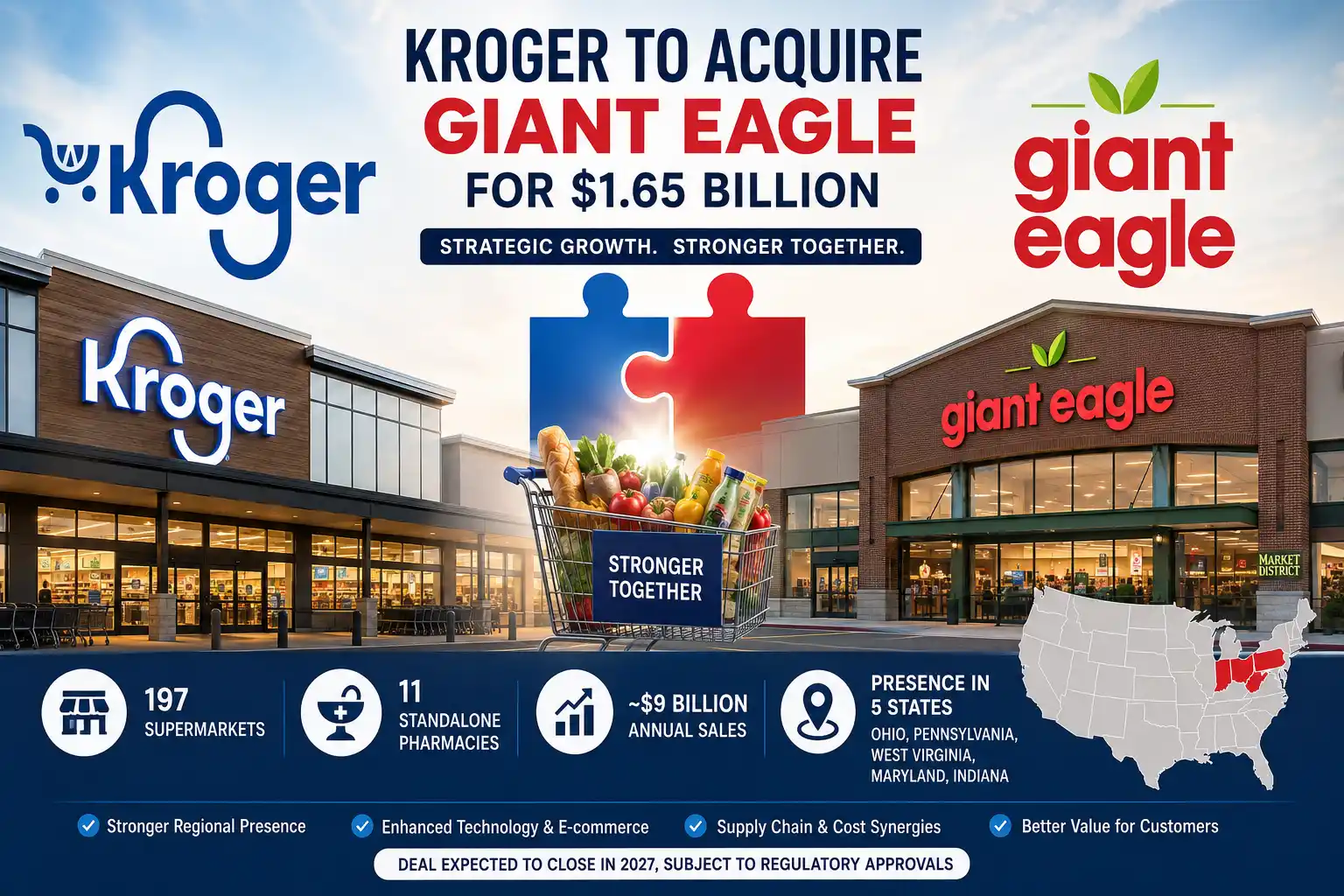
The Kroger Co. has agreed to acquire Giant Eagle, a major regional grocery and pharmacy retailer in the United States, for approximately $1.65 billion. The deal was announced on July 1, 2026. The transaction includes approximately $1.25 billion in cash consideration and the assumption of around $400 million in liabilities.
The acquisition is not yet complete. It still requires regulatory approvals and other customary closing conditions, with the transaction expected to close in 2027. Giant Eagle operates approximately 197 supermarkets and 11 standalone pharmacies across Ohio, Pennsylvania, West Virginia, Maryland and Indiana. The company generates around $9 billion in annual sales.
Deal Snapshot
| Detail | Information |
| Acquirer | The Kroger Co. |
| Target | Giant Eagle, Inc. |
| Deal Type | Acquisition |
| Deal Value | Approximately $1.65 billion |
| Industry | Grocery Retail |
| Cash Consideration | Approximately $1.25 billion |
| Assumed Liabilities | Approximately $400 million |
| Target Annual Sales | Approximately $9 billion |
| Target Supermarkets | 197 |
| Standalone Pharmacies | 11 |
| Target States | Ohio, Pennsylvania, West Virginia, Maryland, Indiana |
| Announcement Date | July 1, 2026 |
| Expected Closing | 2027 |
| Current Status | Pending regulatory approval |
| Acquirer Exchange | NYSE |
| Ticker | KR |
About Kroger
The Kroger Co. is one of the largest grocery retailers in the United States. Headquartered in Cincinnati, Ohio, Kroger operates supermarkets under multiple banners across the country. Its business includes grocery retail, pharmacies, private-label products, e-commerce and digital customer services.
Kroger says its network includes more than 400,000 associates and serves more than 11 million customers each day. The company is publicly listed on the New York Stock Exchange (NYSE) under the ticker KR.
About Giant Eagle
Giant Eagle is a major American grocery and pharmacy retailer with a strong regional presence. The company was founded in 1931 and has built a particularly strong customer base in Pennsylvania and Ohio.
Today, Giant Eagle operates approximately:
- 197 supermarkets
- 11 standalone pharmacies
- Stores across five U.S. states
- Approximately $9 billion in annual sales
Its business includes grocery products, fresh food, pharmacy services, private-label products and customer loyalty programs.
Unlike Kroger, Giant Eagle has remained a privately owned, family-controlled company.
Why Is Kroger Buying Giant Eagle?
The acquisition is about much more than simply adding 197 stores. Kroger is looking for faster growth and a stronger position in important regional markets.
The U.S. grocery industry is highly competitive, with companies such as Walmart, Costco, Aldi and Amazon putting pressure on traditional supermarket chains.
Instead of building hundreds of new stores from scratch, Kroger can acquire an established regional retailer with an existing customer base, stores, employees and supply chain.
In simple terms
If Kroger wanted to build 200 new stores itself, it would need to:
- Find and purchase real estate
- Build new stores
- Hire employees
- Develop distribution networks
- Attract customers
- Establish brand recognition
By acquiring Giant Eagle, much of this infrastructure already exists.
That makes the acquisition a faster route to expansion.
Kroger Will Strengthen Its Midwest and Mid-Atlantic Presence
Giant Eagle’s stores are concentrated in:
- Pennsylvania
- Ohio
- West Virginia
- Maryland
- Indiana
These markets are strategically important for Kroger because the acquisition can give the company a stronger presence in areas where Giant Eagle already has established customer relationships.
Markets such as Pittsburgh and Cleveland are particularly important because Giant Eagle already has strong local recognition there.
Instead of starting from zero, Kroger can build on an existing regional business.
What Exactly Is Included in the $1.65 Billion Deal?
The transaction has two major components. Kroger will pay approximately:
$1.25 billion in cash
In addition, Kroger will assume approximately:
$400 million of liabilities
Together, this brings the transaction value to approximately:
$1.65 billion
Kroger has said that the transaction will be financed with cash.
The company also expects to maintain its net total debt-to-adjusted EBITDA ratio within its targeted 2.3x–2.5x range following the transaction.
Will the Giant Eagle Brand Disappear?
Not necessarily.
The current plan is to retain the Giant Eagle brand. That means the acquisition does not automatically mean that Giant Eagle stores will immediately be converted into Kroger stores.
This could be important because Giant Eagle has strong local brand recognition. Keeping the existing brand can help Kroger maintain customer loyalty while gradually introducing its technology, purchasing power and operational capabilities.
How Can Kroger Benefit From Giant Eagle?
1. Nearly 200 Additional Stores
Kroger will gain access to approximately 197 supermarkets through the acquisition. This gives the company immediate scale in several regional markets.
2. Approximately $9 Billion in Annual Sales
Giant Eagle generates approximately $9 billion in annual sales. This provides Kroger with a substantial additional revenue base.
However, it is important to remember that sales are not the same as profit.
Grocery retail generally operates with relatively thin margins, so Kroger’s real financial benefit will depend heavily on improving efficiency and generating synergies.
Technology and Scale Could Be a Major Advantage
One of the most interesting aspects of the deal is the combination of the two companies’ strengths.
Giant Eagle brings:
- Established stores
- Local customer relationships
- A regional loyalty program
- Pharmacy operations
- Private-label products
- Strong regional brand recognition
Kroger brings:
- Large-scale purchasing power
- Supply-chain expertise
- E-commerce capabilities
- Digital technology
- Customer data
- Personalization technology
- Operational scale
Combining these capabilities could allow Kroger to improve Giant Eagle’s digital and operational performance.
A simple example
A customer who currently shops mainly at a Giant Eagle physical store could potentially gain access to a stronger digital ecosystem involving:
Store → Online Ordering → Pickup → Delivery → Personalized Offers
This is where the long-term strategic value of the acquisition could emerge.
Cost Savings Could Be Another Major Benefit
A key concept in acquisitions is synergy. Synergy means that two companies together can potentially operate more efficiently than they could separately.
For this transaction, potential savings could come from:
- Purchasing
- Supply chain
- Logistics
- Technology
- Corporate expenses
- Distribution
- Inventory management
Some analysts have estimated that Kroger could potentially achieve approximately $50 million to $100 million in annual savings over time.
However, this is an analyst estimate, not a guaranteed figure from Kroger.
Why This Deal Matters After Kroger’s Failed Albertsons Merger
The Giant Eagle acquisition is particularly interesting because Kroger previously attempted a much larger transaction. Kroger had agreed to acquire Albertsons in a deal worth approximately $25 billion.
However, the transaction faced significant antitrust opposition and ultimately failed in 2024.
The difference between the two transactions is substantial:
| Deal | Approximate Value |
| Kroger–Albertsons | $25 billion |
| Kroger–Giant Eagle | $1.65 billion |
This shows a potentially different strategy from Kroger.
Instead of pursuing another massive national supermarket merger, Kroger appears to be focusing on smaller, targeted regional acquisitions.
Could the Deal Face Antitrust Problems?
Yes. Regulatory approval is one of the biggest risks.
Both Kroger and Giant Eagle operate grocery stores, so regulators will examine whether the acquisition could reduce competition in particular local markets.
This is especially important in areas where Kroger and Giant Eagle stores overlap. As part of the regulatory process, the companies may need to divest certain Giant Eagle stores.
What does divestiture mean?
Suppose a particular city has:
- A Kroger store
- A Giant Eagle store
- Walmart
If Kroger acquires Giant Eagle, competition in that local market could decrease.
Regulators could therefore require Kroger to sell one or more overlapping stores to another grocery company.
That process is known as divestiture.
When Will the Acquisition Be Completed?
The acquisition has not been completed yet. The companies have signed a definitive agreement, but the transaction still requires regulatory approvals and the satisfaction of other closing conditions.
The transaction is currently expected to close in 2027.
Until the closing takes place, Giant Eagle remains a separate company.
What Could Happen to Customers?
Customers are unlikely to see major immediate changes. Because the Giant Eagle brand is expected to continue, stores could initially operate largely under their existing names.
Over the longer term, customers could potentially benefit from:
- Better e-commerce services
- More digital promotions
- Improved supply-chain efficiency
- More private-label products
- Competitive pricing
- Better loyalty and personalization tools
However, some changes could also occur during integration.
These could include:
- Store divestitures
- Operational restructuring
- Changes to corporate functions
- Changes in employee responsibilities
The exact impact will become clearer after the transaction receives approval and moves into the integration phase.
What Does the Deal Mean for Employees?
The acquisition could create opportunities as Kroger expands its operations, but it could also lead to organizational changes. When two companies combine, there can be overlapping corporate, administrative and operational functions.
At this stage, it would be premature to predict a specific number of job cuts or job additions.
Unless Kroger and Giant Eagle announce specific workforce changes, any precise job-loss figure should be treated as speculation.
What Does the Acquisition Mean for Kroger Shareholders?
Kroger expects the acquisition to become adjusted EPS accretive in the second full year after closing, excluding transaction and integration costs.
In simple terms, Kroger expects the acquisition to eventually increase its adjusted earnings per share once the business is fully integrated.
Kroger has also indicated that it intends to:
- Continue its dividend
- Continue its previously announced $2 billion share repurchase program
- Maintain financial flexibility for strategic investments
This suggests that Kroger does not expect the acquisition to fundamentally change its capital-return strategy.
Biggest Risks for Kroger
The biggest risks are not simply the purchase price.
The real challenges are:
Regulation + Integration + Competition
1. Regulatory Risk
If regulators require Kroger to sell more stores than expected, the financial benefits of the acquisition could become smaller.
2. Integration Risk
Combining two businesses involves integrating:
- Technology systems
- Employees
- Supply chains
- Corporate structures
- Data systems
- Store operations
Poor integration can reduce the expected benefits of an acquisition.
3. Intense Grocery Competition
Kroger will continue to face strong competition from Walmart, Costco, Aldi and Amazon.
Even after acquiring Giant Eagle, Kroger will need to keep prices competitive while protecting profit margins.
Is the $1.65 Billion Deal Expensive?
At first glance, the transaction looks interesting.
Giant Eagle generates approximately $9 billion in annual sales, while the transaction value is approximately $1.65 billion.
However, investors should not judge the deal simply by comparing sales with the purchase price.
A proper acquisition valuation should also consider:
- EBITDA
- Debt
- Free cash flow
- Profit margins
- Store productivity
- Real estate value
- Liabilities
- Future synergies
The approximately $400 million of assumed liabilities are also important when evaluating the overall transaction economics.
Therefore, the deal cannot be described as cheap or expensive based only on its sales-to-price ratio.
Analysis: Kroger May Have Chosen a Smaller but Smarter Deal
The most important aspect of this acquisition may actually be its size.
Kroger’s proposed Albertsons transaction was a massive national-scale merger that faced significant regulatory challenges.
The Giant Eagle transaction is completely different.
It is:
Smaller → Regional → Targeted → More Manageable
Kroger gets nearly 200 stores and a business generating around $9 billion in annual sales, while avoiding the scale of regulatory complexity associated with a $25 billion mega-merger.
There will still be antitrust scrutiny and potential store divestitures, but the overall transaction is much smaller.
For Kroger, this could represent a more balanced approach between growth and regulatory risk.
What Does This Mean for Walmart, Costco and Aldi?
The acquisition is not only important for Kroger and Giant Eagle.
The U.S. grocery market is highly competitive.
By acquiring Giant Eagle, Kroger could strengthen its position in several regional markets and potentially improve its purchasing and operating efficiency.
That could increase competition between:
Kroger vs. Walmart
Kroger vs. Costco
Kroger vs. Aldi
The impact could be particularly important in markets where Giant Eagle already has a strong customer base.
Overall Impact of the Deal
| Area | Expected Impact |
| Kroger Store Network | Positive |
| Regional Expansion | Strong Positive |
| Revenue Growth | Positive |
| E-commerce Potential | Positive |
| Supply Chain Efficiency | Positive |
| Cost Synergies | Potentially Positive |
| Competition | More Intense |
| Regulatory Risk | Medium |
| Integration Risk | Medium |
| Giant Eagle Brand | Expected to Continue |
| Employees | Changes Possible |
| Deal Completion | Expected in 2027 |
Final Takeaway
Kroger’s planned acquisition of Giant Eagle is an important regional consolidation deal in the U.S. grocery industry.
For approximately $1.65 billion, Kroger will gain access to around 197 supermarkets, 11 standalone pharmacies and approximately $9 billion in annual sales.
But Kroger is not simply buying stores. It is acquiring an established customer base, regional brand, pharmacy network, loyalty ecosystem and existing infrastructure.
Kroger can then potentially use its scale, technology, e-commerce capabilities, purchasing power and supply-chain expertise to improve the performance of the acquired business.
The biggest uncertainties are regulatory approval, possible store divestitures and the difficulty of integrating the two businesses.
The deal is also strategically important because it represents a very different approach from Kroger’s failed $25 billion Albertsons merger.
Instead of another mega-merger, Kroger appears to be pursuing a smaller, targeted and potentially easier-to-integrate acquisition.
If successfully completed, the Giant Eagle deal could strengthen Kroger’s position across the Midwest and Mid-Atlantic regions while increasing competition in the U.S. grocery market.
Source: Kroger official announcement, SEC filing, Reuters and Associated Press.