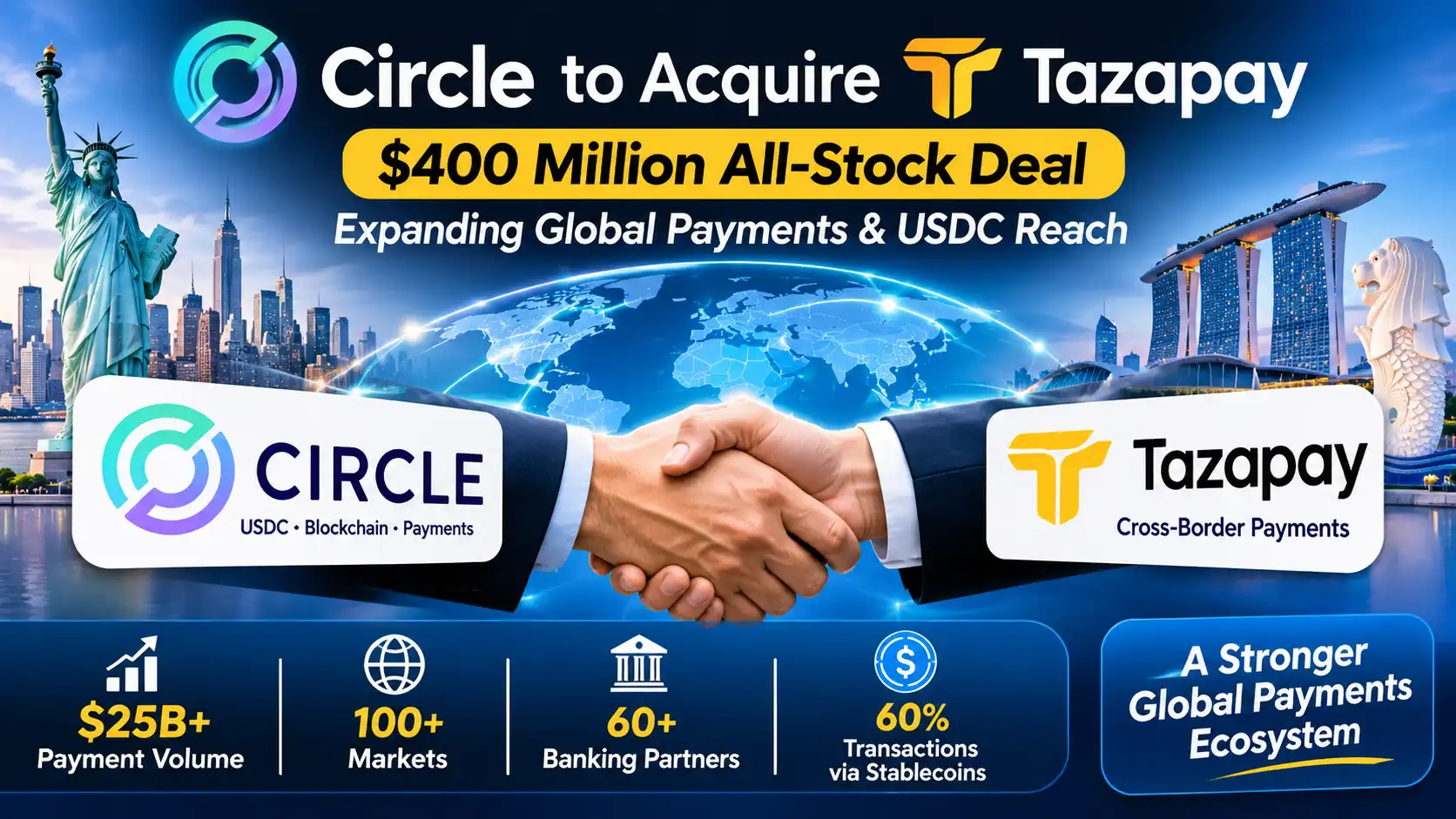
US-based financial technology company Circle Internet Group has entered into an agreement to acquire Singapore-based cross-border payments company Tazapay in a transaction valued at approximately $400 million. The acquisition is expected to strengthen Circle’s USDC stablecoin ecosystem and expand its global payment infrastructure, particularly across Asia, Southeast Asia, and emerging markets.
The deal was announced on September 8, 2026. Tazapay has more than 60 banking and fintech partners, local payout infrastructure across more than 100 markets, and an annualized payment volume of over $25 billion. According to Circle, approximately 60% of Tazapay’s transaction volume already involves stablecoins.
The important aspect of this acquisition is that Circle is not simply purchasing another payment company. It is acquiring an established network that helps businesses collect payments from customers in different countries and send money to recipients through local payment methods.
This could give Circle an opportunity to make USDC more useful for international business payments.
Deal status: As of November 2026, Circle’s SEC filings indicate that the acquisition is still pending. The companies expect the transaction to close in 2027, subject to required regulatory approvals, including approval from the Monetary Authority of Singapore (MAS), and other closing conditions.
Key Acquisition Details
| Deal Detail | Information |
| Acquirer | Circle Internet Group, Inc. |
| Target Company | Tazapay Pte. Ltd. |
| Deal Type | Acquisition |
| Agreement Date | September 4, 2026 |
| Announcement Date | September 8, 2026 |
| Deal Industry | Fintech |
| Transaction Value | Approximately $400 million |
| Payment Method | All-stock transaction |
| Acquirer Country | USA |
| Acquirer Stock Ticker | NYSE: CRCL |
| Target Stock Ticker | Private Company |
| Target Headquarters | Singapore |
| Expected Closing | 2027 |
| Regulatory Approval | Includes Monetary Authority of Singapore approval |
| Deal Status | Announced and pending |
Company Introduction: Circle Internet Group
Circle is a global financial technology company focused on blockchain infrastructure, digital assets, and internet-based payment systems. It is best known as the issuer of the USDC stablecoin.
Circle Investor Relations+1
What Does Circle Do?
Circle’s main objective is to build financial infrastructure that allows digital money to move quickly and efficiently across the internet.
Its most important product is USDC (USD Coin).
USDC is a US dollar-backed stablecoin designed to maintain a value close to one US dollar. Unlike cryptocurrencies such as Bitcoin, whose prices can fluctuate significantly, USDC is designed to maintain a relatively stable value against the US dollar.
For example, if a business in the United States needs to send money to Singapore, it may be able to use USDC-based payment infrastructure instead of relying entirely on traditional international banking transfers. The recipient can then convert the stablecoin into local currency through an available and appropriately regulated service.
Circle’s Main Business Areas
- USDC Stablecoin: A digital dollar designed for payments and financial transactions.
- Circle Payments Network (CPN): A network designed to enable cross-border payments between financial institutions and payment providers.
- Arc Blockchain: Circle’s enterprise-focused blockchain infrastructure project.
- Digital Asset Services: Payment and digital asset-related services for businesses and financial institutions.
Circle’s strategy is not limited to issuing USDC. It aims to develop a broader ecosystem of payment, settlement, and financial applications around digital dollars.
Company Introduction: Tazapay
Tazapay is a Singapore-based fintech company founded in 2020. It provides international payment collection and payout infrastructure for businesses, marketplaces, fintech companies, and payment service providers.
What Does Tazapay Do?
Imagine an Indian company selling online services to customers in Singapore, the United States, and Europe. It needs to accept payments from different countries, manage foreign currencies, and send money to suppliers or business partners internationally.
Managing separate banking relationships and payment providers in every country can be complicated. Tazapay aims to simplify this process by providing a unified payment infrastructure.
Its major services include:
- Payment Gateway: Accepting online payments from international customers.
- Global Collection Accounts: Collecting payments in multiple currencies.
- Escrow Solutions: Holding funds securely until agreed transaction conditions are met.
- Global Payouts: Sending money to recipients in different countries through local payment methods.
- Stablecoin On/Off-Ramp: Supporting conversion between traditional currencies and stablecoins through applicable regulated arrangements.
Tazapay’s platform offers payment gateways, local collection methods, virtual accounts, and international payout infrastructure that businesses can access through an API.
What Does $25 Billion in Payment Volume Mean?
According to Circle’s acquisition announcement, Tazapay’s business had the following key metrics as of July 31, 2026:
| Business Metric | Tazapay |
| Annualized Payment Volume | $25 Billion+ |
| Banking and Fintech Partners | 60+ |
| Local Payout Markets | 100+ |
| Transaction Volume Involving Stablecoins | Approximately 60% |
| Headquarters | Singapore |
Does $25 Billion in Payment Volume Mean Revenue?
No. It is important to understand the difference between payment volume and revenue.
Annualized payment volume of more than $25 billion means that the estimated yearly value of transactions processed through Tazapay’s payment infrastructure exceeds $25 billion.
It does not mean that the company earned $25 billion in revenue.
For example, if Tazapay processes a $1 million international payment for a business, that amount may be included in its payment volume. However, the company’s actual revenue comes from transaction fees and other services.
Similarly, the statement that approximately 60% of transaction volume involves stablecoins does not mean that the entire 60% is processed in USDC. Circle’s announcement refers to stablecoins collectively and does not disclose a separate percentage for USDC.
What Will Circle Gain From the Tazapay Acquisition?
One of the biggest benefits for Circle is expected to be access to Tazapay’s existing payment network and local banking infrastructure.
Circle already has USDC and blockchain-based payment infrastructure. However, simply making digital currency available is not enough for international payments. Businesses also need a way to deliver money to local bank accounts and payment systems in the recipient’s country.
This is where Tazapay becomes important.
A. More Than 60 Banking and Fintech Partners
Tazapay has relationships with more than 60 banking and fintech partners. These connections help it provide payment collection and payout services across different countries.
Circle could use this network to expand the reach of its global payment infrastructure.
B. Local Payouts Across More Than 100 Markets
One of the biggest challenges in international payments is delivering money to recipients in their local currency.
For example, if a US company sends money to a supplier in India, the supplier may need to receive Indian rupees in an Indian bank account.
It is not enough to transfer digital dollars. The final payment must reach the recipient through an available local payment channel.
Tazapay’s local payout connections can help address this last-mile payment requirement.
C. Access to an Existing Customer Network
Tazapay already works with payment service providers and financial institutions. This could give Circle access to institutional customers interested in using stablecoin-based infrastructure for cross-border payments.
Circle Payments Network and Tazapay’s Existing Partnership
The relationship between Circle and Tazapay began before the acquisition announcement.
According to Circle, Tazapay has been a design partner of the Circle Payments Network (CPN) since 2025.
CPN is designed to connect banks, payment companies, and businesses through digital-dollar-based international payment infrastructure. It aims to help financial institutions and payment providers transfer money across borders through a connected network.
How Can Tazapay Strengthen CPN?
Imagine a financial institution that needs to send money to another country. It needs more than the ability to transfer USDC. It also needs local payment connections, currency conversion, and a way to deliver the money to the final recipient.
Combining CPN with Tazapay’s capabilities could create opportunities to:
- Connect more local banking and payment partners.
- Add new international payment corridors.
- Improve the final payout stage of cross-border transactions.
- Give payment service providers access to more markets through a broader network.
This could reduce the need for Circle to build separate payment infrastructure in every country.
Combining Stablecoins With Traditional Banking
One of the most important aspects of this acquisition is the potential combination of stablecoin infrastructure and traditional banking connections.
Consider a simple example.
A company in the United States needs to pay a supplier in Singapore.
Illustrative Cross-Border Payment Flow
Step 1: US Business
The American company initiates a payment.
Step 2: USDC / Payment Network
The payment may move through digital-dollar and available payment infrastructure.
Step 3: Tazapay’s Local Payment Connections
Local payout and currency conversion arrangements in the recipient’s country.
Step 4: Singapore Supplier
The supplier receives money through an available local payment method.
This is a simplified illustrative example, not a confirmed transaction flow. Actual settlement routes, currency conversion, and payment times will depend on the services and regulations involved.
In this arrangement, Circle could provide digital-dollar and blockchain infrastructure, while Tazapay could support local payment connections and payout services.
Circle aims to make international payments more accessible, convenient, and available around the clock. However, this does not guarantee that every transaction will be instant or always cheaper than traditional payment methods.
Understanding the $400 Million All-Stock Deal
Circle will pay approximately $400 million in consideration for the acquisition using its Class A common stock.
This means Circle does not need to pay the entire acquisition amount in cash. Instead, under the agreement, Tazapay’s sellers will receive shares in Circle.
What Is an All-Stock Acquisition?
An all-stock acquisition occurs when a company uses its own shares to purchase another business.
For example, if Company A acquires Company B by issuing its own shares, the sellers of Company B receive an ownership interest in Company A instead of receiving the entire purchase price in cash.
In this transaction:
- Circle will not need to pay the entire acquisition consideration in cash.
- Tazapay’s sellers will receive Circle Class A common shares.
- The issuance of new shares could dilute the ownership percentage of existing Circle shareholders.
- The final number of shares will be determined using the VWAP over the 20 trading days before closing.
The consideration may also be adjusted based on Tazapay’s unpaid debt, transaction expenses, and cash position.
Tazapay’s Regulatory Licences and Compliance
Cross-border payments are a regulated business. Payment companies must comply with local rules when providing services such as money transfers, payment collection, and related financial activities.
In Singapore, Tazapay Pte. Ltd. holds a Major Payment Institution (MPI) licence from the Monetary Authority of Singapore (MAS).
The MAS directory lists the following regulated services for Tazapay:
- Account Issuance Service
- Domestic Money Transfer Service
- Cross-border Money Transfer Service
- Merchant Acquisition Service
- E-money Issuance Service
Tazapay also refers to relevant licences or registrations in countries including Canada, Australia, and Hong Kong. Its website mentions payment arrangements involving the Rupee Drawing Arrangement (RDA) in India. The legal status and scope of these arrangements vary by entity and service.
Why Is MAS Approval Important?
Tazapay already holding an MPI licence in Singapore and Circle obtaining regulatory approval for its acquisition are two different matters.
The companies have stated that the transaction requires regulatory approvals, including approval from the Monetary Authority of Singapore.
This is important because a change in ownership of a regulated payment business must comply with the applicable financial and regulatory requirements.
Important Details About Stablecoin Services
According to Circle’s announcement, Tazapay’s stablecoin services are provided through Tazapay Canada Corp., which is registered as a Money Services Business with FINTRAC in Canada.
The announcement also clarifies that Tazapay Pte. Ltd. in Singapore does not provide digital payment token services under Singapore’s Payment Services Act.
Therefore, Tazapay’s different entities and services should not all be treated as operating under the same regulatory category.
What Are the Potential Benefits for Circle?
The potential benefits of this acquisition go beyond gaining access to Tazapay’s payment volume. The deal is connected to Circle’s broader strategy of expanding its global financial ecosystem.
1. Greater USDC Usage: Tazapay’s existing customers and payment network could create more opportunities for USDC-based payment services.
2. Stronger Presence in APAC: Local payment connections in Singapore and other Asian and emerging markets could expand Circle’s reach.
3. Expanded Payment Infrastructure: Circle could gain access to local collection, virtual accounts, and payout connections.
4. Stronger Circle Payments Network: Tazapay’s existing network could create opportunities to add payment corridors and institutional participants to CPN.
5. Access to Business Customers: Circle could offer more comprehensive cross-border payment solutions to payment providers and financial institutions.
These are potential strategic benefits identified by Circle. Their actual financial impact will depend on future adoption, transaction economics, and successful integration.
Key Risks and Challenges of the Acquisition
Despite the potential benefits, the acquisition also involves several challenges.
A. Regulatory Approval
If MAS or other relevant regulatory authorities require additional reviews, the closing timeline could be delayed.
B. Stablecoin Adoption
Approximately 60% of Tazapay’s transaction volume involves stablecoins. However, this does not mean that all those transactions use USDC. Circle will need to demonstrate that it can increase USDC adoption within this existing stablecoin activity.
C. Integration of Banking Partnerships
Combining banking partners, local payment systems, and compliance requirements across different countries can be complicated.
D. Competition
Traditional banks, payment companies, and other fintech providers already operate in the international payments market. Stablecoin-based payment solutions will need to compete with these existing services.
E. Shareholder Dilution
Because Circle will pay for the acquisition using its own shares, issuing new shares could reduce the ownership percentage of existing shareholders.
F. Actual Profitability
Annualized payment volume of more than $25 billion does not automatically mean high revenue or profit. Circle will need to demonstrate that Tazapay’s business can generate sustainable revenue and profitability at an appropriate operating cost.
Conclusion
Circle Internet Group’s proposed acquisition of Tazapay in an approximately $400 million all-stock transaction is an important development for the global digital payments and stablecoin industry.
Through this acquisition, Circle could gain access to more than 60 banking and fintech partners, local payout infrastructure across more than 100 markets, and annualized payment volume exceeding $25 billion.
One particularly important factor is that Tazapay has already been a design partner of Circle Payments Network. This means the two companies have an existing foundation for technical and business collaboration.
If completed, the acquisition could help Circle position USDC not just as a digital asset but as a useful payment instrument within international business payment infrastructure.
This deal represents an important step in Circle’s global payments strategy and its efforts to expand USDC distribution. However, its actual success will depend on regulatory approvals, customer adoption, network integration, and future profitability.
Sources: Circle – Official Acquisition Announcement | SEC – Form 8-K | Circle – Tazapay Acquisition Overview | Tazapay – Official Website