
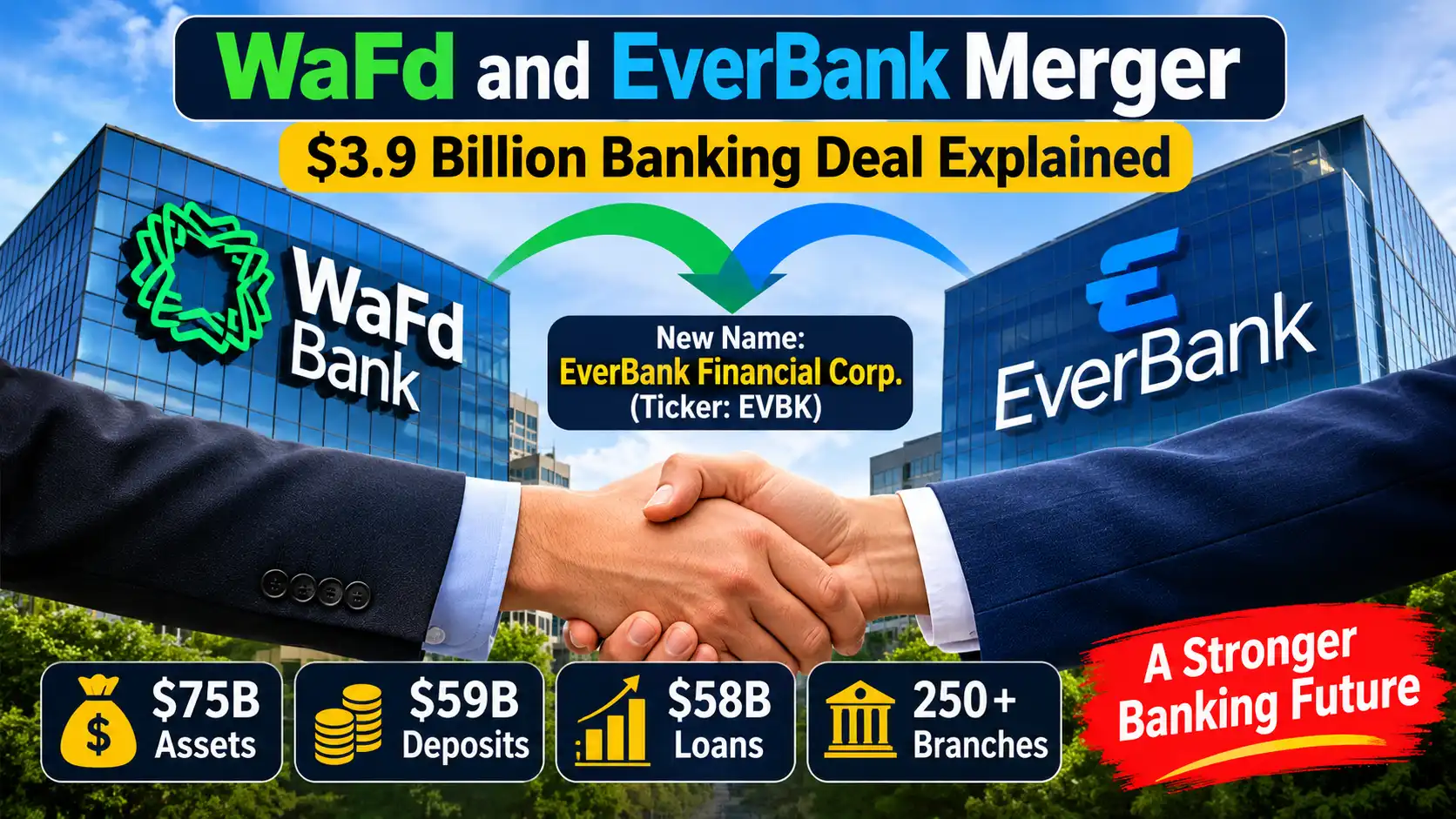
Two major American banking companies, WaFd, Inc. and EverBank Financial Corp., have entered into a merger agreement valued at approximately $3.9 billion. The objective of this transaction is to combine their Consumer Banking, Commercial Banking, Deposit and Lending businesses to create a larger banking group in the United States.
The most interesting aspect of this transaction is that it is not a conventional acquisition in which one bank simply purchases another. Instead, both companies are combining their businesses through a new ownership structure. The transaction is structured as a Reverse Merger.
Legally, WaFd, Inc. will remain the surviving company. However, after the merger is completed, its name will change to EverBank Financial Corp., and its new stock ticker on Nasdaq will be EVBK.
The combined banking group is expected to have approximately $75 billion in assets, $59 billion in deposits and $58 billion in loans. The companies aim to strengthen their retail and commercial banking operations, expand their customer reach and improve operating efficiency.
The merger was announced on September 7, 2026. The companies expect the transaction to close in early 2027, subject to the necessary regulatory approvals and shareholder approval.
Key Merger Details
| Deal Detail | Information |
| Acquirer | WaFd, Inc. |
| Target | EverBank Financial Corp. |
| Deal Type | Reverse Merger / Strategic Combination |
| Deal Industry | Banking & Financial Services |
| Acquirer Country | USA |
| Acquirer Exchange | NASDAQ (WAFD) |
| Announced Deal Value | Approximately $3.9 Billion |
| Announcement Date | September 7, 2026 |
| Merger Agreement Date | September 6, 2026 |
| Transaction Structure | All-stock transaction |
| Legal Acquirer | WaFd, Inc. |
| Accounting Acquirer | EverBank Financial Corp. |
| New Company Name | EverBank Financial Corp. |
| New Stock Ticker | EVBK |
| Stock Exchange | Nasdaq |
| EverBank Shareholders’ Ownership | Approximately 59.2% |
| WaFd Shareholders’ Ownership | Approximately 40.8% |
| Expected Closing | Early 2027 |
| Combined Assets | Approximately $75 Billion |
| Combined Deposits | Approximately $59 Billion |
| Combined Loans | Approximately $58 Billion |
| Transaction Status | Announced and pending |
Important: This is an all-stock transaction valued at approximately $3.9 billion. It means EverBank shareholders will receive shares in the combined company instead of cash. Therefore, it should not be interpreted as a $3.9 billion cash acquisition.
Company Introduction: WaFd, Inc. (WaFd Bank)
WaFd, Inc. is an American financial holding company, and its banking subsidiary is WaFd Bank. The company was originally established in 1917 as Washington Federal and later adopted the name WaFd Bank.
What Does WaFd Bank Do?
WaFd Bank is a regional commercial bank that provides banking services to individuals, small businesses and commercial customers.
Its major business areas include:
- Personal Banking: Savings accounts, checking accounts and other banking services.
- Business Banking: Deposit accounts and lending services for small and medium-sized businesses.
- Commercial Real Estate Lending: Loans for commercial properties and real estate projects.
- Commercial Banking: Financing and cash-management services for businesses.
- Mortgage and Lending: Financing products for homebuyers and other borrowers.
WaFd has a strong branch network across the western United States. Its branches operate in states including Washington, Oregon, Idaho, Utah, Nevada, Arizona, Texas, New Mexico and California.
What Is WaFd’s Role in the Merger?
WaFd’s existing branch network and commercial banking experience are important parts of this transaction.
EverBank has nationwide consumer and commercial banking operations, while WaFd has strong local banking relationships and an established branch network in the western United States.
Combining these businesses could provide the new organization with access to more customers and businesses.
Company Introduction: EverBank Financial Corp.
EverBank Financial Corp. is an American financial holding company with EverBank, N.A. as its banking subsidiary. It provides consumer banking, commercial banking and specialized lending services.
What Does EverBank Do?
EverBank serves both retail customers and commercial clients.
Its major business areas include:
- Consumer Banking: Deposit accounts and banking products for individuals.
- Commercial Real Estate Lending: Financing for commercial properties.
- Commercial and Industrial Lending: Loans for businesses to meet working capital and other financial requirements.
- Specialty Finance: Specialized lending businesses such as life insurance premium finance and fund finance.
- SBA Lending: Financing solutions related to the Small Business Administration.
- Wealth Management: Investment advisory and financial services for high-net-worth customers.
EverBank’s consumer and commercial banking capabilities make it a diversified financial services provider.
What Is EverBank’s Role in the Merger?
EverBank is not simply joining the transaction as another regional bank. It will also be the accounting acquirer of the combined organization.
This means that although WaFd, Inc. will legally survive the merger, EverBank will be treated as the acquiring business for accounting and financial reporting purposes.
This is one of the most important features of the transaction.
Why Are WaFd and EverBank Merging?
Both companies have some important similarities in their businesses, along with complementary capabilities that could strengthen the combined organization.
WaFd has experience in commercial banking and an established branch network in the western United States. EverBank, on the other hand, has a nationwide consumer banking platform, commercial lending operations and specialized financial products.
The main objectives behind the merger include:
1. Expanding the Banking Network: Combining the two companies’ locations to create a network of more than 250 financial centers.
2. Strengthening Commercial Banking: Bringing together WaFd’s commercial real estate lending expertise and EverBank’s commercial and industrial lending business.
3. Increasing the Deposit Base: Combining WaFd’s commercial deposits with EverBank’s retail deposits to diversify funding sources.
4. Nationwide Growth: Using the existing customer bases and distribution networks of both companies to expand into additional markets.
5. Improving Profitability: Increasing operating scale, managing expenses more efficiently and potentially improving earnings.
Understanding the $3.9 Billion Deal Value
The announced transaction value is approximately $3.9 billion. However, it is important to understand that this is not a conventional cash acquisition.
Under the merger structure, EverBank shareholders will receive shares in WaFd, which will become the combined company. This means EverBank’s existing investors will continue to own a significant stake in the new organization.
What Will Be the Ownership Structure?
The combined company will have the following ownership structure after the merger:
| Shareholder Group | Expected Ownership |
| Existing EverBank Shareholders | 59.2% |
| Existing WaFd Shareholders | 40.8% |
| Total | 100% |
Ownership on a fully diluted basis, as specified in the merger agreement.
This means that after the merger, EverBank’s existing shareholders are expected to own approximately 59.2% of the combined company, while WaFd shareholders will own approximately 40.8%.
EverBank’s investors include Stone Point Capital, Warburg Pincus, Reverence Capital Partners, Sixth Street, Bayview Asset Management and TIAA.
What Is a Reverse Merger and How Will This Deal Work?
To understand this transaction, it is important to know what a reverse merger means.
In a conventional acquisition, one company purchases another, and the acquired company may lose its independent corporate identity. However, this transaction has a different legal and accounting structure.
What Will Happen in This Merger?
Step 1 – Holding Company Merger
EverBank Financial Corp. will merge into WaFd, Inc. WaFd, Inc. will legally remain the surviving company.
Step 2 – Company Name Change
After the merger is completed, WaFd, Inc. will change its name to EverBank Financial Corp.
Step 3 – New Stock Market Name and Ticker
The combined company will remain listed on Nasdaq, but its new stock ticker will be EVBK. The existing WaFd ticker, WAFD, will be replaced by EVBK.
Step 4 – Merger of Banking Subsidiaries
WaFd Bank will merge into EverBank, N.A. Following the bank-level merger, EverBank, N.A. will be the surviving banking entity and will operate as a national bank under the supervision of the Office of the Comptroller of the Currency (OCC).
Difference Between Legal Acquirer and Accounting Acquirer
| Term | Company | Meaning |
| Legal Acquirer / Surviving Company | WaFd, Inc. | The company that legally survives the merger |
| Accounting Acquirer | EverBank Financial Corp. | The business treated as the acquirer for financial reporting |
| Surviving Bank | EverBank, N.A. | The banking entity that continues after the bank-level merger |
This is why the transaction is described as a Reverse Merger. It is not simply a name change; it involves changes in ownership, accounting treatment and the legal structure of the banking subsidiaries.
Combined Bank’s Financial Strength: Assets, Deposits and Loans
After the merger, the combined banking group is expected to become significantly larger in terms of financial size.
According to the companies’ figures as of June 30, 2026:
| Financial Metric | EverBank | WaFd | Combined |
| Total Assets | $46.7B | $27.6B | $74.3B |
| Deposits | $37.7B | $21.0B | $58.7B |
| Loans | — | — | Approx. $58B |
Individual asset and deposit figures are reported on EverBank’s merger information page. The combined loan figure of approximately $58 billion is reported in merger-related disclosures. The asset and deposit totals are calculated by adding the individual figures and are consistent with the rounded announcement figures of $75 billion and $59 billion.
What Are Assets?
A bank’s assets include loans, cash, investments and other financial holdings. Approximately $75 billion in combined assets indicates that the new banking group will have a substantial balance sheet.
Why Are Deposits Important?
The money customers keep in savings and checking accounts is known as bank deposits. Banks use these funds to support lending and other banking activities while meeting applicable liquidity and regulatory requirements.
What Is the Importance of Loans?
Banks generate interest income from loans. These may include personal loans, commercial loans and real estate financing.
After the merger, the combined banking group is expected to have approximately $58 billion in loans, increasing the scale of its lending operations.
Branch Network: More Than 250 Financial Centers
One of the major benefits of this merger will be the expansion of the combined companies’ branch and financial-center network.
According to EverBank’s merger information, the combined organization is expected to have more than 250 financial centers across 11 US states.
The major states include:
- Arizona
- California
- Florida
- Idaho
- Nevada
- New Mexico
- New York
- Oregon
- Texas
- Utah
- Washington
How Could This Benefit Customers?
WaFd has a strong presence in the western United States, while EverBank has operations in markets such as California, Florida and New York.
Combining these networks could allow the new banking group to serve customers in more locations and expand its in-person banking services.
However, customers should not assume that all branches will immediately become accessible to customers of both banks after closing. The companies have indicated that shared access will depend on the integration of systems and operations.
What Will Happen to Existing Customers?
The merger is important not only for shareholders but also for customers of both banks.
EverBank and WaFd have indicated that both banks will continue operating separately until the transaction is completed.
Personal Banking Customers
For now, customers of EverBank and WaFd can continue using their existing accounts and banking services as usual.
Business Banking Customers
No immediate changes have been announced for commercial customers. Existing relationship managers, products and services are expected to continue during the transition.
Branch Access
Until the merger is completed and operational integration takes place, customers should not assume they can use the branches of one bank as though they were already customers of the other.
FDIC Insurance
The merger announcement does not indicate an immediate change to FDIC insurance coverage. After completion, the treatment of deposit accounts and insurance coverage will be governed by applicable FDIC rules. Customers should review their coverage based on their account balances and ownership categories following the merger.
How Much Growth in Earnings Is Expected?
One of the important objectives of this transaction is to improve the combined bank’s profitability.
The companies have also provided certain financial projections as part of the merger announcement.
Approximately 29% EPS Accretion in 2027
The companies estimate that the combined company’s 2027 earnings per share (EPS) could increase by approximately 29% for existing WaFd shareholders. This is management’s projection, not a guaranteed financial result.
EPS, or Earnings Per Share, measures how much profit a company generates for each outstanding share.
For example, if a company’s earnings increase relative to its share count, its earnings per share may also increase.
Return on Tangible Common Equity of Approximately 15%
The companies expect the combined organization to achieve a Return on Tangible Common Equity (ROTCE) of approximately 15% after realizing the expected cost synergies.
ROTCE measures how effectively a bank generates profit using its tangible common equity.
Recovery of Tangible Book Value Dilution
The companies estimate that the transaction-related tangible book value dilution could be recovered in less than two years.
In simple terms, the acquisition may initially reduce tangible book value per share. However, if the merger increases earnings and profitability, the company may recover this reduction over time.
What Changes Are Expected in Management and Board Structure?
After the merger is completed, the combined company plans to include members of both banks’ existing management teams.
| Position | Proposed Management |
| CEO | Greg Seibly |
| President | Brent Beardall |
| Chairman | Robert Radway |
Greg Seibly is currently the CEO of EverBank Financial Corp., while Brent Beardall is the CEO of WaFd. Robert Radway is currently the Chairman of EverBank Financial Corp.
Board of Directors
The new combined company and bank are expected to have a 13-member board:
- 7 directors representing EverBank.
- 6 directors representing WaFd.
This arrangement is intended to give both companies’ existing leadership groups representation in the combined organization.
Has Shareholder Approval Been Received?
It is important to understand the approval status of the two companies separately.
- EverBank shareholder approval has been reported in KBRA’s merger-related credit analysis.
- WaFd shareholders still need to approve the proposed stock issuance.
- WaFd’s proxy documents ask shareholders to vote on the stock issuance and a merger-related executive compensation proposal.
In addition, the necessary regulatory approvals and other closing conditions must be satisfied.
Main Risks and Challenges Associated With the Merger
Although the transaction could create growth opportunities for both banks, several risks need to be considered.
A. Regulatory Approval
Bank mergers involve multiple regulatory requirements. Obtaining the necessary approvals from authorities such as the Federal Reserve and OCC can take time.
B. Integration Challenges
Combining the technology systems, customer databases, branches and banking processes of two banks can be complicated.
C. Credit Risk
A bank’s profitability also depends on the quality of its loan portfolio. If borrowers fail to repay their loans on time, the bank may face additional provisions and financial losses.
D. Interest Rate Changes
Bank earnings are influenced by interest rates and deposit costs. Changes in interest rates can affect lending margins and overall profitability.
E. Financial Targets May Not Be Achieved
The projected 29% EPS accretion and 15% ROTCE are management estimates. If cost savings are lower than expected or integration expenses are higher, actual financial performance could differ.
F. Shareholder and Ownership Structure
EverBank shareholders are expected to own approximately 59.2% of the combined company. This means WaFd shareholders’ relative ownership will decrease to approximately 40.8%. This change could also influence corporate governance and future strategic decisions.
Conclusion
The proposed $3.9 billion merger between WaFd and EverBank is a major strategic combination in the US banking sector. Through this transaction, both companies plan to combine their consumer banking, commercial lending, deposits and branch networks.
After completion, WaFd, Inc. will change its name to EverBank Financial Corp., and the combined company will trade on Nasdaq under the ticker EVBK. EverBank shareholders are expected to own approximately 59.2% of the combined company, while WaFd shareholders will own approximately 40.8%.
With approximately $75 billion in assets, $59 billion in deposits and $58 billion in loans, the combined banking group could strengthen its presence in the US financial market.
However, the actual success of the merger will depend on regulatory approvals, technology integration, loan portfolio quality and the management’s ability to achieve its projected financial targets.
This is not simply a merger between two banks. It is a reverse merger in which WaFd will remain the legal surviving company, while the combined business will adopt the new identity of EverBank Financial Corp.
Sources: EverBank – Official Merger Announcement | EverBank – Stronger Together | SEC – Merger Proxy Filing | WaFd – Investor Relations