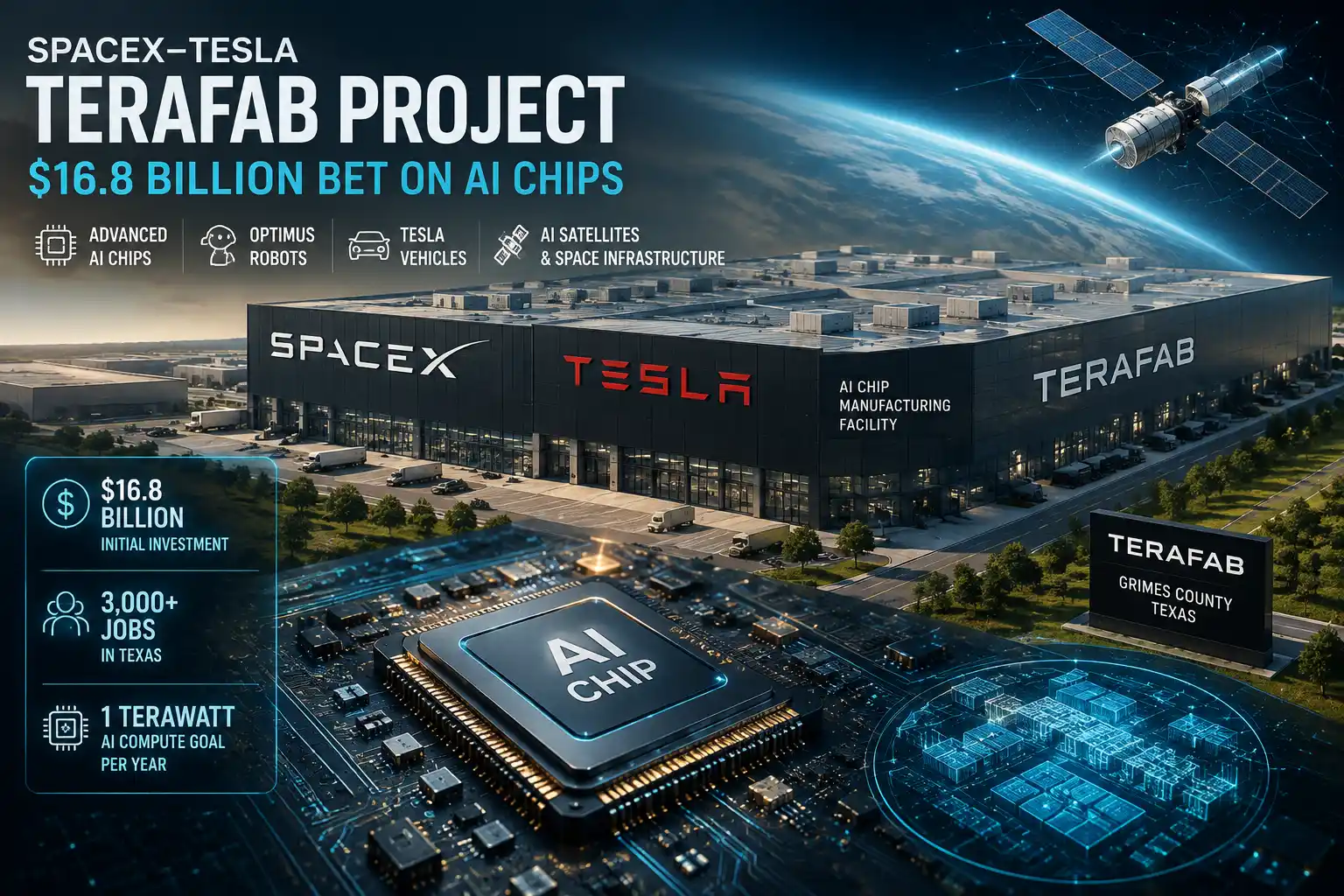
SpaceX and Tesla are planning to invest $16.8 billion initially to build a massive semiconductor manufacturing complex called Terafab in Texas.
The project is designed to help Elon Musk’s companies secure the advanced chips they will need for artificial intelligence, autonomous vehicles, humanoid robots, space-based computing and other future technologies.
The most important point is that $16.8 billion is the initial investment, not the total potential cost. If all planned phases are completed, the overall investment could eventually reach approximately $119 billion.
The planned facility in Grimes County, Texas, could cover more than 100 million square feet, making it far more than a conventional chip factory.
What Is Terafab?
In simple terms, Terafab is planned as a giant semiconductor manufacturing and advanced-computing campus.
Today, companies often depend on outside semiconductor manufacturers for producing their chips. Tesla and SpaceX want greater control over this critical part of their supply chain.
The basic idea is:
Chip Design → Manufacturing → Packaging → Testing → Use in Products
By bringing more of these activities together, Musk’s companies could reduce their dependence on external suppliers. That could become especially important as demand for AI chips continues to rise.
$16.8 Billion vs. $119 Billion: What Is the Difference?
This is one of the most important details of the project.
Initial Investment: $16.8 Billion
The newly reported plan calls for approximately $16.8 billion in initial investment for the Terafab project. This represents the first stage of the development.
Potential Total Investment: Up to $119 Billion
If the project expands through all planned phases, the total investment could eventually reach approximately $119 billion.
So, it would be incorrect to say that Tesla and SpaceX are immediately spending $119 billion.
The more accurate description is:
$16.8 billion = initial investment
Up to $119 billion = potential long-term project investment
This distinction is important when evaluating the financial scale of Terafab.
Where Will Terafab Be Built?
The planned Terafab facility will be located in Grimes County, Texas. Texas has become an increasingly important location for technology, manufacturing and semiconductor investment.
Tesla already has a major presence in the state, while several other companies connected to Musk’s broader technology ecosystem also operate in Texas.
Terafab could further strengthen the state’s position as a major US technology and manufacturing hub.
Why Does Elon Musk Need a Huge Chip Factory?
The biggest reason is the rapidly growing demand for AI computing power. Tesla is no longer focused only on electric vehicles. The company is investing heavily in:
- Autonomous driving
- Robotaxis
- Humanoid robots
- AI systems
- Robotics
- High-performance computing
SpaceX is also exploring increasingly ambitious computing applications, including space-based computing infrastructure.
All of these technologies require powerful and specialized semiconductor chips. If the demand for AI chips grows faster than supply, access to chips could become a major bottleneck. Terafab is essentially an attempt to prepare for that future.
What Chips Could Terafab Produce?
Terafab is expected to support advanced semiconductor requirements for several applications.
Tesla
The chips could potentially be used in:
- Autonomous driving systems
- Robotaxis and Cybercabs
- Optimus humanoid robots
- Future Tesla vehicles
- AI computing systems
SpaceX
Potential applications include:
- Space-based data centers
- AI computing
- High-performance computing
- Advanced space systems
This gives Terafab a potential role across several parts of Musk’s technology ecosystem.
What Makes Terafab Different?
One of the most interesting aspects of Terafab is its planned level of integration. The semiconductor industry is normally divided into multiple stages.
For example:
Design → Wafer Manufacturing → Packaging → Testing
Different companies and facilities may handle different stages. Terafab aims to bring more of these capabilities together in a large integrated complex. That could give Tesla and SpaceX greater control over their semiconductor supply chain.
Intel Could Play an Important Role
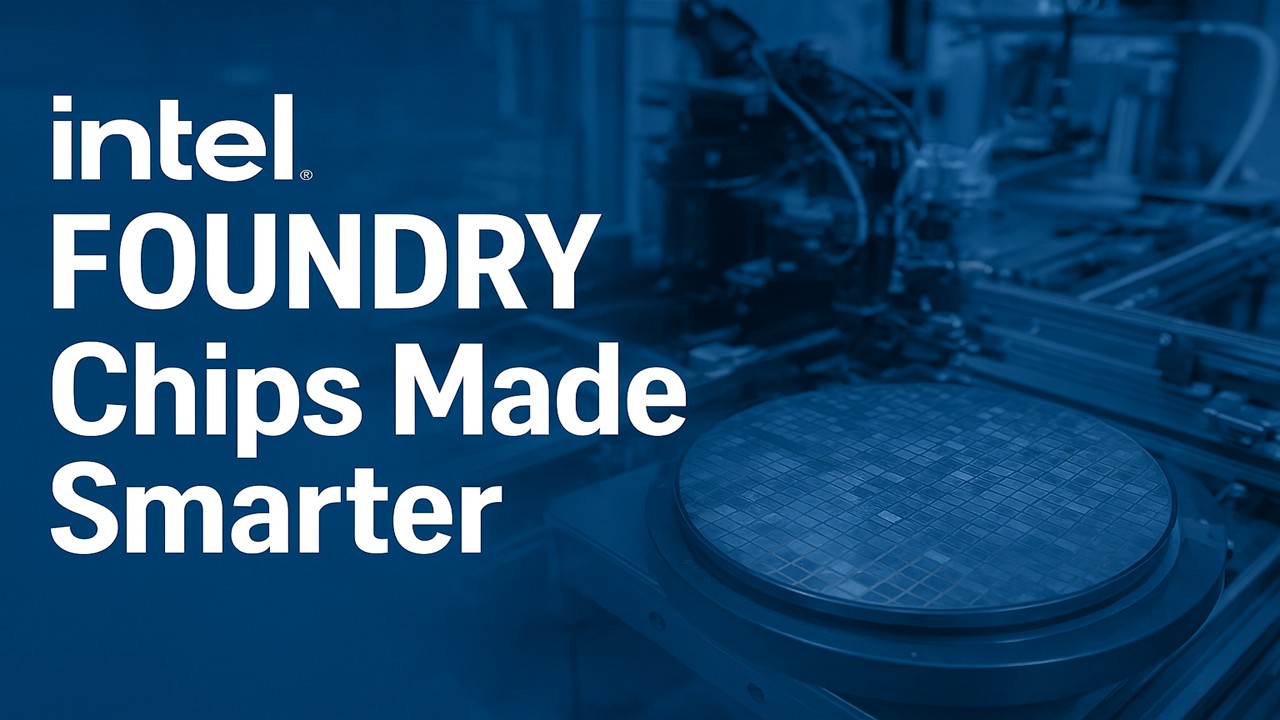
Intel could also become an important technology partner in the Terafab project. Earlier plans indicated that Tesla was looking at Intel’s next-generation semiconductor manufacturing technology for Terafab.
This does not mean Intel will necessarily build and operate the entire facility.
Instead, Intel’s manufacturing expertise and advanced process technology could play an important role in some parts of the project. This would give Tesla access to established semiconductor manufacturing expertise while allowing it to pursue greater control over its own chip supply.
Why Does Tesla Want to Make Its Own Chips?
Tesla’s future ambitions require enormous computing capacity. Imagine millions of autonomous vehicles operating simultaneously, along with large numbers of humanoid robots.
Each system would require powerful computing hardware. If Tesla relies entirely on external chip suppliers, a semiconductor shortage could potentially slow its expansion.
Terafab could therefore act as a form of supply-chain protection.
In simple terms:
More internal chip capacity = less dependence on external suppliers.
This could become particularly valuable during periods of semiconductor shortages or geopolitical disruptions.
How Could Terafab Help SpaceX?
SpaceX’s future ambitions extend beyond rockets and Starlink. The company is increasingly associated with advanced computing infrastructure and potential space-based data centers.
Such systems could require enormous amounts of computing power. Reliable access to advanced chips could therefore become strategically important for SpaceX.
Terafab could potentially provide a dedicated source of semiconductor capacity for these future computing systems.
How Big Is the Terafab Project?
The planned facility could cover more than 100 million square feet. That is an enormous footprint for semiconductor manufacturing. This is why Terafab should not simply be viewed as a traditional chip factory.
It is better understood as a large semiconductor and advanced-computing campus that could include manufacturing, packaging, testing and supporting infrastructure.
How Many Jobs Could It Create?
The project is expected to create at least 3,000 high-paying jobs.
These could include:
- Semiconductor engineers
- Manufacturing specialists
- Technicians
- Process engineers
- Construction workers
- Operations professionals
A project of this scale could also create thousands of indirect jobs through suppliers, construction companies, logistics providers and other businesses.
What Does Terafab Mean for Texas?
Terafab could become another major boost for Texas’s technology and manufacturing ecosystem.
There are three major potential benefits.
1. Massive Investment
Billions of dollars could be invested in Texas infrastructure and manufacturing.
2. High-Skilled Jobs
The project could create thousands of high-paying technology and manufacturing jobs.
3. Stronger Semiconductor Position
Texas could further strengthen its position in the US semiconductor industry.
The project could also attract suppliers and other technology companies to the surrounding region.
But Terafab Faces Major Challenges
Building a semiconductor factory is extremely difficult.
Announcing a project is one thing. Successfully producing advanced chips at scale is another.
1. The Investment Is Huge
A potential investment of up to $119 billion is enormous.
Funding such a project over many years could be challenging.
The actual investment will likely depend on demand, project progress, technology requirements and economic conditions.
2. Advanced Chip Manufacturing Is Extremely Complex
A modern semiconductor factory requires much more than a large building.
It needs:
- Advanced lithography equipment
- Ultra-clean manufacturing facilities
- Huge electricity supplies
- Ultra-pure water
- Advanced packaging technology
- Highly skilled engineers
- Sophisticated manufacturing processes
Even established semiconductor companies spend years developing and optimizing advanced manufacturing facilities.
3. Competition From TSMC, Samsung and Intel
Tesla and SpaceX would be entering a highly competitive semiconductor industry.
Companies such as TSMC, Samsung and Intel already have decades of experience in advanced chip manufacturing.
Matching their technology, production efficiency and manufacturing yields will be a major challenge.
4. Huge Electricity and Water Requirements
Semiconductor fabs consume significant amounts of electricity and ultra-pure water.
A facility of Terafab’s planned scale could require major supporting infrastructure.
Reports indicate that power-generation and wastewater-treatment infrastructure are also part of the broader project planning.
This shows that Terafab is not simply a factory—it could become a large industrial ecosystem.
Does Terafab Compete With Nvidia?
Terafab should not be interpreted as a direct attempt to replace Nvidia. Nvidia remains one of the strongest companies in the AI accelerator market. Tesla’s strategy is somewhat different. Tesla wants greater control over the chips required for its own products and AI systems.
The company already designs specialized chips for its AI workloads. Terafab could potentially provide more control over the manufacturing side of that equation.
The broader strategy is therefore:
AI chip design + manufacturing capacity + AI infrastructure + robotics + autonomous systems
What Could Terafab Mean for the US Semiconductor Industry?
Terafab could also have strategic importance for the United States.
The US has been trying to increase domestic semiconductor manufacturing and reduce dependence on overseas production for critical technologies.
A large new semiconductor complex in Texas could contribute to that effort. If successfully developed, Terafab could strengthen the connection between:
AI + Semiconductors + Robotics + Autonomous Vehicles + Space Technology
That combination could become increasingly important in the global technology race.
The Bigger Strategy Behind Terafab
Terafab makes more sense when viewed as part of Elon Musk’s broader technology strategy. The different businesses may eventually reinforce one another:
AI → Chips → Robots → Autonomous Vehicles → Space → Data Centers
Tesla needs chips for autonomous vehicles and robots. SpaceX could need chips for advanced computing and space infrastructure. Terafab could provide semiconductor capacity that supports both ecosystems.
This makes the project strategically more significant than a normal manufacturing investment.
What Does Terafab Mean for Investors?
Investors should look at Terafab from both sides.
Potential Benefits
- Greater control over semiconductor supply
- Reduced dependence on external chip manufacturers
- Support for Tesla’s AI ambitions
- Support for Optimus and autonomous vehicles
- Potential support for SpaceX’s future computing infrastructure
- Greater US semiconductor capacity
- Potential long-term manufacturing advantages
Major Risks
- Extremely high capital requirements
- Complex semiconductor technology
- Competition from established chip manufacturers
- Long development timeline
- Electricity and water requirements
- Risk of technology changing before the facility reaches full capacity
- Execution risk
The biggest question is not whether Terafab is ambitious.
It clearly is.
The bigger question is whether Tesla and SpaceX can turn this ambition into competitive, high-volume semiconductor production at an economically attractive cost.
Terafab Project at a Glance
| Parameter | Details |
| Project | Terafab |
| Companies | SpaceX and Tesla |
| Location | Grimes County, Texas |
| Initial Investment | $16.8 billion |
| Potential Total Investment | Up to $119 billion |
| Planned Size | More than 100 million sq. ft. |
| Expected Jobs | 3,000+ |
| Main Focus | Advanced semiconductors and computing |
| Tesla Applications | Autonomous vehicles, Cybercabs, Optimus and AI |
| SpaceX Applications | Space-based computing and advanced systems |
| Potential Technology Partner | Intel |
| Strategic Goal | Greater control over future AI-chip supply |
Conclusion
SpaceX and Tesla’s Terafab project is much more than another factory announcement. It represents an attempt to gain greater control over one of the most important resources of the AI era: advanced computing chips.
The initial $16.8 billion investment is already substantial, but the potential $119 billion long-term scale makes the project even more significant.
The strategy is straightforward: as Tesla expands autonomous vehicles, robotics and AI, and SpaceX moves toward increasingly advanced computing applications, both companies will need enormous amounts of semiconductor capacity.
If Terafab succeeds, Tesla and SpaceX could have greater control over their chip supply chain while Texas could strengthen its position as a major US semiconductor and technology hub.
However, the project also comes with enormous technological, financial and execution challenges.
The real story is not simply that Elon Musk wants to build a $16.8 billion chip factory. The bigger story is that Musk is trying to build an integrated ecosystem where AI, chips, robots, vehicles, space technology and computing infrastructure work together.
Sources
The analysis is based on recent Reuters reporting on the Terafab project, earlier reporting on its proposed investment and expansion plans, spacex updates and Texas-based reporting on the project’s size, infrastructure and economic impact.