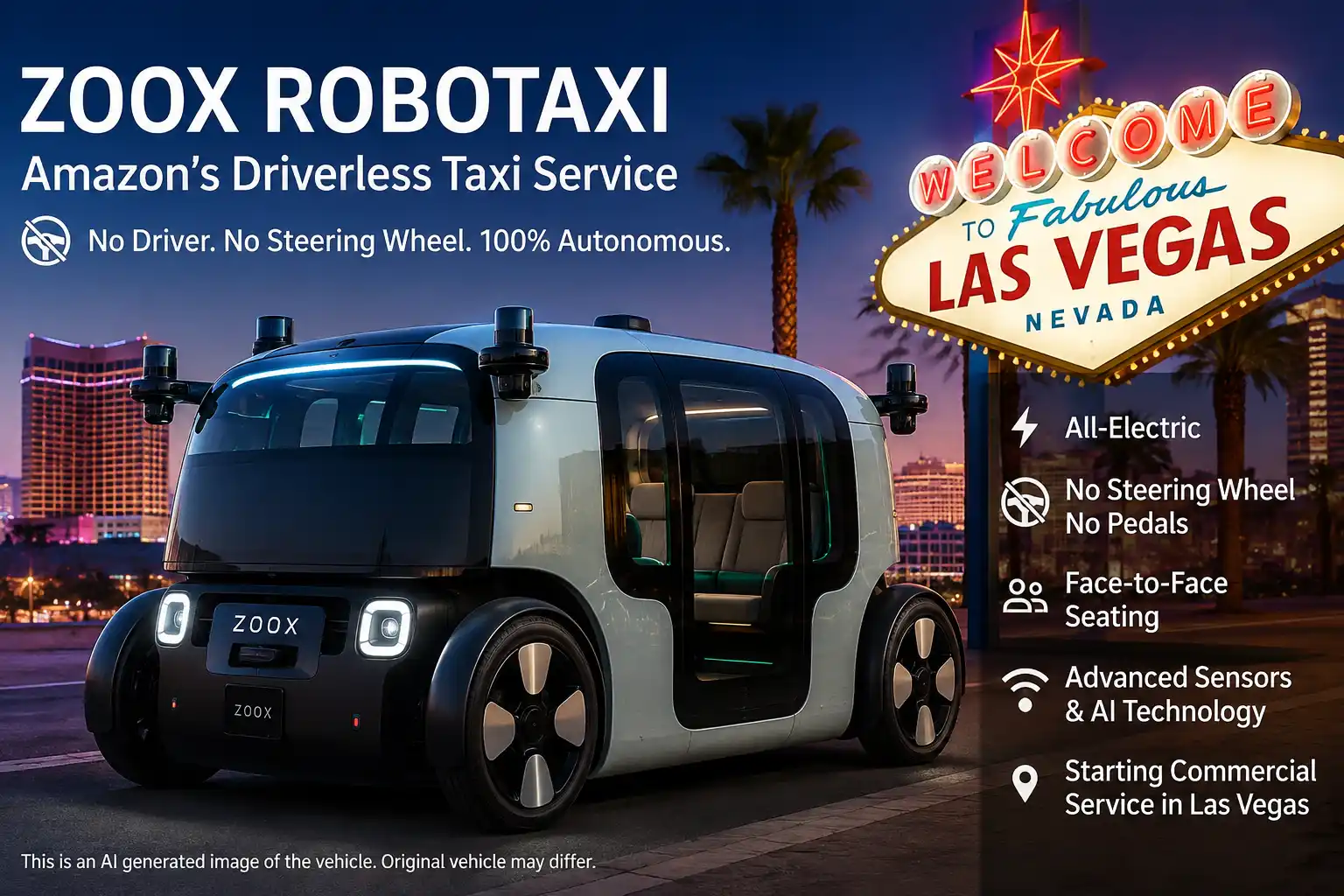
Amazon-owned autonomous vehicle company Zoox has reached a major milestone by launching its paid commercial robotaxi service in Las Vegas. Until now, the company had been offering limited free test rides, but customers can now book and pay for fully autonomous rides, marking Zoox’s transition from testing to a real commercial business. According to Reuters, this is one of the biggest developments in the autonomous mobility industry this year.
Zoox also recently received a commercial exemption from the U.S. National Highway Traffic Safety Administration (NHTSA), allowing it to operate its uniquely designed robotaxi without a steering wheel or pedals. The exemption initially covers up to 2,500 vehicles, making Zoox one of the first companies permitted to commercially deploy purpose-built autonomous vehicles in the United States.
The launch intensifies competition in the rapidly growing robotaxi market, where companies such as Waymo, Tesla, and Nuro are also investing heavily in autonomous transportation.
Company Overview
Zoox is an American autonomous mobility company founded in 2014 with the vision of creating a fully autonomous ride-hailing service rather than simply adding self-driving technology to conventional vehicles.
In 2020, Amazon acquired Zoox for approximately $1.3 billion, giving the e-commerce giant a strong position in the future mobility sector. Today, Zoox is considered one of the leading companies developing purpose-built autonomous electric vehicles.
What is the Zoox Robotaxi?
The Zoox Robotaxi is a fully autonomous, all-electric vehicle specifically designed for ride-hailing services.
Unlike most competitors that convert traditional cars into self-driving vehicles, Zoox built its robotaxi from the ground up exclusively for autonomous transportation.
The vehicle features:
- No steering wheel
- No accelerator pedal
- No brake pedal
- No driver’s seat
Everything is controlled by advanced autonomous driving software powered by artificial intelligence.
Unique Vehicle Design
One of the biggest differences between Zoox and its competitors is its futuristic vehicle design.
Key highlights include:
- Seating for four passengers
- Face-to-face seating arrangement
- Bidirectional driving capability
- Four-wheel steering
- Fully electric powertrain
Because the vehicle can travel in either direction without turning around, it is particularly suitable for dense urban environments where space is limited.
How Does Zoox Robotaxi Work?
The Robotaxi continuously monitors its surroundings using an advanced sensor suite, including:
- LiDAR
- Radar
- High-resolution cameras
- Thermal sensors
- Microphones
These sensors generate a detailed 360-degree view of the environment, allowing the AI system to identify pedestrians, cyclists, vehicles, traffic lights, and road conditions in real time.
The onboard autonomous driving software then determines steering, acceleration, braking, and navigation decisions without human intervention.
NVIDIA’s Role
Zoox relies on NVIDIA’s high-performance computing platform to process enormous amounts of sensor data every second.
The company also runs millions of virtual driving simulations to train and validate its AI system, enabling the software to safely handle a wide range of real-world driving scenarios before deployment.
What Makes Zoox Different?
Most autonomous vehicle companies retrofit existing passenger vehicles with self-driving technology.
Zoox follows a completely different strategy by developing every major component itself, including:
- Vehicle design
- Autonomous driving software
- Sensor integration
- Fleet management system
- Ride-hailing platform
This vertically integrated approach allows Zoox to optimize both hardware and software specifically for autonomous transportation.
Where is Zoox Operating?
Zoox has been testing its autonomous vehicles in several U.S. cities, including:
- Las Vegas
- San Francisco
- Austin
- Miami
However, Las Vegas is the first city where the company has officially launched paid commercial robotaxi services, marking a significant milestone in its commercialization strategy.
Pricing Model
Zoox has indicated that its pricing will be comparable to the comfort-tier ride-hailing services currently available in the market.
The fare will generally depend on:
- Base fare
- Travel distance
- Trip duration
This pricing strategy is intended to make autonomous transportation accessible while remaining competitive with premium ride-sharing services.
Challenges Ahead
Although Zoox has achieved an important milestone, several challenges remain.
1. Scaling Production
The company must significantly increase vehicle production to support commercial expansion across multiple cities.
2. Safety and Regulations
Operating fully driverless vehicles requires meeting strict regulatory requirements and maintaining extremely high safety standards. Zoox has previously issued software recalls to improve vehicle safety, highlighting the importance of continuous system updates.
3. Intense Competition
The autonomous mobility industry is becoming increasingly competitive, with major players including:
- Waymo
- Tesla
- Nuro
- May Mobility
Each company is pursuing different technological approaches and expanding commercial operations.
Future Plans
Zoox aims to build far more than just an autonomous vehicle—it wants to establish a complete autonomous mobility ecosystem.
The company’s future plans include:
- Expanding commercial services to additional U.S. cities
- Increasing robotaxi production capacity
- Growing its autonomous fleet
- Enhancing AI driving capabilities
- Scaling its ride-hailing platform nationwide
With Amazon’s financial backing, Zoox has significant resources to continue investing in long-term autonomous mobility development.
Outcome
Zoox Robotaxi represents more than just another electric vehicle—it is a glimpse into the future of urban transportation. By eliminating the steering wheel, pedals, and driver’s seat, Zoox has created one of the world’s first purpose-built autonomous electric taxis designed entirely around self-driving technology.
The launch of its paid commercial service in Las Vegas marks an important turning point, demonstrating that robotaxi technology is moving beyond pilot programs into real-world commercial use. If Zoox successfully scales production, maintains high safety standards, and expands into more cities, it has the potential to become one of the world’s leading autonomous mobility companies.
Source: Information compiled from the Zoox Official Website, Reuters, NHTSA, and publicly available company announcements.