Autonomous driving technology is no longer limited to passenger cars and robotaxis. Companies are increasingly developing autonomous systems for heavy-duty trucks, where the technology could eventually transform freight and logistics operations.
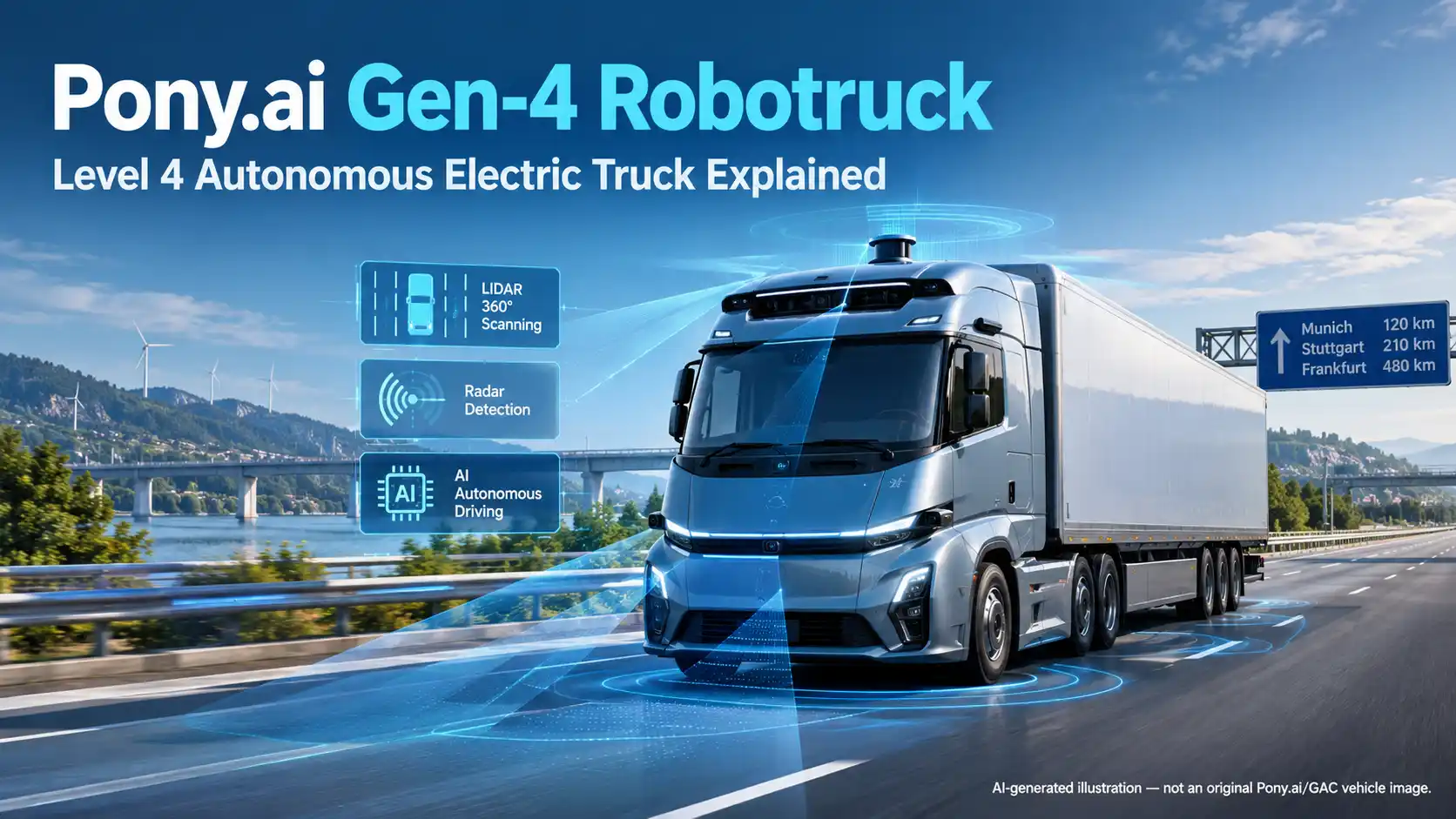
On September 14, 2026, Pony.ai and GAC Commercial Vehicle unveiled a new Level 4 (L4) autonomous electric heavy-duty truck at IAA Transportation 2026 in Hannover, Germany. The vehicle combines Pony.ai’s Gen-4 autonomous driving system with GAC Commercial Vehicle’s T9 battery-electric heavy-duty truck platform.
According to Pony.ai, volume production of the new Robotruck is planned for later in 2026. The vehicle is being developed for applications such as long-haul freight, dedicated-route logistics and port transportation.
Pony.ai Gen-4 Robotruck: Key Highlights
| Feature | Details |
| Company | Pony.ai |
| Vehicle Partner | GAC Commercial Vehicle |
| Vehicle Type | Heavy-Duty Electric Truck |
| Autonomous Level | Level 4 |
| Truck Platform | GAC T9 Battery-Electric Platform |
| Autonomous System | Pony.ai Gen-4 |
| LiDAR | 9 |
| Millimeter-Wave Radar | 3 |
| Cameras | 13 |
| Sensing | 360-Degree Coverage |
| Production | Planned for Later 2026 |
| Main Applications | Freight, Logistics and Ports |
| International Expansion | Europe and Middle East |
| Partnership Agreement | April 16, 2026 |
| Autonomous Kit Cost Claim | 70% Lower BOM Cost |
| Transportation Cost Claim | Up to 30% Lower per Ton-Kilometer |
| Energy Consumption Claim | Around 10% Lower Than Conventional Trucks |
What Did Pony.ai and GAC Unveil?
The new Robotruck combines an electric heavy-duty truck platform with an advanced autonomous driving system.
GAC Commercial Vehicle provides the T9 battery-electric truck platform, while Pony.ai integrates its Gen-4 Level 4 autonomous driving technology.
The partnership is aimed not only at developing a technology demonstrator but also at moving autonomous electric trucking toward commercial deployment and mass production.
The new vehicle is part of Pony.ai’s expanding Gen-4 Robotruck product portfolio.
What Does Level 4 Autonomous Driving Mean?
Level 4 autonomous driving means a vehicle can perform the driving task without human intervention within specific operating conditions or designated areas.
This is different from Level 2 driver-assistance systems. With Level 2 technology, the driver remains responsible for monitoring the vehicle and must be ready to take control.
With Level 4 technology, the autonomous system is designed to handle the driving task itself within its defined operational conditions.
Pony.ai has already been developing autonomous vehicles in China, and the company is now expanding its Robotruck strategy toward international markets.
Based on GAC’s T9 Electric Truck Platform
The new Pony.ai Robotruck is based on GAC Commercial Vehicle’s T9 battery-electric heavy-duty truck platform.
This partnership allows both companies to focus on their respective strengths.
GAC brings vehicle engineering and manufacturing capabilities, while Pony.ai contributes autonomous driving technology, software and vehicle intelligence.
This type of cooperation could become increasingly important as autonomous trucking moves from prototypes toward commercial deployment.
9 LiDARs, 3 Radars and 13 Cameras
One of the most important parts of the new Robotruck is its sensor system.
According to Pony.ai, the vehicle uses:
| Sensor | Quantity |
| LiDAR | 9 |
| Millimeter-Wave Radar | 3 |
| Cameras | 13 |
Together, these sensors are designed to provide 360-degree environmental sensing around the vehicle.
What Does LiDAR Do?
LiDAR helps the autonomous system detect objects and understand their distance and three-dimensional structure.
For a heavy-duty autonomous truck, this can help the vehicle identify other vehicles, road boundaries and objects around it.
Why Is Radar Important?
Millimeter-wave radar helps detect objects around the truck and can provide useful information under different visibility and weather conditions.
What Do the Cameras Do?
Cameras provide visual information that can be used to identify lane markings, road signs, vehicles and other objects.
The autonomous driving system combines information from these different sensors to build an understanding of the surrounding environment.
Redundant Safety Architecture
Safety is particularly important for autonomous heavy-duty trucks because of their size and weight.
Pony.ai says the new Robotruck uses fully redundant architectures for critical systems, including steering, braking, communications, power supply, computing and sensing.
In simple terms, redundancy means that critical functions are designed with backup capabilities. If one component or system encounters a problem, the backup architecture can help maintain safe operation.
This type of system is an important part of developing autonomous vehicles for commercial freight operations.
Pony.ai Says Autonomous Driving Hardware Cost Has Fallen 70%
Another important development is the reduction in the cost of Pony.ai’s autonomous driving hardware.
According to the company, the bill-of-materials cost of its autonomous driving kit has fallen by around 70% compared with the previous generation.
This could be significant for commercial adoption.
Autonomous trucking needs more than advanced technology. The technology also needs to become economically viable for logistics companies.
Lower hardware costs could make it easier for operators to deploy autonomous systems across larger fleets.
Potential 30% Reduction in Transportation Costs
Pony.ai says its Gen-4 Robotruck could reduce transportation costs per ton-kilometer by up to 30%.
This is a company projection rather than a guaranteed result under every operating condition.
Actual savings could vary depending on factors such as route length, payload, energy prices, charging costs, maintenance, regulations and vehicle utilization.
However, if such cost reductions can be achieved in real-world commercial operations, autonomous electric trucks could significantly change freight economics.
Lower Energy Consumption
The Robotruck also combines GAC’s aerodynamic T9 design with Pony.ai’s autonomous driving algorithms.
Pony.ai says the T9 has a 0.4 Cd drag coefficient and that its energy-efficiency algorithms are expected to help reduce energy consumption by around 10% compared with conventional trucks.
Actual energy consumption will depend on factors such as payload, driving speed, road conditions, weather and route characteristics.
When Will Mass Production Start?
Pony.ai plans to begin volume production later in 2026.
This is important because the vehicle is being positioned as more than a concept or technology demonstration.
If the production timeline is achieved, the Robotruck could move toward commercial logistics operations and broader fleet deployment.
The real test, however, will be whether the technology can operate safely, reliably and economically at commercial scale.
Where Could the Robotruck Be Used?
Pony.ai identifies several potential applications for its Robotruck technology.
1. Long-Haul Freight
Long-distance freight is one of the major potential applications for autonomous trucks.
Highway routes can offer relatively structured driving environments, making them an important area for autonomous trucking development.
2. Dedicated-Route Logistics
Some logistics operations use fixed or repetitive routes.
These routes may be particularly suitable for autonomous vehicles because the operating environment can be mapped, tested and validated in advance.
3. Port Transportation
Ports often involve repetitive transportation routes within controlled or semi-controlled environments.
Autonomous electric trucks could therefore be useful for moving cargo between different parts of port facilities.
Pony.ai and GAC Partnership
The partnership between Pony.ai and GAC Commercial Vehicle was established earlier in 2026.
The two companies signed a strategic cooperation agreement on April 16, 2026. Pony.ai says the development, testing and validation of the Robotruck were completed in roughly five months before its September unveiling.
The partnership demonstrates how autonomous vehicle companies can work with established vehicle manufacturers to accelerate commercialization.
Pony.ai contributes autonomous driving technology, while GAC provides vehicle engineering and manufacturing capabilities.
Pony.ai Has Been Developing Robotruck Technology Since 2018
Pony.ai’s Robotruck business is not a new initiative.
The company began developing Robotruck technology in 2018 and has since worked on autonomous solutions for both heavy-duty and light-duty trucks.
The Gen-4 Robotruck therefore represents another stage in Pony.ai’s longer-term autonomous trucking strategy.
The company is also developing its Virtual Driver technology for different applications, including Robotaxi and Robotruck operations.
Europe Could Become an Important Market
The September 14 unveiling also highlights Pony.ai’s international ambitions.
The company plans to expand its Robotruck business into Europe and the Middle East over the next two years.
According to Reuters, Pony.ai is also discussing road-testing permissions with European governments and potential customers.
Europe could offer an attractive market for autonomous freight technology because of factors such as high transportation costs and driver shortages.
However, entering the European market will not be simple.
Autonomous truck companies must deal with regulatory approvals, safety validation, road-testing requirements, insurance and country-specific rules before large-scale deployment can take place.
Growing Competition in European Electric Trucks
Pony.ai is not the only Chinese company targeting Europe’s electric commercial vehicle market.
Companies including BYD, Farizon, Sany, Sinotruk, Windrose and SuperPanther are also seeking opportunities in the European electric truck market.
This means competition in the automotive industry may increasingly extend beyond electric passenger cars.
Heavy-duty electric trucks and autonomous freight vehicles could become an important part of the competition between Chinese and European automotive companies.
What Does This Mean for Pony.ai?
The Robotruck launch highlights three major parts of Pony.ai’s strategy.
First — Robotaxi:
The company is developing autonomous driving technology for passenger transportation.
Second — Robotruck:
Pony.ai is applying autonomous driving technology to freight and logistics.
Third — International Expansion:
The company is looking beyond China toward markets such as Europe and the Middle East.
This suggests that Pony.ai does not want to limit its autonomous driving technology to a single type of vehicle.
Why Is This Launch Important?
The biggest significance of the new Robotruck is not simply that it is an L4 autonomous vehicle.
The more important development is the combination of autonomous driving, battery-electric power and planned commercial production in a heavy-duty truck.
If autonomous electric trucks reach large-scale commercial deployment, logistics companies could potentially benefit from:
- Lower dependence on human drivers
- Automation of repetitive freight routes
- Lower fuel-related operating costs
- Reduced emissions from electric powertrains
- Higher vehicle utilization
- More automated and data-driven logistics operations
However, there are also significant challenges.
Regulatory approval, safety validation, charging infrastructure, battery range, maintenance, insurance and real-world operating reliability all need to be addressed before autonomous electric trucks can become mainstream.
Therefore, the planned production timeline should not be treated as proof of commercial success.
The most important test will be how safely and consistently these trucks operate in real-world logistics environments.
Outcome
The Pony.ai and GAC Gen-4 Level 4 Robotruck represents an important development in autonomous freight transportation. The vehicle combines GAC Commercial Vehicle’s T9 battery-electric heavy-duty truck platform with Pony.ai’s Gen-4 autonomous driving technology.
With 9 LiDARs, 3 millimeter-wave radars, 13 cameras and redundant safety architecture, the vehicle has been designed for autonomous commercial freight applications.
The most important part of the announcement is that Pony.ai is targeting volume production later in 2026, rather than presenting the vehicle solely as a concept. The company also plans to expand its Robotruck business into Europe and the Middle East.
If Pony.ai can successfully address the regulatory, safety and commercial challenges associated with autonomous trucking, its Gen-4 Robotruck technology could strengthen the company’s position in the global autonomous freight market.
For now, the next major milestones to watch are production, real-world testing, regulatory approvals and commercial fleet deployment.
Source: Pony.ai Official Announcement and Reuters, September 14, 2026.