Artificial Intelligence is rapidly evolving beyond chatbots that simply answer questions. Technology companies are now developing AI models that can perform complex tasks, analyze large amounts of information, write software, conduct research, use digital tools and assist businesses with everyday operations.
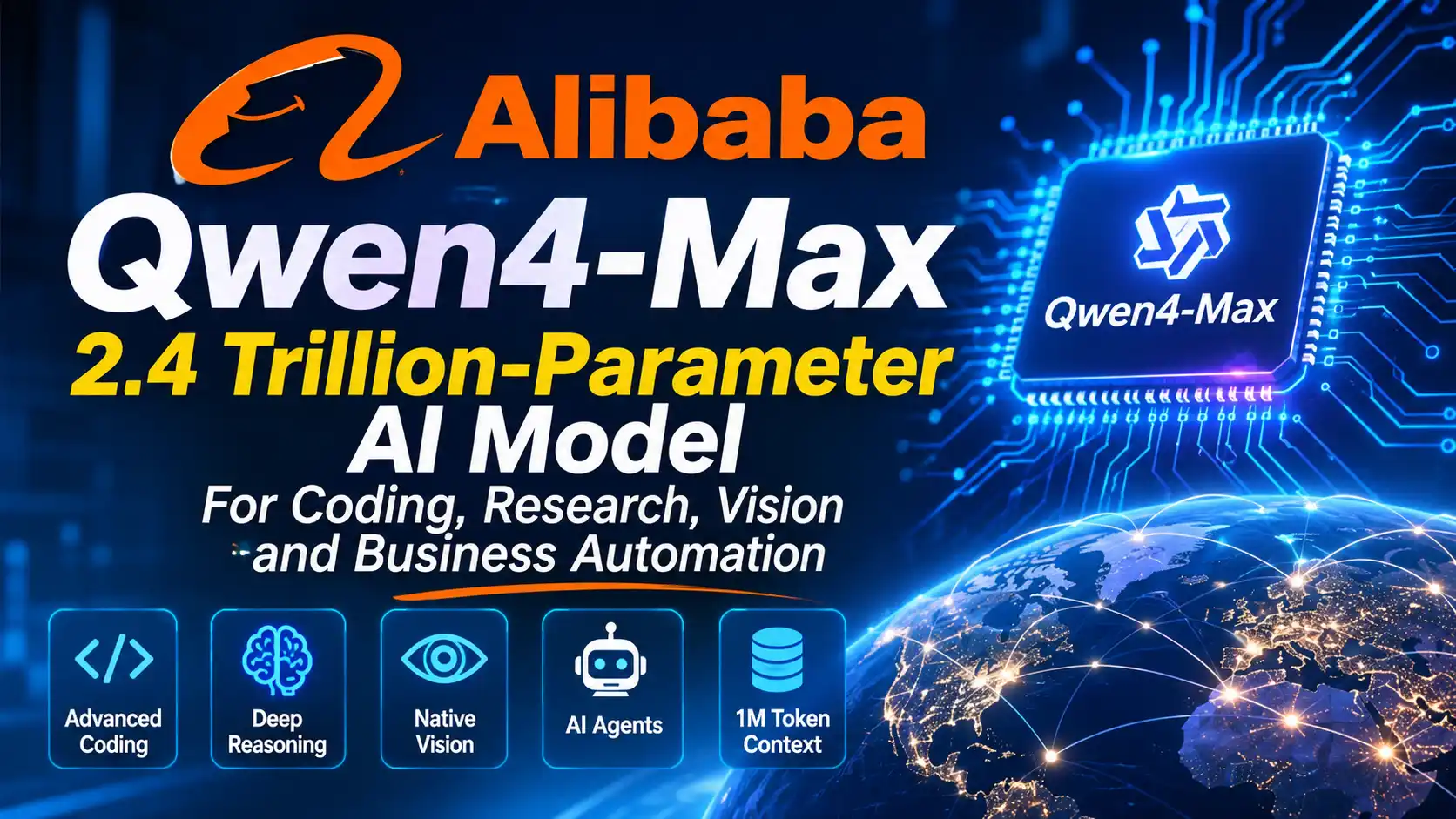
China’s technology giant Alibaba Group is moving further into this direction with its reported new AI model, Qwen4-Max, introduced on November 16, 2026. The model is designed to handle professional tasks, coding, research, creative work and AI-agent workflows.
According to the reported specifications, Qwen4-Max features 2.4 trillion total parameters, native vision capabilities and a context window of up to one million tokens. Alibaba says the model is designed to deliver stronger performance on complex tasks while improving computational efficiency compared with its previous generation.
The launch reflects a broader shift in the AI industry, where companies are competing not only to build smarter models but also to develop AI systems that can become useful digital workers for businesses, developers, researchers and professionals.
What Is Alibaba Qwen4-Max?
Qwen4-Max is a reported advanced large language model developed by Alibaba as part of its Qwen AI ecosystem. It is designed to process text, understand visual information, solve complex problems and assist with tasks that may require several steps to complete.
Traditional AI chatbots generally respond to a user’s prompt and wait for the next instruction. Newer AI systems are being developed to work through longer tasks, plan their actions, use tools, gather information and produce completed results.
Qwen4-Max is designed around this more advanced approach. It aims to support workflows that involve software development, business analysis, document processing, research, industrial applications and other professional activities.
The model could potentially be useful across several industries, including finance, manufacturing, scientific research, technology, education and enterprise services.
Alibaba is positioning Qwen4-Max as an AI teammate capable of supporting complex work rather than simply functioning as a conversational assistant.
Qwen4-Max Key Specifications
The model’s reported specifications highlight its large architecture, efficient processing design and focus on advanced AI applications.
| Specification | Details |
| AI Model | Qwen4-Max |
| Developer | Alibaba |
| Reported launch date | November 16, 2026 |
| Architecture | Mixture-of-Experts (MoE) |
| Total parameters | 2.4 trillion |
| Active parameters per token | 71 billion |
| Context window | 1 million tokens |
| Vision capability | Native vision |
| Primary focus | Coding, reasoning, research, AI agents and productivity |
| Availability | QwenCloud API and Alibaba AI platforms |
| Access model | Token-based API access |
| Smaller models | Planned smaller open-weight Qwen4 models |
The architecture is particularly important because a model with trillions of parameters would be extremely expensive to operate if all of its parameters were activated for every task. Alibaba uses a Mixture-of-Experts design to help manage this computational challenge.
Understanding the 2.4 Trillion Parameters
Parameters are the internal numerical values that an AI model learns during training. They help the model identify patterns, process information and generate responses.
Qwen4-Max reportedly contains 2.4 trillion total parameters, making it an extremely large AI model. However, the model does not necessarily activate every parameter for every input.
Alibaba uses a Mixture-of-Experts (MoE) architecture, which divides parts of the model into specialized components. Depending on the task, the system can activate selected components instead of using the entire model for every token.
According to the reported specifications, Qwen4-Max activates approximately 71 billion parameters per token despite having 2.4 trillion total parameters.
This approach is designed to improve computational efficiency while maintaining the capabilities of a large model.
The MoE architecture may help AI systems handle complex tasks without requiring the full model to operate at maximum computational capacity for every interaction. This is particularly important for commercial AI services, where the cost of processing millions of requests can significantly affect profitability.
A One-Million-Token Context Window
One of the most important features of Qwen4-Max is its reported context window of one million tokens.
A context window determines how much information an AI model can process and consider during a task. A larger context window can make it easier to analyze lengthy documents, large software projects, multiple research papers and extensive datasets within a single workflow.
This capability could help businesses use AI for tasks such as:
- Analyzing large financial and business reports.
- Reviewing lengthy legal documents and contracts.
- Understanding entire software codebases.
- Comparing multiple research papers.
- Examining historical and current business data.
- Working with long project histories and complex instructions.
A million tokens does not mean a million words. Tokens can represent complete words, parts of words, punctuation or other text units. The actual amount of readable text varies depending on the language and content.
Large context windows can make AI more useful for long tasks, although they do not automatically guarantee accuracy or perfect recall of every detail.
Improved Coding and Software Development Capabilities
Software development has become one of the most competitive areas in the AI industry. AI models are no longer limited to writing small code snippets. They are increasingly being designed to assist with debugging, software architecture, testing, code reviews and entire development workflows.
Alibaba says Qwen4-Max delivers improved performance in coding and agentic tasks and reportedly ranked sixth on the Code Arena leaderboard.
These capabilities could help software developers with:
- Developing new software features.
- Identifying bugs and errors in code.
- Modernizing legacy software.
- Writing automated test cases.
- Creating software documentation.
- Building websites and applications.
- Understanding complex software projects.
If an AI model can understand an entire software project within its context, developers may not need to repeatedly explain the structure and purpose of different files.
This could make AI coding assistants more useful for professional development teams, although AI-generated code still requires human review, security testing and validation before deployment.
AI Agents and Long-Running Tasks
Qwen4-Max places significant emphasis on AI agents and long-running tasks.
An AI agent is a system designed to work toward a goal rather than simply answer a question. It may plan steps, use digital tools, gather information, perform actions and evaluate its progress to complete a task.
For example, a business user could ask an AI to research an industry, identify major companies, compare market developments, organize the findings and prepare a report. An agent-based system could attempt to complete this work through several stages.
Alibaba is developing Qwen4-Max to support long-horizon tasks that may require multiple steps and extended processing.
Potential applications include:
- Corporate research
- Software development
- Data processing
- Financial analysis
- Business reporting
- Customer support workflows
- Enterprise knowledge management
The success of AI agents will not depend only on intelligence. They will also require reliable tools, appropriate permissions, secure data access and the ability to recover from mistakes during task execution.
Native Vision: Understanding Images and Visual Information
Another important capability of Qwen4-Max is native vision support. This means the model is designed to process visual information as part of its AI workflow instead of relying exclusively on text.
This expands the potential applications of AI across multiple industries.
Business documents
AI could help interpret charts, graphs, tables, scanned documents and visual presentations.
Manufacturing
Visual information from production lines, engineering designs and inspection workflows could be analyzed to assist industrial operations.
Research
Scientific diagrams, experimental images and visual datasets could become easier to interpret.
Software development
AI could help developers understand interface layouts, visual design references and application screenshots.
Education
Students and teachers could use AI to explain diagrams, illustrations, charts and other learning materials.
The ability to understand both text and visual information could make AI models more useful in real-world business workflows.
AI in Manufacturing and Industrial Businesses
Qwen4-Max has also been presented in the context of industrial applications, particularly automotive manufacturing and machining workflows.
According to Alibaba, a demonstration showed AI reducing workpiece programming time from approximately 475 minutes to 24 minutes. This represents a reported reduction of around 95% in the time required for the demonstrated task.
The example highlights how AI could assist in manufacturing processes that involve programming, design validation, production planning and machining verification.
Potential industrial applications include:
- Manufacturing process planning.
- Machine programming assistance.
- Design validation.
- Identifying production errors.
- Industrial engineering.
- Workflow automation.
If AI systems can reduce the time required for repetitive engineering tasks, manufacturers may be able to improve productivity, reduce delays and use engineering resources more efficiently.
However, the reported 95% time reduction comes from a specific demonstration and should not be interpreted as a guaranteed productivity improvement across every factory, machine or manufacturing process.
How AI Could Support Scientific Research
AI is becoming increasingly important in scientific research. Developing new medicines, materials, chemical compounds and technologies often requires researchers to analyze thousands of possible combinations and experimental results.
Alibaba has highlighted the long-running agent capabilities of Qwen4-Max through scientific research examples.
According to the company, one experiment involved a workflow that ran for approximately 48 hours and explored coolant molecules for next-generation chip cooling. The process reportedly included molecular design, synthesis and testing-related workflows, and active learning.
In another Alzheimer’s research-related experiment, Alibaba reported that the model performed 454 tool calls and 3,239 metric evaluations while working on the design and optimization of 24 candidate molecules.
These examples illustrate how AI could potentially assist researchers by:
- Exploring potential molecular designs.
- Analyzing scientific information.
- Organizing experimental data.
- Evaluating possible research candidates.
- Supporting computational simulations.
- Automating repetitive research workflows.
AI could potentially accelerate parts of the research process, but computationally promising candidates still require real-world laboratory testing, safety evaluation and scientific validation.
Business Productivity and Lower AI Operating Costs
For businesses, the cost of using AI is becoming just as important as its capabilities. If an AI system requires large amounts of computing resources, tokens and processing time to complete a task, it can become expensive to deploy at scale.
Alibaba claims that Qwen4-Max is more efficient than its previous model, Qwen3.8-Max.
According to the company’s Work360 evaluation:
- High-effort reasoning tasks reportedly used approximately 35% fewer tokens.
- Average cost per task reportedly decreased by up to 60%.
- The MoE architecture was improved to enhance efficiency.
- Performance on long-running professional tasks reportedly improved.
These improvements could be important for businesses that use AI to perform thousands or millions of tasks.
Even a small reduction in the cost of each AI task could create significant savings over time for businesses with large-scale AI operations.
However, these figures are based on Alibaba’s own evaluations and should not be interpreted as independently verified results across all business environments.
Pricing and Availability of Qwen4-Max
Alibaba has made Qwen4-Max available through its AI ecosystem and cloud-based services, targeting developers, businesses and professional users.
Reported access platforms
- QwenCloud: API and model access.
- QwenWork: Professional and work-oriented AI platform.
- QwenStudio: AI creativity and development experience.
- Qoder: AI-powered software development platform.
- Qwen App: Consumer-facing AI access.
Reported API pricing
| Pricing category | Reported price |
| Input tokens | $1.50 per 1 million tokens |
| Output tokens | $4.50 per 1 million tokens |
| Cached input | $0.075 per 1 million tokens |
Pricing may vary depending on usage tier, platform, region and future pricing updates. Developers should check Alibaba’s official pricing pages before purchasing API access.
Alibaba has also reportedly planned to release smaller open-weight models within the Qwen4 family for developers. Such models could create opportunities for local deployment, customization and AI application development, depending on their licensing and hardware requirements.
AI Safety and Cybersecurity
As AI models become more capable, safety and cybersecurity are becoming increasingly important. Systems that can write code, conduct research, use tools and perform complex tasks need safeguards against misuse.
Alibaba says safety has been integrated into the Qwen4-Max development lifecycle.
Reported safeguards include:
- Code security testing.
- Training focused on reducing injection and access-control vulnerabilities.
- Limiting cybersecurity training data toward defensive tasks.
- Safety datasets designed to reduce harmful instructions.
- Safeguards related to chemical, biological, radiological and nuclear risks.
According to Reuters, Alibaba disclosed some safety testing results for the model, although Reuters did not independently verify those testing outcomes.
The development of advanced AI will increasingly require companies to demonstrate not only performance but also reliability, responsible deployment and protection against misuse.
Which AI Companies Will Compete With Qwen4-Max?
Qwen4-Max enters a competitive AI market where major technology companies are continuously upgrading their flagship models and agent platforms.
| AI company | Major competitive focus |
| OpenAI | Advanced reasoning, coding and agentic AI |
| Google DeepMind | Multimodal AI, research and ecosystem integration |
| Anthropic | Enterprise AI, coding and reliability-focused models |
| xAI | Large-scale AI models and assistants |
| Alibaba | AI models, cloud infrastructure and business applications |
The competition is no longer limited to model benchmarks. Companies are also competing through cloud infrastructure, enterprise customers, developer tools, consumer applications and pricing.
If Alibaba integrates Qwen4-Max effectively across its cloud services and enterprise products, it could strengthen its position by offering AI not merely as a standalone chatbot, but as a broader business technology ecosystem.
Why Qwen4-Max Is Important for Alibaba’s Business
Qwen4-Max is not just another AI model launch. It is part of Alibaba’s broader AI and cloud business strategy.
Alibaba is attempting to create business opportunities across several layers of the AI ecosystem.
Cloud computing: Businesses need computing infrastructure to train, operate and deploy AI models. Greater AI usage could increase demand for cloud resources.
Enterprise services: Companies may purchase APIs, AI platforms and enterprise solutions to integrate AI into their workflows.
Developer ecosystem: Developers can use AI models to build new applications, software, agents and digital services.
Consumer AI: AI assistants can be integrated into search, shopping, communication and other digital services.
Industrial AI: Manufacturing, logistics, research and professional services could become new markets for AI-powered automation.
By connecting AI models with cloud infrastructure, applications and enterprise services, Alibaba is attempting to strengthen its position across the AI value chain.
Challenges and Limitations of Qwen4-Max
Despite its large architecture, extended context window and advanced agent capabilities, Qwen4-Max will face several challenges.
- Accuracy: AI can still produce incorrect information, particularly in complex research and factual tasks.
- Computing requirements: Operating a 2.4 trillion-parameter model requires substantial infrastructure.
- Enterprise adoption: Businesses must evaluate privacy, security, reliability and integration costs before adopting AI.
- Competition: OpenAI, Google, Anthropic and other AI companies continue to upgrade their models.
- Benchmark limitations: Company-reported benchmark results may not reflect performance in real business environments.
- Monetization: Alibaba must demonstrate that enterprises are willing to pay at scale for its AI services.
The long-term success of Qwen4-Max will depend not only on model size or benchmark rankings, but also on its real-world performance, developer adoption and ability to deliver measurable business value.
Impact on the Global AI Market and Technology Competition
Qwen4-Max reflects a broader shift in the AI industry. Companies are increasingly focusing not only on building models with more parameters, but also on improving reasoning, efficiency, agent capabilities, operating costs and real-world applications.
This could have several important effects on global businesses.
Growing demand for AI infrastructure
Advanced AI models require powerful computing infrastructure. Competition between AI companies could increase demand for data centres, chips, networking equipment, electricity and cooling systems.
Greater enterprise AI adoption
Businesses are looking for AI systems that can perform practical tasks, reduce operating costs and improve productivity. If AI agents become reliable enough to complete complex workflows, enterprise AI spending could increase further.
Increasing AI price competition
If large AI models become more efficient and deliver better results at lower costs, AI service prices may come under pressure. This could make advanced AI tools more accessible to smaller businesses and startups.
China’s position in the global AI industry
Chinese technology companies such as Alibaba are attempting to strengthen their position in the global AI market. AI models, cloud infrastructure, chips, developer ecosystems and enterprise applications are becoming important parts of the technology competition between China and the United States.
Conclusion
Alibaba’s Qwen4-Max represents an important development in the evolution of artificial intelligence, with a focus on long-running professional tasks, coding, research, visual understanding and business automation rather than simply answering questions.
With 2.4 trillion total parameters, a one-million-token context window and a Mixture-of-Experts architecture, the model reflects the growing ambition of AI companies to develop systems capable of handling increasingly complex workloads. Alibaba also claims that Qwen4-Max can perform more efficiently and at lower costs, potentially making advanced AI more practical for enterprise and industrial applications.
If the model can demonstrate its reported capabilities in real-world business environments, it could find applications across software development, manufacturing, scientific research, finance and enterprise automation.
The future of AI competition will not be determined only by which company builds the most powerful model. It will also depend on which AI system can deliver reliable results, operate efficiently, attract developers and create measurable value for businesses.