
India’s early internet company, Rediff.com India Ltd, is preparing for a potential return to the public capital markets with an updated IPO filing. The company is reportedly planning to raise ₹600 crore through a fresh issue of shares, marking an important step in its efforts to explore a public listing and strengthen its business.
An IPO filing does not mean shares are immediately available to investors. The company must go through the regulatory process, publish the required offer documents, disclose its financials and risks, and announce IPO dates and pricing details before the issue opens.
Rediff.com India ₹600 Crore IPO: An Old Internet Brand’s New Digital Business Strategy
Rediff.com India Ltd, one of India’s early internet companies, is preparing to enter the public capital markets again. In November 2026, the company filed its Updated Draft Red Herring Prospectus (UDRHP-I) with SEBI, proposing to raise ₹600 crore through an IPO.
The proposed IPO will consist entirely of a fresh issue of shares. It will not include an Offer for Sale (OFS) by existing shareholders. The company intends to use the proceeds for expanding its digital platforms, payment services, video content, marketing, and potential acquisitions.
Rediff’s IPO is significant because the company is attempting to move beyond its traditional identity as an internet portal and email service provider and build a wider digital business around multiple platforms.
What Is Rediff.com and What Does the Company Do?
Rediff.com was founded in 1996. In its early years, it became popular in India through internet services such as online news, email, web portals and other digital offerings.
At that time, the internet was very different from today’s mobile-app and social-media-driven environment. Rediff was among the early platforms where users could read news, access email and explore various online services.
Over the years, the company has evolved and is now working across digital media, enterprise software, online communication, payments and business-oriented digital services.
Rediff.com India Ltd is a subsidiary of AvenuesAI Ltd. Its parent company also operates the digital payment platform CCAvenue and other technology-related businesses.
How Much Money Does Rediff.com Want to Raise Through Its IPO?
| Proposed total IPO size | ₹600 crore |
| New shares will be issued | Fresh Issue |
| OFS | No OFS |
According to the company’s Updated Draft Red Herring Prospectus, the proposed IPO will be entirely a fresh issue.
This means Rediff.com will issue new shares to investors and receive the proceeds directly. Existing shareholders will not sell their shares as part of this offering.
The money raised is expected to support the company’s expansion plans and other stated business objectives.
Where Will the IPO Money Be Used?
Rediff has outlined several uses for the IPO proceeds. A significant portion will be allocated to platform development and expansion.
Proposed allocation of the ₹600 crore IPO proceeds. Other uses include potential acquisitions and general corporate purposes.
| Use of Funds | Amount |
| Expansion of Rediff One, Rediff Pay and Rediff TV | ₹224.80 crore |
| Marketing and branding | ₹183.34 crore |
| Potential acquisitions and other general corporate purposes | ₹191.86 crore |
| Total | ₹600 crore |
The company plans to spend approximately ₹224.8 crore on its digital platforms and ₹183.34 crore on marketing and branding. The remaining funds will be allocated toward potential acquisitions and general corporate purposes.
Rediff One: ₹94.5 Crore Investment in Platform Expansion
Rediff One is an important part of the company’s digital communication and enterprise-services strategy. The company plans to invest ₹94.5 crore from the IPO proceeds to develop and expand this platform.
Today, businesses need more than email. They require employee communication tools, online collaboration, digital workflows and productivity solutions. Through Rediff One, the company wants to strengthen its presence in the market for these digital business services.
The investment may help Rediff add new features, improve its technology infrastructure, expand its capabilities and reach more business customers.
However, the success of this business will depend on how many customers it can acquire, how effectively it can compete with established software providers and how much recurring revenue it can generate.
Rediff Pay: ₹64.3 Crore Investment in Digital Payments
Rediff Pay is part of the company’s digital payments strategy. In India, UPI, mobile payments and digital transactions have grown significantly, creating new opportunities for fintech companies.
Rediff received approval to operate as a Third-Party Application Provider (TPAP) under the NPCI’s UPI framework in December 2025. Following this approval, Rediff Pay became an important part of the company’s future digital strategy.
The company plans to invest ₹64.3 crore from the IPO proceeds in expanding Rediff Pay. The investment is intended to support platform development, technological improvements, user experience and business expansion.
However, competing in India’s digital payment market will not be easy. Established players such as PhonePe, Google Pay, Paytm and others already have large user bases. Rediff will need to attract users to its platform and encourage them to continue using its services over the long term.
Rediff TV: ₹66 Crore for Video Platform Expansion
Rediff launched Rediff TV in July 2025. The platform is a new part of the company’s digital media strategy.
Demand for digital videos, news, entertainment, business updates and mobile content continues to create opportunities for media companies. Many businesses are expanding beyond traditional websites into video-based and mobile-first services.
Rediff plans to invest ₹66 crore in developing and expanding Rediff TV.
This investment is expected to support platform development, increase audience reach, improve its digital content business and help the company explore new opportunities in online media.
However, the company will face competition from YouTube, Instagram, OTT platforms and established digital media brands. Simply launching a video platform will not be enough. Rediff will need engaging content, audience growth and the ability to attract advertisers to build a sustainable business.
Why Is Rediff Spending ₹183.34 Crore on Marketing and Branding?
Rediff.com is an established internet brand in India, but the digital market has changed significantly over the years. Mobile apps, social media, online payments, video content and digital services have created intense competition.
The company has allocated ₹183.34 crore for marketing and branding, making it one of the largest planned uses of IPO proceeds.
The spending could help Rediff strengthen its brand identity, reach new users, launch advertising campaigns, promote its products and increase awareness of its platforms.
Rediff’s legacy brand may give it an advantage, but building a strong connection with a new generation of internet users is a different challenge. The company will need to demonstrate that its new digital platforms offer useful services and can attract consistent user engagement.
Funds Also Reserved for Potential Acquisitions
The remaining IPO proceeds will be allocated toward potential acquisitions and general corporate purposes.
Digital companies often acquire other businesses to expand faster, enter new markets, gain technology or strengthen their customer base. For example, a company may acquire businesses in payment technology, artificial intelligence, digital content, enterprise software or other areas that complement its existing operations.
Rediff may also explore such opportunities in the future. However, the company has not announced any specific acquisition as part of this IPO plan.
Therefore, this allocation should be viewed as a provision for possible future expansion rather than confirmation of a particular acquisition.
Rediff.com’s Financial Performance Shows Improvement
For IPO investors, the company’s business expansion plans are important, but its financial performance is equally significant. Rediff’s reported FY26 figures show a substantial improvement in revenue and profit compared with the previous financial year.
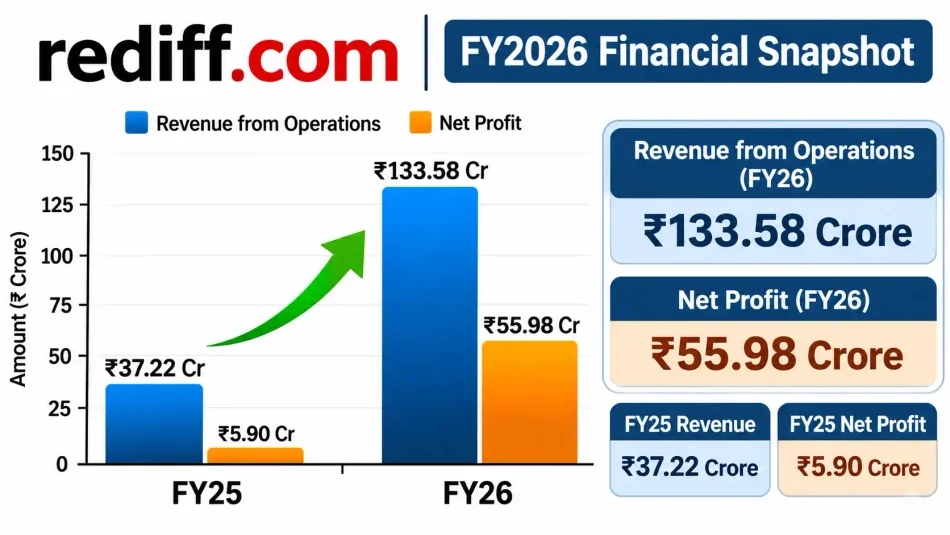
Comparison of reported revenue and net profit in FY25 and FY26 (₹ crore).
The company’s operating revenue increased from ₹37.22 crore in FY25 to ₹133.58 crore in FY26. Net profit also increased from ₹5.90 crore to ₹55.98 crore during the same period.
The improvement indicates a significant change in the company’s reported financial performance. However, investors will need to examine whether this growth is sustainable, how expenses are changing and how much revenue each of its platforms contributes.
A single year of strong financial results is not enough to determine a company’s long-term performance.
Key Details of the Rediff.com IPO
| Particulars | Details |
| Company | Rediff.com India Ltd |
| IPO Size | Up to ₹600 crore |
| Issue Type | Fresh Issue |
| Offer for Sale (OFS) | None |
| IPO Document | UDRHP-I |
| Filing Date | November 13, 2026 |
| IPO Purpose | Platform expansion, marketing, acquisitions and general corporate purposes |
| Promoters | Vishal Ajitbhai Mehta and AvenuesAI Ltd |
| Parent Company | AvenuesAI Ltd |
| Book Running Lead Manager | Keynote Financial Services |
| Registrar | MUFG Intime India |
| Proposed Exchanges | NSE and BSE |
| IPO Opening Date | Not announced yet |
| Price Band | Not announced yet |
| Listing Date | Not announced yet |
What Should Investors Watch Before the IPO?
Rediff’s IPO could offer investors an opportunity to evaluate how an established internet brand is transforming into a broader digital business. However, several factors should be carefully considered before making an investment decision.
Fresh Issue Benefit: Since there is no OFS, the entire issue proceeds will go to the company. This may support expansion, but the benefit will depend on how efficiently the capital is deployed.
Investment Across Multiple Platforms: Rediff plans to invest in Rediff One, Rediff Pay and Rediff TV. This could diversify its business, but developing multiple platforms simultaneously also increases spending and execution risks.
Marketing Expenditure: The ₹183.34 crore marketing budget is substantial. Investors should monitor whether this spending translates into new customers, user growth and actual revenue.
Competition: Rediff will need to compete with established companies in digital payments, enterprise software, media and video platforms.
Financial Performance: FY26 reported revenue and profit growth are encouraging, but investors should review future quarterly results and the quality of earnings.
IPO Valuation: The final price band and valuation will be important in determining whether the company’s shares are reasonably priced relative to its business and financial performance.
Conclusion
Rediff.com’s proposed ₹600 crore IPO is more than a fundraising exercise. It represents the company’s attempt to take its digital business strategy to the next level. Using its legacy internet brand, the company wants to develop newer platforms such as Rediff One, Rediff Pay and Rediff TV.
The IPO proceeds could help Rediff invest in technology, marketing, user expansion and potential acquisitions. However, the success of this strategy will depend on how effectively the company develops its new platforms, attracts users, generates sustainable revenue and improves profitability over the long term.
For investors, the most important next steps will be to examine the final IPO documents, price band, valuation, financial performance, business risks and listing details once they become available. The proposed ₹600 crore IPO could be a major opportunity for Rediff, but its long-term success will ultimately depend on the results of its business expansion.
Sources
Rediff.com India – Official Updated Draft Red Herring Prospectus (PDF) · NSE – Parent Company Disclosure · Rediff Business / PTI Report ·
Disclaimer: This article is for informational and educational purposes only. It is not investment advice or a recommendation to subscribe to the IPO.