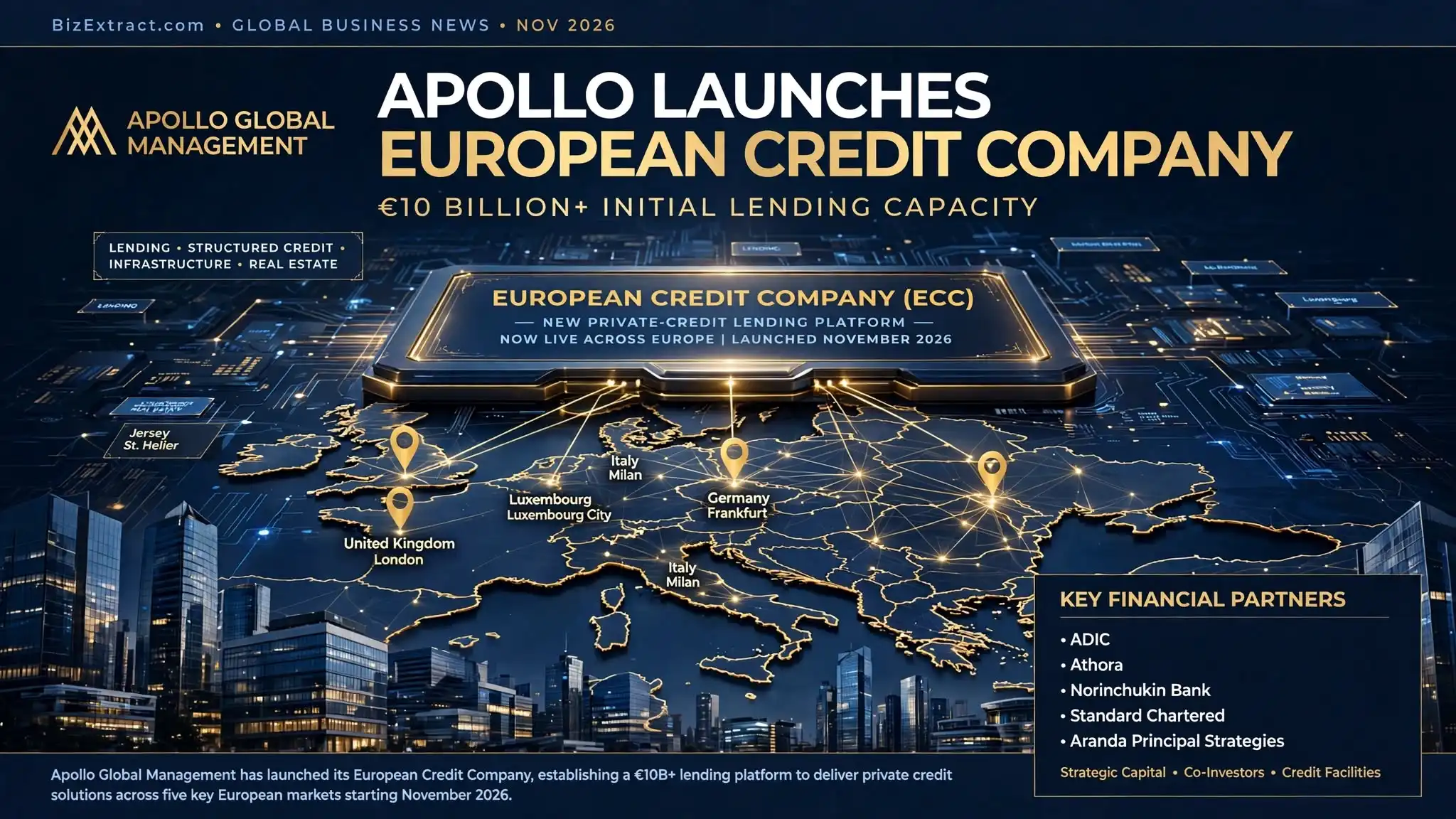
US-based investment management company Apollo Global Management launched a new financing platform in Europe on November 2, 2026, called European Credit Company (ECC). The platform was introduced with an initial lending capacity of more than €10 billion. Its primary objective is to provide long-term financing to large and mid-sized European companies, infrastructure projects, and real estate businesses.
Europe is currently going through several major economic and industrial changes. Countries are increasing investments in defence, renewable energy, electricity transmission, AI data centres, digital infrastructure, and traditional industries. All these sectors require substantial capital. However, companies sometimes find it difficult to obtain the required financing from traditional banks because of lending restrictions, regulatory requirements, or loan conditions.
In this situation, private credit is becoming an important alternative source of business financing. Instead of borrowing exclusively from banks, companies can obtain loans directly from investment firms and institutional investors.
Apollo has identified this opportunity and introduced ECC to expand its presence in Europe’s corporate financing market. The platform is supported by several international financial institutions and investors from different regions, including Abu Dhabi, Japan, Europe, and the United States.
The launch represents an important step in Apollo’s strategy to expand its credit investment business and connect international institutional capital with Europe’s growing financing requirements.
Key Highlights
| Particulars | Details |
| Parent Company | Apollo Global Management |
| New Platform | European Credit Company (ECC) |
| Announcement Date | November 2, 2026 |
| Initial Lending Capacity | More than €10 Billion |
| Business Category | Private Credit & Corporate Lending |
| Headquarters / Market | Europe |
| Financing Types | Corporate Lending & Asset-Backed Financing |
| Target Businesses | Large and Mid-Sized European Companies |
| Key Industries | Defence, Renewable Energy, AI, Infrastructure & Real Estate |
| Key Investors / Partners | ADIC, Athora, Norinchukin Bank, Standard Chartered & Aranda Principal Strategies |
| Initial European Offices | Frankfurt, Jersey, London, Luxembourg & Milan |
| CEO | Giacomo Petrobelli |
| Chairman | Christian Meissner |
| Parent Company Ticker | NYSE: APO |
| Main Objective | Providing Alternative Financing to European Businesses |
What Is European Credit Company (ECC)?
European Credit Company is a specialised financing and credit investment platform designed to provide loans to European businesses and companies with valuable assets.
In simple terms, ECC will help businesses obtain financing for activities such as business expansion, factory construction, machinery purchases, infrastructure development, real estate projects, and other corporate requirements.
For example, imagine a manufacturing company in Germany planning to build a new factory. The company requires €300 million to purchase land, machinery, and production equipment. Instead of depending entirely on traditional bank financing, it may approach ECC for a suitable loan.
Similarly, an infrastructure company developing electricity transmission networks or a real estate developer constructing commercial properties may also seek financing through this platform.
ECC will focus on different financing structures, particularly corporate lending and asset-backed financing.
Key features of ECC include:
- More than €10 billion in initial lending capacity.
- Financing for large and mid-sized European businesses.
- Corporate loans and asset-backed financing.
- Support for infrastructure and real estate businesses.
- Participation from international institutional investors.
- Expansion across multiple European financial markets.
Why Did Apollo Launch ECC With More Than €10 Billion in Lending Capacity?
Europe is expected to require substantial investments in several industries over the coming years. These include defence manufacturing, renewable energy, electricity transmission, transportation, and digital infrastructure.
Both governments and private companies need significant capital to develop these sectors.
Apollo believes that Europe’s industrial expansion is creating new opportunities for private financing. The company has therefore introduced ECC with an initial lending capacity exceeding €10 billion.
However, it is important to understand that lending capacity does not mean that ECC has already distributed €10 billion in loans. It represents the platform’s initial capacity to provide financing.
Actual lending will depend on suitable investment opportunities, borrower requirements, credit assessments, and available capital.
Therefore, the €10 billion figure should be understood as an initial financing capacity rather than the amount of loans already issued.
What Types of Financing Will ECC Provide?
ECC will primarily focus on two major financing categories.
A. Corporate Lending
Corporate lending means providing loans directly to businesses. Companies often require financing to expand operations, establish factories, purchase machinery, acquire other businesses, or refinance existing debt.
ECC aims to support such financing requirements.
For example, an Italian automobile component manufacturer wants to increase its production capacity and requires €150 million. The company plans to use this money to purchase new machinery and expand its manufacturing facility.
After evaluating the company’s financial position, business model, and repayment capacity, ECC may provide the required loan.
The company receives capital for expansion, while ECC earns interest income from the financing arrangement.
B. Asset-Backed Lending
Asset-backed lending refers to providing loans supported by the value or income-generating capacity of specific assets.
These assets may include:
- Commercial buildings and real estate properties.
- Electricity transmission infrastructure.
- Industrial machinery and equipment.
- Financial assets and business receivables.
For example, imagine a real estate company owns commercial properties valued at €200 million. It needs €80 million to develop another property.
The company may approach ECC for financing using its existing assets as collateral, subject to the loan structure and legal conditions.
In this arrangement, the assets provide security for the lender. If the borrower fails to repay the loan, the lender may have rights over the pledged assets, depending on the agreement and applicable laws.
Through these two financing models, ECC aims to support businesses with different capital requirements.
Which International Investors Are Supporting ECC?
One of the major features of this platform is its international institutional investor support.
According to Apollo’s announcement, several major financial institutions and investment organisations are associated with ECC.
| Investor / Institution | Country / Region | Business |
| Apollo Global Management | USA | Alternative Asset Management |
| Abu Dhabi Investment Council (ADIC) | UAE | Institutional Investment |
| Athora | Europe | Insurance & Retirement Services |
| Norinchukin Bank | Japan | Banking & Institutional Investment |
| Standard Chartered | UK | International Banking |
| Aranda Principal Strategies | USA | Alternative Investment |
The participation of these institutions connects ECC with international investment capital and financial networks.
Apollo Global Management: Apollo is the principal investment management company behind the platform. It will contribute its experience in credit investment, asset management, and financing.
Abu Dhabi Investment Council (ADIC): This institutional investment organisation from Abu Dhabi brings connections to the Middle Eastern investment market.
Athora: Athora operates in the insurance and retirement savings sector. Such institutions generally look for long-term investment opportunities.
Norinchukin Bank: This Japanese financial institution has experience in banking and institutional investments.
Standard Chartered: The international bank has a significant presence across Asia, Europe, Africa, and other markets.
Aranda Principal Strategies: This organisation operates in the alternative investment sector.
However, the individual investment contributions of these institutions have not been separately disclosed in the launch announcement.
How Will ECC’s Business Model Work?
ECC will use several approaches to identify financing opportunities and reach potential borrowers.
A. Direct Lending
The first approach is to work directly with companies that require financing.
For example, a French energy company planning a renewable energy project may approach ECC for funding.
ECC will evaluate the company’s financial condition, project potential, expected revenue, and ability to repay the loan before deciding whether to provide financing.
This approach is known as direct lending.
B. Partnerships With Financial Institutions
The second approach involves working with financial institutions and other financial market participants.
Sometimes, local banks cannot independently fulfil all the financing requirements of their corporate customers. They may therefore work with other financial institutions to arrange or share financing opportunities.
ECC may use such partnerships to identify borrowers and expand its access to European markets.
However, the complete list of European institutions involved in these arrangements and their individual partnership terms has not been publicly disclosed.
C. Using Apollo’s Existing European Credit Network
The third approach involves using Apollo’s existing European credit business and investment network.
Apollo already has considerable experience in credit investment and corporate financing. Its relationships with companies, institutional investors, and financial organisations may help ECC identify new lending opportunities.
This existing network could help ECC expand without having to build its entire European business infrastructure from the beginning.
In Which Countries Will ECC Operate?
At launch, ECC identified five major European financial centres for its initial operations.
| Location | Country | Financial Importance |
| Frankfurt | Germany | Banking, manufacturing and industrial finance |
| Jersey | Channel Islands | International finance and investment funds |
| London | United Kingdom | Global financial markets and corporate lending |
| Luxembourg | Luxembourg | Investment funds and asset management |
| Milan | Italy | Manufacturing and corporate finance |
These locations provide access to major financial institutions, corporate borrowers, investment professionals, and different European business markets.
Apollo also indicated plans to expand ECC into additional European markets in the coming quarters.
Who Will Lead European Credit Company?
Apollo has appointed experienced financial industry professionals to lead the new platform.
| Position | Name |
| Chief Executive Officer (CEO) | Giacomo Petrobelli |
| Chairman | Christian Meissner |
Giacomo Petrobelli – CEO
Giacomo Petrobelli has been appointed Chief Executive Officer of ECC. His responsibilities include managing business operations, developing financing strategies, building institutional relationships, and expanding the platform across Europe.
His objective is to help establish ECC as a major pan-European credit platform.
Christian Meissner – Chairman
Christian Meissner has been appointed Chairman. He will play an important role in the platform’s strategic direction and governance.
Apollo President Jim Zelter also highlighted the growing financing requirements in Europe, particularly in areas such as energy transition, defence, digital infrastructure, and traditional infrastructure.
What Is Apollo Global Management?
Apollo Global Management is a major US-based alternative asset management company headquartered in New York.
Its shares are listed on the New York Stock Exchange under the ticker symbol APO.
The company operates across several financial sectors, including:
- Credit investment and direct lending.
- Private equity.
- Asset-backed finance.
- Insurance and retirement services.
- Institutional investment management.
Unlike traditional commercial banks, Apollo primarily manages investment capital on behalf of clients and institutional investors and allocates it across different investment and financing opportunities.
According to Apollo’s announcement, the company had approximately $1.05 trillion in Assets Under Management (AUM) as of June 30, 2026.
AUM represents the total assets managed on behalf of clients and investors. It does not mean that the entire amount belongs to Apollo or is available for lending through ECC.
The launch of ECC allows Apollo to expand its existing credit business through a specialised European financing platform.
Why Is the Private Credit Market Growing in Europe?
Private credit is becoming an increasingly important part of the global financial system.
Private credit refers to loans provided by investment firms, private credit funds, and institutional investors rather than traditional banks.
Several factors are contributing to its growth.
1. Banking Lending Restrictions: Traditional banks operate under regulatory requirements and risk management policies. As a result, some companies may find it difficult to obtain the financing they require.
2. Flexible Financing Requirements: Different businesses require different loan structures. Some need short-term financing, while others require long-term capital. Private credit providers may offer more customised financing arrangements.
3. Institutional Investor Demand: Insurance companies, pension funds, and other institutional investors are increasingly interested in long-term investment opportunities that generate interest income.
According to Moody’s 2026 Private Credit Outlook, global private credit assets under management were expected to exceed $2 trillion in 2026 and potentially reach approximately $4 trillion by 2030.
These estimates highlight the potential growth of the market in which Apollo is expanding its operations. However, these are industry projections, not ECC’s own growth forecasts.
How Is ECC Different From Traditional Bank Loans?
Understanding the difference between traditional bank lending and private credit helps explain ECC’s business model.
| Basis | Traditional Banks | ECC / Private Credit |
| Funding Source | Deposits and other bank funding | Institutional and investor capital |
| Loan Approval | Bank lending policies | Platform credit policies |
| Loan Structure | Often standardised | Can be customised |
| Borrowers | Retail and corporate customers | Primarily corporate and asset owners |
| Loan Terms | Based on bank conditions | Negotiated financing terms |
| Credit Risk | Generally held by the bank | Depends on the financing structure and investors involved |
Private credit is not necessarily cheaper than traditional bank financing. In some cases, interest rates may be higher because lenders take different types of credit risks.
However, flexible loan structures and customised financing can make private credit attractive to companies with specialised funding requirements.
What Does ECC Mean for Apollo’s Business Strategy?
The launch of ECC is strategically important for Apollo for three major reasons.
First – Stronger European Presence: Apollo is already a major global asset manager. Through ECC, it can strengthen its position in Europe’s corporate and asset-backed lending markets.
Second – Access to Institutional Capital: The participation of international institutions connects ECC with long-term investment capital from different countries. This creates opportunities to connect global investors with European financing requirements.
Third – Expansion Into Growing Industries: Defence, renewable energy, AI infrastructure, and real estate may require significant financing over the coming years. ECC could benefit from these emerging lending opportunities.
The launch is therefore not simply about increasing lending capacity. It is also about developing a specialised credit origination and financing network across Europe.
What Challenges and Risks Could ECC Face?
Despite its growth opportunities, ECC will also face several important risks.
1. Loan Default Risk
If a borrower experiences financial difficulties and cannot repay its loan or interest, ECC could suffer losses.
2. Interest Rate Changes
Higher interest rates can increase borrowing costs for companies. This may affect their financial position and ability to repay loans.
3. Economic Slowdown
A slowdown in European economic activity could affect the revenue and profitability of manufacturing, real estate, and infrastructure businesses.
4. Competition
Europe already has several major private credit managers and investment firms. ECC will need to compete with these established players.
5. Regulatory and Transparency Risks
Private credit loans are generally not traded in public markets. Therefore, information about their valuation, risk exposure, and financial performance may be less publicly available than traditional publicly traded bonds.
These challenges make borrower selection, credit risk management, and capital management particularly important for ECC’s long-term success.
Conclusion
Apollo Global Management’s launch of European Credit Company represents an important development in Europe’s private credit and corporate financing markets.
With more than €10 billion in initial lending capacity and support from international institutions such as Abu Dhabi Investment Council, Athora, Norinchukin Bank, and Standard Chartered, ECC is positioned to become a significant financing platform in Europe.
Its primary objective is to provide corporate lending and asset-backed financing to large and mid-sized companies, infrastructure businesses, and real estate owners.
As European investment in defence, energy transition, AI infrastructure, and manufacturing continues to develop, new financing opportunities may emerge for ECC.
However, the platform’s long-term success will depend on its ability to select reliable borrowers, structure profitable financing deals, manage credit risks, and maintain strong relationships with institutional investors.
Overall, ECC’s launch highlights the growing role of private credit alongside traditional banking in Europe. It creates a new business expansion opportunity for Apollo while providing European companies with an additional source of financing.
Sources – Official & Research Links
- Apollo – Official ECC Launch Announcement
- European Credit Company – Official Website
- Reuters – Apollo Launches European Credit Platform
- Moody’s – Private Credit Outlook 2026
- European Banking Authority – Risk Assessment Report
- Latham & Watkins – ECC Launch and Legal Structure
Disclaimer: This article is for informational and educational purposes only. Financing capacity, investment opportunities, and market projections should not be interpreted as guaranteed lending volumes or investment returns.