India’s economy is growing rapidly, and one of the biggest engines behind this growth is credit growth (loan growth).
When banks give more loans, people buy homes, businesses expand, companies invest — and money flows through the economy, boosting overall growth.
However, not all growth is healthy.
If loans grow too fast without strong quality, they can turn into NPAs (bad loans) in the future and create stress in the banking system.
So the key question is:
Is India’s current credit growth sustainable, or could it become a risk in the future?
Current Credit Growth
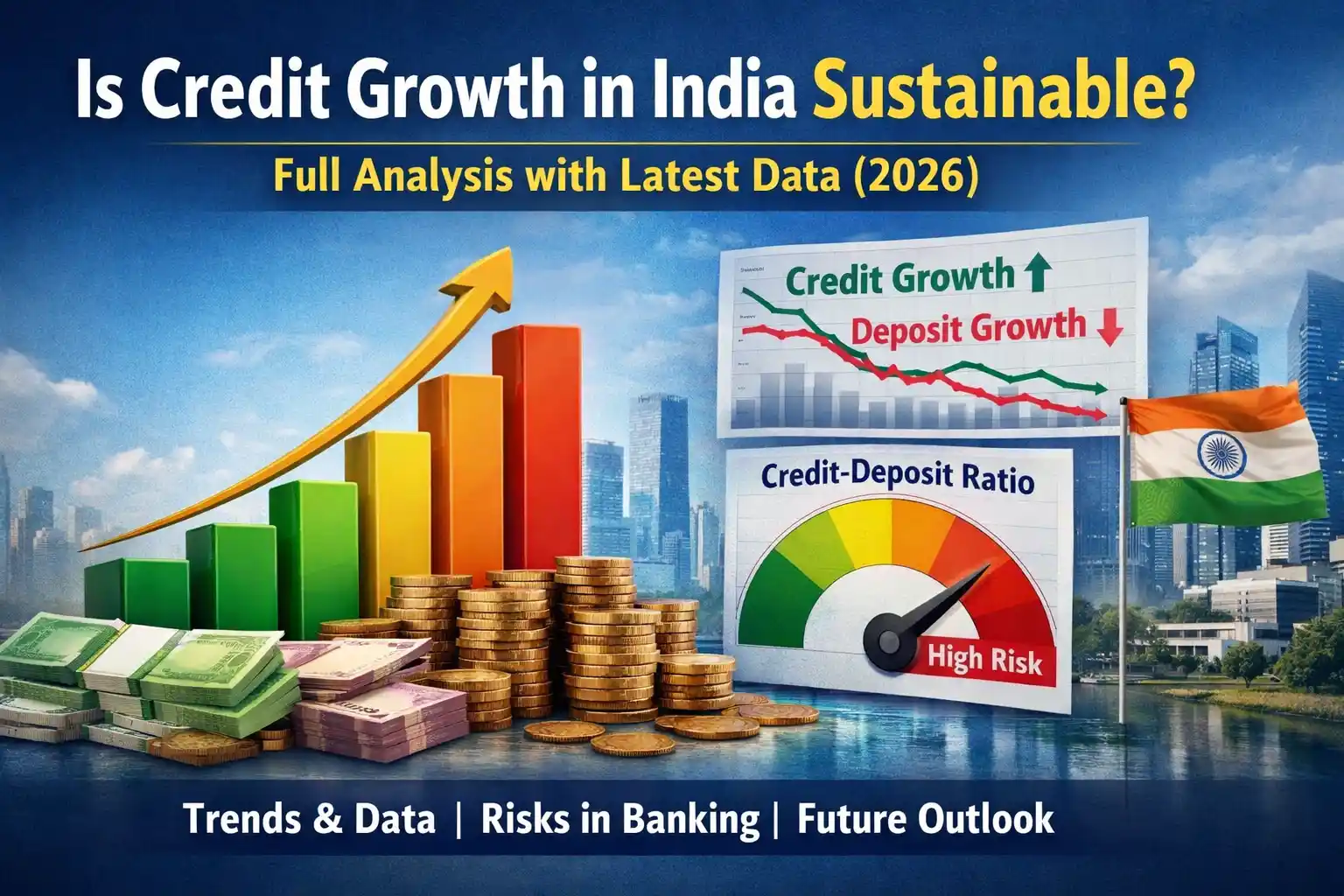
As per 2026 data, credit growth in India remains strong, though some moderation is visible.
- Bank credit growth: around 13%–16%
- Deposit growth: around 11%–13%
This clearly shows:
Loan growth is higher than deposit growth
What does this mean?
When loans grow faster than deposits, banks face funding pressure.
They may need to increase deposit rates or rely on alternative funding sources.
This trend raises a major concern about long-term sustainability.
Structure of Credit Growth (Where is the Growth Coming From)
To understand sustainability, it’s important to see which sectors are driving loan growth.
1. Retail Loans – The Biggest Driver
Retail loans are loans given to individuals — such as home loans, car loans, and personal loans.
What is happening?
- Home loans are growing steadily
- Auto loans are rising strongly
- Personal and credit card loans are growing the fastest
- Gold loans have seen sharp growth
Why is it growing?
- Rising middle-class income
- Rapid urbanization
- Easy loan access (digital lending)
What is the risk?
Retail loans, especially unsecured loans (personal loans, credit cards), are riskier.
If the economy slows or jobs are affected, repayment may become difficult.
So, retail growth is positive, but excessive growth can become risky.
2. MSME Lending – Fastest Growing Segment
Loans to MSMEs (small and medium businesses) are growing rapidly.
What is happening?
- MSME credit growth is around 25%–30%
- Supported by government schemes (Mudra, CGTMSE)
Why is it important?
MSMEs are the backbone of India’s economy.
They generate employment and support local economic activity.
What is the risk?
MSMEs are highly sensitive to economic slowdowns.
If demand falls, they may struggle to repay loans.
So, MSME growth is positive but carries higher risk.
3. Corporate Lending – Gradual Recovery
Corporate lending refers to loans given to large companies.
What is the trend?
- Earlier slow due to NPA crisis
- Now recovering (~12%–13% growth)
Why is it growing?
- Increase in infrastructure projects
- Private sector capex rising
- Government spending support
Why is it important?
Corporate lending supports long-term investment, which is essential for sustainable growth.
Rising corporate lending is a healthy sign for the economy.
4. NBFC & Shadow Banking – Hidden Growth Engine
NBFCs (Non-Banking Financial Companies) are also expanding lending rapidly.
What is happening?
- NBFC lending is growing aggressively
- Strong growth in microfinance and rural lending
Why is it important?
NBFCs provide credit to segments where banks have limited reach.
What is the risk?
- Less strict regulation compared to banks
- Higher exposure to risky borrowers
NBFC growth supports the economy but also adds risk.
Why is Credit Growth Strong?
1. Strong Economic Growth
India is one of the fastest-growing major economies.
As the economy grows, demand for loans naturally increases — for business expansion, consumption, and investment.
Strong credit growth is a natural outcome of economic expansion.
2. Consumption Boom
India is gradually becoming a consumption-driven economy.
- Higher spending by consumers
- Growth in EMI culture
- Improving lifestyle
This directly boosts demand for loans.
3. Government Policy Support
The government is actively supporting credit growth through:
- MSME schemes
- Infrastructure spending
- Rural credit expansion
These factors structurally support loan demand.
4. Improved Banking Sector Health
Earlier, banks were dealing with high NPAs, but now the situation has improved:
- Lower NPA levels
- Strong capital position
- Better profitability
Banks are now more confident in lending.
Sustainability Risks
Now the most important part — the risks
1. Credit vs Deposit Gap (Biggest Risk)
When loan growth exceeds deposit growth, it creates liquidity pressure.
Why is it risky?
- Banks have limited funds
- If deposits do not grow fast enough, lending may slow down
This can impact future economic growth.
2. High Credit-Deposit Ratio
India’s credit-deposit ratio is around 80%+.
What does it mean?
Banks have already lent a large portion of their available funds.
Risk:
In case of economic stress, banks may have limited buffer.
3. Unsecured Loan Risk
Personal loans and credit card loans are growing rapidly.
Problem:
- No collateral
- Higher default risk
In an economic slowdown, this segment is the most vulnerable.
4. Global Risk Impact
Global factors such as:
- Rising oil prices
- High global interest rates
- Geopolitical tensions
These indirectly affect India’s credit growth.
5. Sectoral Imbalance
Currently, growth is more retail-driven, while corporate investment is still catching up.
For long-term sustainability:
Both consumption and investment must grow together
Sustainability Verdict
The overall picture is mixed:
Positive:
- Strong demand
- Healthy banking system
- Economic growth support
Negative:
- Weak deposit growth
- Rising unsecured loan risk
- Global uncertainties
Future Outlook (2026–2028)
- Credit growth may normalize to ~12%–13%
- Retail growth may slow down
- Corporate lending is expected to increase
This shift indicates healthier, more balanced growth.
Final Conclusion
In simple terms:
India’s credit growth is strong, but not completely risk-free
The biggest concern:
Loan growth is faster than funding (deposits)
Final takeaway:
“Credit growth is sustainable, but only at a controlled and balanced pace in the long term.”
“India does not just need fast credit growth — it needs balanced and quality-driven credit growth to ensure long-term economic stability.”