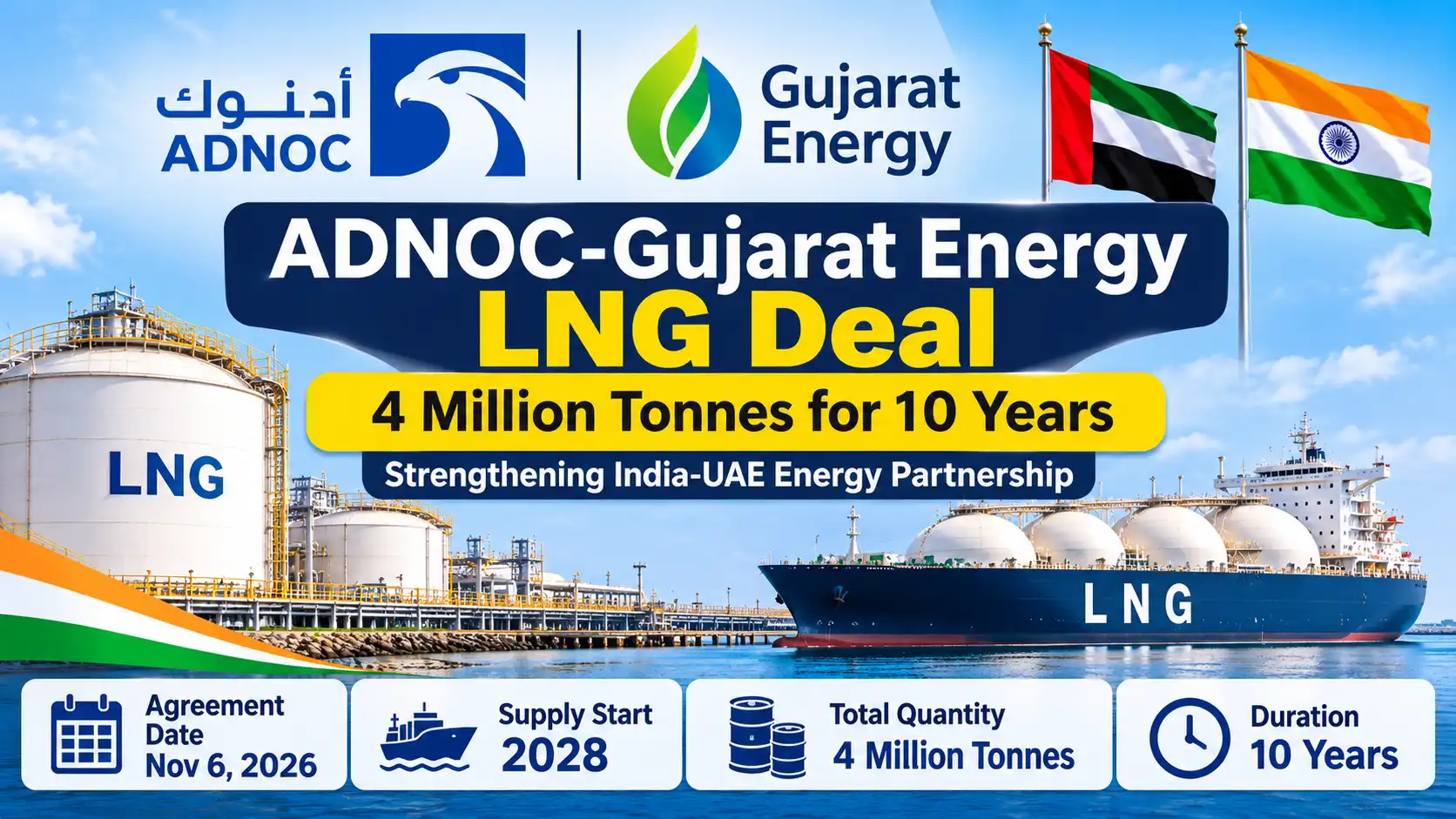
Abu Dhabi National Oil Company (ADNOC), one of the UAE’s leading energy companies, signed a major 10-year Liquefied Natural Gas (LNG) supply agreement with India’s Gujarat Energy Limited (GEL) on November 6, 2026. Under the agreement, Gujarat Energy will purchase up to 4 million tonnes of LNG from ADNOC Trading Limited over the next ten years, with deliveries scheduled to begin in 2028.
One of the most important aspects of this agreement is that the LNG will be supplied from the international gas portfolio of XRG, ADNOC’s international investment company. This transaction also represents the first sale from XRG’s international gas portfolio.
The agreement is expected to support India’s growing natural gas requirements, strengthen long-term gas procurement arrangements and expand energy trade between India and the UAE.
While ADNOC aims to increase its presence in India’s energy market, Gujarat Energy intends to strengthen its natural gas procurement and distribution business through this long-term arrangement.
Deal Overview – Key Highlights
| Particulars | Details |
| Agreement Date | November 6, 2026 |
| Supplier | ADNOC Trading Limited |
| Buyer | Gujarat Energy Limited |
| Parent Energy Group | ADNOC |
| International Portfolio | XRG |
| Deal Type | Long-Term LNG Supply Agreement |
| Total LNG Quantity | Up to 4 Million Tonnes |
| Annual Quantity | Approximately 0.4 MMTPA |
| Agreement Duration | 10 Years |
| Supply Commencement | 2028 |
| Pricing Benchmark | Henry Hub Index |
MMTPA stands for Million Metric Tonnes Per Annum, which indicates the quantity of LNG supplied annually.
It is important to understand that the 4 million tonnes represent the total quantity over the ten-year agreement, not the annual supply volume.
What Is ADNOC?
ADNOC, or Abu Dhabi National Oil Company, is a major state-owned energy company based in Abu Dhabi, United Arab Emirates (UAE). It was established in 1971.
The company operates across several segments of the energy industry, including oil and natural gas exploration, production, processing, storage, refining, petrochemicals and energy trading.
ADNOC is not limited to energy production within the UAE. It is also expanding its international business through investments in overseas energy assets, natural gas projects and global trading opportunities.
Liquefied Natural Gas (LNG) is an important part of its long-term growth strategy because several countries are increasingly relying on imported natural gas to meet their energy requirements.
Through its international investments and trading operations, ADNOC aims to strengthen its position in the global natural gas market.
The agreement with Gujarat Energy is part of this broader strategy to expand its international LNG business and establish long-term relationships with major energy buyers.
What Is Gujarat Energy Limited?
Gujarat Energy Limited (GEL) is an integrated energy company in India. It was previously known as Gujarat Gas Limited.
Following the approval of a Composite Scheme of Amalgamation and Arrangement involving companies within the GSPC Group by the Ministry of Corporate Affairs in April 2026, the company adopted the name Gujarat Energy Limited.
Its business is not limited to the distribution of natural gas. The company operates across several areas of the energy industry.
Its major business activities include:
1. City Gas Distribution: The company supplies natural gas to households, commercial establishments and industrial customers through pipeline networks. Its operations include Piped Natural Gas (PNG) and Compressed Natural Gas (CNG).
2. Gas Trading: The company purchases LNG and natural gas from domestic and international suppliers and makes it available to different customers.
3. Oil and Gas Exploration: Through its investments and subsidiaries, the company is involved in oil and natural gas exploration and production activities.
4. Renewable Energy: The company also has wind power generation assets in Gujarat.
5. LNG Import Infrastructure: Its subsidiary, GSPC LNG Limited, operates a 5 Million Tonnes Per Annum (MTPA) LNG terminal at Mundra, Gujarat.
According to the company’s published information, its City Gas Distribution network covers 44 districts across six states. It operates more than 45,900 kilometres of natural gas pipeline network and over 844 CNG stations.
Additionally, its PNG network has connected more than 2.477 million households.
This extensive distribution infrastructure makes a reliable long-term natural gas supply important for the company’s operations.
What Is LNG and Where Is It Used?
LNG stands for Liquefied Natural Gas. It is simply natural gas converted into liquid form.
Natural gas is cooled to approximately -162°C to turn it into a liquid. This process is known as liquefaction.
When natural gas becomes liquid, its volume is reduced by approximately 600 times. This makes it easier to store and transport in large quantities using specially designed LNG carriers.
For example, suppose one country produces more natural gas than it needs, while another country has a high demand for it. Instead of constructing expensive international pipelines, the gas can be converted into LNG and transported by ships.
This is particularly important for countries like India, which import natural gas through maritime routes from several international suppliers.
LNG is used in multiple industries:
- Fertilizer Industry: Natural gas is an important raw material for manufacturing fertilizers such as ammonia and urea.
- Power Generation: Gas-fired power plants use natural gas to generate electricity.
- Industrial Manufacturing: Industries such as steel, glass, ceramics and chemicals use natural gas for heating and manufacturing processes.
- City Gas Distribution: Imported LNG can be converted back into gaseous form and supplied to households and businesses as PNG.
- Transportation: Natural gas can also be processed and supplied as CNG for vehicles.
Therefore, LNG is not just a fuel. It is also an important energy resource for several industrial and commercial activities.
What Is the LNG Supply Agreement Between ADNOC and Gujarat Energy?
On November 6, 2026, ADNOC and Gujarat Energy signed a long-term Sales and Purchase Agreement (SPA) for LNG.
Under this agreement, Gujarat Energy will purchase LNG from ADNOC Trading Limited. The gas will be sourced from the international gas portfolio of XRG, ADNOC’s international investment company.
According to the official announcement, Gujarat Energy will receive up to 4 million tonnes of LNG over ten years, with deliveries expected to begin in 2028.
The agreement represents approximately 0.4 million tonnes per year (MMTPA), based on the disclosed annual procurement quantity.
To understand this arrangement, consider a simple example.
Suppose a company needs a large quantity of natural gas every year to supply industries and other customers. If it purchases gas entirely from the international spot market, it may face uncertainty regarding prices and availability.
However, if the company signs a long-term supply agreement with an international supplier, it can establish a more predictable procurement arrangement for several years.
This is the main purpose of the ADNOC-Gujarat Energy agreement.
It creates a long-term commercial relationship between the two companies and provides Gujarat Energy with another international source of LNG.
What Is XRG’s Role in This Agreement?
XRG is an important part of this transaction.
XRG is a wholly owned international investment company of ADNOC. It focuses on international investments in natural gas, chemicals and energy solutions.
Through XRG, ADNOC aims to expand its business beyond traditional energy production in the UAE and participate in international energy markets.
Under the Gujarat Energy agreement, LNG will be supplied from XRG’s international gas portfolio.
This means that the natural gas does not necessarily have to be produced within the UAE. It can also come from international assets and resources included in XRG’s global portfolio.
According to the companies’ announcement, the agreement represents the first sale from XRG’s international gas portfolio.
This is an important development for XRG because it connects its international gas investments with actual customers and markets.
It also supports ADNOC’s broader strategy of developing a global natural gas trading business.
How Will the LNG Price Be Determined?
One of the important features of this agreement is its pricing mechanism.
According to Gujarat Energy’s stock exchange disclosure, the LNG supply agreement is linked to the Henry Hub Index.
What Is Henry Hub?
Henry Hub is a major natural gas trading point located in Louisiana, United States. It serves as an important pricing benchmark for natural gas traded in the American market.
To understand it simply, Brent Crude is an important international benchmark for crude oil prices. Similarly, Henry Hub is a major benchmark for natural gas prices in the United States.
In this agreement, linking LNG prices to Henry Hub means that the American natural gas market price will serve as an important reference for determining the purchase price.
This provides both companies with an internationally recognised pricing benchmark.
However, the final delivered LNG price may also include other costs, such as liquefaction, shipping, insurance and related charges.
Therefore, the final price paid by Gujarat Energy may differ from the Henry Hub benchmark price.
The complete pricing formula, additional charges and total contract value have not been publicly disclosed.
ADNOC’s Global LNG Trading Strategy
The Gujarat Energy agreement is also part of ADNOC’s larger international expansion strategy.
In July 2026, ADNOC launched its Global LNG Marketing and Trading Platform at Abu Dhabi Global Market.
The purpose of this platform is to integrate the LNG marketing activities of ADNOC Gas and XRG with the trading capabilities of ADNOC Trading.
This platform is expected to help the company manage LNG procurement, sales, shipping and international supply operations more efficiently.
ADNOC has set a target of reaching 47 million tonnes per annum (47 MTPA) of marketable LNG by 2035 through its broader LNG business strategy.
The company has also entered into LNG supply agreements with international partners, including Japan’s INPEX, Thailand’s Gulf Group and India’s Gujarat Energy.
These developments show that ADNOC is not focusing only on domestic energy production. It is also building a larger international LNG trading business to serve customers across different countries.
How Will This Agreement Benefit India?
India is one of the world’s major economies, and its demand for energy is increasing due to industrial growth, transportation requirements, electricity consumption and urbanisation.
Natural gas is an important part of India’s energy mix. However, domestic production is not sufficient to meet the country’s entire demand, making LNG imports necessary.
The ADNOC agreement could provide several benefits.
1. Long-Term Gas Supply: The ten-year agreement will give Gujarat Energy a long-term LNG procurement arrangement. This can help the company plan its future gas requirements more effectively.
2. Improved Energy Security: Agreements with multiple international suppliers can increase India’s available gas procurement options and reduce excessive dependence on a single supplier.
3. Industrial Development: Industries such as ceramics, chemicals, fertilizers, glass and manufacturing require natural gas for their operations. A reliable gas supply can support their production activities.
4. City Gas Distribution: Gujarat Energy operates an extensive PNG and CNG distribution network. The agreement can strengthen its overall gas procurement arrangements and support its distribution business.
5. Stronger India-UAE Energy Relations: The agreement can further strengthen energy trade between India and the UAE and create opportunities for future cooperation.
However, this agreement alone will not eliminate India’s dependence on imported natural gas. It is one step towards diversifying the country’s energy supply sources.
Why Is This Deal Important for Gujarat Energy?
Gujarat Energy already operates a large City Gas Distribution network and has an established presence in the LNG trading business.
Its subsidiary, GSPC LNG Limited, operates a 5 MTPA LNG import terminal at Mundra, Gujarat.
The terminal can receive LNG shipments from specialised carriers, store the imported LNG and convert it back into gaseous form through a process known as regasification.
The gas can then be supplied to customers through pipeline networks.
This infrastructure gives Gujarat Energy an established platform for importing and distributing LNG.
The agreement with ADNOC adds another international supplier to its LNG procurement portfolio.
This is important because Gujarat Energy is not simply a gas distribution company. It is also involved in international gas procurement and trading activities.
The new arrangement can help the company manage its future gas requirements and plan supplies according to customer demand.
Challenges and Risks Associated with the Agreement
Although this agreement is important for both companies, several risks and challenges could affect its implementation.
1. International Gas Price Fluctuations: Since the pricing mechanism is linked to Henry Hub, changes in American natural gas prices may affect LNG procurement costs. Therefore, the actual cost of gas can change over time.
2. Shipping and Transportation Costs: LNG must be transported internationally using specialised ships. Shipping costs, vessel availability and maritime conditions can influence the overall supply cost.
3. Currency Risk: International LNG transactions are generally priced in US dollars. Changes in the exchange rate between the Indian rupee and the US dollar can affect the final cost for Indian buyers.
4. Geopolitical Risks: International conflicts, disruptions in shipping routes and changes in energy export policies can affect LNG availability and transportation.
5. Environmental Challenges: Natural gas generally produces lower carbon dioxide emissions than coal when burned for energy. However, it is still a fossil fuel and is not a zero-emission energy source. Methane leakage during production and transportation is also an important environmental concern.
Therefore, natural gas can support the energy transition, but it should not be considered a complete replacement for renewable energy sources.
What Could Be the Future Impact of This Agreement?
The importance of this agreement goes beyond the purchase of 4 million tonnes of LNG.
It highlights three major developments in the international energy market.
First, India is strengthening its long-term energy procurement arrangements with international LNG suppliers to meet its growing natural gas requirements.
Second, ADNOC is using XRG’s international investment portfolio to connect gas resources and investments across different countries with new international markets.
Third, companies such as Gujarat Energy are expanding their role beyond traditional gas distribution by participating in international LNG procurement and trading.
If the agreement begins as scheduled in 2028 and deliveries continue smoothly, it could provide long-term support to Gujarat Energy’s gas procurement strategy.
For ADNOC, India will remain an important LNG market and an opportunity to expand its global energy trading business.
Outcome
The 10-year LNG supply agreement between ADNOC and Gujarat Energy is an important development for India-UAE energy trade.
Under the agreement, Gujarat Energy will receive up to 4 million tonnes of LNG over ten years, starting in 2028. The gas will be supplied from XRG’s international portfolio, with pricing linked to the Henry Hub Index.
Gujarat Energy already has a large gas distribution network, an LNG trading business and access to important infrastructure, including the Mundra LNG import terminal. Therefore, the agreement could strengthen its long-term gas procurement arrangements.
On the other hand, ADNOC is using this partnership to expand its international LNG trading business and establish a stronger presence in the Indian energy market.
Overall, the agreement represents an important step towards strengthening India’s energy security, expanding international energy trade and supporting the country’s future natural gas requirements.
Sources: ADNOC Official Announcement | Gujarat Energy Press Release | Gujarat Energy Company Profile | ADNOC Global LNG Trading Platform | US Department of Energy – LNG Basics