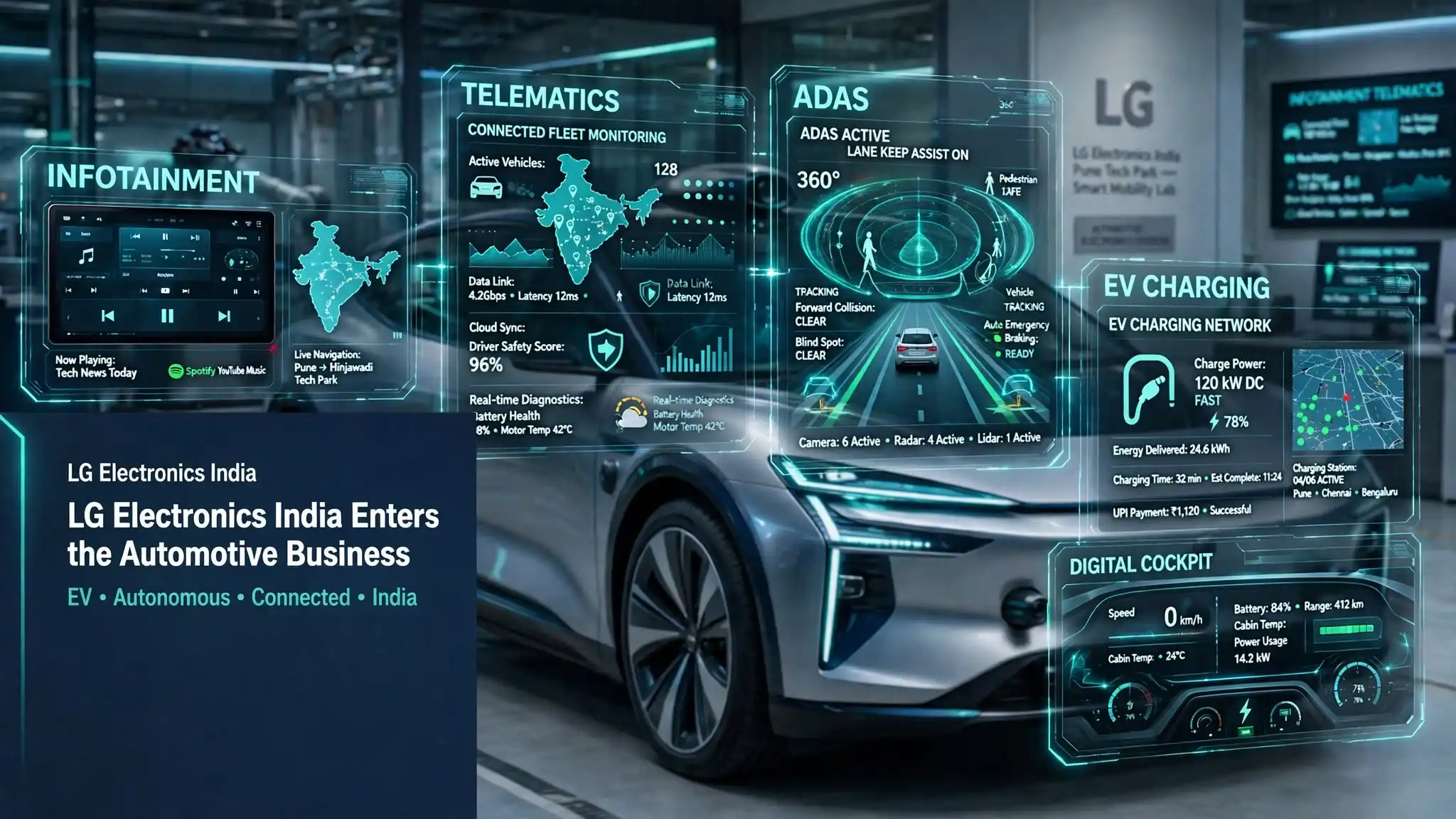
South Korean company LG Electronics is preparing to enter India’s Automotive Electronics Market. On November 5, 2026, the company announced its entry into a new business segment called the ‘Vehicle Solutions Business’. Under this business, LG plans to manufacture and supply products for cars and other vehicles, including In-Vehicle Infotainment Systems, Automotive Displays, Digital Cockpit Solutions, Telematics, Vehicle Computing Systems, ADAS and Automotive Software. According to the company, these products will be manufactured at its third manufacturing plant located in Sri City, Andhra Pradesh.
This is an important step for LG Electronics India as the company looks to expand beyond its traditional Consumer Electronics Business into the B2B market for Automotive Technology and Mobility Solutions.
Importantly, LG’s proposed Automotive Portfolio is not limited to car screens and music systems. It also covers several areas related to vehicle computing, connectivity, safety and software.
LG Electronics Automotive Business: Key Highlights
The following table presents the major details of the new business based on the company’s announcement dated November 5, 2026.
| Particulars | Details |
| Company | LG Electronics India Limited |
| Parent Company | LG Electronics, South Korea |
| New Business | Vehicle Solutions Business |
| Announcement Date | November 5, 2026 |
| Business Segment | Automotive Electronics & Mobility Technology |
| Main Products | Infotainment, Displays, Telematics, Digital Cockpit, ADAS, Vehicle Computing |
| Manufacturing Location | Sri City, Andhra Pradesh |
| Manufacturing Facility | Company’s Third Plant in India |
| Investment | Phased Investment; Amount Not Disclosed |
| Shareholder Approval | MOA Amendment Subject to Postal Ballot |
Company Introduction
LG Electronics India Limited is the Indian subsidiary of South Korea-based LG Electronics. In India, the company is primarily known for products such as televisions, refrigerators, washing machines, air conditioners and other consumer electronics.
Now, the company is planning to expand its business into Automotive Electronics. Rather than manufacturing cars or electric vehicles, LG’s focus will be on supplying the electronic systems, digital technologies and software used in modern vehicles.
For example, when a car manufacturer wants to introduce a large touchscreen, digital instrument cluster, connected-car features or advanced safety technology in a new model, it needs electronic systems and technology suppliers. LG is preparing to become a supplier of such products and solutions.
The announcement confirms LG’s decision to make Automotive and Mobility Technology a new business area. However, the company has not yet disclosed a production start date, a specific investment amount or supply agreements with any vehicle manufacturer.
What Did LG Announce on November 5, 2026?
The Board of Directors of LG Electronics India approved a proposal to introduce a new business line called the ‘Vehicle Solutions Business’ at its meeting held on November 5, 2026.
According to the company’s Stock Exchange Filing, the new business will cover activities related to the manufacturing, assembly, import, export, distribution, sale, supply, installation, integration and servicing of Automotive and Mobility Technology products.
The Board also approved a proposal to amend the company’s Memorandum of Association (MOA) to include this new business activity. However, the amendment will require shareholder approval through a Postal Ballot.
This announcement makes it clear that LG Electronics India intends to make Automotive Electronics a new part of its business. The company can use its existing manufacturing and technology experience to develop and supply products for the automotive industry.
What Products Will Be Included in LG’s New Automotive Business?
LG’s official announcement outlines several categories of Automotive Electronic Products and Technologies under the proposed Vehicle Solutions Business. Some of these products are already used in modern cars, while others may become increasingly important for future connected and software-defined vehicles.
1. In-Vehicle Infotainment Systems
In-Vehicle Infotainment Systems are among the major electronic systems used in modern cars. They generally include the touchscreen display installed on the dashboard and the digital features connected to it.
Drivers and passengers can use these systems for navigation, music, Bluetooth calling, smartphone connectivity and vehicle settings.
For example, when someone uses the car’s screen to view directions, connects a smartphone to play music or uses voice commands to control certain features, these functions are part of the infotainment system.
LG’s proposed Automotive Portfolio includes In-Vehicle Infotainment Systems, Head Units and Audio-Video Navigation Solutions.
With the growing demand for larger screens and connected features in modern vehicles, this could become an important product category for LG.
2. Automotive Displays and Digital Cockpit
Modern cars are increasingly replacing traditional analogue meters with digital displays. These displays provide information such as vehicle speed, battery status, driving range and other important details.
LG’s new business will include Automotive Displays, Instrument Clusters, Central Information Displays and Digital Cockpit Solutions.
A Digital Cockpit brings different digital features of a vehicle’s dashboard together in an integrated interface. For example, a driver may be able to view speed, battery percentage, navigation and vehicle status through a single digital setup.
The company’s portfolio also includes Head-Up Displays (HUDs). This technology can project important information, such as vehicle speed and navigation instructions, onto the windshield, making it easier for drivers to view essential information.
3. Telematics and Connected Vehicle Technology
Telematics is a technology that helps connect vehicles to the internet and communication networks. It can be used to access information such as vehicle location, driving data and vehicle status.
For example, a connected car may allow its owner to check the vehicle’s location through a smartphone application. Some vehicles also offer features such as remote locking, vehicle health monitoring and emergency assistance.
LG’s proposed business includes Telematics and Telematics Control Units (TCUs).
A TCU is an electronic module installed in a vehicle that helps establish communication between the vehicle and external communication networks.
With the growing demand for connected vehicles, Telematics could become an important segment of the Automotive Electronics Market.
4. ADAS – Advanced Driver Assistance Systems
ADAS stands for Advanced Driver Assistance Systems. It refers to a group of technologies designed to warn drivers about potential hazards and assist with vehicle control in certain driving situations.
These technologies may include Adaptive Cruise Control, Emergency Braking, Traffic Sign Recognition, Driver Monitoring and Automotive Vision Systems.
For example, if a car is travelling on a highway and the vehicle ahead suddenly slows down, an ADAS system may alert the driver or assist with braking, depending on the vehicle’s system capabilities.
LG has included ADAS, Automotive Vision and Sensing Systems in its proposed Automotive Business.
However, the company has not yet announced which specific ADAS products it will manufacture in India first.
5. Vehicle Computing Systems and Electronic Control Units
Modern vehicles use several Electronic Control Units (ECUs) and computing systems. These systems help manage different electronic functions of a vehicle.
For example, separate control units may be used for the battery, lighting, air conditioning, dashboard and other electronic features.
LG’s proposed portfolio includes the following systems:
| Product / System | Full Form |
| ECU | Electronic Control Unit |
| CCU | Central Control Unit |
| BCU | Body Control Unit |
| DCU | Domain Control Unit |
| CDC | Cockpit Domain Controller |
| HPC | High-Performance Computing |
A Cockpit Domain Controller is associated with the vehicle’s digital cockpit and related electronic systems. High-Performance Computing, meanwhile, is useful for systems that need to process large amounts of data.
As vehicles incorporate more digital features, cameras and sensors, the demand for such computing systems may also increase.
6. Automotive Software and Human-Machine Interface
Software is becoming increasingly important in modern vehicles, alongside hardware. Automotive Software is required to operate digital dashboards, infotainment systems, navigation and connected features.
LG’s proposed business includes Automotive Software and Human-Machine Interface (HMI) solutions.
HMI refers to the interface through which drivers interact with a vehicle’s digital systems. For example, selecting an option on a touchscreen, giving a voice command or controlling music and displays through steering-wheel buttons are all part of HMI.
The company’s proposed business scope also includes Software Platforms, Applications, Middleware, Cloud-Based Solutions and Cybersecurity-related technologies.
These areas could become important for the development of Software-Defined Vehicles in the future. However, LG has not yet announced a timeline for introducing these products in India.
7. Vehicle Electrification and Power Electronics
LG’s proposed new business activities also mention Vehicle Electrification and Power Electronics Components.
Power Electronics refers to electronic systems that help control the flow and use of electrical power in a vehicle. In Electric Vehicles, these systems play an important role in managing electricity between the battery and other electrical components.
For example, an EV requires power electronics to manage and control the electricity supplied by its battery to different vehicle systems.
However, LG has not yet announced the launch or manufacturing of any specific EV Power Electronics product in India. This should be understood as part of the company’s broader proposed business scope.
Manufacturing Location: Sri City, Andhra Pradesh
LG Electronics India has selected its third plant in Sri City, Andhra Pradesh, for manufacturing its new Vehicle Solutions Products.
According to the company’s official filing, the proposed Vehicle Solutions Products will be manufactured at this third facility. This move will give LG an opportunity to develop its manufacturing and supply operations for Automotive Electronics in India.
However, some important details about the facility have not yet been made public.
| Manufacturing Details | Current Status |
| Location | Sri City, Andhra Pradesh |
| Facility | LG India’s Third Plant |
| Planned Products | Vehicle Solutions Products |
| Investment Amount | Not Disclosed |
| Automotive Production Capacity | Not Disclosed |
| Commercial Production Start Date | Not Disclosed |
| Confirmed Automotive Customers | Not Disclosed |
The company has stated that investment in this business will be made in phases. The investment will depend on the scale of operations, technology and equipment requirements, regulatory requirements and market conditions.
One important point is that reports about the start of compressor manufacturing at the Sri City plant should not be interpreted as the start of Automotive Products manufacturing. These are separate product categories. LG has not yet announced a separate commercial production date for its Automotive Products.
Why Is LG Electronics India Entering the Automotive Market?
The importance of electronics and software in the automotive industry is increasing. Earlier, competition among car manufacturers was mainly focused on engines, mileage, design and mechanical performance. Today, digital displays, connected features, infotainment, sensors and driver assistance technologies are also becoming important.
The expansion of Electric Vehicles and Connected Cars is creating new opportunities for Automotive Electronics suppliers.
Some of the key business opportunities behind LG’s move include:
Expansion of B2B Business: Along with selling televisions and refrigerators to consumers, LG is now preparing to supply electronic systems and technology solutions to vehicle manufacturers.
Connected Vehicle Market: Demand for internet connectivity, remote monitoring and digital services in vehicles may increase in the coming years. This could create opportunities for Telematics and Connectivity Products.
Growing Demand for Digital Cockpits: Modern cars increasingly feature larger screens, digital instrument clusters and advanced infotainment systems.
ADAS and Computing Technology: The growing use of safety features, cameras, sensors and computing systems is creating new opportunities for Automotive Electronics suppliers.
In its filing, the company has also highlighted business diversification, growth opportunities, market presence and long-term business growth as potential benefits of entering this segment.
Which Companies Could Benefit from LG’s Automotive Business?
LG’s new business will primarily be connected to the Automotive Supply Chain. Its potential customers could include vehicle manufacturers and Automotive System Integrators.
For example, if a car manufacturer wants to introduce a Digital Cockpit, Infotainment System or Telematics Technology in a new vehicle, it may approach a technology supplier such as LG for these products.
If LG starts manufacturing these products in India, domestic vehicle manufacturers could gain another local technology supplier. This may also create opportunities for the development of India’s Automotive Electronics Supply Chain.
However, LG has not yet announced any supply agreement with a specific Indian car company, Electric Vehicle manufacturer or international automaker. Therefore, it would be incorrect to identify any company as a confirmed customer of LG at this stage.
What Should Be Watched Next?
LG has announced its plan to enter the Automotive Business, but the actual scale and impact of this business will become clearer over time.
| Upcoming Information | Why It Matters |
| Shareholder Approval | Formal approval for the MOA amendment |
| Investment Details | How much the company will invest in Automotive Business |
| Product Launch | Which products will be introduced first |
| Manufacturing Start | When production will begin at Sri City |
| Production Capacity | How many products the plant will be able to manufacture |
| Customer Agreements | Which vehicle manufacturers will receive supplies |
| Export Plans | Whether products will also be exported from India |
These developments will help determine how quickly LG’s Automotive Business progresses and what role the company may play in India’s Automotive Electronics Market.
Conclusion
LG Electronics India’s entry into the Vehicle Solutions Business marks an important change in the company’s business strategy. Along with Consumer Electronics, the company is preparing to establish a presence in the Automotive Electronics and Mobility Technology markets.
The proposed business covers a wide range of products and technologies, including In-Vehicle Infotainment, Automotive Displays, Digital Cockpit, Telematics, ADAS, Vehicle Computing, Electronic Control Systems and Automotive Software. The company plans to manufacture these products at its third plant in Sri City, Andhra Pradesh.
This move could create new opportunities for LG in India’s rapidly changing Automotive Technology Market. However, the investment amount, production capacity, production start date and customer details have not yet been disclosed.
Therefore, the actual progress of LG’s Automotive Business will need to be assessed through future product launches, manufacturing developments and supply agreements with vehicle manufacturers.
Sources: LG Electronics India – Investor Relations | NSE Corporate Announcements | BSE Corporate Announcements | The Economic Times – LG Enters Automotive Solutions Business
Disclaimer: This article is based on the company’s announcement and available news reports. The proposed Product Portfolio should be understood as the company’s announced business plan. Products, customers, investments and production timelines that have not been confirmed should not be treated as completed developments or operational manufacturing activities.