The digital advertising industry is becoming increasingly complex as companies spend billions of dollars on online advertising, streaming platforms, social media and mobile applications. Advertisers need to know not only how many people see their advertisements, but also whether those ads reach genuine audiences, appear in suitable environments and deliver measurable results.
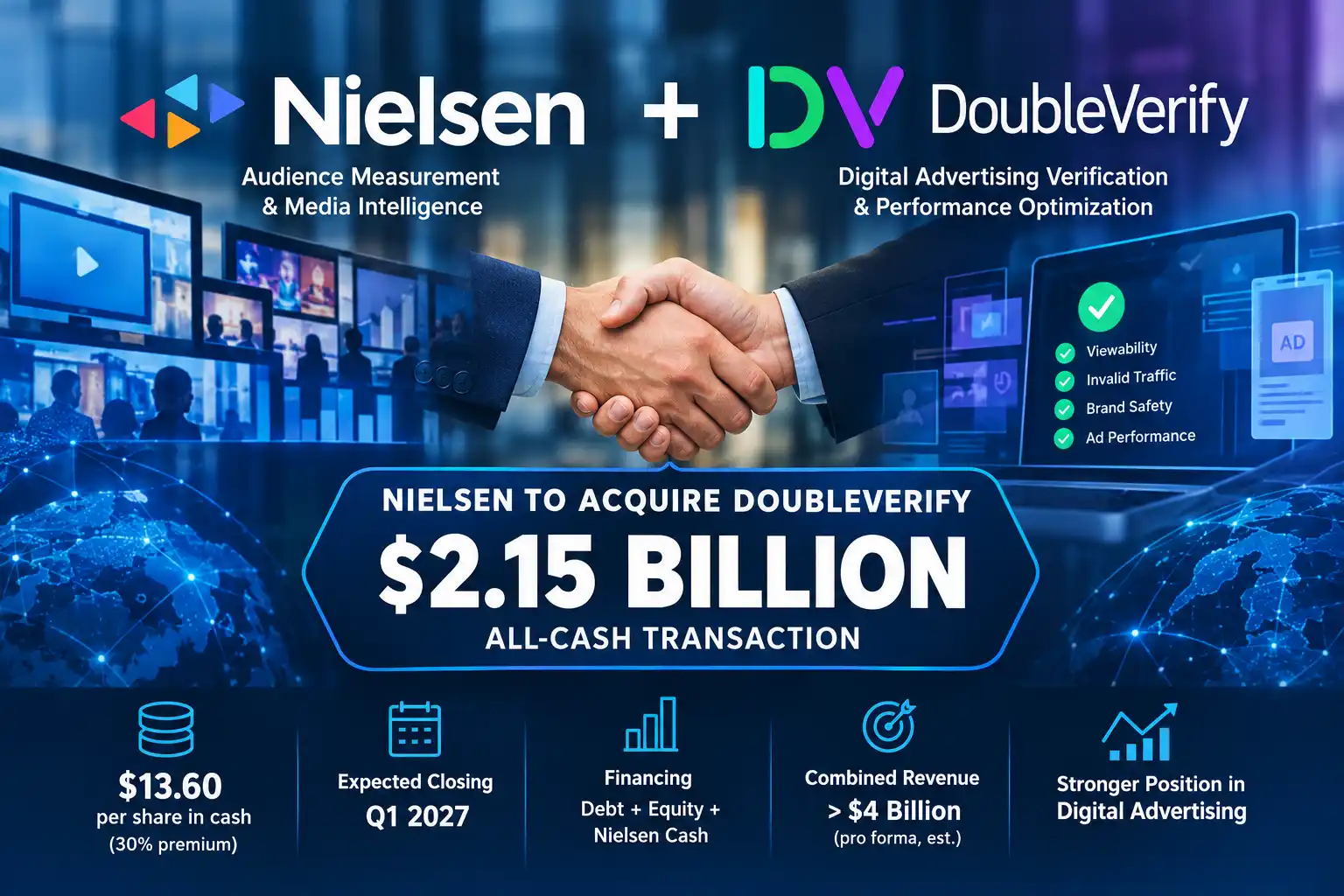
To strengthen its position in this market, Nielsen Holdings has agreed to acquire DoubleVerify Holdings, Inc. in an all-cash transaction with an enterprise value of approximately $2.15 billion. Announced on August 6, 2026, the deal will combine Nielsen’s expertise in audience measurement and media intelligence with DoubleVerify’s technology for digital advertising verification and performance optimization.
Under the agreement, DoubleVerify shareholders will receive $13.60 in cash for each eligible share, representing a 30% premium to the company’s 60-trading-day volume-weighted average share price as of August 5, 2026. The transaction is expected to close by the first quarter of 2027, subject to shareholder approval, regulatory clearances and other customary closing conditions. Until the deal closes, both companies will continue to operate separately.
Deal Snapshot
| Deal Detail | Information |
| Acquirer | Nielsen Holdings |
| Target | DoubleVerify Holdings, Inc. |
| Deal Type | Acquisition |
| Announcement Date | August 6, 2026 |
| Enterprise Value | Approximately $2.15 billion |
| Offer Price | $13.60 per share in cash |
| Premium | 30% over 60-trading-day VWAP |
| Acquirer Country | United States |
| Target Country | United States |
| Target Stock Exchange | New York Stock Exchange (NYSE) |
| Target Ticker | DV |
| Expected Closing | By Q1 2027 |
| Current Status | Announced; pending closing conditions |
Company Introduction
Nielsen Holdings
Nielsen is a global media intelligence company that measures audience behaviour across television, streaming, digital platforms, audio and other media channels. Its data helps advertisers, broadcasters, agencies and media companies understand who is watching content and how audiences interact with advertising.
Nielsen’s business is built around collecting, analysing and providing reliable information about audiences. For example, a television network may want to know how many people watched a particular programme, while an advertiser may want to understand whether a campaign reached the intended audience across television and streaming services.
Nielsen provides data and measurement solutions to help answer these questions.
The company has also expanded its capabilities beyond traditional television measurement into cross-platform analytics and advertising effectiveness. Its acquisition of DoubleVerify is intended to strengthen that strategy by adding deeper digital advertising verification capabilities.
DoubleVerify Holdings, Inc.
DoubleVerify is a technology company that helps advertisers check the quality and effectiveness of their digital advertising campaigns. Its platform supports the verification of ad visibility, invalid traffic, brand suitability and advertising performance.
Suppose a company pays to display an advertisement on a website or social media platform. Simply counting the number of times the advertisement was delivered does not necessarily tell the advertiser whether the campaign was successful.
Several questions need to be answered:
- Was the advertisement actually viewable?
- Was it displayed to genuine users rather than automated bots?
- Did it appear alongside suitable content?
- Did the campaign deliver the expected results?
DoubleVerify provides technology designed to help advertisers evaluate these aspects of their campaigns. Its tools support advertisers, agencies, publishers and digital platforms in assessing media quality and campaign performance.
Before the proposed acquisition, DoubleVerify was listed on the New York Stock Exchange under the ticker DV.
Why Is Nielsen Acquiring DoubleVerify?
The main reason behind the acquisition is to combine two complementary areas of advertising intelligence.
Nielsen specialises in audience measurement and media intelligence, while DoubleVerify focuses on digital advertising verification, media quality and performance.
These capabilities can provide advertisers with a more complete view of their advertising campaigns.
For example, Nielsen may help an advertiser understand the audience reached by a campaign across television and streaming services. DoubleVerify can add information about whether digital ad impressions were viewable, valid and delivered in suitable environments.
By combining these capabilities, Nielsen aims to provide a more integrated platform for planning, measuring and evaluating advertising campaigns.
According to the companies’ announcement, the combined business is expected to generate more than $4 billion in pro forma annual revenue. This is a projected combined-company figure, not a guarantee of future revenue growth.
How Will the Acquisition Work?
The deal is structured as a merger under a definitive agreement signed on August 6, 2026.
The legal structure involves three entities:
- Neptune BidCo US Inc. — the parent company formed for the transaction and associated with Nielsen’s ownership structure.
- Wallace Merger Sub Inc. — a wholly owned subsidiary of Neptune BidCo created to complete the merger.
- DoubleVerify Holdings, Inc. — the company being acquired.
The planned structure is:
Neptune BidCo → Merger Sub merges into DoubleVerify → DoubleVerify becomes a wholly owned subsidiary of Neptune BidCo.
DoubleVerify will survive the merger as the operating company, but it will become privately held after the transaction is completed.
The legal buyer named in the merger agreement is Neptune BidCo US Inc.; Nielsen announced the transaction as its acquisition of DoubleVerify.
What Does the $2.15 Billion Deal Value Mean?
Nielsen has announced an enterprise value of approximately $2.15 billion for DoubleVerify.
Enterprise value is a measure of the value of a business that takes account of its equity value and net debt, subject to the relevant transaction calculations. It is not necessarily the same as the cash paid directly to shareholders.
Under the agreement, eligible DoubleVerify shareholders will receive $13.60 per share in cash when the merger closes.
The offer price represents a 30% premium to DoubleVerify’s 60-trading-day volume-weighted average share price as of August 5, 2026.
For shareholders, this means:
- They will receive cash rather than continuing to own publicly traded DoubleVerify shares.
- The payment is conditional on the merger being completed.
- They should not treat the announced offer price as a payment already received.
- The final transaction remains subject to applicable closing conditions.
Following completion, DoubleVerify’s common stock is expected to be delisted from the NYSE and the company will cease to be an independently publicly traded business.
How Will Nielsen Finance the Acquisition?
Nielsen has announced that the transaction will be financed through a combination of:
- Debt financing committed by Barclays, BofA Securities and Citi.
- Incremental equity financing.
- Cash available at Nielsen.
This combination allows the buyer to fund the acquisition using multiple sources instead of relying on a single source of capital.
However, the financing structure also matters after closing.
Debt financing can increase interest expenses and financial obligations. Equity financing can affect ownership interests, depending on how it is structured. The impact on Nielsen’s financial position will depend on the final financing arrangements and the combined company’s subsequent operating performance.
The public announcement does not mean that all financing has already been drawn or that every final funding detail is settled.
How Could the Combined Company Benefit Advertisers?
The acquisition could allow Nielsen to combine audience insights with more detailed information about digital advertising quality.
A. Better Audience Measurement
Nielsen’s audience data can help advertisers understand who is watching content and how campaigns reach audiences across media channels.
B. More Reliable Digital Ad Verification
DoubleVerify’s technology helps advertisers evaluate whether digital advertisements are viewable, whether traffic is invalid and whether ads appear in suitable environments.
C. Cross-Platform Campaign Analysis
Advertisers increasingly run campaigns across television, connected TV, websites, mobile applications and social media. Combining measurement capabilities could help them evaluate performance across these channels more consistently.
D. More Informed Advertising Decisions
By bringing audience and media-quality data together, the companies aim to help advertisers make better decisions about campaign planning, delivery and measurement.
These are the intended strategic benefits described in the transaction announcement. Their actual impact will depend on product integration, customer adoption and execution after closing.
Why Is Digital Advertising Important to This Deal?
Advertising budgets are spread across an increasingly diverse set of channels, including television, streaming, search, social media, mobile applications and other digital services.
Advertisers need ways to evaluate whether their spending reaches genuine audiences and whether campaigns are delivered in the environments they expect.
DoubleVerify already operates in the digital advertising ecosystem, with integrations supporting advertising platforms, publishers and agencies. Nielsen’s existing audience-measurement capabilities could complement these services.
The companies have described the acquisition as a way to expand Nielsen’s reach into digital advertising and strengthen its position in media intelligence. Their announcement references a digital advertising segment of approximately $240 billion. This is a market figure cited by the companies, not DoubleVerify’s revenue or the value of this acquisition.
What Will Happen to DoubleVerify’s Name and Operations?
After the acquisition, DoubleVerify is expected to continue operating under the DoubleVerify name and brand, but as a privately held subsidiary of the buyer’s parent company.
Its common stock will no longer trade on a public stock exchange once the merger is completed.
The transaction announcement also indicates that the companies intend to preserve DoubleVerify’s independent verification standards, including its capabilities in invalid-traffic detection, viewability and brand suitability.
This is important because advertisers rely on verification services to assess the quality of their media purchases. Maintaining trust in these services will be a key consideration as the businesses are brought together.
What Is the Expected Closing Date?
The companies expect the acquisition to close by the first quarter of 2027.
However, the announcement date and the closing date are different.
The merger agreement was signed on August 6, 2026, but the transaction still requires:
- Approval from DoubleVerify shareholders.
- Required regulatory approvals.
- Satisfaction of other customary closing conditions.
Until these conditions are met and the merger is completed, Nielsen and DoubleVerify remain separate businesses.
What Are the Main Risks and Challenges?
Although the acquisition offers strategic opportunities, several issues could affect the outcome.
Integration Risk
Combining data systems, software platforms, products and teams can be complicated. The companies will need to coordinate their operations without disrupting services for existing customers.
Financing and Debt Risk
The use of debt financing could increase financial obligations and interest expenses. The effect will depend on the final funding structure and the combined company’s cash generation.
Customer and Competition Risk
Advertisers need reliable measurement and verification services. The combined business will need to retain customer trust and continue competing with other advertising technology and measurement providers.
Regulatory and Closing Risk
The transaction requires shareholder approval and regulatory clearances. If the necessary conditions are not satisfied, closing could be delayed or the deal could fail to complete under the agreement’s terms.
Expected Benefits May Not Materialise
The combined company expects to benefit from a broader media-intelligence platform and expanded digital capabilities. However, projected revenue and strategic benefits are not guarantees of future results.
These risks are important because the deal’s success will depend not only on completing the acquisition but also on integrating the businesses and delivering the expected benefits.
What Should Investors Watch Next?
The following milestones will help readers track the transaction:
- Shareholder approval: Whether DoubleVerify shareholders approve the merger.
- Regulatory clearance: Whether the required regulatory approvals are obtained.
- Financing: How the debt, equity and cash components are finalised.
- Closing announcement: Whether the acquisition closes by the expected Q1 2027 deadline.
- NYSE delisting: When DoubleVerify’s publicly traded shares cease trading following completion.
- Post-acquisition performance: Whether the combined business achieves its integration and growth objectives.
Investors should rely on subsequent SEC filings and official company announcements for confirmed developments.
Source: Nielsen news, SEC