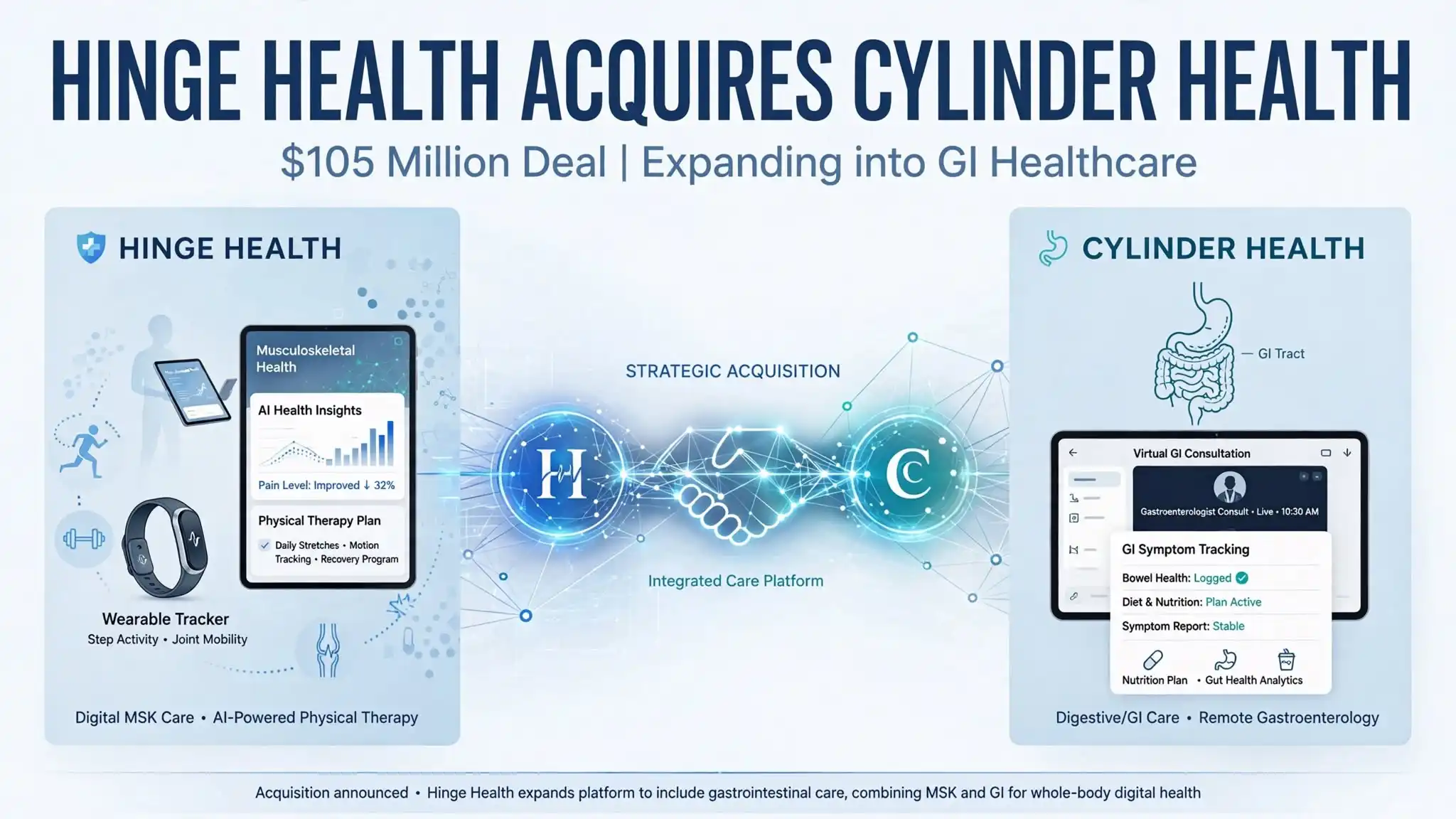
Hinge Health has agreed to acquire Cylinder Health, a virtual-first digestive healthcare company, for $105 million in cash. The deal, announced on August 4, 2026, is an important strategic move for Hinge Health because it will allow the company to enter the growing gastrointestinal (GI) healthcare market.
Hinge Health is already known for its digital healthcare solutions for musculoskeletal conditions such as back and joint pain. It has also expanded into areas such as migraine care. With Cylinder Health, the company plans to add gastrointestinal care to its healthcare platform and expects to launch an integrated GI Care Program in 2027.
The acquisition is therefore more than just a purchase of another healthcare company. It shows Hinge Health’s strategy of becoming a broader multi-condition digital healthcare platform.
Deal Snapshot
| Deal Detail | Information |
| Acquirer | Hinge Health, Inc. |
| Target | Cylinder Health, Inc. |
| Deal Type | Company Acquisition |
| Deal Value | $105 million |
| Payment | Cash |
| Announcement Date | August 4, 2026 |
| Expected Closing | Q3 2026 |
| Acquirer Country | United States |
| Acquirer Exchange | NYSE |
| Ticker | HNGE |
| Target Industry | Digital Healthcare / Gastrointestinal Care |
| Strategic Focus | Expansion into Gastrointestinal Care |
| Planned New Program | Integrated Gastrointestinal Care Program |
| Expected Launch | 2027 |
Hinge Health: Company Introduction
Hinge Health is a U.S.-based digital healthcare technology company focused on using technology to provide personalized healthcare.
The company originally built its business around musculoskeletal (MSK) care, which includes problems related to muscles, joints, bones and movement.
Its platform combines digital healthcare, artificial intelligence, wearable technology and clinical support. Patients can receive personalized treatment and exercise-based care without having to visit a physical clinic for every part of their treatment.
Hinge Health mainly works with employers and health plans, allowing their members and employees to access digital healthcare programs.
Over time, the company has started expanding beyond MSK care. It has also entered areas such as migraine care, showing that its long-term strategy is broader than treating only back and joint problems.
Cylinder Health: Company Introduction
Cylinder Health is a virtual-first digestive healthcare company founded in 2021.
The company focuses on helping people manage gastrointestinal and digestive health conditions through virtual care.
Its care model brings together healthcare professionals such as:
- Gastroenterologists
- Physicians
- Registered dietitians
- Health coaches
Cylinder provides care for a wide range of digestive conditions, including:
- Irritable bowel syndrome (IBS)
- Inflammatory bowel disease (IBD)
- GERD
- Constipation
- Bloating
- Celiac disease
- Crohn’s disease
- SIBO
- Gas
- Nausea
- Women’s digestive health
- Weight management
According to Cylinder Health, its platform has helped more than 150,000 people access digestive healthcare.
Why Is Hinge Health Acquiring Cylinder Health?
The biggest reason behind the acquisition is market expansion.
Hinge Health already has a strong position in digital MSK care. However, healthcare is much broader than musculoskeletal conditions.
By acquiring Cylinder Health, Hinge Health can enter the large and growing gastrointestinal healthcare market without having to build an entire GI healthcare business from scratch.
According to Hinge Health, GI conditions affect approximately one in four U.S. adults and are associated with around $135 billion in annual medical spending.
There is also a shortage of specialists. Hinge Health says that approximately 69% of U.S. counties do not have a gastroenterologist.
This creates an opportunity for virtual healthcare.
What Does Cylinder Health Bring to Hinge Health?
Cylinder brings several important assets to the deal.
1. Gastrointestinal Clinical Expertise
Cylinder has already built a specialized digestive healthcare model.
Its network includes gastroenterologists, dietitians and health coaches.
This means Hinge Health does not have to develop all of this expertise from the beginning.
2. Existing Customers and Market Relationships
Cylinder has approximately 100 clients covering nearly 2 million lives.
The company also has relationships with major pharmacy benefit managers and large self-insured health plans.
For Hinge Health, these existing relationships could provide a faster route into the GI healthcare market.
3. More Than 150,000 People Served
Cylinder says that its platform has already helped more than 150,000 people.
This gives Hinge Health access to an existing patient-care model and real-world experience in delivering virtual digestive healthcare.
How Will the Two Companies Work Together?
The two companies have complementary strengths.
Hinge Health brings:
- AI-powered healthcare technology
- Digital healthcare infrastructure
- Wearable technology
- Large employer and health-plan relationships
- MSK care
- Migraine care
- Healthcare automation and technology
Cylinder brings:
- GI clinical expertise
- Gastroenterologists
- Dietitians
- Health coaches
- Digestive healthcare programs
- GI patient experience
- Existing GI clients
- Digestive-health technology
By combining these capabilities, Hinge Health plans to build a new Gastrointestinal Care Program.
The company expects to launch the program in 2027.
From MSK Care to Multi-Condition Healthcare
This acquisition becomes more interesting when we look at Hinge Health’s overall strategy.
The company started primarily with:
Musculoskeletal Care
It then expanded into:
Migraine Care
Now it is moving into:
Gastrointestinal Care
This suggests that Hinge Health wants to become a broader multi-condition healthcare platform.
Instead of offering only one healthcare service, the company could potentially provide multiple types of care through the same digital platform.
For example, one person could need:
Back Pain Care + Migraine Care + Digestive Care
Instead of using three completely separate healthcare platforms, Hinge Health wants to make it possible to access multiple programs through one ecosystem.
Why Is GI Care a Logical Expansion?
At first, MSK care and digestive healthcare may appear unrelated.
However, many patients experience multiple health conditions at the same time.
For example, a person could suffer from chronic back pain as well as digestive problems or migraines.
Hinge Health believes there can also be connections between GI conditions and other health conditions through mechanisms involving the gut-brain connection and central sensitization.
This gives the company a potential opportunity to build a more integrated approach to healthcare.
Cylinder Health’s AI and Technology Capabilities
Cylinder Health is not simply a traditional telehealth company.
The company has also invested in healthcare technology.
In 2025, Cylinder acquired Dieta Health, a company that developed AI-powered stool imaging technology.
The technology uses smartphone images to analyze stool-related information and provide objective data that can support digestive-health assessment.
Cylinder also introduced Stool Scan technology as part of its digestive-health platform.
These capabilities could become useful additions to Hinge Health’s technology-driven healthcare model.
How Large Is the $105 Million Deal?
The acquisition price is $105 million in cash.
For Hinge Health, the transaction appears financially manageable relative to its balance sheet and cash generation.
At the end of Q2 2026, Hinge Health reported approximately $475.6 million in cash, cash equivalents, marketable securities and restricted cash.
During Q2 2026, the company generated approximately:
- $212.8 million revenue
- $101.4 million operating cash flow
- $99.6 million free cash flow
This suggests that Hinge Health had the financial capacity to fund the acquisition without making the transaction disproportionately large for the company.
Hinge Health’s Strong Growth
The acquisition also comes at a time when Hinge Health itself is growing rapidly.
In Q2 2026:
| Financial Metric | Q2 2026 |
| Revenue | $212.8 million |
| Year-over-Year Revenue Growth | 53% |
| Free Cash Flow | $99.6 million |
| Operating Cash Flow | $101.4 million |
| LTM Billings | $861.8 million |
| Clients | 2,929 |
The company also increased its 2026 full-year revenue guidance midpoint to approximately $858 million.
This is important because it shows that the Cylinder acquisition is taking place while Hinge Health is already expanding its core business.
What Are the Benefits for Hinge Health?
1. Entry Into a New Healthcare Market
The acquisition gives Hinge Health immediate access to the gastrointestinal healthcare market.
This can increase the company’s total addressable market over the long term.
2. More Services for Existing Customers
Hinge Health already works with thousands of clients.
The company can potentially offer GI care to some of these existing employers and health plans.
This creates an opportunity to increase the value of existing customer relationships.
3. Cross-Selling Opportunity
Suppose an employer already provides Hinge Health’s MSK program to its employees.
Hinge Health could potentially offer:
MSK + Migraine + GI Care
through the same healthcare ecosystem.
This could increase revenue per client and make customer relationships stronger.
4. Faster Market Entry
Building a GI healthcare business internally could take years.
Hinge Health can accelerate this process by acquiring a company that already has:
- GI doctors
- Clinical workflows
- Patients
- Customers
- Healthcare programs
- Technology
This is a classic build-versus-buy strategy.
What Does Cylinder Health Gain?
The acquisition can also provide significant benefits to Cylinder.
Hinge Health offers Cylinder access to:
- A larger technology platform
- A broader customer ecosystem
- AI capabilities
- Greater distribution
- More operational resources
- A larger healthcare infrastructure
Cylinder can therefore potentially reach more patients than it could as a standalone company.
Key Risks of the Acquisition
Although the deal has a strong strategic rationale, there are still risks.
Integration Risk
Combining two healthcare companies is not always easy.
Hinge Health will have to integrate:
- Technology
- Employees
- Clinical processes
- Customer relationships
- Data systems
- Healthcare workflows
Poor integration could reduce the expected benefits of the acquisition.
GI Healthcare Is Complex
Gastrointestinal healthcare is a very broad field.
Simple digestive problems and complex chronic diseases can require very different levels of medical care.
Therefore, Hinge Health will need to maintain strong clinical standards while scaling the service.
Revenue Impact May Take Time
Hinge Health plans to launch its integrated GI Care Program in 2027.
Therefore, the company should not necessarily be expected to generate a major revenue contribution from the acquisition immediately.
The real financial benefit will depend on how successfully Hinge Health integrates Cylinder and attracts GI-care customers.
Is the $105 Million Acquisition a Good Deal?
From a strategic perspective, the acquisition looks logical.
The value of the transaction is not simply the current standalone business of Cylinder Health.
The larger potential value comes from combining:
GI Expertise + Existing Customers + Hinge Health’s Technology Platform
If Hinge Health successfully integrates these capabilities, the long-term opportunity could be significantly larger than the $105 million purchase price.
However, investors should also note that Hinge Health has not publicly disclosed enough standalone financial information about Cylinder to calculate a meaningful acquisition multiple based on revenue or EBITDA.
Therefore, it would be premature to say that the deal is definitely cheap or expensive purely based on the $105 million price.
The Bigger Strategic Picture
The most important point about this acquisition is that it is not just a GI healthcare acquisition.
It represents a broader shift in Hinge Health’s business strategy.
The company appears to be moving from:
Single-condition digital healthcare
toward:
Multi-condition digital healthcare
Its expansion can be viewed as:
MSK Care → Migraine Care → Gastrointestinal Care
If this strategy works, Hinge Health could potentially continue adding other healthcare categories to its platform in the future.
That could make the company’s digital healthcare ecosystem more valuable to employers, health plans and patients.
Outcome
Hinge Health’s $105 million acquisition of Cylinder Health is a strategic expansion into gastrointestinal healthcare.
The deal gives Hinge Health access to Cylinder’s GI clinical expertise, approximately 100 clients, nearly 2 million covered lives and experience serving more than 150,000 people.
At the same time, Cylinder gets access to Hinge Health’s larger technology platform, AI capabilities and broader commercial ecosystem.
The most important opportunity is the potential to offer multiple healthcare programs through a single platform. Hinge Health could eventually provide MSK, migraine and GI care to the same customers, creating opportunities for cross-selling and deeper relationships with employers and health plans.
For investors, the key question will be whether Hinge Health can successfully integrate Cylinder and turn its GI capabilities into a scalable and profitable new healthcare program.
Overall, the acquisition appears strategically strong, while its long-term financial success will depend mainly on execution, adoption of the new GI program and Hinge Health’s ability to expand its multi-condition healthcare platform.
Source: hingehealth , sec