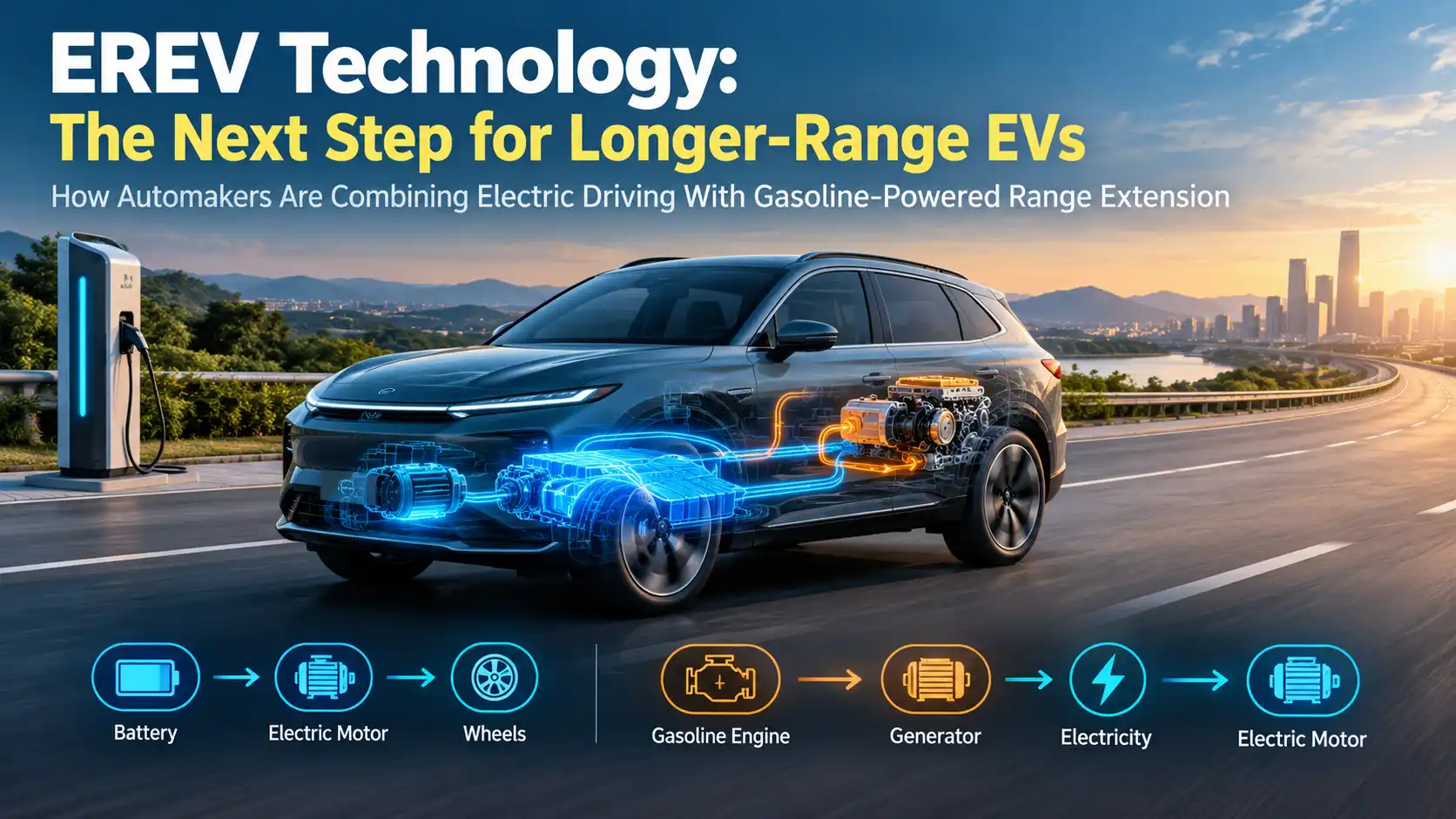
The electric vehicle industry has made remarkable progress over the past few years. Automakers are launching new battery-electric models, battery technology is improving, and charging networks are expanding. However, one major challenge still remains: many consumers want the benefits of electric driving without worrying about charging during long-distance journeys.
This is where a technology called EREV, or Extended-Range Electric Vehicle, is gaining renewed attention.
An EREV combines the key advantage of an electric vehicle with a gasoline-powered range extender. The vehicle is primarily driven by an electric motor, while a gasoline engine can generate electricity when the battery gets low. Unlike a conventional hybrid, the gasoline engine in an EREV is generally designed to act as a generator rather than directly powering the wheels.
In simple terms, an EREV aims to provide:
The driving experience of an EV + the long-distance flexibility of a gasoline vehicle.
This concept is becoming increasingly important as automakers look for practical ways to increase driving range without simply installing extremely large and expensive batteries.
Companies including Hyundai, Ford and Stellantis are exploring EREV technology, particularly for larger vehicles such as SUVs and pickup trucks. Hyundai is preparing EREV models around 2027, while Stellantis has been developing range-extender versions of vehicles such as the Jeep Grand Wagoneer and Ram 1500.
What Is an EREV?
EREV stands for Extended-Range Electric Vehicle.
It is a vehicle that uses:
- A rechargeable battery
- One or more electric motors
- A gasoline engine
- A generator
The most important point is that the electric motor is responsible for driving the vehicle.
When the battery has enough charge, the vehicle operates much like a normal battery-electric vehicle.
When the battery becomes low, the gasoline engine can start and operate a generator to produce electricity.
The basic energy flow can therefore look like this:
Battery → Electric Motor → Wheels
And when the battery needs additional energy:
Gasoline → Engine → Generator → Electricity → Electric Motor → Wheels
This design is what makes an EREV different from many conventional hybrids.
How Does EREV Technology Work?
The technology can be understood through a simple example.
Imagine an EREV SUV with a fully charged battery.
Step 1: The Vehicle Starts on Battery Power
When you start driving, the vehicle uses electricity stored in the battery.
The electric motor drives the wheels.
The gasoline engine can remain switched off.
Step 2: The Battery Level Drops
After driving for some distance, the battery reaches a predetermined charge level.
Instead of immediately requiring the driver to find a charging station, the vehicle can activate its range extender.
Step 3: The Gasoline Engine Generates Electricity
The gasoline engine starts and powers a generator.
The generator produces electricity for the vehicle’s electrical system.
Step 4: The Electric Motor Keeps Driving the Vehicle
The electric motor continues to drive the wheels.
As a result, the driver can continue the journey without immediately stopping for a battery recharge.
How Is an EREV Different From a Normal EV?
A traditional battery-electric vehicle, or BEV, has a relatively simple powertrain:
Battery → Inverter → Electric Motor → Wheels
There is no gasoline engine.
An EREV adds another energy-generation system:
Battery → Electric Motor → Wheels
plus:
Fuel → Engine → Generator → Electricity
The result is a vehicle that can operate electrically but has an additional source of energy for longer journeys.
EREV vs Hybrid: What Is the Difference?
EREV technology can sound very similar to a hybrid, but there is an important difference.
In many conventional hybrid vehicles:
Gasoline Engine + Electric Motor → Wheels
Both the engine and electric motor can contribute directly to moving the vehicle.
In an EREV, the architecture is different:
Gasoline Engine → Generator → Electricity → Electric Motor → Wheels
In other words, the gasoline engine primarily serves as a range extender.
This gives the vehicle an electric-drive character while still providing access to gasoline energy when the battery is running low.
EREVs can be considered closely related to plug-in hybrid technology, but their power-flow architecture can be significantly different.
Why Are Automakers Paying Attention to EREV Technology?
There are several reasons behind the renewed interest.
1. Range Anxiety
One of the biggest concerns among some EV buyers is the possibility of running out of battery during a long trip.
Even if an EV has a long range, consumers may still worry about:
- Finding a charger
- Waiting for a charger
- Charger availability
- Unexpected detours
- Cold-weather range loss
- Heavy loads or towing
An EREV provides another energy source.
2. Charging Infrastructure Is Still Uneven
Charging infrastructure has improved significantly, but it is not equally developed everywhere.
Major cities and highways may have many fast chargers, while rural areas and less-developed routes may have fewer options.
For an EV owner, this can require careful trip planning.
An EREV reduces this dependence because gasoline stations can provide an alternative when the battery cannot be conveniently recharged.
3. Extremely Large Batteries Can Be Expensive and Heavy
There is another important problem.
If an automaker wants to give a large SUV or pickup truck extremely long electric range, it may need a very large battery.
A larger battery can mean:
- Higher vehicle cost
- Greater weight
- More battery materials
- Increased manufacturing complexity
EREV technology offers another approach.
Instead of trying to provide the entire long-distance range using a massive battery, an automaker can combine a battery with a gasoline-powered generator.
The result can potentially provide long overall range without relying entirely on an enormous battery.
Why Are Large SUVs and Pickup Trucks Ideal for EREV?
This may be one of the most important reasons automakers are considering the technology.
Large SUVs and pickup trucks consume more energy than small cars.
A pickup truck becomes even more demanding when it is carrying:
- Heavy cargo
- Several passengers
- A trailer
- Towing equipment
If the vehicle has to provide very long range under those conditions, a very large battery may be required.
EREV can provide an alternative.
This is why large SUVs, pickups and commercial vehicles could become important EREV segments.
Hyundai’s EREV Strategy
Hyundai is one of the major automakers preparing to enter the EREV market.
The company is working on an EREV version of the Santa Fe, with production planned around 2027.
Reports have indicated that the Santa Fe EREV could target a total driving range of more than 600 miles. Hyundai’s premium Genesis brand is also reportedly preparing an EREV crossover with a similarly ambitious range target.
This strategy is significant because Hyundai is not treating EREV simply as a small-car technology.
Instead, the company is looking at larger SUVs where long range, weight and battery cost are particularly important.
Why Could EREV Be a Smart Strategy for Hyundai?
Consider a customer who drives 50–100 km every day.
For most daily journeys, the vehicle could operate primarily on battery power.
But on weekends, the same customer may want to drive several hundred kilometers.
With a pure EV, the driver would need to plan around charging.
With an EREV, the battery could handle much of the normal driving while the gasoline-powered range extender provides additional flexibility during longer trips.
This could make EREV attractive to consumers who want to move toward electric driving but are not ready to depend entirely on charging infrastructure.
Stellantis Is Also Exploring EREV
Stellantis is another major automaker investing in extended-range technology.
Its plans have included large vehicles such as:
- Jeep Grand Wagoneer
- Ram 1500
The Jeep Grand Wagoneer EREV has been associated with a 92-kWh battery and a 3.6-liter V6 range-extender system, with a reported target of around 500 miles of combined range.
However, Stellantis’ plans have also experienced delays.
Reports have indicated that the Ram 1500 range-extended pickup and Jeep Grand Wagoneer EREV have been pushed back, showing that developing and mass-producing this type of powertrain is not necessarily easy.
Ford and the EREV Opportunity
Ford also has strong reasons to consider range-extender technology, particularly in the pickup truck market.
Electric pickups face a unique challenge.
A pickup that is towing a heavy trailer can consume electricity much faster than when it is being driven without a load.
For example:
Normal driving → Lower energy consumption
Heavy towing → Much higher energy consumption
This means the advertised range of an electric pickup can fall substantially under demanding conditions.
An EREV could provide a backup energy source for customers who frequently travel long distances or tow heavy loads.
This could make the technology particularly interesting for the American pickup market.
What Is the Biggest Advantage of EREV?
The biggest advantage is long-distance flexibility.
A pure EV depends entirely on its battery and charging infrastructure.
An EREV still uses electricity as its primary method of propulsion, but it has another energy source available.
For example:
Daily city driving → Battery
Highway road trip → Battery + Range Extender
Battery gets low → Gasoline engine generates electricity
This reduces the pressure on drivers to find a charging station immediately.
Is an EREV a Zero-Emission Vehicle?
No—not completely.
This distinction is important.
When an EREV is operating on battery power and the gasoline engine is switched off, there are no tailpipe emissions from the vehicle.
However, when the gasoline engine operates, it burns fuel and produces emissions.
Therefore, an EREV should not be described as a completely zero-emission vehicle in the same way as a pure battery-electric vehicle.
It is better understood as an electrified vehicle with a combustion-engine range extender.
What Are the Disadvantages of EREV?
EREV technology also has several weaknesses.
1. More Mechanical Complexity
A pure EV has relatively few major drivetrain components.
An EREV adds:
- Gasoline engine
- Generator
- Fuel tank
- Exhaust system
- Additional cooling components
That means the vehicle has more systems that need to be engineered and maintained.
2. Potentially Higher Cost
An EREV essentially combines two technologies:
Electric vehicle system + combustion engine system
That can increase manufacturing complexity and potentially increase the price of the vehicle.
3. More Weight
The vehicle has to carry both a battery and an engine-generator system.
That adds weight.
More weight can increase energy consumption, particularly when the vehicle is operating in electric mode.
Therefore, engineers have to carefully balance:
Battery size + engine size + generator + vehicle weight + efficiency
4. It Still Uses Gasoline
This is perhaps the biggest environmental disadvantage.
A pure EV does not need gasoline.
An EREV still does.
Therefore, EREV technology cannot provide the same level of tailpipe-emission reduction as a fully battery-electric vehicle when its range extender is operating.
What Can Automakers Learn From China?
China is particularly important when discussing EREV technology.
Range-extended vehicles have already gained significant popularity in the Chinese market.
Companies such as Li Auto, AITO and Leapmotor have used range-extender architectures in several models.
This has demonstrated that there can be consumer demand for vehicles that combine electric driving with long-distance fuel flexibility.
The success of these vehicles is one reason other global automakers are taking another serious look at the technology.
EREV vs BEV
| Feature | BEV | EREV |
| Electric motor | Yes | Yes |
| Battery | Yes | Yes |
| Gasoline engine | No | Yes |
| Long-distance backup | Charging required | Fuel-powered range extender |
| Tailpipe emissions | None | Yes, when engine operates |
| Mechanical complexity | Lower | Higher |
| Charging dependence | Higher | Lower |
| Maintenance requirements | Generally lower | Potentially higher |
| Large SUV/Pickup suitability | Can require a very large battery | Potentially attractive |
Could EREV Become the Future of EVs?
EREV is unlikely to completely replace battery-electric vehicles.
Instead, it may become one part of the broader electrification strategy.
The automotive market has different types of customers.
Group 1: Full EV Buyers
These customers are comfortable with charging and want a completely electric vehicle.
Group 2: Traditional Vehicle Buyers
These customers are still more comfortable with gasoline or diesel vehicles.
Group 3: Transition Buyers
These customers want electric driving but are still concerned about long-distance travel and charging.
EREV is primarily targeting the third group.
Why EREV Could Become Important During the EV Transition
The global transition to electric vehicles will not happen at exactly the same pace in every country or vehicle segment.
Some regions have excellent charging infrastructure.
Others do not.
Some consumers drive short distances.
Others regularly travel hundreds of kilometers.
Some vehicles are small and lightweight.
Others are large SUVs or heavy-duty pickups.
A single powertrain technology may therefore not be the perfect solution for everyone.
EREV gives automakers another option.
It allows them to offer:
Electric driving for everyday use
while also providing:
Gasoline-powered backup for long-distance travel.
Which Vehicles Could Benefit Most From EREV?
The technology could be particularly useful in four areas.
1. Large SUVs
Large SUVs need significant energy because of their size and weight.
2. Pickup Trucks
Towing and heavy loads can dramatically increase energy consumption.
3. Commercial Vans
Commercial vehicles may spend many hours on the road and cannot always afford long charging stops.
4. Premium Vehicles
Premium buyers may want long range, strong performance and flexibility without compromising on comfort.
Small urban EVs may have less need for EREV technology because their normal driving range can already be sufficient for daily use.
EREV Could Change the EV Range Debate
For years, automakers have largely approached EV range by asking:
“How big should the battery be?”
EREV introduces another question:
“Does the vehicle need to get all of its range from the battery?”
That is a major change in thinking.
Instead of continuously increasing battery size, automakers can combine:
A reasonably sized battery + an efficient electric motor + a small range-extender engine.
The result could be a more practical long-distance electrified vehicle.
Outcome
The renewed interest in EREV technology shows that the automotive industry is moving beyond a simple “gasoline vs EV” debate.
Automakers are increasingly looking for different solutions for different customers.
A BEV provides completely electric driving and zero tailpipe emissions.
A PHEV combines electric and combustion power.
An EREV focuses on electric propulsion while using a gasoline engine primarily as a range extender.
For consumers who have reliable access to charging, a pure EV may remain the better long-term solution.
But for people who regularly drive long distances, live in areas with limited charging infrastructure, or own large SUVs and pickup trucks, EREV could offer an attractive compromise.
The renewed interest from companies such as Hyundai, Ford and Stellantis suggests that automakers see a potential market for this approach. Hyundai’s planned long-range EREV SUVs and Stellantis’ range-extender programs demonstrate how manufacturers are trying to solve one of the biggest practical problems in EV adoption: how to provide long-distance flexibility without relying entirely on an enormous battery.
However, EREV also has clear disadvantages. The additional engine, generator and fuel system add complexity, weight and emissions. Delays in some upcoming EREV programs also show that the technology still faces engineering and production challenges.
In Simple Words
A traditional EV works like this:
Battery → Electric Motor → Wheels
An EREV works like this:
Battery → Electric Motor → Wheels
And when the battery gets low:
Gasoline → Engine → Generator → Electricity → Electric Motor
That is the core idea behind EREV:
Electric driving for everyday use, with a gasoline-powered backup for long-distance travel.
If automakers can control the cost, weight and complexity, EREV could become an important bridge between today’s gasoline vehicles and the fully electric vehicles of the future.