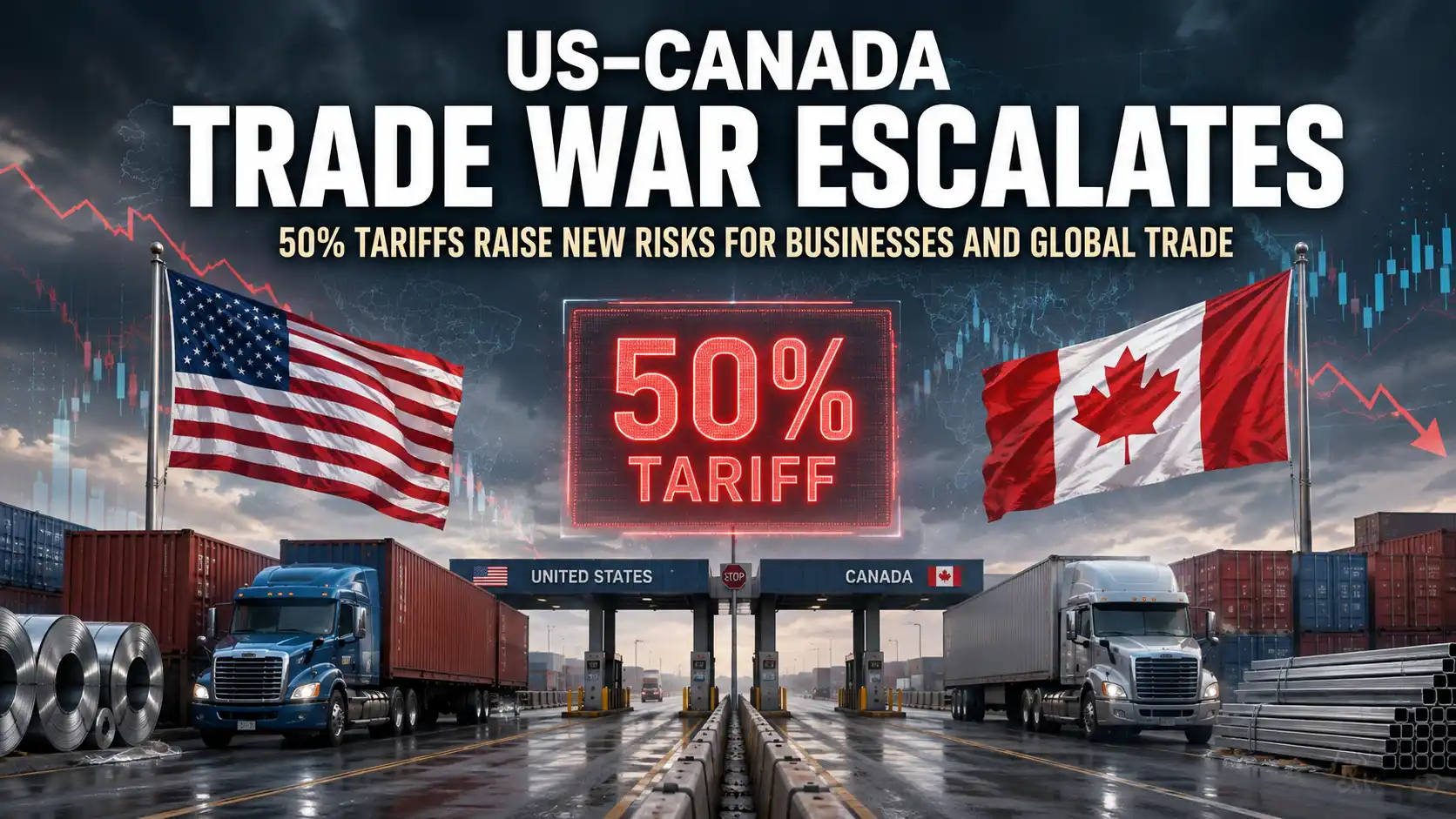
The United States and Canada have failed to reach a new trade agreement, turning what had been difficult negotiations into a fresh escalation of the North American trade conflict. After talks broke down late on August 21, the United States moved ahead with 50% tariffs on around $20 billion worth of Canadian goods, with the new duties taking effect on August 22. Canada has responded by preparing dollar-for-dollar retaliatory tariffs, with the new measures scheduled to begin on September 8.
The development is important not only for the US and Canada but also for global businesses because the two countries have deeply integrated supply chains, particularly in automobiles, metals, manufacturing, agriculture, energy and consumer products. The dispute also creates new uncertainty around the future of the USMCA, the trade agreement connecting the United States, Canada and Mexico.
What Happened Between the US and Canada?
The US and Canada had been negotiating for weeks to avoid another round of tariffs. At one point, both sides indicated that a deal was close.
On August 20, Canada said the negotiations were making progress, while the US was also reportedly interested in reaching an agreement before the tariff deadline. A potential deal was expected to reduce the tariff on Canadian-built vehicles from 25% to 15% and lower some steel and aluminum tariffs.
However, the negotiations collapsed at the last moment.
According to Reuters, disagreements over steel, aluminum, automobiles and softwood lumber remained unresolved. The US ultimately imposed the new 50% tariffs on roughly $20 billion of Canadian goods.
Canada then suspended the negotiations and announced retaliatory action.
Why Did the Trade Talks Collapse?
There was no single issue responsible for the breakdown. Several major disagreements came together.
1. Steel and Aluminum
Steel and aluminum became one of the biggest sticking points.
The US wanted stronger protection for its domestic steel industry, while Canada wanted better access to the US market.
Earlier proposals reportedly included reducing the top-line tariffs on Canadian steel and aluminum to 25%, but the two sides could not agree on the final arrangement.
This is particularly important because Canada is deeply connected to the US manufacturing sector.
2. Automobile Trade
The automobile industry was another major problem.
The US had already imposed tariffs on Canadian-built vehicles. Negotiators discussed reducing the tariff from 25% to 15%, but disagreements remained over how Canadian content in vehicles would be treated.
Canada also wanted broader protection covering medium- and heavy-duty vehicles, while Washington was reportedly more limited in what it was willing to offer.
This matters because modern vehicles contain components that cross the US-Canada border multiple times before the final vehicle reaches customers.
3. Canada’s Future Trade Deals
One of the more significant disagreements was about Canada’s ability to make trade agreements with other countries.
Canadian Prime Minister Mark Carney said the US wanted language that would restrict Canada’s ability to negotiate future trade deals with other nations. Canada considered those conditions unacceptable.
This turned the dispute from a simple tariff negotiation into a much broader question about Canada’s economic independence and trade policy.
4. Last-Minute US Demands
The negotiations appeared to be moving toward a possible agreement, but additional US demands reportedly emerged near the deadline.
Canada argued that the late changes made it impossible to accept the proposed agreement, while the US blamed Canada for walking away from what Washington considered a favorable deal.
This disagreement over who was responsible for the collapse has further damaged trust between the two governments.
What Are the New US Tariffs?
The United States has imposed 50% tariffs on approximately $20 billion worth of Canadian goods.
That sounds extremely large, but there is an important detail: the affected goods represent only around 5% of Canada’s exports to the United States. US Census Bureau data cited by Reuters show that the US imported about $383 billion of goods from Canada in 2025, while the newly targeted category is approximately $20 billion.
So the immediate direct impact is concentrated rather than covering all Canada-US trade.
However, the broader economic impact could be much larger because businesses may change suppliers, prices and investment decisions in response to the uncertainty.
Which Canadian Products Are Affected?
The new tariffs cover a range of Canadian products.
Potentially affected categories include:
- Consumer products
- Manufactured goods
- Cement
- Hockey sticks
- Wine and other products
- Various industrial products
Some important categories, including energy, potash and critical minerals, have exemptions from the new measures, while some products already facing separate US tariffs are also treated differently.
This means the 50% headline tariff does not mean every Canadian product entering the US will suddenly become 50% more expensive.
How Is Canada Responding?
Canada has decided to respond with its own tariffs.
Prime Minister Mark Carney announced that Canada would introduce dollar-for-dollar tariffs on US goods beginning September 8. The measures will target products including steel, dairy products, appliances and electronics.
This creates a classic retaliatory tariff cycle:
US imposes tariff → Canadian exporters face higher costs → Canada retaliates → US exporters face higher costs → businesses raise prices or reduce imports.
If the cycle continues, both economies could suffer.
Why Is This a Big Problem for Businesses?
The biggest issue is not simply the tariff percentage.
It is uncertainty.
A company that imports a product from Canada needs to know its cost months in advance. If the tariff suddenly changes from 10% to 50%, the company’s calculations can become useless.
Businesses may therefore:
- Increase prices
- Reduce imports
- Search for alternative suppliers
- Move production
- Delay investments
- Reduce hiring
- Hold more inventory
- Pass higher costs to customers
Canadian businesses are already warning about the difficulty of operating under the new tariff environment.
Impact on US Consumers
American consumers could also feel the effects.
If a US company imports a Canadian product and suddenly has to pay a much higher tariff, it has three basic choices:
- Absorb the additional cost.
- Find a cheaper supplier.
- Increase the price for customers.
For large companies, absorbing some of the cost may be possible.
For small businesses operating with thin margins, it can be much harder.
Therefore, even though the new tariffs cover only a portion of Canadian exports, the affected industries could experience noticeable price increases.
Impact on Canadian Businesses
Canadian exporters are particularly vulnerable because the United States is Canada’s dominant export market.
According to AP, around 75% of Canadian exports go to the United States.
That makes it difficult for Canadian companies to quickly replace American customers with buyers in Europe or Asia.
A Canadian manufacturer selling almost all of its products to the US cannot simply switch to another market overnight.
This could lead to:
- Lower sales
- Reduced production
- Lower profit margins
- Layoffs
- Delayed investment
- Greater pressure to find new export markets
Automobile Industry Could Face Major Pressure
The auto industry is one of the sectors that needs close attention.
US and Canadian automobile manufacturing is highly integrated. Parts can cross the border several times during the production process.
For example:
Canadian component → US factory → Canadian assembly → US dealership
A tariff at multiple stages can increase the final cost substantially.
That could force automakers and suppliers to reconsider where they manufacture components and vehicles.
In the long term, companies could move more production toward the US to reduce tariff exposure.
However, rebuilding supply chains takes years and requires billions of dollars of investment.
Steel and Aluminum Industry
Steel and aluminum are at the center of the dispute.
For US steel producers, higher tariffs on Canadian steel can provide some protection from foreign competition.
Companies such as Nucor, Steel Dynamics and Cleveland-Cliffs could potentially benefit if US steel prices and domestic demand remain strong. Market analysts have already highlighted US steel companies as possible beneficiaries of the breakdown.
But there is another side.
US manufacturers that buy steel and aluminum could face higher input costs.
So:
US steel producers → potentially benefit
US steel-consuming manufacturers → potentially suffer
This is why tariffs often create winners and losers within the same economy.
What Happens to the USMCA?
Another major concern is the future of the United States-Mexico-Canada Agreement (USMCA).
USMCA is the framework governing a huge amount of North American trade.
The current tariff escalation could make businesses question how reliable the agreement will be in the future. Reuters notes that the new duties fall outside the preferential treatment provided under the agreement, increasing concerns about jobs and vulnerable industries.
For businesses, predictable trade rules are extremely important.
If companies cannot confidently predict tariffs several years ahead, they may hesitate to build new factories or expand supply chains across borders.
Could Mexico Benefit?
Interestingly, the dispute could create an opportunity for Mexico.
Companies that currently depend heavily on Canada-US trade may start looking for alternative production locations within North America.
Mexico could benefit from:
- New manufacturing investment
- Automotive production
- Electronics manufacturing
- Supply-chain relocation
- Nearshoring
Mexico’s government has already indicated that it expects to reach trade understandings with the US and potentially achieve outcomes similar to the emerging US-Canada arrangements.
However, Mexico itself is also exposed to US trade policy, so the opportunity comes with risks.
Could Other Countries Benefit?
Yes.
If Canadian companies need to reduce their dependence on the US, they may search for customers in:
- Europe
- Asia
- India
- Japan
- South Korea
- Southeast Asia
Similarly, US companies affected by Canadian retaliation may seek alternative suppliers.
This could accelerate the broader global trend of supply-chain diversification.
For countries such as India, Vietnam, Indonesia and Mexico, this can create opportunities to attract manufacturing and investment.
Impact on Global Trade
The US-Canada dispute is happening at a time when global trade is already facing considerable uncertainty.
Businesses are increasingly dealing with:
- Higher tariffs
- Export restrictions
- Supply-chain restructuring
- Geopolitical tensions
- Higher transportation costs
- Changing trade agreements
The latest US-Canada conflict therefore adds another layer of uncertainty to the global economy.
It could encourage multinational companies to move from a “lowest-cost supplier” strategy toward a “multiple-supplier” strategy.
In simple terms, companies may decide:
“Even if one supplier is cheaper, we don’t want our entire business dependent on one country.”
That could permanently change global supply chains.
What Happens Next?
The immediate question is whether Washington and Ottawa will return to negotiations.
Canada has announced retaliatory tariffs beginning September 8, while the US has already implemented the new 50% duties.
There are several possible scenarios.
Scenario 1: New negotiations
The two countries could return to the negotiating table and eventually reach a compromise.
This would be the most positive outcome for businesses.
Scenario 2: Longer trade conflict
If both governments maintain their current positions, companies could face higher costs for months.
This would be negative for investment and supply chains.
Scenario 3: Supply-chain restructuring
Companies could permanently move production away from Canada-US routes and diversify toward Mexico, Asia and other markets.
This could have a much longer-lasting impact than the tariffs themselves.
Business Impact at a Glance
| Area | Expected Impact |
| Canadian exporters | 🔴 High pressure |
| US importers | 🔴 Higher costs |
| US consumers | 🟠 Potential price increases |
| Auto industry | 🔴 High risk |
| Steel producers | 🟢 Potential benefit |
| Steel-consuming manufacturers | 🔴 Higher input costs |
| Canadian small businesses | 🔴 High risk |
| Mexico manufacturing | 🟢 Potential opportunity |
| Global supply chains | 🟠 More diversification |
| USMCA | 🔴 Increased uncertainty |
| Cross-border investment | 🔴 Negative pressure |
Final Analysis
The collapse of the US-Canada trade talks is much more than another tariff announcement. It represents a significant increase in uncertainty for one of the world’s most integrated economic relationships.
The immediate numbers are important: the US has imposed 50% tariffs on around $20 billion of Canadian goods, while Canada plans matching tariffs from September 8.
But the bigger story is what businesses do next.
If companies begin moving factories, changing suppliers and reducing dependence on cross-border trade, the consequences could continue even after the governments eventually reach a new agreement.
For investors, the most important sectors to watch are automobiles, steel and aluminum, manufacturing, energy, consumer goods and logistics. At the same time, Mexico and other manufacturing hubs could potentially benefit as companies diversify their supply chains.
In short, the immediate tariff impact is concentrated, but the long-term supply-chain and investment impact could be much broader.
Sources: Reuters, Government of Canada — Canada–US Relations & Trade Negotiations, U.S. Trade Representative (USTR) — Canada Tariffs and other international business and trade reports.