The electric vehicle market is changing quickly. While major global automakers are launching premium electric SUVs and high-performance EVs, Chinese manufacturers are increasingly focusing on affordable electric cars that combine long range, modern technology and competitive pricing.
Leapmotor B05 and A05 are two good examples of this strategy.
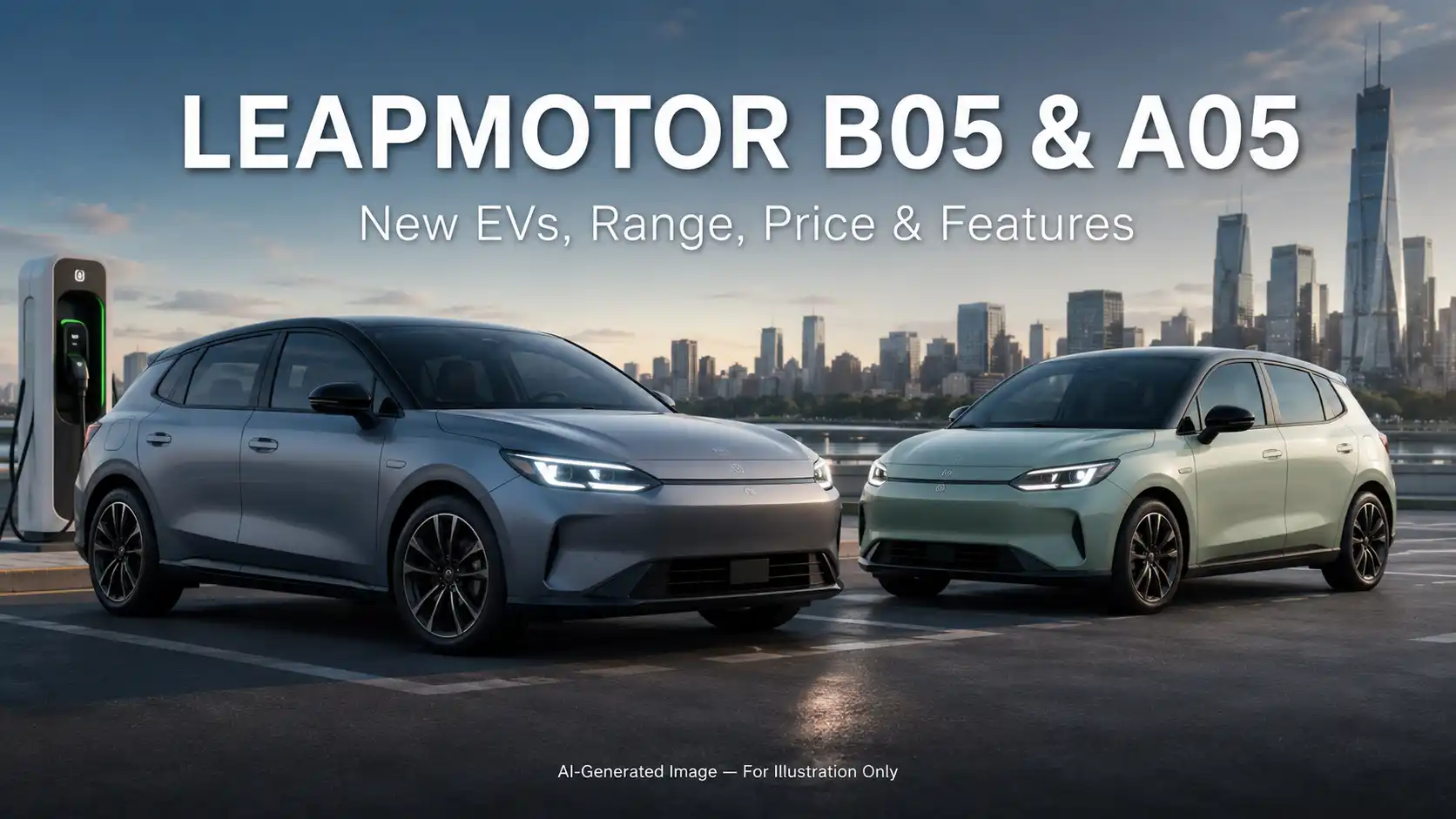
Although their names are similar, the two vehicles are not the same. The B05 is a larger, sportier electric hatchback designed for international markets, while the A05 is a smaller and more affordable compact EV launched in China.
The timing is particularly interesting because the A05 entered the Chinese market in August 2026, while the B05 is expanding into additional international markets. In Australia, for example, the B05 is scheduled to reach dealerships from late August 2026.
Leapmotor Expands Its Affordable EV Lineup
Leapmotor launched the A05 in China on August 11, 2026, with a starting price of RMB 63,900. The model is available with claimed ranges of 405 km and 510 km under the CLTC testing cycle.
The B05, meanwhile, is moving further into international markets. It has already entered European markets, while Australia is scheduled to receive the vehicle from late August 2026. Australian pricing starts at A$35,990 drive-away, with the higher-range version priced at A$39,990.
This gives Leapmotor two different products for two different customer groups: the A05 focuses on very low-cost electric mobility, while the B05 focuses on performance, range and international appeal.
Leapmotor B05: What Is It?
The Leapmotor B05 is a compact electric hatchback positioned in the C-segment.
Its design is more sporty than a traditional affordable city EV. The car uses a low, wide stance and a fastback-style hatchback shape, making it visually closer to European electric hatchbacks than conventional budget cars.
The B05 competes in a segment that includes vehicles such as the MG4 and Volkswagen ID.3.
One of its biggest advantages is its rear-wheel-drive layout. This is relatively unusual among affordable electric hatchbacks, where front-wheel drive is more common.
B05 Battery and Range
The B05 is offered with different battery configurations depending on the market.
In Australia, two versions are planned:
- 56.2 kWh LFP battery — up to 401 km WLTP range
- 67.1 kWh LFP battery — up to 482 km WLTP range
Both versions use a single electric motor driving the rear wheels. The motor produces 160 kW and 240 Nm.
The 67.1 kWh version is the more interesting one for long-distance driving because of its significantly higher range.
It is important to remember that WLTP range is a laboratory-tested figure. Actual range can be lower depending on speed, temperature, road conditions, air-conditioning use and driving style.
B05 Performance
The B05 is not designed only for efficiency.
Its electric motor produces 160 kW, equivalent to around 218 hp, and the car can accelerate from 0 to 100 km/h in approximately 6.7 seconds in the higher-range version.
That makes it considerably quicker than many conventional affordable electric hatchbacks.
The rear-wheel-drive layout also gives the B05 a different driving character. Instead of concentrating entirely on low-speed city driving, Leapmotor has attempted to give the vehicle more balanced handling and stronger acceleration.
This could help the B05 attract younger buyers who want an EV that is both practical and enjoyable to drive.
B05 Fast Charging
Charging speed is another major strength.
The higher-range B05 can accept up to 174 kW of DC fast charging.
Leapmotor quotes a 30% to 80% charging time of roughly 18 minutes for the 67.1 kWh version. The smaller battery version can make the same charge in approximately 16 minutes under the Australian specification.
In practical terms, this means drivers can add a significant amount of usable range during a relatively short charging stop.
For buyers considering an EV for highway travel, fast charging can be almost as important as battery size.
B05 Interior and Technology
The B05 is designed to look and feel more expensive than its price suggests.
The cabin features a large central infotainment display and a digital instrument panel. International versions also offer features such as smartphone connectivity, panoramic glass roof, heated seats and advanced audio equipment.
Leapmotor’s strategy is to provide a high level of equipment as standard rather than making customers pay for numerous expensive options.
This is becoming an important competitive advantage for Chinese EV manufacturers.
B05 Safety and Driver Assistance
The B05 is equipped with a large number of driver-assistance technologies.
Depending on the market specification, the vehicle uses multiple cameras, radar and ultrasonic sensors to provide functions such as:
- Adaptive cruise control
- Lane-keeping assistance
- Blind-spot monitoring
- Automatic emergency braking
- Traffic-sign recognition
- Parking assistance
- Lane-change assistance
The system provides Level 2 driver assistance, rather than fully autonomous driving.
That distinction is important. Level 2 systems can assist with steering, acceleration and braking, but the driver must continue to monitor the road and remain responsible for the vehicle.
Leapmotor A05: The Affordable EV
The A05 takes a very different approach.
It is a smaller compact electric hatchback designed primarily around affordability and everyday urban use.
Leapmotor launched the A05 in China on August 11, 2026, after opening pre-orders in July. The vehicle is available in five versions and starts at RMB 63,900, with the highest version reaching RMB 90,900.
At the starting price, the A05 is positioned aggressively against other affordable Chinese EVs.
Its main competitors include models such as the BYD Dolphin and Geely Xingyuan.
A05 Battery and Range
The A05 is available with two LFP battery options:
| Battery | Claimed Range |
| 39.8 kWh | 405 km CLTC |
| 53 kWh | 510 km CLTC |
The 510 km figure is particularly impressive considering the A05’s relatively affordable price.
However, this is a CLTC range, which is generally more optimistic than WLTP. Therefore, buyers should not expect to achieve 510 km in every real-world situation.
Still, even after accounting for real-world conditions, the A05 has the potential to provide enough range for daily commuting and city use.
A05 Performance
The A05 is not intended to be a performance EV.
Depending on the version, the electric motor produces either 70 kW or 90 kW.
The top speed is around 160 km/h, while acceleration is focused more on smooth urban driving than outright performance.
This is actually an advantage for its target market.
Most buyers of affordable city EVs do not need 0–100 km/h performance. They want low running costs, sufficient range, easy charging and useful technology.
A05 Advanced Technology
One of the most surprising features of the A05 is its available driver-assistance technology.
Higher versions can use a LiDAR sensor, along with cameras, millimetre-wave radar and ultrasonic sensors.
The technology package can support more advanced navigation-assistance functions for city and highway driving.
This is significant because LiDAR-based driver assistance is traditionally associated with more expensive vehicles.
Leapmotor is therefore trying to bring advanced automotive technology into a much cheaper segment.
Again, these systems should not be confused with fully autonomous driving. The A05 remains a driver-controlled vehicle.
A05 Charging
The larger-battery A05 can recharge from approximately 30% to 80% in around 16 minutes, according to reported specifications.
For a low-cost EV, this is an important selling point.
A buyer may accept a smaller battery if the vehicle can quickly recharge during a lunch break or short highway stop.
This combination of low price, useful range and relatively fast charging is one of the strongest aspects of the A05.
B05 vs A05: Summary Comparison
| Feature | Leapmotor B05 | Leapmotor A05 |
| Vehicle type | Compact electric hatchback | Small compact electric hatchback |
| Main market | Europe, Australia and international markets | China initially |
| August 2026 status | Australia arrival from late August | Launched Aug. 11 |
| Battery | 56.2 / 67.1 kWh | 39.8 / 53 kWh |
| Maximum claimed range | 482 km WLTP | 510 km CLTC |
| Motor | 160 kW | 70 / 90 kW |
| Drive | Rear-wheel drive | Front-wheel drive |
| 0–100 km/h | About 6.7 sec | Not performance-focused |
| Fast charging | Up to 174 kW | About 30–80% in 16 min |
| Starting price | A$35,990 in Australia | RMB 63,900 in China |
| Main strength | Performance + range | Price + practicality |
| Target buyer | International EV buyers | Budget-conscious urban buyers |
Which One Is Better?
The answer depends on what the buyer wants.
B05 is better for:
- Long-distance driving
- Higher performance
- More engaging driving
- International markets
- Buyers wanting rear-wheel drive
- Buyers looking for a larger battery
- Buyers who frequently use highways
A05 is better for:
- City driving
- First-time EV buyers
- Budget-conscious customers
- Daily commuting
- Buyers who want a low purchase price
- Customers who still want modern driver-assistance technology
In simple words:
B05 = performance + range + international market
A05 = affordability + practicality + technology
Leapmotor: Company Introduction
Leapmotor is a Chinese electric-vehicle manufacturer founded in 2015.
The company focuses primarily on electric vehicles and has developed its own vehicle platforms, batteries, electric motors and intelligent-driving technologies.
One of the most important developments in the company’s history was its partnership with Stellantis.
In 2023, Stellantis invested €1.5 billion in Leapmotor and acquired a 20% stake. The two companies subsequently created Leapmotor International, giving the Chinese EV manufacturer access to Stellantis’ international distribution and manufacturing network.
This partnership is extremely important for Leapmotor’s global expansion.
Instead of building an international sales and service network entirely by itself, Leapmotor can use Stellantis’ existing infrastructure in several markets.
Why the B05 and A05 Matter
The two cars show how Leapmotor is trying to build a global EV portfolio.
The A05 demonstrates that the company can produce a very inexpensive EV with modern technology.
The B05, on the other hand, shows that Leapmotor wants to compete with established European and international electric hatchbacks.
The company is therefore not relying on just one segment.
It is trying to compete from affordable city cars to larger and more performance-oriented EVs.
Leapmotor’s Global Expansion
The B05 is particularly important for this strategy.
The model has already entered European markets, while Australia is now preparing for its arrival in late August 2026. In Australia, the B05 starts at A$35,990 drive-away and reaches up to 482 km WLTP in the higher-range version.
In Europe, pricing also remains aggressive. Germany, for example, has listed the B05 from €27,900, with the 67.1 kWh version offering up to 482 km WLTP range.
This pricing strategy could put pressure on established EV manufacturers.
The Biggest Advantage: Value for Money
Perhaps the biggest common feature of both cars is Leapmotor’s value-for-money strategy.
The B05 combines:
- Rear-wheel drive
- 160 kW motor
- Up to 482 km WLTP range
- Fast charging
- Advanced driver assistance
- High equipment levels
The A05 takes that philosophy even further by offering a starting price of just RMB 63,900 in China while still offering a claimed range of up to 510 km CLTC.
This is exactly where Chinese EV manufacturers have become highly competitive.
Final Analysis
Leapmotor B05 and A05 are important not because they are the most powerful or technologically advanced EVs on the market, but because they show how quickly advanced EV technology is moving into lower price segments.
The A05 is the more disruptive model from a pricing perspective. Starting at RMB 63,900, it combines a compact body, LFP batteries, up to 510 km CLTC range and available LiDAR-based driver assistance.
The B05 is the stronger global product. Its rear-wheel-drive layout, 160 kW motor, up to 482 km WLTP range and fast charging make it a more complete international EV. Its Australian arrival from late August 2026 is particularly notable because it brings another competitively priced Chinese EV into a market where affordable electric hatchbacks are becoming increasingly popular.
For Leapmotor, the bigger story is the combination of Chinese EV technology and Stellantis’ international network.
If the company can maintain competitive prices while delivering reliable quality, service and after-sales support, the B05 and A05 could help Leapmotor establish itself as a serious global EV brand.
The broader message is clear: the next stage of the EV competition may not simply be about who can build the longest-range or fastest electric car. It may be about who can bring useful technology, good range and strong performance to the lowest practical price. Leapmotor is clearly targeting that opportunity.
Source: stellantis media