The Tesla Cybercab is not just another electric vehicle from Tesla. It is a completely new type of vehicle designed from the ground up for a future where cars can operate without a human driver. Unlike Tesla’s existing vehicles, which are being adapted for autonomous ride-hailing, the Cybercab has been designed specifically as a purpose-built robotaxi.
Tesla first unveiled the Cybercab in October 2024, but the project has moved considerably closer to reality in 2026. Tesla has confirmed that pilot production has begun, while production vehicles have also entered road-testing programs.
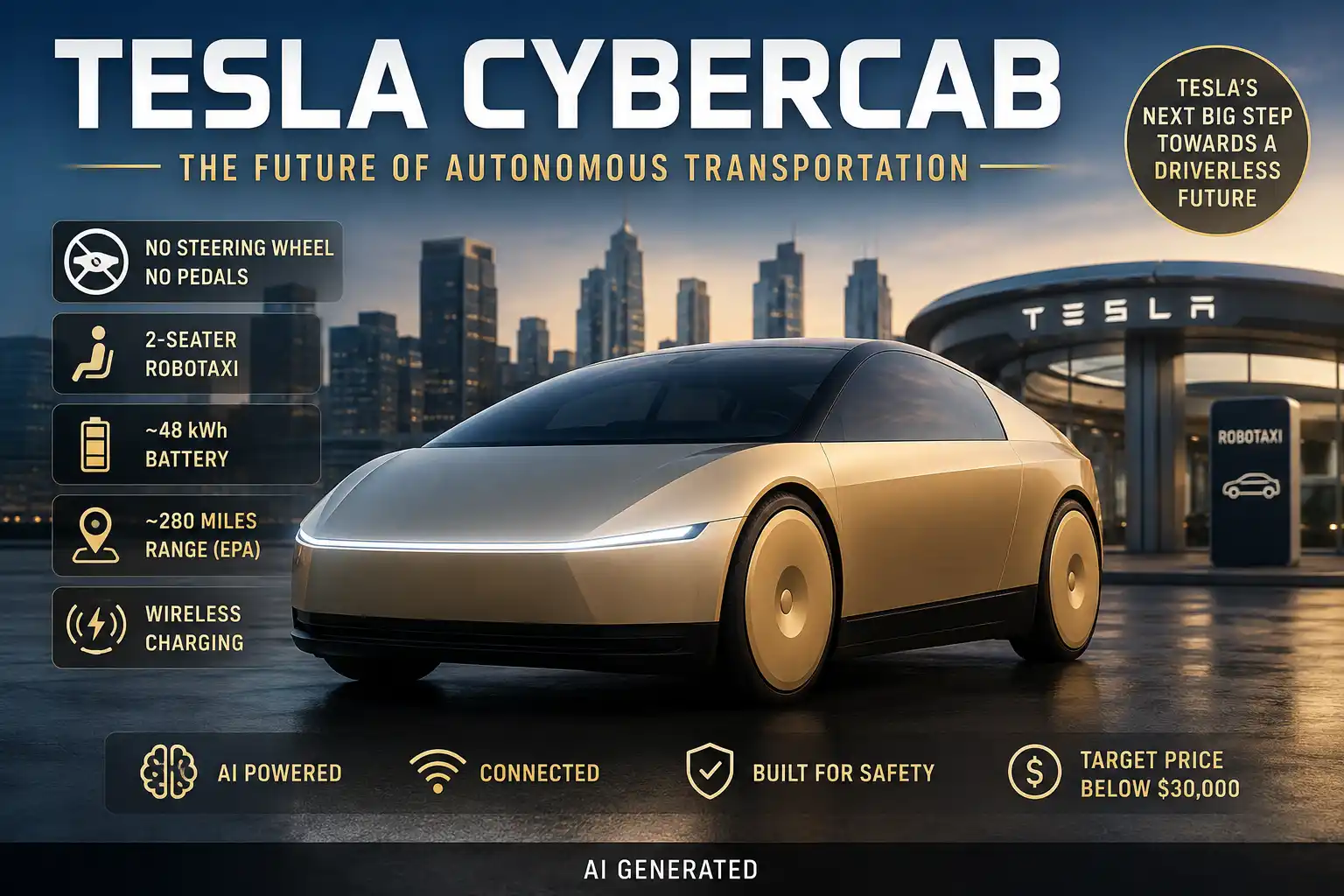
The Cybercab has a strikingly different design: there is no steering wheel, no accelerator pedal and no brake pedal. It is designed around a two-passenger layout and Tesla’s autonomous-driving technology.
What Is the Tesla Cybercab?
The Tesla Cybercab is a fully electric, purpose-built autonomous robotaxi developed by Tesla.
Unlike a conventional Tesla Model 3, Model Y or Cybertruck, the Cybercab was designed specifically for autonomous transportation.
Its basic concept is simple:
Passenger opens an app → Cybercab arrives → passenger gets in → vehicle drives itself → passenger reaches destination.
The vehicle is intended to operate without a human driver.
Tesla has positioned the Cybercab as a key part of its future Robotaxi business. Tesla’s current Robotaxi service mainly uses modified Model Y vehicles, while Cybercab is being developed as a dedicated autonomous vehicle for the fleet.
When Was the Cybercab First Revealed?
Tesla officially unveiled the Cybercab in October 2024. At the unveiling, Tesla showed a futuristic two-seat vehicle without conventional driving controls. At that point, Cybercab was still essentially a prototype and technology demonstration.
By 2026, however, the project had moved into a much more advanced stage.
Tesla confirmed in its 2026 filings that pilot production of the Cybercab had started, marking an important transition from concept vehicle to production development.
Cybercab Has No Steering Wheel or Pedals
One of the most unusual aspects of the Cybercab is its interior.
Unlike almost every conventional car, it does not have:
- Steering wheel
- Accelerator pedal
- Brake pedal
- Traditional driver controls
Instead, the entire vehicle is designed around autonomous operation.
There are only two passenger seats, making the Cybercab considerably smaller and simpler than a conventional five-seat Tesla.
This design is possible because Tesla does not expect a human driver to operate the vehicle.
Cybercab vs Tesla Robotaxi: What Is the Difference?
These two terms can easily cause confusion.
Tesla Robotaxi
Tesla’s current Robotaxi service uses vehicles based primarily on the Model Y platform.
These are existing vehicles equipped with Tesla’s autonomous-driving technology.
Cybercab
The Cybercab is different. It is being designed from the beginning as an autonomous robotaxi.
In simple terms:
Model Y Robotaxi = Existing EV + autonomous technology
Cybercab = Purpose-built autonomous EV
Tesla has indicated that once Cybercab production reaches scale, it could eventually become the company’s highest-volume vehicle in its Robotaxi fleet.
Cybercab Battery and Range
Technical details emerging from certification documents have provided a better picture of the Cybercab.
Reported specifications include:
| Specification | Tesla Cybercab |
| Vehicle type | Autonomous electric robotaxi |
| Seating | 2 passengers |
| Drive | Front-wheel drive |
| Motor output | About 219 hp |
| Battery | About 48 kWh |
| Weight | About 1,412 kg |
| Voltage | About 326V |
| Reported EPA range | Around 280 miles |
| Steering wheel | No |
| Pedals | No |
The approximately 48-kWh battery is relatively small compared with many modern electric SUVs.
However, Cybercab is much smaller and lighter than a typical passenger EV, and Tesla is focusing heavily on efficiency.
The final production specifications may still change as Tesla continues development and certification.
Why Does Cybercab Need a Smaller Battery?
At first glance, a 48-kWh battery may seem surprisingly small for a vehicle expected to operate as a robotaxi.
But the Cybercab has been designed differently from a normal family EV.
It has:
- Only two seats
- A relatively lightweight body
- An aerodynamic design
- A small footprint
- A focus on energy efficiency
For a robotaxi, efficiency is extremely important.
Consider two vehicles:
Vehicle A: 80-kWh battery + high energy consumption
Vehicle B: 48-kWh battery + very low energy consumption
If Vehicle B can travel almost as far while using less energy, it can potentially spend less money on electricity and charging.
That could improve the economics of a robotaxi fleet.
Wireless Charging Could Make Cybercab More Autonomous
Tesla is also developing wireless charging for the Cybercab.
This could be particularly useful for a robotaxi fleet.
Imagine a Cybercab finishing a ride and automatically driving to a charging area.
Instead of a human plugging in a charging cable, the vehicle could position itself over a wireless charging pad.
The process could eventually become:
Passenger drop-off → vehicle drives to charging area → automatic parking → wireless charging → next passenger
This could reduce the amount of human involvement required to operate a large autonomous fleet.
How Will Cybercab Drive Itself?
Tesla plans to use its Full Self-Driving technology and AI systems to operate the Cybercab.
Tesla’s current FSD system is still described as FSD (Supervised), meaning the driver remains responsible for monitoring the vehicle.
Cybercab, however, is being developed with the ultimate goal of unsupervised autonomous operation.
The basic technology chain is:
Cameras and sensors → AI perception → decision making → vehicle control
The AI must continuously understand:
- Road markings
- Traffic lights
- Pedestrians
- Other vehicles
- Cyclists
- Road construction
- Emergency vehicles
- Unexpected obstacles
- Complex intersections
The major challenge is not simply making the car drive itself.
The challenge is making it reliably safe without a human driver.
Why Is Cybercab So Important for Tesla?
Cybercab could change Tesla’s business model. Tesla’s traditional business is based largely on selling vehicles.
The basic model is:
Tesla builds car → customer buys car → Tesla receives revenue
Robotaxi economics can work differently:
Tesla owns/operates vehicle → vehicle carries passengers → vehicle generates revenue repeatedly
One Cybercab could potentially provide thousands of paid rides during its useful life.
That creates the possibility of recurring revenue from the same vehicle.
How Could Tesla Make Money From Cybercab?
Tesla could potentially generate revenue from several parts of the autonomous mobility ecosystem.
1. Robotaxi rides: Passengers would pay for transportation through Tesla’s Robotaxi platform.
2. Fleet operations: Tesla could operate its own autonomous fleet.
3. Autonomous software: Tesla’s autonomous-driving technology could eventually become another source of revenue.
4. Charging: A large fleet would create additional demand for charging infrastructure.
5. Vehicle sales: If Tesla eventually offers Cybercab to private customers, vehicle sales could become another revenue source.
This could create a much broader business around the vehicle.
What Will the Cybercab Cost?
Tesla has previously discussed a target price of less than $30,000 for the Cybercab.
However, this should not currently be treated as a final confirmed retail price.
The eventual price could depend on:
- Manufacturing costs
- Battery prices
- Autonomous hardware
- Production scale
- Regulatory requirements
- Software and computing costs
So the safest description is:
Tesla has targeted a price below $30,000, but final production pricing has not been confirmed.
Will Consumers Be Able to Buy the Cybercab?
This remains an interesting question.
Cybercab is primarily being designed for Tesla’s Robotaxi fleet.
However, there have been reports suggesting that Tesla could eventually consider making Cybercab available to private customers as well.
If Tesla follows this strategy, the Cybercab could have two roles:
Robotaxi fleet vehicle
and
Private autonomous vehicle
But Tesla’s final retail strategy has not been fully confirmed.
Where Is Cybercab Being Produced?
Tesla is producing the Cybercab at Gigafactory Texas. The factory is becoming increasingly important to Tesla’s next-generation products. Tesla confirmed that Cybercab pilot production had begun in 2026.
The company now needs to gradually increase production while improving:
- Manufacturing efficiency
- Battery integration
- Autonomous hardware
- Vehicle reliability
- Production costs
Large-scale production will be crucial if Tesla wants Cybercab to become a mass-market robotaxi.
When Will Tesla Cybercab Launch?
This is where it is important to distinguish between production, testing and commercial deployment.
The development timeline broadly looks like this:
October 2024
Cybercab unveiled
↓
2026
Pilot production begins
↓
2026
Production vehicle road testing
↓
Future
Autonomous fleet deployment
↓
Later
Large-scale Robotaxi operations
Tesla has not yet provided a single definitive date for large-scale, fully driverless Cybercab deployment across multiple cities.
The vehicle reaching production does not automatically mean that it can immediately operate without a safety driver everywhere.
Tesla’s Robotaxi Expansion in 2026
Cybercab is being developed alongside Tesla’s existing Robotaxi program. Tesla currently operates Robotaxi services using Model Y-based vehicles in selected U.S. locations. The company’s broader strategy is to gradually expand autonomous ride-hailing into additional markets.
However, regulatory approval remains a major factor.
For example, Tesla reportedly requested permission to deploy 5,000 Robotaxis in Las Vegas, but regulators initially approved only a much smaller number of vehicles and imposed additional requirements.
This shows that Tesla’s biggest challenge is not simply manufacturing the vehicles. It must also convince regulators that its autonomous technology is safe enough for large-scale deployment.
What Are the Biggest Challenges for Cybercab?
1. Fully Autonomous Driving
This is the biggest challenge.
Tesla’s current FSD technology still requires supervision.
For Cybercab to operate as intended, Tesla must demonstrate that the vehicle can safely operate without human intervention.
2. Government Regulation
Autonomous vehicle regulations differ from country to country and even from state to state.
A system approved in one location may not automatically be approved somewhere else.
Tesla therefore needs regulatory approvals alongside technological development.
3. Safety
A robotaxi must handle unpredictable situations.
For example:
- A pedestrian suddenly crosses the road
- An ambulance approaches
- Traffic lights stop working
- A road is unexpectedly closed
- Construction changes lane markings
- Heavy rain reduces visibility
The AI must make the correct decision in real time.
4. Competition
Tesla is not alone in the robotaxi race.
Major competitors include:
- Waymo
- Zoox
- Pony.ai
- WeRide
- Baidu Apollo Go
- Motional
- Uber’s autonomous partners
The autonomous mobility market is becoming increasingly competitive.
Tesla Cybercab vs Zoox Robotaxi
| Feature | Tesla Cybercab | Zoox Robotaxi |
| Purpose-built | Yes | Yes |
| Steering wheel | No | No |
| Pedals | No | No |
| Passenger capacity | 2 | 4 |
| Electric | Yes | Yes |
| Autonomous target | Fully autonomous | Level 4 |
| Primary business | Tesla Robotaxi | Zoox ride service |
| Manufacturer | Tesla | Zoox |
Both vehicles are designed specifically for autonomous transportation.
However, their approaches are different.
Tesla is combining its existing EV manufacturing, AI and Robotaxi ecosystem, while Zoox has focused heavily on building a dedicated autonomous transportation service.
Tesla Cybercab and Artificial Intelligence
Cybercab is much more than an electric vehicle.
Its future depends heavily on:
EV technology + AI + Computer Vision + Autonomous Driving + Connectivity
Tesla has been investing heavily in AI infrastructure because autonomous driving requires enormous amounts of computing power and training data.
Tesla and SpaceX have also announced the Terafab semiconductor project in Texas, with an initial investment of approximately $16.8 billion. The facility is intended to support AI-related products including Tesla’s autonomous vehicles and Optimus robots.
This illustrates how Tesla’s future strategy increasingly connects:
AI chips → AI software → Autonomous vehicles → Robotaxi network
Starlink Connectivity Could Also Become Part of Cybercab
Tesla has also been working on integrating Starlink connectivity into Cybercab.
For passengers, this could provide high-speed internet connectivity during rides.
For Tesla, reliable connectivity could also support fleet management and communication.
This creates an interesting combination:
Tesla → Vehicle
FSD/AI → Autonomous driving
Starlink → Connectivity
Terafab → AI chips
Together, these technologies could form a broader autonomous mobility ecosystem.
Tesla Cybercab vs Traditional Taxi
The difference becomes clearer when we compare the business models.
Traditional Taxi
Driver + Car + Fuel/Electricity + Passenger
The driver is one of the largest ongoing operating costs.
Cybercab
Cybercab + AI + Electricity + Passenger
There is no conventional driver salary.
If Tesla can operate the vehicle safely and efficiently, the company could potentially reduce one of the biggest operating costs in the traditional taxi business.
That is one of the main reasons the robotaxi model is attracting so much attention.
Why Cybercab Could Be a Big Deal
The most important thing about Cybercab is not its futuristic appearance. It is the potential business model behind it.
A normal EV is usually purchased by an individual customer and spends much of its life parked.
A robotaxi could potentially operate for many hours every day and continuously generate revenue.
For Tesla, that creates a possible shift from:
Selling cars → Operating autonomous mobility
If Tesla can achieve reliable unsupervised driving, obtain regulatory approval and manufacture Cybercab at a low cost, the economics could become very different from traditional car manufacturing.
However, there is a major “if.”
Tesla still has to prove that its autonomous technology can operate safely at scale without human supervision.
The company’s Robotaxi rollout has been slower than some earlier expectations, while regulators in markets such as Las Vegas have imposed limitations on deployment.
Outcome
The Tesla Cybercab represents Tesla’s attempt to move beyond traditional electric vehicles and build a new autonomous transportation business.
Its steering-wheel-free, pedal-free design, two-seat configuration and purpose-built robotaxi architecture make it fundamentally different from Tesla’s existing passenger vehicles.
The project has also moved beyond the concept stage. Pilot production began in 2026, and production vehicles are undergoing road testing, bringing Tesla closer to its vision of a large autonomous taxi network.
But the real test is still ahead.
Tesla must demonstrate that Cybercab can operate safely without human supervision, receive regulatory approval and achieve sufficiently low operating costs to make autonomous ride-hailing commercially attractive.
If Tesla succeeds, Cybercab could become more than a new EV. It could become the foundation of a large-scale autonomous mobility network, potentially creating a new recurring-revenue business for Tesla.
For that reason, Cybercab is one of the most closely watched autonomous vehicles currently moving from prototype toward real-world deployment.
Source: Tesla, Tesla Investor Relations, Reuters, Car and Driver, and official Tesla Robotaxi/FSD information.