Most autonomous-driving companies today are focusing on robotaxis, where self-driving vehicles operate as commercial fleets and transport passengers. But AutoX has taken a different direction.
AutoX was one of the early companies to develop and deploy fully driverless robotaxi technology in China. It also conducted driverless testing in California and achieved important regulatory milestones in the United States.
Today, however, the company has moved beyond its original robotaxi-focused strategy. AutoX’s China operations and AutoX brand have been discontinued, while the company has shifted its focus to Tensor, a personal Level 4 autonomous vehicle.
The goal is ambitious: instead of operating autonomous vehicles as a company-owned taxi fleet, Tensor wants to build a vehicle that individual consumers can own and use as a self-driving car.
What Was AutoX?
AutoX was founded in 2016 in Silicon Valley by Professor Jianxiong Xiao, a researcher known for his work in computer vision and autonomous driving.
The company’s original goal was to develop fully driverless technology capable of operating on complex urban roads.
AutoX eventually worked on several applications, including:
- Autonomous driving
- Robotaxis
- Autonomous delivery
- AI-based perception
- Driverless vehicle technology
The company received backing from investors and strategic partners including Alibaba, SAIC and Dongfeng Motor. Alibaba Entrepreneurs Fund documents show AutoX raised significant venture funding during its growth phase.
AutoX’s Major Autonomous Driving Achievements
Fully Driverless Robotaxi in China
One of AutoX’s most important achievements was the deployment of fully driverless robotaxis in Shenzhen.
According to AutoX, its vehicles operated without a safety driver or remote operator inside the vehicle.
This was significant because operating an autonomous vehicle in a controlled test environment is very different from operating one on busy urban roads with pedestrians, cyclists, traffic signals and unpredictable human drivers.
Driverless Permit in California
AutoX also achieved an important milestone in the United States.
In 2020, the California Department of Motor Vehicles granted AutoX a permit to test driverless vehicles.
AutoX said the permit allowed it to operate vehicles without a safety driver under the approved conditions. This gave the company an opportunity to demonstrate its autonomous-driving technology outside China.
How Did AutoX’s Technology Work?
AutoX developed an autonomous-driving system based on multiple types of sensors and artificial intelligence.
Its technology included:
- Cameras
- LiDAR
- Radar
- Ultrasonic sensors
- High-performance computing
- AI-based perception
- HD maps
- Sensor fusion
The vehicle collects information from its surroundings and processes that data in real time.
The basic process is:
Sensors → Environment data → AI processing → Decision → Vehicle control
In simple terms, the vehicle continuously tries to understand what is around it and then decides what it should do next.
AutoX also developed a 360-degree sensor-fusion system called xFusion.
AutoX Gen5 Robotaxi
AutoX introduced its Gen5 autonomous-driving system for fully driverless robotaxis.
The system was designed for complex urban environments rather than only simple highway driving.
According to earlier reports, the Gen5 system used around 50 sensors along with a high-performance computing system.
The system was designed to handle situations such as:
- Crowded city streets
- Pedestrians
- Cyclists
- Intersections
- Parked vehicles
- Traffic signals
- Unexpected obstacles
The objective was to allow the vehicle to make driving decisions without continuous human control.
Why Did AutoX Move From Robotaxis to Tensor?
This is the most important part of AutoX’s current story.
In a traditional robotaxi business, a company owns or operates a fleet of autonomous vehicles. The company maintains the cars, manages charging and offers rides to customers.
Tensor is pursuing a different model.
Its goal is:
Personal Autonomous Vehicle
Instead of only using autonomous vehicles as taxis, the company wants individual consumers to purchase and own them.
According to Tensor, the company discontinued/divested its AutoX brand and China operations and shifted its focus toward personal autonomous vehicles.
This changes the business model from:
Company-owned Robotaxi → Consumer-owned Autonomous Car
What Is the Tensor Robocar?
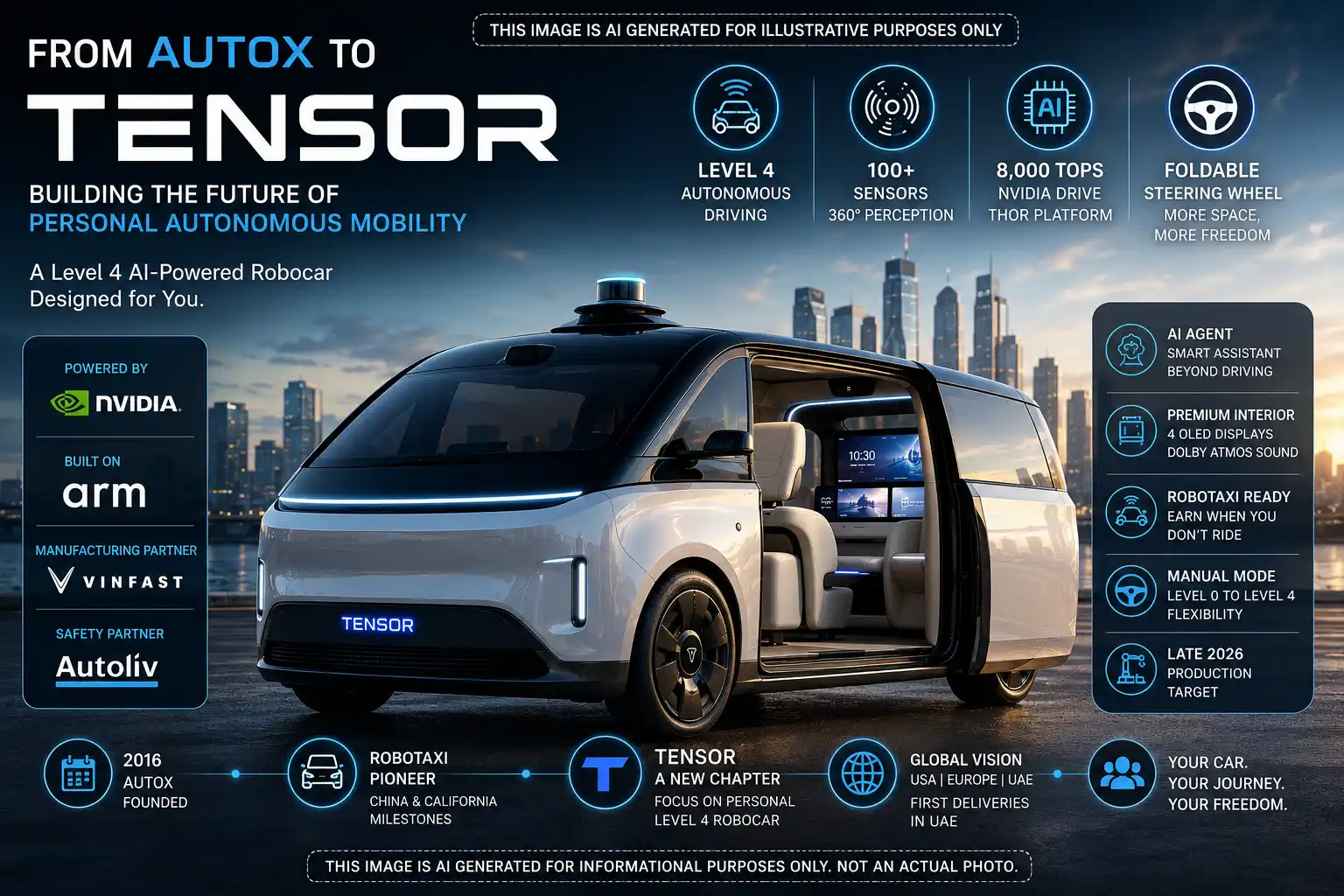
The Tensor Robocar is being developed as a Level 4 autonomous vehicle designed for private ownership.
Level 4 means that under approved operating conditions and areas, the vehicle can perform the complete driving task without requiring continuous human supervision.
According to Tensor, the vehicle is designed to:
- Drive autonomously
- Park itself
- Pick up passengers at the curb
- Operate without human supervision in approved conditions
- Return to manual driving when required
However, Level 4 does not mean that the vehicle can drive anywhere in the world under every weather and road condition without a human.
Its autonomous operation depends on the approved operating conditions and regulatory framework.
The Biggest Difference: Private Ownership
Most Level 4 autonomous vehicles currently being developed are connected to robotaxi fleets.
Tensor is taking a different approach.
The company wants consumers to be able to:
Buy the vehicle → sit inside → let the vehicle drive
This could potentially change how people think about car ownership.
Instead of autonomous driving being available only through a ride-hailing service, it could become a feature of a privately owned vehicle.
More Than 100 Sensors
The Tensor Robocar has been designed around a large sensor architecture.
According to Tensor, the vehicle has more than 100 sensors, including:
- 37 cameras
- 5 LiDAR sensors
- 11 radars
- 22 microphones
- 10 ultrasonic sensors
- 3 IMUs
- GNSS
- Collision detectors
- Other vehicle-monitoring sensors
These sensors are designed to give the vehicle a 360-degree view of its surroundings.
The reason for using so many sensors is simple: an autonomous vehicle needs multiple ways to detect and understand its environment.
Why Does the Robocar Have a Foldable Steering Wheel?
One of the most unusual features of the Tensor Robocar is its foldable steering wheel.
When autonomous mode is active, the steering wheel can fold away.
This creates more usable space inside the cabin when the passenger does not need to control the vehicle.
Tensor developed the system with Autoliv, a major automotive safety supplier.
The vehicle is still designed to support manual driving when required.
Level 0 to Level 4 Autonomy
Tensor’s vehicle is designed around different levels of driving assistance.
These include:
- Level 0: Manual driving
- Level 2: Assisted driving
- Level 3: Conditional automated driving
- Level 4: Highly automated driving in approved conditions
The important point is that Level 4 does not require the driver to continuously monitor the road when the vehicle is operating within its approved autonomous domain.
NVIDIA AI Computing
An autonomous vehicle with dozens of sensors needs enormous computing power.
Tensor has partnered with NVIDIA for its AI computing architecture.
According to Tensor, the Robocar uses eight NVIDIA DRIVE Thor chips, providing approximately 8,000 TOPS of AI computing capability.
In simple terms, the vehicle needs to process huge amounts of sensor information in real time.
It has to answer questions such as:
- What is in front of the car?
- Is that object moving?
- Is a pedestrian about to cross?
- Is another vehicle changing lanes?
- Should the car slow down?
- Should it stop?
- Which route is safest?
All of this requires powerful onboard computing.
Tensor’s Partnership With Arm
Tensor also announced a multi-year strategic collaboration with Arm in February 2026.
According to Tensor, its vehicle architecture includes more than 400 Arm-based safety-capable cores.
The objective is to create a powerful and safety-focused computing architecture for autonomous vehicles.
VinFast Manufacturing Partnership
Developing an autonomous vehicle prototype is only one part of the challenge.
Mass-producing the vehicle reliably is much harder.
Tensor has partnered with VinFast for vehicle manufacturing.
According to Tensor, the Robocar is being designed for production using VinFast’s automotive manufacturing capabilities.
This could help Tensor move from prototype development toward commercial production without having to build an entirely new manufacturing system from scratch.
The Robocar Is Designed as a Large Vehicle
Tensor describes the Robocar as a large, spacious vehicle.
According to the company’s specifications:
- Wheelbase: 124.0 inches
- Length: 217.5 inches
- Width: 79.9 inches, excluding mirrors
The larger cabin is intended to make the vehicle more comfortable when passengers are no longer required to focus on driving.
The Vehicle Is Designed as a Personal Space
With Level 4 autonomy, the passenger may be able to use travel time for activities other than driving.
Tensor is therefore positioning the Robocar as more than just a transportation device.
The vehicle includes features such as:
- Large OLED displays
- Video calling
- Entertainment
- Premium audio
- AI assistant
- Autonomous driving
Tensor says the cabin includes four 15.7-inch Samsung OLED displays and a 20-speaker Dolby Atmos audio system.
AI Agent: Beyond Self-Driving
Tensor’s vision goes beyond autonomous driving.
The company is also positioning the vehicle as an AI agent.
That means the vehicle could eventually do more than simply drive from one location to another.
It could potentially understand user preferences and assist with:
- Navigation
- Entertainment
- Communication
- Vehicle controls
- Other everyday tasks
Tensor describes this broader concept as an AI-defined vehicle and an agentic AI vehicle.
Could the Robocar Also Become a Robotaxi?
One of Tensor’s most interesting ideas is that the privately owned vehicle could potentially operate as a robotaxi.
According to Tensor, an owner could allow the vehicle to operate in RoboTaxi mode when it is not being personally used.
In theory:
Owner uses car → Car is parked → Car works as an autonomous taxi → Owner potentially earns revenue
This could create a completely different model of vehicle ownership.
Instead of a car being only an expense, an autonomous vehicle could potentially become a transportation asset.
However, this concept will depend heavily on regulations, ride-hailing partnerships and commercial approvals.
When Will Tensor Start Production?
This is one of the most important questions.
Tensor has targeted the second half of 2026 for volume production of the Robocar.
The company has also discussed late-2026 production and initial deliveries.
Therefore, as of August 2026, it would be inaccurate to describe the Robocar as an already established mass-market autonomous vehicle.
A more accurate description is:
“Tensor is preparing its Level 4 personal Robocar for late-2026 production and initial deliveries.”
Which Markets Will Tensor Target?
Tensor has identified several international markets for its Robocar, including:
- United States
- Europe
- Middle East
The company has also indicated that the UAE is expected to be among the initial markets for deliveries, followed by further international expansion.
The Transformation From AutoX to Tensor
The company’s journey can be understood in three major stages.
Phase 1 — Autonomous Driving Technology
After its founding in 2016, AutoX focused on developing AI and autonomous-driving technology.
Phase 2 — Robotaxis
AutoX tested and deployed autonomous robotaxi technology in China and achieved important driverless testing milestones in California.
Phase 3 — Personal Robocar
The company then shifted its focus toward Tensor and a consumer-owned Level 4 autonomous vehicle.
The business model therefore changed from:
Robotaxi Fleet → Personal Autonomous Vehicle
Why Is This Strategy Important?
The autonomous vehicle market is becoming increasingly competitive.
Companies such as Waymo, Zoox, Baidu, Pony.ai, WeRide and Tesla are developing or expanding autonomous mobility services.
Tensor is attempting to take a different path.
Instead of competing only in the robotaxi fleet market, it is trying to make autonomous driving a consumer-owned product.
If successful, this could move autonomous transportation from:
“Ride in a self-driving car”
to:
“Own your own self-driving car.”
That would represent a significant shift in the automotive industry.
Major Challenges
Despite the technology, Tensor faces several major challenges.
1. Safety
A Level 4 vehicle must make safe decisions in unpredictable real-world situations.
2. Regulation
Autonomous-driving laws differ significantly between countries and even between regions.
3. Mass Production
Building a prototype is very different from producing thousands of reliable vehicles.
4. Cost
More than 100 sensors and powerful AI computing hardware can increase vehicle costs.
5. Consumer Trust
Consumers may take time to become comfortable with allowing an AI system to control their vehicle.
6. Real-World Edge Cases
Autonomous systems must handle construction zones, emergency vehicles, unusual road behavior, unexpected pedestrians and many other situations.
Tensor’s Key Strengths
The company’s major strengths include:
- Long experience in autonomous driving
- Early fully driverless robotaxi experience
- California driverless testing history
- Strong AI and software background
- 100+ sensor architecture
- NVIDIA computing partnership
- Arm computing partnership
- VinFast manufacturing partnership
- Level 4 personal vehicle strategy
- Focus on consumer ownership
Final Analysis
The most interesting part of the AutoX story is not its earlier robotaxi operations. It is the company’s transformation toward a personal autonomous vehicle business.
AutoX initially worked to prove autonomous-driving technology through robotaxis. Tensor is now trying to take that experience and turn it into a vehicle that individual consumers can own.
The Tensor Robocar combines a large sensor suite, powerful AI computing, a foldable steering wheel, Level 4 autonomous capability and a consumer-ownership model.
However, it would still be too early to call it a commercially proven mass-market autonomous car. The real test will come with production, regulatory approvals, safety validation and real-world customer deliveries.
If Tensor successfully achieves its production and deployment goals, the company could become an interesting player in the next stage of autonomous mobility.
The bigger idea is simple:
The future of autonomous driving may not only be robotaxis. It could also be your own personal self-driving car.
Company Snapshot
| Information | Details |
| Original Company | AutoX |
| Current Brand | Tensor |
| Founded | 2016 |
| Headquarters | San Jose, California |
| Founder | Professor Jianxiong Xiao |
| Industry | AI / Autonomous Vehicles / Physical AI |
| Main Product | Tensor Robocar |
| Autonomy | Level 4 |
| Vehicle Type | Personal Autonomous Vehicle |
| Manufacturing Partner | VinFast |
| Key Computing Partners | NVIDIA, Arm |
| Production Target | Second Half / Late 2026 |
| Initial Target Market | UAE, followed by other global markets |
| Former Business | Driverless Robotaxi |
| Current Focus | Consumer-owned Autonomous Robocar |
Source: Tensor and AutoX official materials, NVIDIA, Arm and Alibaba Entrepreneurs Fund.