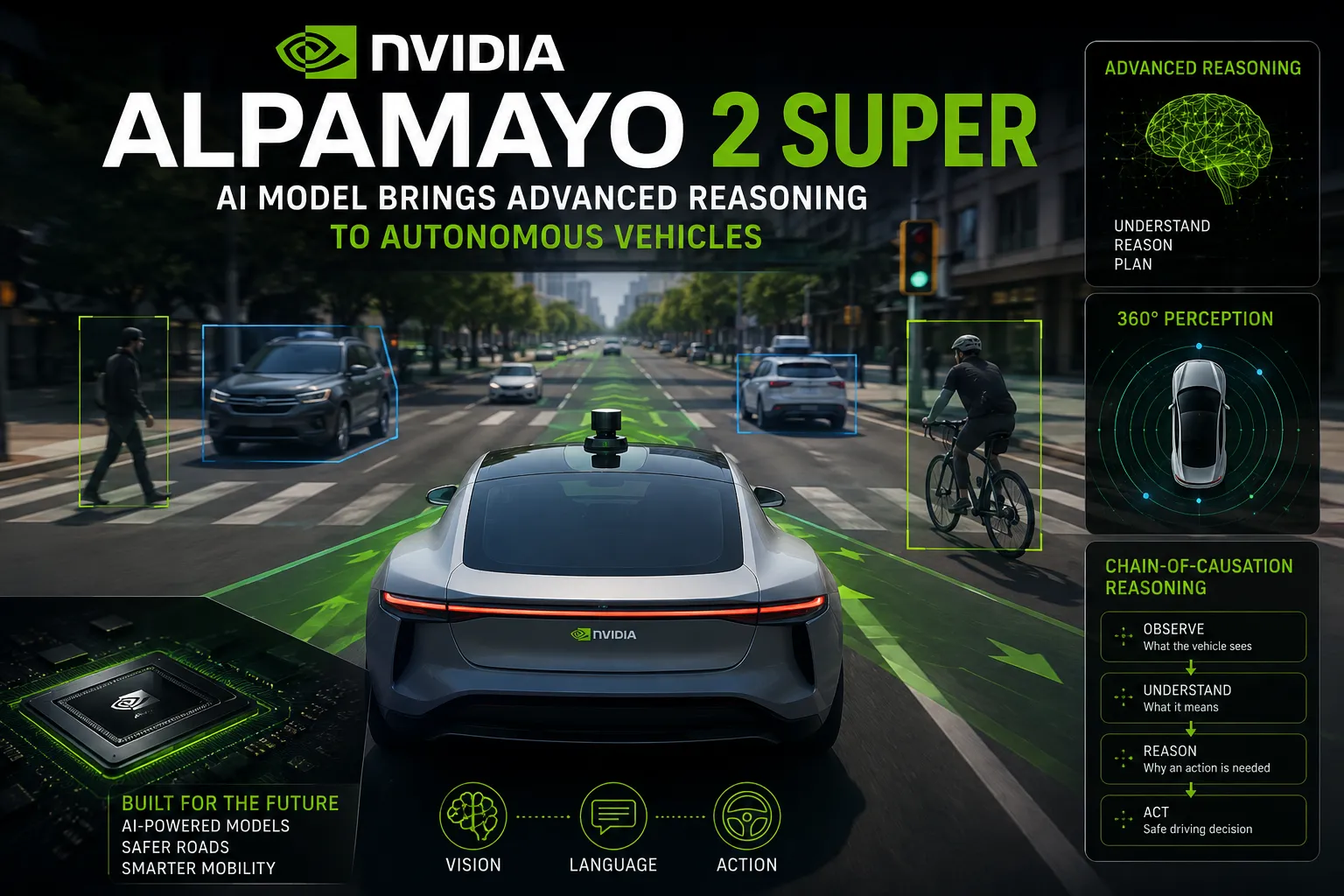
NVIDIA has taken another major step in autonomous-driving technology with Alpamayo 2 Super, an advanced AI model designed to help robotaxis and autonomous vehicles understand complex road situations, reason about what is happening, and plan an appropriate driving response.
The technology became particularly important in August 2026, when NVIDIA made Alpamayo 2 Super available for commercial use under the OpenMDW-1.1 license. This means automakers, autonomous-driving companies and suppliers can fine-tune the model, create derivative models and commercially deploy their own versions without building the entire AI foundation from scratch.
Importantly, Alpamayo 2 Super is not a new autonomous car itself. It is an AI foundation model that can become part of the software stack used to develop autonomous vehicles and robotaxis.
What Is NVIDIA Alpamayo 2 Super?
Alpamayo 2 Super is a reasoning-based Vision-Language-Action (VLA) model developed by NVIDIA for autonomous driving.
In simple terms, it is designed to perform three important jobs:
See → Understand → Decide
For example, an autonomous vehicle may see:
- A pedestrian standing near the road
- A vehicle suddenly changing lanes
- Road construction
- A blocked lane
- An unusual intersection
- Another vehicle failing to yield
Instead of simply recognizing these objects, Alpamayo 2 Super attempts to understand the situation, reason about what could happen next and generate an appropriate driving trajectory.
NVIDIA describes it as a model designed for Level 4 autonomous-driving development, particularly robotaxis.
NVIDIA: Company Introduction
NVIDIA is a U.S.-based technology company best known for its GPUs and accelerated computing platforms.
The company originally became famous for graphics processors, particularly in gaming and professional computing. However, NVIDIA has expanded heavily into AI computing, data centers, robotics, autonomous vehicles and physical AI.
In autonomous driving, NVIDIA provides much more than an AI model. Its broader ecosystem includes:
- NVIDIA DRIVE platforms
- DRIVE AGX computing
- DRIVE Hyperion
- AI training infrastructure
- Simulation systems
- Omniverse-based technologies
- Autonomous-driving software
- Alpamayo AI models
This makes Alpamayo part of NVIDIA’s larger strategy of providing the computing + software + simulation + AI ecosystem required to develop autonomous vehicles.
Why Alpamayo 2 Super Matters
One of the biggest problems in autonomous driving is not normal driving.
Driving straight on an empty road is relatively easy for modern AI systems.
The much harder problem is the “long tail” — rare situations that happen infrequently but can be extremely important for safety.
Examples include:
- A pedestrian suddenly appearing from behind a parked vehicle
- An unusual construction zone
- A car unexpectedly crossing into your lane
- A complicated four-way intersection
- An emergency vehicle approaching
- A vehicle making an illegal maneuver
- A road partially blocked by an unexpected object
These situations are difficult because there may not be enough real-world examples to train a conventional AI model.
Alpamayo 2 Super is designed specifically to improve reasoning in these difficult scenarios.
34 Billion Parameters
One of the most notable features of Alpamayo 2 Super is its scale.
NVIDIA’s technical documentation describes the model as a 34-billion-parameter VLA model.
It combines:
- A 32-billion-parameter NVIDIA Cosmos 3 Super Reasoner
- A 2-billion-parameter Action Expert
- Reinforcement-learning post-training
The Reasoner interprets video, language/context and vehicle-motion information, while the Action Expert converts the resulting representation into a future vehicle trajectory.
This is roughly three times the scale of NVIDIA’s earlier 10-billion-parameter Alpamayo models.
The larger model is intended to improve the ability to generalize from limited examples, especially in complicated driving situations.
How Does Alpamayo 2 Super Work?
The basic process can be simplified into four steps.
1. The vehicle observes its surroundings
The system can process information from multiple cameras around the vehicle. Alpamayo 2 Super supports 360-degree perception using up to seven cameras, allowing it to understand what is happening in front, behind and alongside the vehicle.
2. AI understands the situation
The model doesn’t just identify objects. It attempts to understand relationships between them.
For example:
“A pedestrian is near the road, but a parked vehicle is blocking part of the pedestrian’s movement.”
This type of contextual understanding is important for autonomous driving.
3. It reasons about the situation
The system generates a Chain-of-Causation (CoC) reasoning trace.
This essentially connects:
What the vehicle sees → What it means → Why an action is appropriate
This can make it easier for engineers to inspect why a particular driving decision was generated.
4. It generates a driving trajectory
Finally, the model generates a planned trajectory — essentially the path the autonomous vehicle should follow.
It can also produce higher-level meta-actions, such as:
- Yield
- Stop
- Change lanes
- Continue
- Other driving intentions
What Makes Its Reasoning Different?
Traditional autonomous-driving systems often divide the problem into several separate components.
For example:
Object detection → Prediction → Planning → Control
Different models may be responsible for different parts.
Alpamayo 2 Super is designed as a multitask foundation model that can support several parts of the development process using a common AI foundation.
It can generate:
- Driving trajectories
- Chain-of-Causation reasoning
- Meta-actions
- Reasoning auto-labels
- Visual question-answering responses
- 2D visual grounding
This allows developers to use the same foundation model for multiple autonomous-driving tasks.
What Is Chain-of-Causation Reasoning?
This is one of the most interesting parts of Alpamayo.
Imagine an autonomous car approaches an intersection.
A conventional system may simply produce:
“Brake.”
Alpamayo can additionally generate reasoning information connecting the observed situation to the decision.
For developers, this can help answer questions such as:
- What did the AI see?
- Which object influenced the decision?
- Why did it decide to stop?
- Did it misunderstand the road?
- Was the problem with perception or planning?
NVIDIA says these reasoning traces can also support safety-validation workflows.
This doesn’t mean the AI’s reasoning automatically proves that the vehicle is safe. Rather, it gives engineers additional information to inspect, test and validate the system.
AI Can Also Create Training Data
Another important feature is reasoning auto-labeling
Autonomous vehicles generate huge quantities of video and sensor data. Traditionally, humans and automated systems have to label that data before it can be used for training.
This can take a lot of time.
Alpamayo 2 Super can help generate reasoning labels and connect answers to specific areas of camera images using 2D grounding.
NVIDIA says this can potentially compress some annotation workflows from months to days.
That could significantly reduce the cost and time involved in developing autonomous-driving AI.
Alpamayo 2 Super Is Not Designed to Run Directly as a Giant Model in Every Car
This is an important point.
A 34-billion-parameter model is extremely large compared with what would normally be ideal for real-time vehicle computing.
NVIDIA therefore positions Alpamayo 2 Super partly as a teacher model.
The idea is:
Large AI model in development/cloud → Train or distill smaller model → Deploy optimized model inside vehicle
The smaller specialized model can then run on vehicle computing platforms such as NVIDIA DRIVE AGX Thor.
This creates what NVIDIA describes as a cloud-to-car workflow.
Commercial Availability in August 2026
This is the most important August 2026 news angle.
NVIDIA announced on August 4, 2026, that Alpamayo 2 Super was available for commercial use.
The model is available under OpenMDW-1.1, a permissive open-model license.
Under the licensing terms described by NVIDIA, developers can:
- Fine-tune the model
- Build derivative models
- Redistribute commercially
- Adapt it to their own vehicle data
- Develop specialized autonomous-driving systems
This is a major difference from a closed AI API where developers have limited control over the underlying model.
How Good Is Alpamayo 2 Super?
NVIDIA reports very strong benchmark performance.
On the LingoQA autonomous-driving reasoning benchmark, NVIDIA says Alpamayo 2 Super ranked first among nearly 40 evaluated models.
According to NVIDIA’s testing using its Lingo-Judge metric, it scored:
- 17.0 points higher than Qwen2.5-VL 72B
- 15.1 points higher than Gemini 2.5 Pro
- 23.2 points higher than GPT-4o
NVIDIA’s technical evaluation also reports a LingoQA score of 79.2, along with results across trajectory prediction, meta-actions, visual question answering and closed-loop simulation.
However, these should be understood as NVIDIA-reported benchmark results, not proof that an autonomous vehicle using Alpamayo is automatically safer than every competing system on public roads.
Simulation Is a Major Part of the Technology
Testing autonomous vehicles only on public roads is expensive and potentially dangerous.
NVIDIA therefore combines Alpamayo with simulation technologies.
NVIDIA AlpaSim
AlpaSim provides a closed-loop simulation environment where autonomous-driving systems can be tested repeatedly in virtual environments.
NVIDIA AlpaGym
AlpaGym provides reinforcement learning for autonomous-driving models.
Instead of simply replaying historical driving data, the system can train models based on the consequences of their decisions inside simulation.
NVIDIA Cosmos-Dreams
Cosmos-Dreams is a generative world model designed to create photorealistic driving environments and difficult scenarios for autonomous-vehicle testing.
Together, the concept is:
Real-world data → Simulation → AI training → Testing → Model improvement → Vehicle deployment
Why Simulation Is So Important
Suppose engineers want to test what happens when:
A pedestrian suddenly enters the road during heavy rain while another vehicle is approaching from the opposite direction.
Finding thousands of such events in real-world driving data can be extremely difficult.
Simulation can generate variations of these situations much faster.
The AI can then be tested repeatedly without putting a real passenger or vehicle at risk.
This is particularly important for Level 4 autonomous vehicles, where the system is expected to perform the driving task within defined operational conditions.
What Does This Mean for Robotaxis?
Robotaxis are one of the biggest potential applications for Alpamayo 2 Super.
A robotaxi needs to handle thousands of unusual interactions with:
- Pedestrians
- Cyclists
- Cars
- Motorcycles
- Buses
- Emergency vehicles
- Road construction
- Traffic signals
- Unusual road layouts
A reasoning-based AI foundation model could help robotaxi developers build these capabilities faster.
NVIDIA is therefore not trying to become another robotaxi operator like Waymo. Instead, its strategy is largely to provide the technology platform on which automakers, robotaxi companies and suppliers can build their own autonomous systems.
NVIDIA’s Alpamayo ecosystem already involves mobility companies including JLR, Lucid and Uber, according to NVIDIA’s January 2026 announcement.
What Is the Business Opportunity for NVIDIA?
This is arguably more important than the model itself.
NVIDIA can potentially earn from several layers of the autonomous-driving ecosystem:
AI models → Training infrastructure → Simulation → Vehicle computers → Software → Complete AV platform
If more automakers and robotaxi companies use NVIDIA’s technology, NVIDIA can become a critical infrastructure provider for autonomous mobility.
This is similar to NVIDIA’s broader AI strategy: instead of building every end-user application itself, it supplies the computing and software infrastructure that other companies use to build their products.
Why Open Commercial Licensing Is Important
The August 2026 commercial release could make Alpamayo more attractive to automakers and autonomous-driving startups.
A company could potentially take the model, combine it with:
- Its own driving data
- Its own sensors
- Its own vehicle hardware
- Its own safety systems
- Its own driving policies
and create a customized autonomous-driving system.
That gives companies considerably more control over their proprietary data and AI development process.
What Are the Limitations?
Despite the impressive technology, Alpamayo 2 Super does not mean fully autonomous cars are suddenly solved.
There are still major challenges.
Safety
Autonomous vehicles must perform reliably in extremely rare situations. Benchmark performance alone cannot guarantee road safety.
Real-world validation
A model that performs well in simulation still needs extensive real-world testing.
Hardware requirements
Advanced AI requires significant computing power, especially for real-time vehicle operation.
Regulation
Level 4 autonomous vehicles need regulatory approval and safety validation before large-scale commercial deployment.
Edge cases
There will always be unusual situations that were not present in the training data.
Model size
The 34-billion-parameter model is primarily valuable as a powerful development/teacher model. Production vehicles generally need optimized models that can operate efficiently on in-vehicle hardware.
Alpamayo 2 Super vs Traditional Autonomous Driving
| Feature | Traditional AV approach | Alpamayo 2 Super approach |
| Object understanding | AI models | Foundation VLA model |
| Planning | Separate planning systems | Joint trajectory generation |
| Reasoning | Often limited/implicit | Chain-of-Causation traces |
| Camera coverage | Depends on system | Up to 360° / seven cameras |
| Training data | Human + automated labeling | AI-assisted reasoning auto-labeling |
| Simulation | Separate tools | Integrated ecosystem |
| Fine-tuning | Company-specific | Open model can be adapted |
| Commercial use | Depends on license | OpenMDW-1.1 commercial use |
| Main target | Various AV systems | Level 4 / robotaxi development |
NVIDIA’s Bigger Autonomous Vehicle Strategy
Alpamayo 2 Super should not be viewed as a standalone product.
It is part of a much larger NVIDIA autonomous-driving ecosystem.
The strategy looks roughly like this:
Physical-world data
↓
AI training
↓
Alpamayo reasoning models
↓
Simulation & reinforcement learning
↓
Safety validation
↓
Model distillation
↓
NVIDIA DRIVE computing
↓
Autonomous vehicle / Robotaxi
This is why the development is strategically important.
NVIDIA is attempting to provide much of the technology stack required to move autonomous vehicles from research projects toward scalable commercial deployment.
Why Alpamayo 2 Super Could Be Important
The most important innovation here isn’t simply that NVIDIA built a larger AI model.
The bigger change is the attempt to make autonomous-driving AI more reasoning-based, explainable, reusable and commercially accessible.
Previous autonomous-driving development often required companies to build many specialized components independently. Alpamayo 2 Super offers a large foundation model that can potentially be used for planning, reasoning, data labeling, evaluation and model distillation.
The August 4, 2026 commercial release makes the story even more significant because the technology is moving beyond research and toward commercial development.
However, it would be inaccurate to say that NVIDIA has launched a self-driving car. NVIDIA has launched an AI foundation model and supporting ecosystem that other companies can use to develop autonomous vehicles and robotaxis.
If the technology performs as NVIDIA’s benchmarks suggest and automakers successfully turn the large model into efficient production systems, Alpamayo could strengthen NVIDIA’s position as one of the key technology suppliers behind the next generation of autonomous vehicles.
Source: nvidia