Uber Technologies is making a major shift in its strategy as autonomous vehicles move from testing to commercial ride-hailing.
In August 2026, Uber’s autonomous-vehicle strategy has become one of the company’s most important growth initiatives. Instead of trying to develop a complete self-driving vehicle on its own, Uber is building a large ecosystem of autonomous-vehicle manufacturers and self-driving technology companies and plans to make their vehicles available through the Uber platform.
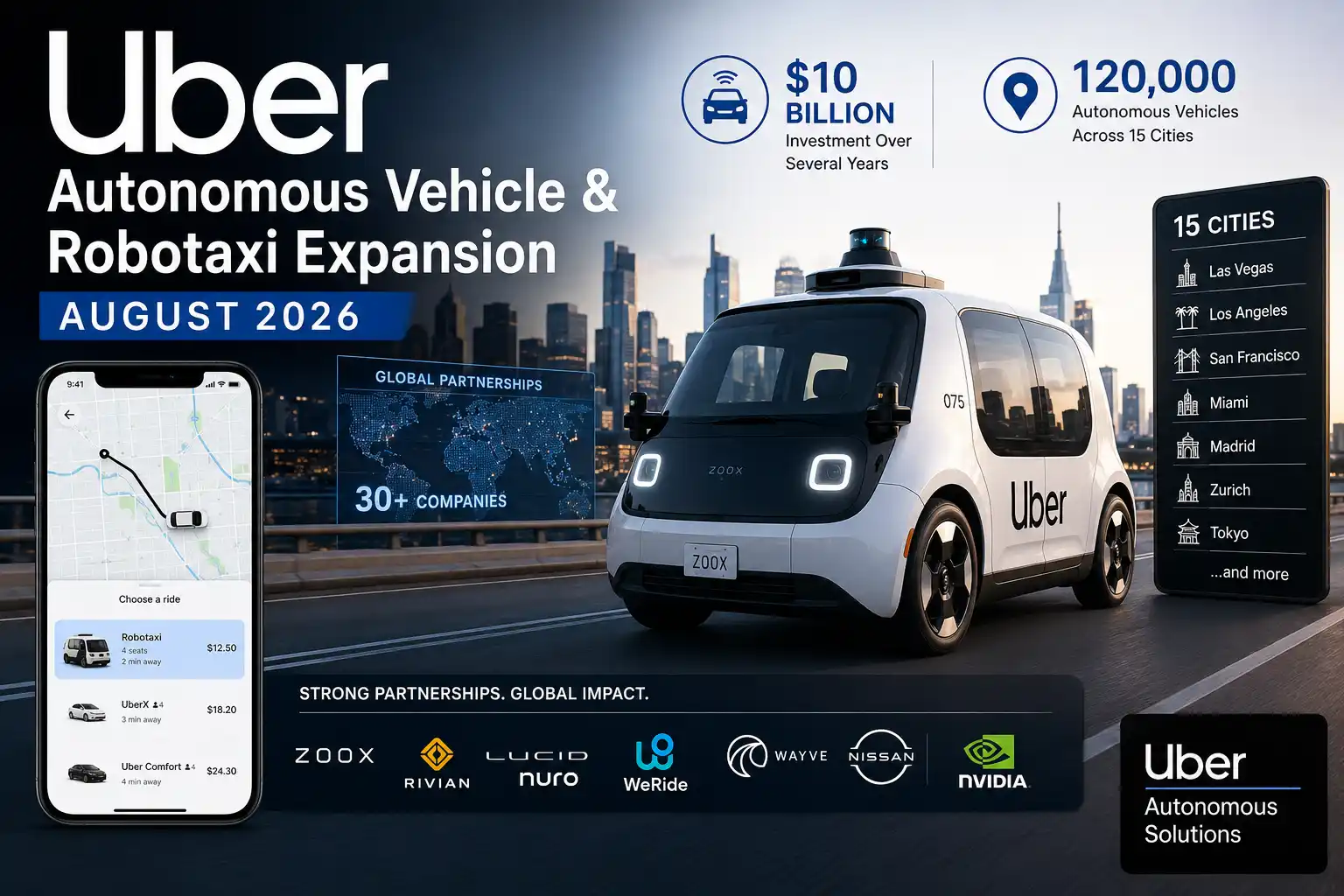
The scale of the ambition is significant. Recent reporting says Uber plans to commit more than $10 billion over several years toward autonomous vehicles, with a target of supporting up to 120,000 autonomous vehicles across 15 cities. The company is effectively trying to become the platform that connects robotaxis with passengers, rather than necessarily owning all the vehicles or developing all the autonomous-driving technology itself.
This is important because autonomous vehicles could eventually change the economics of the ride-hailing industry. If a human driver is no longer required for every trip, the cost structure of a ride could change dramatically.
Company Introduction: Uber Technologies
Uber Technologies is a US-based technology and mobility company best known for its ride-hailing platform.
The company operates a global marketplace connecting riders with drivers and also has businesses in areas such as food delivery and freight.
Uber’s long-term autonomous-vehicle strategy is different from its earlier approach. Rather than attempting to build the entire autonomous-driving stack internally, Uber is increasingly working with automakers, autonomous-driving software companies and fleet operators.
In February 2026, Uber introduced Uber Autonomous Solutions, a set of services designed to help autonomous-vehicle partners commercialize their technology. These services can include access to Uber’s demand marketplace, rider experience, customer support and fleet-operation capabilities.
In simple terms:
The AV company builds the autonomous technology and vehicle; Uber provides the marketplace and operational infrastructure that can put those vehicles in front of millions of riders.
What Is Uber Announcing in August 2026?
The major development is not simply the launch of one new robotaxi.
Instead, Uber is scaling an entire autonomous-vehicle ecosystem.
Recent reporting indicates that Uber has partnered with more than 30 autonomous-vehicle companies over roughly the past two years. These partnerships cover different parts of the ecosystem, including vehicle manufacturers, autonomous-driving technology providers and fleet operators. The company is also targeting a much larger deployment of autonomous vehicles over the coming years.
The strategy can be summarized as:
More partners → more autonomous vehicles → more cities → more rides through Uber.
Uber’s $10 Billion Autonomous Vehicle Strategy
The biggest part of the August 2026 story is the scale of Uber’s financial commitment.
Uber is reportedly planning to commit more than $10 billion toward its autonomous-vehicle strategy over several years. The spending is connected to investments in AV partners, fleet operations, vehicle purchases and other infrastructure required to put large numbers of autonomous vehicles onto the road. This is a major change from simply experimenting with self-driving cars.Uber is now treating autonomous mobility as a potential core business opportunity.
Why is Uber willing to spend so much?
Because Uber sees both an opportunity and a threat. If autonomous vehicles become widely available, traditional ride-hailing could eventually require fewer human drivers.
Uber therefore has two choices:
- Fight against the autonomous-vehicle transition.
- Become one of the biggest platforms for autonomous rides.
Uber is choosing the second option.
Target of 120,000 Autonomous Vehicles
One of the most ambitious parts of the strategy is Uber’s reported plan to support deployment of up to 120,000 autonomous vehicles across 15 cities.
This would represent a major increase from today’s relatively small commercial robotaxi fleets. The important point is that these vehicles will not necessarily come from one manufacturer.
Uber’s model is multi-partner.That means vehicles from different companies could eventually appear inside the same Uber ecosystem.
For example:
| Partner | Vehicle / Technology | Uber Strategy |
| Zoox | Purpose-built robotaxi | Uber app integration |
| Rivian | R2 autonomous vehicle | Large-scale future robotaxi fleet |
| Lucid + Nuro | Lucid Gravity + Nuro autonomous technology | Robotaxi deployment |
| WeRide | Robotaxi technology | Global city expansion |
| Wayve + Nissan | Nissan LEAF + Wayve AI | Tokyo pilot |
| NVIDIA + OEM partners | L4 autonomous-driving platform | Global scaling |
Uber and Zoox: Robotaxis Already Moving Toward the Uber App
One of Uber’s most interesting partnerships is with Zoox.
In March 2026, Uber and Zoox announced that Zoox’s purpose-built robotaxis would be deployed on the Uber network in Las Vegas during summer 2026, with Los Angeles planned for 2027.
This is different from a conventional autonomous vehicle because Zoox designed its vehicle specifically for autonomous transportation rather than simply converting an ordinary car.
For Uber users, the important part is simple:
A rider can potentially request a robotaxi through the same Uber app used to request a conventional ride.
That gives Uber an important advantage: users don’t necessarily need to download a separate application for every autonomous-vehicle company.
Uber and Rivian: Up to 50,000 Robotaxis
Another major partnership is with Rivian Automotive. In March 2026, Uber and Rivian announced plans that could eventually lead to up to 50,000 fully autonomous R2 robotaxis.
Uber plans to invest up to $1.25 billion in Rivian through 2031, subject to autonomous-driving milestones. The initial plan calls for 10,000 vehicles, with an option for up to another 40,000. Initial commercial deployment is planned for San Francisco and Miami in 2028, with expansion to as many as 25 cities through 2031. This partnership is particularly important because it shows that Uber isn’t only interested in small pilot programs.
It is preparing for large-scale fleet deployment.
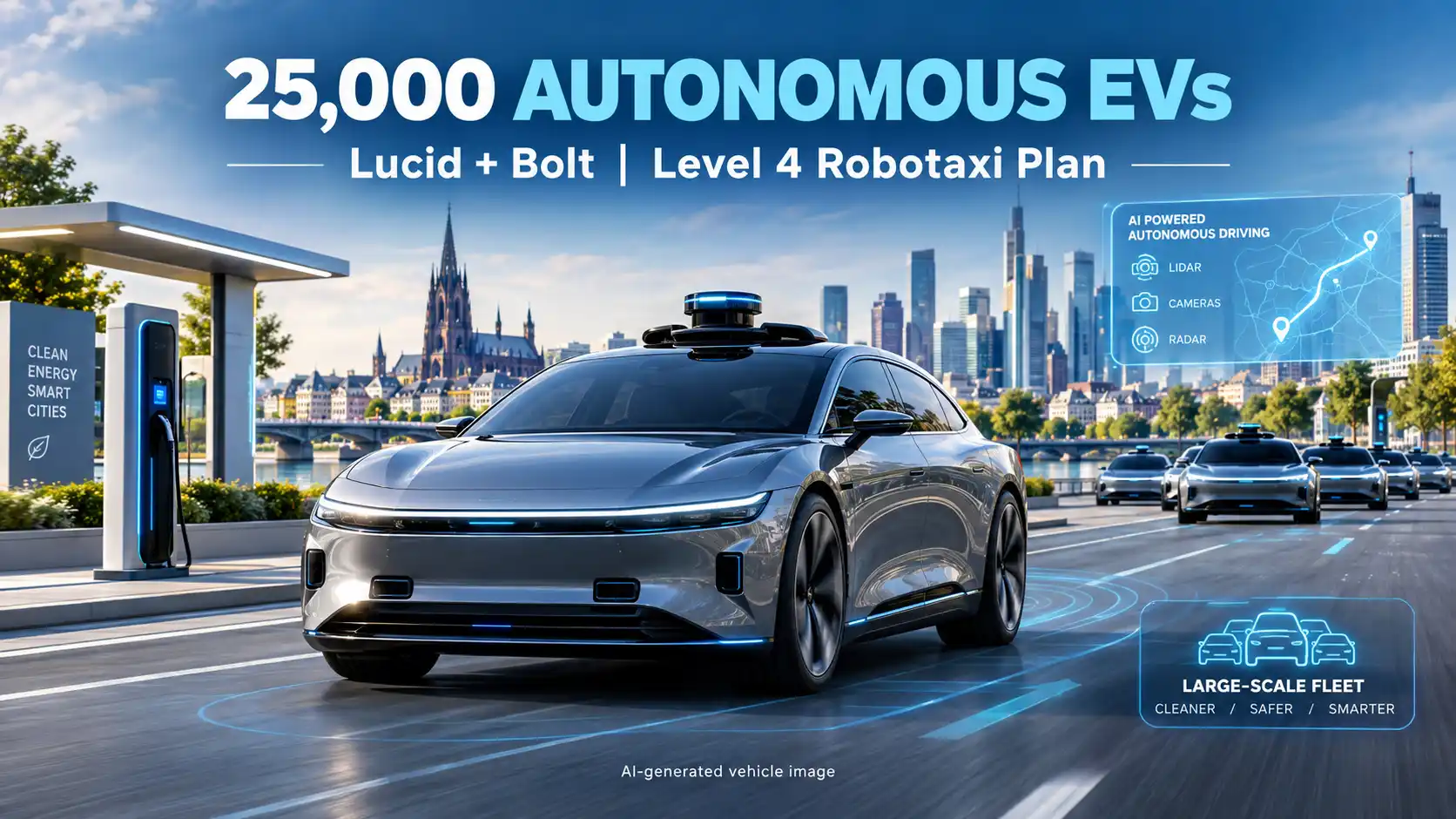
Uber + Lucid + Nuro: Premium Robotaxi
Uber is also working with Lucid Group and Nuro on a premium autonomous vehicle.
The planned robotaxi combines:
- Lucid Gravity — vehicle platform
- Nuro — autonomous-driving technology
- Uber — ride-hailing and commercial platform
The companies began autonomous road testing ahead of an expected launch in 2026. Uber says the vehicle will use its new AV-focused in-car experience, including a dedicated interface for passengers.
This partnership is significant because it demonstrates Uber’s platform-first strategy.
Uber doesn’t need to manufacture the car itself. Instead, it can combine:
Vehicle + autonomous software + Uber marketplace.
Uber and WeRide: Global Robotaxi Expansion
Another major partner is WeRide. Uber and WeRide are pursuing robotaxi deployments across multiple international markets.
In Europe, the companies announced planned robotaxi services in Madrid and Zurich. Madrid is expected to become their first joint European market, while Zurich is also planned for commercial operations subject to regulatory approval.
The partnership is particularly important because Uber wants autonomous mobility to become a global business rather than a US-only service.
WeRide and Uber have previously outlined a broader 15-city agreement, with plans to deploy tens of thousands of robotaxis globally.
Uber’s Middle East Robotaxi Expansion
Uber is also expanding autonomous mobility in the Middle East.
In partnership with WeRide, the companies announced plans to deploy at least 1,200 robotaxis across Abu Dhabi, Dubai and Riyadh.
The vehicles are expected to become available through the Uber app, subject to regulatory approvals and operational milestones.
The Middle East is particularly attractive for autonomous mobility because several cities are actively supporting autonomous transportation and smart-city technology.
Uber + Wayve + Nissan: Japan Entry
Uber’s autonomous strategy is also moving into Japan.
In March 2026, Uber, Wayve and Nissan Motor announced plans for a robotaxi pilot in Tokyo in late 2026, subject to discussions with authorities.
The planned vehicle is a Nissan LEAF powered by Wayve’s AI Driver, with rides expected to be accessible through Uber. This is important because Japan is one of the world’s largest automotive markets and has highly complex urban driving environments.
Uber and NVIDIA: 28-City Autonomous Vehicle Plan
Uber’s partnership with NVIDIA could become one of its most important long-term technology relationships.
In March 2026, the companies announced plans to deploy NVIDIA software-driven L4 autonomous vehicles on Uber’s network.
The first deployments are planned for Los Angeles and San Francisco in the first half of 2027, followed by expansion to 28 cities globally by 2028.
The system uses NVIDIA’s DRIVE Hyperion autonomous vehicle platform and Alpamayo AI technology.
The rollout is expected to happen gradually:
Data collection → operator-led deployment → fully driverless Level 4 operation
This staged approach is important because autonomous driving has to deal with thousands of unusual real-world situations that are difficult to reproduce in testing.
What Does Level 4 Autonomous Driving Mean?
Level 4 is particularly important in Uber’s strategy. At Level 4, the vehicle can perform the entire driving task within a defined operating area or set of conditions without requiring a human driver to take control.
This is different from many current driver-assistance systems.
For example:
Level 2:
The driver still has to monitor the road and remain responsible.
Level 3:
The system can drive under certain conditions, but the driver may need to take over.
Level 4:
The vehicle can operate without a human driver within its approved operating conditions.
Level 5:
The vehicle would theoretically be able to drive autonomously everywhere under all conditions.
Uber’s commercial robotaxi strategy is primarily focused on Level 4, rather than waiting for fully generalized Level 5 autonomy.
Uber’s Autonomous Vehicle Business Model
This may actually be more important than the robotaxi itself.
Uber wants to become the marketplace for autonomous transportation.
Think about the traditional Uber model:
Passenger → Uber app → Driver → Car
The future model could become:
Passenger → Uber app → Autonomous vehicle → Fleet operator
The vehicle and autonomous technology could come from completely different companies.
Uber can potentially earn money by facilitating these rides without having to develop every autonomous-driving technology itself.
Why Uber Is Partnering With So Many Companies
There is a simple reason.
Autonomous driving is extremely difficult.
One company may be good at:
- AI
- Sensors
- Autonomous-driving software
- Vehicle manufacturing
- Fleet management
- Mapping
- Safety systems
Another company may be better at something else.
Uber therefore appears to be building a multi-player ecosystem rather than betting everything on one technology provider.
Its February 2026 launch of Uber Autonomous Solutions reinforces this strategy. Uber said the platform is intended to provide partners with capabilities such as marketplace access, rider experience and operational support.
Why This Strategy Matters for Uber
The autonomous-vehicle revolution could create a serious long-term challenge for Uber.
Today, drivers provide the actual transportation service.
If robotaxis become dominant, the company that controls the autonomous fleet or the consumer relationship could capture a larger share of the economics.
Uber therefore needs to make sure that it remains important even when the driver disappears from the vehicle.
Its strategy is essentially:
If autonomous cars replace drivers, Uber wants the passenger to continue using Uber.
That is the central idea behind the company’s AV expansion.
Financial Strength Gives Uber Room to Invest
Uber’s existing business is generating significant cash, which gives the company more flexibility to invest in autonomous mobility.
In Q1 2026, Uber reported:
- $53.7 billion Gross Bookings
- $13.2 billion Revenue
- $2.3 billion Free Cash Flow
- 3.6 billion trips
- 199 million monthly active platform consumers
Trips increased 20% year over year in the quarter.
This is important because Uber does not have to build its autonomous business from a weak financial position.
Its existing ride-hailing and delivery businesses can help fund the transition.
What Could Change for Passengers?
If Uber’s autonomous strategy succeeds, users could eventually see both human-driven and autonomous rides inside the same application.
For example:
UberX → Human driver
Robotaxi → Autonomous vehicle
The customer could potentially select between different ride types based on:
- Price
- Waiting time
- Vehicle type
- Availability
- Location
Uber itself says autonomous vehicles are already gradually appearing on its app in selected US markets, while availability varies by geography and time.
What Could Change for Drivers?
This is one of the biggest questions surrounding the expansion.
Uber has said that drivers remain an important part of its platform as autonomous vehicles expand. Its current model is therefore not an immediate replacement of all human drivers.
Instead, the transition is likely to happen gradually.
Human drivers could continue serving:
- Areas where robotaxis are unavailable
- Complex routes
- Rural locations
- Higher-demand periods
- Trips outside autonomous operating zones
At the same time, autonomous vehicles could increasingly handle predictable urban routes.
This means the transition could be mixed rather than sudden.
Major Challenges for Uber’s Robotaxi Strategy
Despite the huge opportunity, there are several risks.
1. Regulation
Every city and country has different rules for driverless vehicles.
A technically ready robotaxi cannot simply begin commercial operations without regulatory approval.
Uber’s plans in places such as Munich, Madrid, Zurich and Tokyo are therefore subject to regulatory requirements.
2. Safety
Autonomous vehicles must handle unusual situations such as:
- Pedestrians suddenly crossing
- Construction zones
- Emergency vehicles
- Poor weather
- Road closures
- Unusual driver behavior
This is one reason Uber and NVIDIA are using staged deployment rather than immediately launching fully driverless fleets everywhere.
3. High Initial Cost
Robotaxis require expensive sensors, computing hardware, software and fleet infrastructure.
The economics only become attractive when vehicles can operate at high utilization.
4. Competition
Uber is not alone.
Major competitors include:
- Waymo
- Tesla
- Zoox
- WeRide
- Baidu
- Cruise-related technology
- Other autonomous-driving companies
The robotaxi market is becoming increasingly competitive.
5. Public Trust
Passengers must feel comfortable entering a vehicle without a human driver.
Technology may be ready before consumers are psychologically ready to use it at scale.
Uber vs. Traditional Robotaxi Companies
The interesting difference is that Uber does not necessarily need to become the world’s best autonomous-driving technology company.
Its competitive advantage could instead be its huge passenger network.
| Area | Uber | Dedicated AV Company |
| Ride marketplace | Very strong | Usually limited |
| Global customer base | Very large | Smaller |
| Autonomous technology | Partner-based | Core capability |
| Vehicle manufacturing | Partners | Varies |
| Fleet operations | Strong experience | Varies |
| Customer app | Established | Usually own app |
| Global expansion | Major advantage | Depends on partner |
This is why Uber’s platform strategy could become important even if several different companies ultimately provide the autonomous vehicles.
What Makes August 2026 Important?
August 2026 is significant because Uber’s AV strategy is moving beyond individual partnership announcements and toward large-scale commercialization.
The company is increasingly talking about:
- Tens of thousands of vehicles
- Multiple autonomous-vehicle partners
- Multiple countries
- 15-city near-term expansion
- 28-city longer-term NVIDIA deployment
- Large financial commitments
- Integration of robotaxis into the Uber marketplace
The company had already said earlier in 2026 that it wanted autonomous vehicles operating in more than 15 cities by year-end, and the August developments show how aggressively it is pursuing that objective.
Is Uber Building a Robotaxi Company or an AV Platform?
The second description is more accurate.Uber is not simply trying to manufacture a robotaxi.
It is trying to become the global distribution and operating platform for autonomous mobility. That distinction is extremely important.
Imagine that five different companies eventually manufacture autonomous vehicles. Uber could potentially put all five into its ecosystem.
That would make Uber less dependent on any single AV manufacturer and could allow the company to scale faster across different cities. This is essentially the same platform logic that helped Uber build its conventional ride-hailing business.
The Bigger Picture
The autonomous-vehicle industry is moving from a technology race toward a commercialization race.
Earlier, the key question was:
“Can a car drive itself?”
Now the question is increasingly:
“Can autonomous vehicles operate safely and profitably at large scale?”
Uber’s answer is to provide the marketplace, customers, fleet operations and commercial infrastructure needed to turn autonomous technology into an actual transportation business.
Its partnerships with Zoox, Rivian, Lucid, Nuro, WeRide, Wayve, Nissan and NVIDIA show how broad this strategy has become.
Outcome
Uber’s August 2026 autonomous-vehicle expansion is much bigger than the launch of a single robotaxi.
The company is building a multi-company autonomous mobility ecosystem, backed by a planned investment of more than $10 billion and an ambition to support a very large autonomous fleet.
The most important strategic idea is simple:
Uber does not need to own every robotaxi to benefit from robotaxis. It wants to own the marketplace through which people request them.
If autonomous vehicles become a major part of urban transportation, Uber’s existing customer base, app, payment system, fleet-management capabilities and global reach could give it a significant position in the emerging robotaxi economy.
However, regulation, safety, vehicle costs, consumer acceptance and competition from companies such as Waymo and Tesla will determine whether Uber can turn this ambitious strategy into a highly profitable business.
For now, August 2026 marks an important transition: Uber is moving from experimenting with autonomous vehicles to preparing for autonomous mobility at scale.
Source: Uber Investor Relations and media reports.