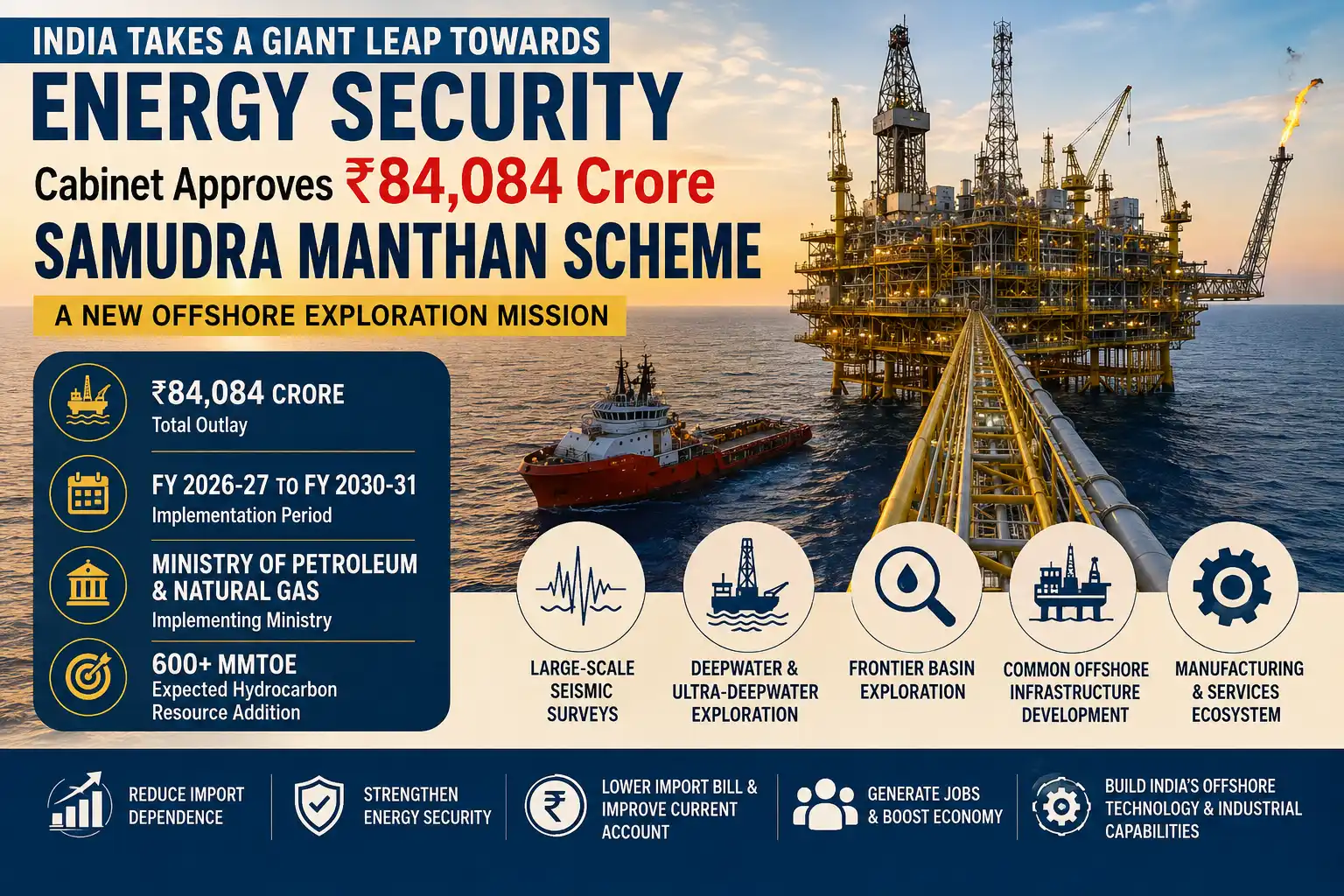
India has taken a major step toward strengthening its energy security. On July 31, 2026, the Union Cabinet approved the ₹84,084 crore “Samudra Manthan – National Offshore Exploration Scheme”, one of the country’s largest investments in offshore oil and natural gas exploration. The scheme aims to accelerate the exploration of India’s offshore sedimentary basins, reduce dependence on imported crude oil, and enhance long-term energy security.
The initiative will be implemented from FY 2026-27 to FY 2030-31 under the Ministry of Petroleum and Natural Gas. According to the government, the programme is expected to unlock more than 600 Million Metric Tonnes of Oil Equivalent (MMTOE) of additional hydrocarbon resources.
Samudra Manthan Scheme Highlights
- Cabinet Approval: July 31, 2026
- Total Outlay: ₹84,084 crore
- Implementation Period: FY 2026-27 to FY 2030-31
- Implementing Ministry: Ministry of Petroleum and Natural Gas
- Primary Objective: Accelerate offshore oil and natural gas exploration across India’s maritime regions
- Expected Resource Addition: More than 600 MMTOE of hydrocarbons
What is the Samudra Manthan Scheme?
The Samudra Manthan Scheme is India’s new national offshore exploration programme designed to identify and develop untapped oil and natural gas reserves beneath the country’s coastal waters.
India currently imports the majority of its crude oil requirements, making the economy vulnerable to global oil price fluctuations and geopolitical disruptions. By increasing domestic offshore production, the government aims to improve energy self-reliance while reducing long-term import dependence.
The programme also seeks to build a stronger offshore exploration ecosystem by encouraging technological advancement, infrastructure development, and private sector participation.
Why Was This Scheme Needed?
India’s energy demand continues to grow rapidly as industrial activity, transportation, and electricity consumption increase.
At present:
- India imports a significant portion of its crude oil requirements.
- Global geopolitical conflicts often create volatility in energy prices.
- Rising oil imports increase pressure on foreign exchange reserves.
- Large offshore sedimentary basins remain underexplored despite their resource potential.
Recognizing these challenges, the government has launched one of the country’s most ambitious offshore exploration programmes to unlock domestic hydrocarbon resources.
Key Components of the Scheme
1. Large-Scale Seismic Surveys
The first phase of the programme focuses on conducting extensive seismic surveys across offshore regions.
High-resolution geological data will help identify promising locations for oil and natural gas deposits before drilling begins, reducing exploration risk and improving success rates.
2. Deepwater and Ultra-Deepwater Exploration
A significant portion of the investment will support exploration in deepwater and ultra-deepwater regions.
These areas have remained relatively unexplored because of high costs and technological complexity. The new scheme aims to accelerate exploration using advanced drilling technologies.
3. Frontier Basin Development
Several offshore sedimentary basins in India have received limited exploration over the years.
The scheme will fund scientific exploration and exploratory drilling to assess the hydrocarbon potential of these frontier basins and discover new commercial reserves.
4. Development of Common Offshore Infrastructure
Discovering hydrocarbons is only one part of the value chain.
The programme also includes investment in common offshore infrastructure such as production platforms, transportation facilities, evacuation systems, and supporting logistics to ensure efficient extraction and delivery of oil and gas.
5. Offshore Manufacturing and Services Ecosystem
The government also plans to develop an integrated industrial ecosystem supporting offshore energy projects.
This includes:
- Offshore equipment manufacturing
- Engineering and technical services
- Repair and maintenance facilities
- Advanced offshore technologies
- Supply-chain development for the energy sector
The initiative aligns with the government’s Make in India and Atmanirbhar Bharat objectives.
Expected Benefits of the Scheme
According to the government, the Samudra Manthan programme could deliver several long-term benefits:
- Addition of more than 600 MMTOE of hydrocarbon resources
- Higher domestic oil and natural gas production
- Reduced dependence on imported crude oil
- Improved national energy security
- Increased private sector investment in offshore exploration
- Expansion of India’s offshore technology capabilities
- Significant direct and indirect employment opportunities
Economic Impact on India
Lower Oil Import Bill
If commercially viable reserves are discovered, India could gradually reduce its dependence on imported crude oil, resulting in substantial foreign exchange savings over the long term.
Improvement in the Current Account Balance
Lower energy imports could help reduce the country’s current account deficit and provide greater stability to the Indian rupee.
Boost to Manufacturing
The programme is expected to increase demand for offshore platforms, drilling equipment, pipelines, subsea systems, engineering services, and heavy industrial machinery, creating new opportunities for Indian manufacturers.
Employment Generation
The initiative has the potential to create jobs across multiple industries, including offshore engineering, logistics, marine services, construction, equipment manufacturing, and technical consulting.
Industries Likely to Benefit
Several sectors could experience long-term growth from the implementation of the scheme:
- Oil & Gas Exploration
- Offshore Engineering
- EPC (Engineering, Procurement and Construction)
- Shipbuilding
- Steel Manufacturing
- Heavy Equipment Manufacturing
- Marine Logistics
- Subsea Technology
- Industrial Automation
- Geophysical Survey and Mapping Services
Key Challenges
Despite its enormous potential, the programme faces several challenges:
- Deepwater exploration requires substantial capital investment.
- Offshore projects typically have long development timelines.
- Environmental approvals and marine ecosystem protection will remain critical.
- Profitability depends on future global oil and gas prices.
- Advanced drilling technologies and highly skilled manpower will be essential.
Why the Scheme Matters Strategically
The Samudra Manthan Scheme is more than an oil exploration programme—it is a long-term strategic initiative aimed at strengthening India’s energy independence.
If the exploration programme successfully identifies commercially recoverable reserves, it could:
- Reduce India’s dependence on imported energy.
- Strengthen national energy security.
- Improve resilience against global energy market disruptions.
- Enhance India’s offshore technological capabilities.
- Support the country’s long-term industrial and economic growth.
Outcome
The Union Cabinet’s approval of the ₹84,084 crore Samudra Manthan Scheme marks a significant milestone in India’s energy strategy. By accelerating offshore oil and natural gas exploration, the government aims to unlock untapped domestic resources, strengthen energy security, and reduce reliance on imports.
Beyond hydrocarbon exploration, the initiative is expected to stimulate investment, create employment, promote advanced offshore technologies, and strengthen India’s industrial ecosystem. While the programme faces challenges related to technology, costs, environmental compliance, and execution, its successful implementation could reshape India’s offshore energy sector and play a crucial role in achieving long-term energy self-reliance.
Source: PIB press