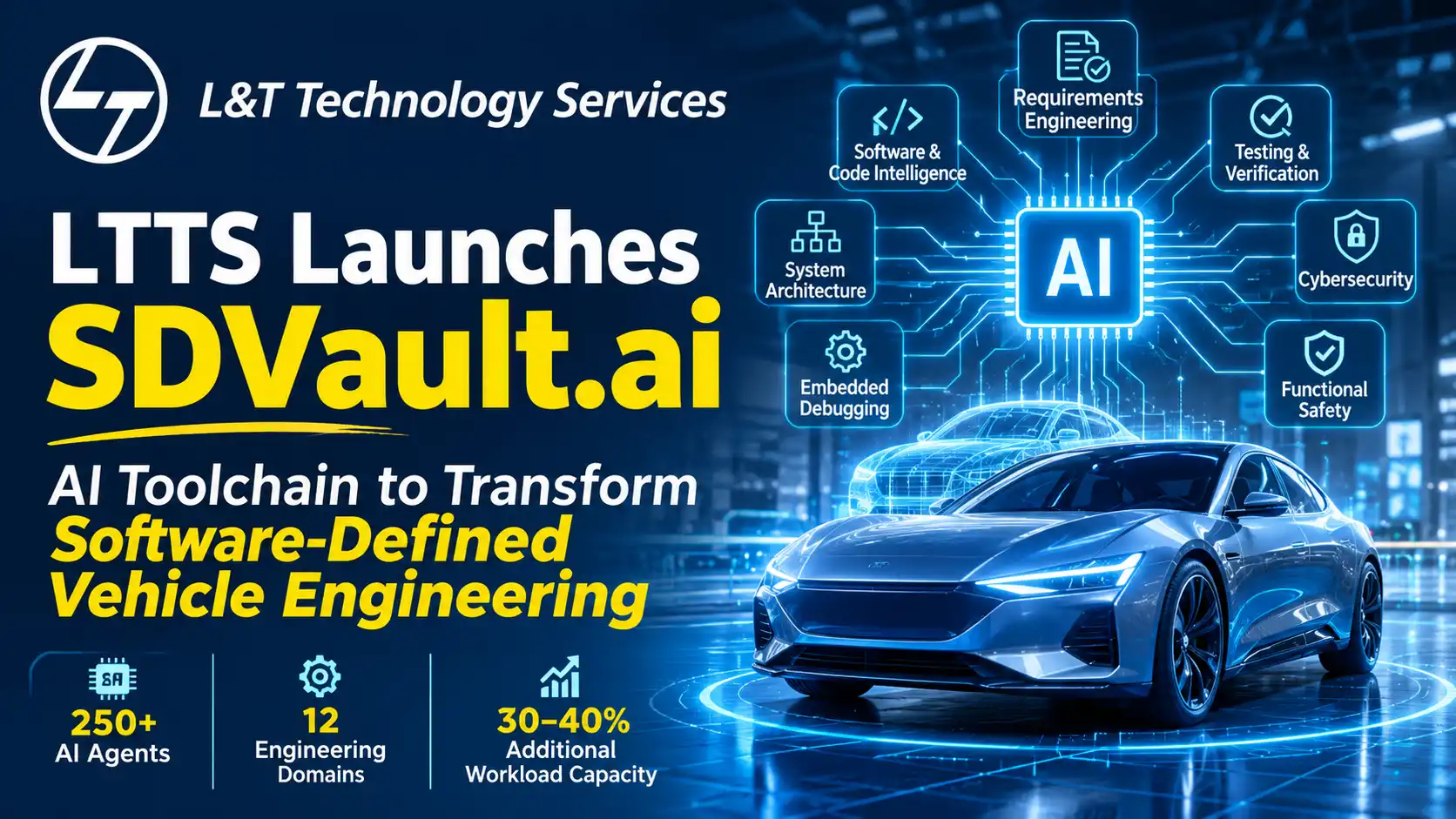
India-based L&T Technology Services (LTTS) has launched an artificial intelligence-powered engineering platform called SDVault.ai, designed to help automotive companies develop, integrate, test and validate next-generation software-defined vehicles (SDVs). The platform brings together more than 250 domain-aware AI agents across 12 engineering domains, aiming to reduce engineering workload, improve testing efficiency and manage the growing complexity of modern vehicles.
The launch reflects a broader shift in the global automotive industry. Automakers are increasingly building vehicles that rely on software for features, performance, connectivity, safety systems and future upgrades. As software becomes a major part of vehicle development, companies need new tools that can connect engineering teams, software development, testing and safety validation.
LTTS says SDVault.ai is designed to address these challenges by bringing engineering intelligence and AI-powered automation into a connected development workflow.
What is SDVault.ai?
SDVault.ai is an AI-powered engineering and assurance toolchain developed by L&T Technology Services. It is part of the company’s engineering intelligence portfolio and is built on its EIOne Engineering Intelligence platform.
The platform is designed specifically for automotive Original Equipment Manufacturers (OEMs) and Tier-1 suppliers involved in software-defined vehicle development.
Instead of using disconnected engineering tools for requirements, software coding, debugging, testing, cybersecurity and validation, SDVault.ai aims to connect these activities within a single engineering workflow.
Its AI agents can assist engineers with repetitive and time-consuming tasks, analyse engineering information, help identify problems and connect technical data across different stages of vehicle development.
The objective is to make engineering teams more productive while maintaining human control over critical decisions.
More than 250 AI agents across 12 engineering domains
One of the biggest highlights of SDVault.ai is its network of more than 250 domain-aware AI agents.
These agents are designed to work across different engineering areas rather than performing only general-purpose AI tasks. They combine artificial intelligence with deterministic, rule-based automation, which is particularly important in automotive engineering where errors can affect vehicle safety and reliability.
The platform covers 12 interconnected engineering domains, including:
| Engineering domain | Purpose |
| Requirements engineering | Managing and analysing vehicle software and system requirements |
| System architecture | Supporting the design and organisation of vehicle systems |
| Electrical and electronic architecture | Managing vehicle electronic systems and their connections |
| Functional safety | Supporting safety-related engineering activities |
| Cybersecurity | Helping analyse security-related engineering requirements |
| Process assurance | Supporting engineering processes and compliance workflows |
| Software and code intelligence | Analysing software development and code-related information |
| Verification | Supporting checks that systems meet defined requirements |
| Embedded debugging | Helping engineers identify software and embedded-system issues |
| Virtual ECU validation | Testing virtual versions of electronic control units |
| Trace and network analysis | Analysing communication and system behaviour |
| Root-cause, regression and release assurance | Investigating issues and supporting software changes and release readiness |
These domains are interconnected, allowing engineering teams to track information across the development process instead of treating each activity as a separate task.
Designed for the Software-Defined Vehicle revolution
Software-Defined Vehicles are vehicles whose functions, features and user experiences increasingly depend on software rather than only fixed mechanical hardware. Software can influence infotainment, driver assistance, vehicle performance, connectivity, battery management and other systems.
This shift is creating a new challenge for automakers. A vehicle may contain hundreds of electronic control units, complex software systems, sensors, communication networks and safety features. Every software update or change can potentially affect other parts of the vehicle.
SDVault.ai is designed to connect these engineering activities. For example, if engineers change a software requirement, the platform can help identify related architecture, code, tests and validation activities that may need attention.
This connected approach is particularly relevant as automotive companies develop electric vehicles, connected vehicles and increasingly autonomous driving technologies.
Connecting the complete vehicle engineering V-cycle
Vehicle development involves a structured process commonly represented by the engineering V-cycle. The process starts with requirements and system design, moves into implementation, and then proceeds through testing, verification and validation.
In traditional engineering environments, different teams may use different tools to manage requirements, software, testing, debugging and quality assurance. Connecting information across these tools can be difficult, especially when projects involve large amounts of software and multiple engineering teams.
SDVault.ai aims to create a connected engineering thread across this lifecycle by linking:
- Requirements with system architecture
- Architecture with software development
- Software with testing and verification
- Test failures with root-cause analysis
- Engineering changes with corrective actions
- Validation results with release evidence
This allows engineers to better understand what has changed, which systems could be affected and whether necessary checks have been completed before a software release.
For automotive companies, this could help reduce gaps between engineering teams and improve visibility throughout the vehicle development cycle.
AI automation with human engineering control
A major concern about using AI in automotive engineering is reliability. Vehicles are safety-critical products, and decisions related to braking, steering, power systems, battery management and other important functions cannot simply depend on unchecked AI-generated outputs.
LTTS is addressing this issue by combining AI agents with deterministic, rule-based engineering automation.
AI can help analyse information, identify patterns, assist with tasks and speed up engineering workflows. Rule-based systems, meanwhile, can provide structured and repeatable checks where predefined conditions and processes must be followed.
The company says engineers remain in control of engineering decisions, verification and certification.
This approach is important because AI assistance in vehicle development is not intended to replace the responsibility of engineering teams. Instead, it is meant to reduce repetitive work and help engineers focus more on complex technical problems, decision-making and safety validation.
Early pilots show potential productivity improvements
One of the most interesting aspects of the SDVault.ai launch is the efficiency improvement reported by LTTS during early pilot projects.
According to the company, engineering teams demonstrated the potential to absorb 30–40% additional workload using the platform.
In a selected workflow, ticket triage reportedly took around four hours before the improvement, while the platform reduced the process to approximately 10 minutes.
| Metric | Reported result |
| Additional workload capacity | 30–40% |
| Ticket triage time before | Approximately 4 hours |
| Ticket triage time after | Approximately 10 minutes |
| Source of results | Early pilot projects |
If these improvements can be achieved consistently in larger deployments, automotive engineering organisations may be able to manage more projects, software updates and validation activities without increasing workforce size at the same rate.
However, these are company-reported early pilot results, not independently verified industry-wide outcomes. LTTS has not publicly identified the pilot customers in the launch announcement, so actual results may vary depending on project complexity, existing engineering tools and implementation requirements.
Integration with existing automotive engineering tools
Automotive companies already use multiple software platforms for product engineering, testing, simulation, code development and vehicle validation. Replacing these systems with an entirely new platform can be expensive, time-consuming and operationally complicated.
SDVault.ai is designed with a modular approach. Companies can potentially deploy the platform across the complete engineering lifecycle or use selected capabilities alongside their existing toolchains.
This flexibility could be particularly useful for large automotive manufacturers and Tier-1 suppliers that manage several vehicle programmes simultaneously and operate engineering teams across multiple locations.
The ability to integrate AI into existing workflows rather than completely replace current systems may make adoption easier for companies that are gradually introducing AI into their engineering operations.
Data security and intellectual property protection
Automotive companies handle highly sensitive information, including vehicle designs, proprietary software, system architecture, technical specifications and future product plans. Sharing such information with AI systems creates important security and intellectual property concerns.
LTTS says SDVault.ai is designed to allow sensitive engineering data to remain within customer-controlled environments. This can help companies address enterprise security and intellectual property protection requirements.
For companies developing vehicles that have not yet been announced, protecting engineering data is especially important because information leaks could expose upcoming products, technologies or competitive strategies.
The platform’s customer-controlled data approach could therefore be an important factor for companies considering AI-based engineering tools.
LTTS has filed 15 patents related to SDVault.ai
L&T Technology Services says it has filed 15 patents related to SDVault.ai, reflecting its investment in AI-based engineering intelligence and next-generation mobility technologies.
The patent filings indicate that the company is working to develop and protect intellectual property associated with its engineering intelligence capabilities. However, the announcement does not detail the individual patents or their specific technical scope.
As software complexity increases in vehicles, engineering intelligence, automated validation, software assurance and connected engineering workflows could become important areas of competition among engineering service providers.
What does the launch mean for the automotive industry?
The launch of SDVault.ai highlights a growing change in the automotive engineering business. In the past, vehicle development was heavily focused on mechanical engineering, manufacturing processes and hardware integration. Today, software is increasingly becoming a major part of vehicle differentiation.
Automakers are competing through digital cockpit features, connected services, driver assistance, vehicle software updates, intelligent energy management and increasingly advanced automation.
AI-powered engineering platforms could become important in three areas:
- Faster development: Automating repetitive engineering tasks may shorten development cycles.
- Improved testing and validation: Connected engineering data may help teams identify problems and assess the impact of changes more efficiently.
- Higher engineering productivity: Engineers may be able to manage more development work with existing resources.
SDVault.ai is LTTS’s effort to bring these capabilities together within one engineering intelligence platform.
About L&T Technology Services
L&T Technology Services (LTTS) is an Indian engineering research and development (ER&D) services company and a listed subsidiary of Larsen & Toubro.
The company works across industries including mobility, industrial products, sustainability, medical technology, telecommunications and high-tech sectors. Its services include product design, engineering development, testing, digital engineering and technology solutions for global businesses.
With the growing adoption of electric vehicles, autonomous technologies, industrial automation and artificial intelligence, LTTS is expanding its focus on engineering intelligence solutions that combine traditional engineering expertise with software and AI capabilities.
SDVault.ai is part of this strategy, targeting the increasingly complex engineering requirements of the global automotive industry.
Conclusion
The launch of SDVault.ai is an important development in AI-powered automotive engineering. By combining more than 250 specialised AI agents, 12 engineering domains, rule-based automation and connected engineering workflows, LTTS is attempting to address one of the industry’s biggest challenges: managing growing vehicle software complexity without compromising engineering quality and safety.
The platform’s reported early pilot results suggest the potential for meaningful productivity improvements, although larger deployments will be needed to establish how consistently these benefits can be achieved.
As software-defined vehicles become more common, AI tools capable of connecting requirements, architecture, software development, testing, debugging and release assurance may become increasingly valuable. SDVault.ai places LTTS in this emerging market, where engineering intelligence could become a key part of the future automotive development process.
Sources: L&T Technology Services – Official SDVault.ai Launch Announcement