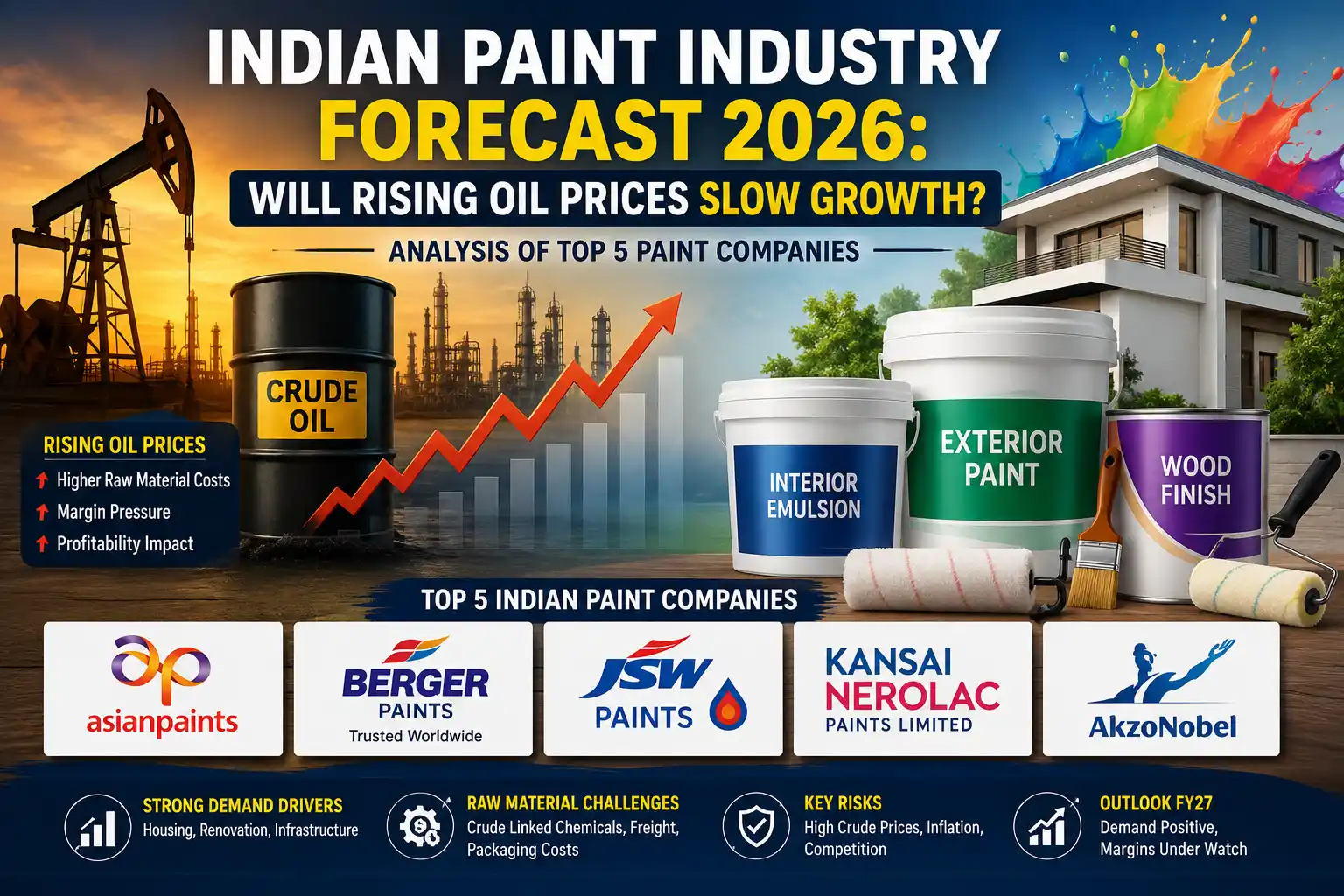
The Indian paint industry has been growing steadily over the past few years. Rising housing demand, home renovation activities, infrastructure projects, and increasing demand for premium products have provided strong support to the sector. Major players such as Asian Paints, Berger Paints, Kansai Nerolac, and Akzo Nobel India have strengthened their market presence, while new entrants are also expanding aggressively.
However, alongside this growth, the industry faces a significant risk—crude oil prices. Many of the raw materials used in paint manufacturing are petrochemical-based and are directly linked to crude oil prices. As a result, whenever oil prices rise, paint companies face higher input costs, putting pressure on their profit margins.
With crude oil market volatility and geopolitical tensions in the Middle East during 2026, investors are closely watching whether paint companies will be able to maintain their profitability or whether higher oil prices will impact their growth. Let’s take a detailed look at the current situation of the paint industry and the latest performance of leading companies.
How Is the Paint Industry Connected to Crude Oil?
Several key raw materials used in paint manufacturing are petrochemical-based, including:
- Resins
- Solvents
- Monomers
- Additives
- Emulsions
According to industry estimates, approximately 35% to 55% of the total raw material cost of paint companies is linked to crude oil-based products.
This means:
- When crude oil prices increase, raw material costs rise.
- Higher raw material costs put pressure on profit margins.
- When crude oil prices decline, paint companies generally benefit from improved profitability.
This is why crude oil prices are considered one of the most important external factors affecting the paint industry.
Current Situation of the Indian Paint Industry
In 2026, crude oil prices witnessed significant volatility due to geopolitical tensions in the Middle East.
This has affected paint companies in several ways:
- Higher petrochemical raw material costs
- Increased freight and transportation expenses
- Rising packaging costs
- Uncertainty regarding chemical feedstock supplies
Industry management teams have also highlighted the possibility of margin pressure in FY27.
Despite these challenges, demand remains strong. Housing construction, renovation activities, and infrastructure spending continue to support paint demand across the country.
Asian Paints Analysis
Asian Paints is India’s largest paint company and is often viewed as a key indicator of the industry’s overall performance.
Latest Q4 FY26 Performance
| Particulars | Q4 FY26 | Q4 FY25 | Growth |
| Revenue | ₹9,229 Cr | ₹8,359 Cr | +11% |
| Net Profit | ₹1,172 Cr | ₹692 Cr | +69% |
| Decorative Volume Growth | 12.4% | – | Strong |
| EBITDA Margin | 19.4% | 17.2% | Improvement |
Analysis
Despite oil-related inflation, Asian Paints delivered a strong performance.
Key reasons include:
- Premium product mix
- Strong decorative paint demand
- Better pricing strategy
- Cost efficiencies
- Benefits from backward integration
The company also reported margin expansion during FY26, which is considered a positive sign for investors.
Risk
If Brent crude rises above $100 per barrel again:
- Raw material inflation could increase
- Margins may come under pressure
- Profit growth could slow down
Berger Paints Analysis
Berger Paints is India’s second-largest decorative paint company and has shown a strong recovery in recent quarters.
Latest Q4 FY26 Performance
| Particulars | Q4 FY26 | Q4 FY25 | Growth |
| Revenue | ₹2,868 Cr | ₹2,704 Cr | +6.1% |
| Net Profit | ₹335 Cr | ₹263 Cr | +27.5% |
| Volume Growth | 11.8% | – | Strong |
| Margin | 10-Quarter High | – | Improvement |
Analysis
Berger Paints reported an impressive margin recovery during FY26.
Key growth drivers included:
- Strong volume growth
- Better product mix
- Increasing demand for premium paints
- Efficient cost management
Risk: Middle East tensions and crude-linked raw material inflation could affect future margins.
JSW Paints Analysis
JSW Paints is currently in an aggressive expansion phase and is focused on gaining market share.
Current Situation
- Double-digit volume growth target
- Distribution network expansion
- Focus on urban market penetration
Analysis
The company is aggressively pursuing growth opportunities.
However, rising crude oil and gas prices may result in:
- Higher input costs
- Short-term margin pressure
- Potential price increases
Kansai Nerolac Paints Analysis
Kansai Nerolac has a strong presence in both decorative paints and industrial coatings.
Analysis
Because of its industrial coatings business, the company may face a greater impact from petrochemical inflation.
If crude oil remains elevated:
- Industrial paint margins may come under pressure
- Profitability in the auto coatings segment may be affected
However, demand recovery and industrial activity could provide support.
Akzo Nobel India Analysis
Akzo Nobel India is well known for its Dulux brand and has a strong position in the premium paint segment.
Analysis
Its premium positioning allows the company to pass a portion of raw material inflation to customers.
Key strengths include:
- Strong brand value
- Premium customer base
- Better pricing power
As a result, Akzo Nobel may be better positioned to protect margins in a high crude oil environment.
Paint Industry Financial Comparison
| Company | Revenue Growth (YoY) | Profit Growth (YoY) | Current Situation |
| Asian Paints | +11% | +69% | Strong recovery |
| Berger Paints | +6% | +27% | Margin recovery |
| JSW Paints | Strong volume growth | Positive | Expansion phase |
| Kansai Nerolac | Positive trend | Positive | Industrial exposure |
| Akzo Nobel India | Stable | Positive | Premium positioning |
Key Positive Factors for FY27
1. Growth in Housing Demand
Strong housing demand in India is expected to support decorative paint consumption.
2. Home Renovation Trend
Consumers are spending more on renovation and repainting activities than before.
3. Infrastructure Spending
Government infrastructure projects continue to support both decorative and industrial paint demand.
4. Demand for Premium Products
Growth in premium and luxury paint categories is helping improve industry margins.
5. Recovery in Rural Demand
Improving demand from rural markets could provide an additional growth driver for paint companies.
Major Risks for FY27
- High Crude Oil Prices: The biggest risk for rising raw material costs.
- Middle East Geopolitical Tensions: Potential disruptions in oil supply and higher freight costs.
- Petrochemical Inflation: Direct pressure on company margins.
- Competitive Pricing Pressure: Increasing competition could lead to aggressive pricing strategies.
- Birla Opus and New Competition: New entrants may put pressure on both market share and profitability.
Outcome
The long-term growth story of the Indian paint industry remains strong. Housing demand, renovation activity, infrastructure spending, and premium product adoption continue to support the sector.
Recent quarterly results show that market leaders such as Asian Paints and Berger Paints are currently managing cost pressures effectively and delivering strong profit growth.
However, crude oil prices will remain the most important factor in FY27. If oil prices stay elevated, raw material costs are likely to rise further, putting pressure on margins.
In the current environment, established players such as Asian Paints and Berger Paints appear better positioned due to their strong brands, pricing power, and extensive distribution networks. Smaller players and companies pursuing aggressive expansion may face greater challenges in a high crude oil price environment.
Overall, the demand outlook for the paint industry remains positive, but profitability in FY27 will largely depend on crude oil prices and the direction of raw material costs.