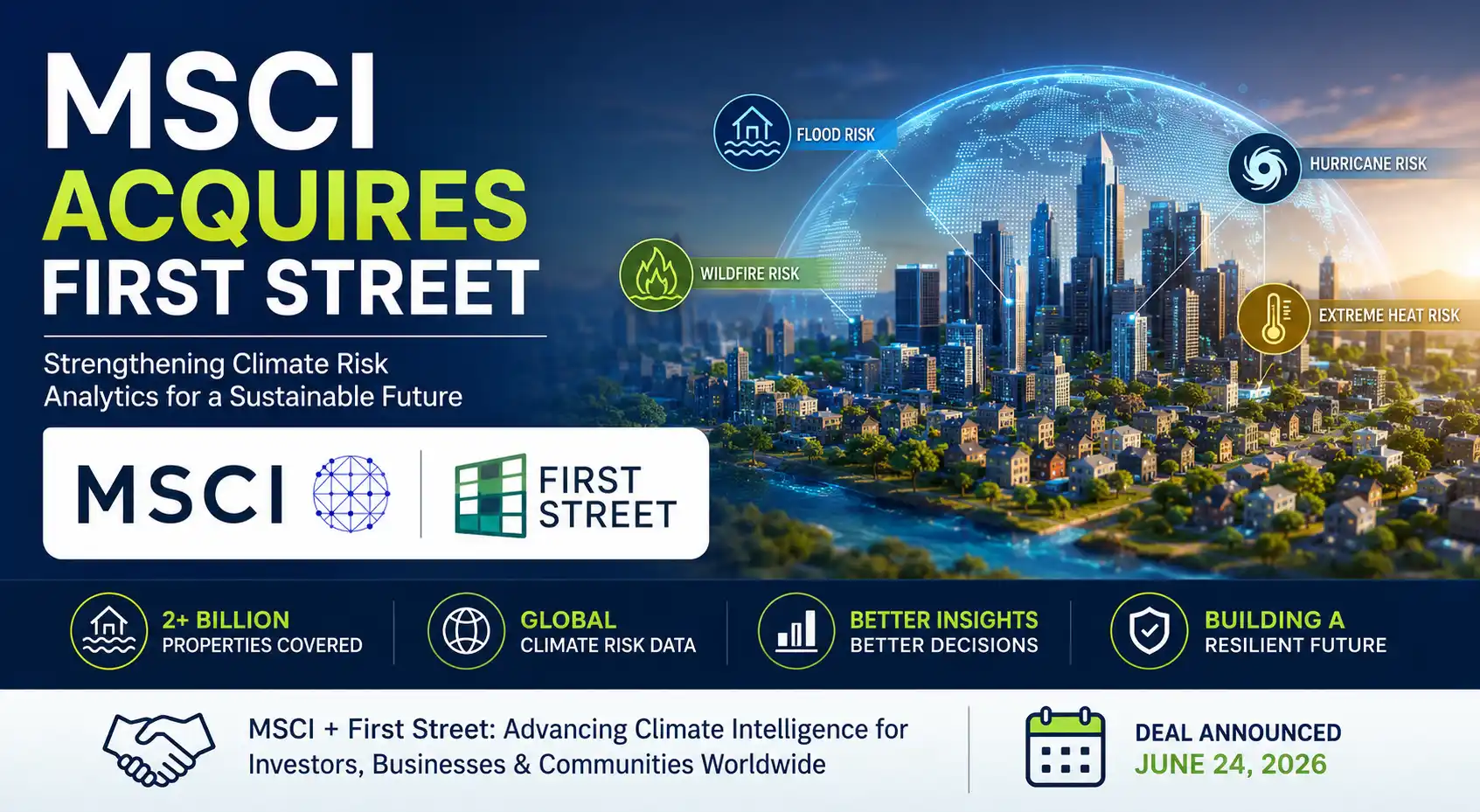
On June 24, 2026, MSCI Inc. announced that it has entered into an agreement to acquire First Street, a leading climate risk intelligence company. The acquisition is aimed at significantly enhancing MSCI’s Physical Climate Risk Analytics capabilities for investors, financial institutions, insurers, and businesses worldwide.
Under the terms of the agreement:
- MSCI will pay $120 million in cash at closing.
- Additional performance-based payments may be made over the next two years if First Street achieves certain revenue targets.
- The transaction is expected to close in Q3 2026, subject to customary regulatory approvals.
The acquisition will enable MSCI to provide physical climate risk insights covering more than 2 billion properties and locations worldwide, helping investors make better long-term investment decisions.
Key Deal Highlights
| Field | Details |
| Acquirer | MSCI Inc. |
| Target Company | First Street |
| Deal Type | Acquisition |
| Deal Value | US$120 Million (Cash at Closing) + Performance-Based Earnout (up to 2 years) |
| Industry | Financial Services / Climate Risk Analytics / ESG & Investment Data |
| Acquirer Country | United States |
| Exchange | NYSE |
| Ticker | MSCI |
| Expected Closing | Q3 2026 |
About MSCI
MSCI Inc. is one of the world’s leading providers of investment decision support tools. The company is widely recognized for its:
- Global Equity Indexes
- ESG Ratings
- Climate Analytics
- Portfolio Risk Management Solutions
- Market Research and Data Analytics
Institutional investors, asset managers, pension funds, ETFs, and financial advisors across the globe rely on MSCI’s data and indexes to benchmark portfolios and manage investment risks. More than $16 trillion in assets are benchmarked to MSCI indexes.
About First Street
First Street is a U.S.-based climate technology company specializing in physical climate risk modeling.
Using artificial intelligence, advanced physics models, satellite imagery, and geospatial data, the company predicts how climate change could impact individual properties and infrastructure.
Its analytics cover multiple climate hazards, including:
- Flood Risk
- Wildfire Risk
- Hurricane Risk
- Extreme Heat
- Wind Damage
- Heavy Rainfall
- Coastal Flooding
Its services are widely used by banks, insurance companies, real estate firms, government agencies, and infrastructure investors.
Why Did MSCI Acquire First Street?
Investment decisions today require more than analyzing a company’s financial statements.
Investors also need answers to important questions such as:
- Is the company’s factory located in a flood-prone region?
- Could rising sea levels threaten its assets?
- Is its supply chain vulnerable to extreme weather?
- How might climate change affect future earnings?
By acquiring First Street, MSCI aims to integrate high-quality physical climate risk data directly into its investment and risk management platforms.
How Will This Acquisition Strengthen MSCI?
The acquisition significantly expands MSCI’s climate intelligence offerings by adding:
- Property-Level Climate Risk Assessment
- Geographic Risk Mapping
- Asset-Level Exposure Analysis
- Climate Stress Testing
- Infrastructure Risk Analysis
- Supply Chain Climate Assessment
These capabilities will allow investors to better understand how climate-related events may affect individual assets and entire investment portfolios.
Benefits for Investors
The combined platform will help investors evaluate risks beyond traditional financial metrics.
For example, investors can determine:
- Whether company facilities are exposed to flooding or wildfires.
- Which regions face increasing climate-related threats.
- How physical climate risks may impact long-term profitability.
- Whether investment portfolios are adequately diversified against climate risks.
This supports more informed, data-driven investment decisions.
Benefits for Banks and Insurance Companies
Financial institutions will gain improved visibility into climate-related exposure.
Banks can better evaluate:
- Mortgage risks
- Commercial property loans
- Infrastructure financing
- Long-term credit exposure
Insurance companies can use the enhanced analytics to:
- Improve risk pricing
- Estimate potential claims
- Strengthen catastrophe modeling
- Better assess property insurance portfolios
Importance for ESG Investing
Environmental, Social, and Governance (ESG) investing continues to grow rapidly worldwide.
While investors have traditionally focused on carbon emissions and sustainability reporting, there is now increasing demand for data showing how climate change physically impacts business operations and assets.
By combining First Street’s property-level climate intelligence with MSCI’s existing ESG and climate solutions, the company aims to deliver a more comprehensive view of climate-related investment risks.
What This Means for the Future
Climate intelligence is becoming an essential part of modern investment decision-making rather than an optional analytical tool.
As climate-related disasters become more frequent, investors, lenders, insurers, and corporations increasingly need accurate, property-level climate data to assess long-term risks.
With this acquisition, MSCI strengthens its position in the rapidly growing climate analytics market and enhances its ability to deliver advanced risk intelligence to global financial institutions.
Outcome
MSCI’s acquisition of First Street represents more than a corporate transaction—it reflects the financial industry’s growing emphasis on physical climate risk analysis.
By combining MSCI’s global investment analytics platform with First Street’s advanced climate risk modeling technology, the company is creating a more comprehensive solution for investors, banks, insurers, and businesses. As climate risk becomes a critical factor in investment and lending decisions, this acquisition positions MSCI to play an even larger role in the future of sustainable finance and risk management.
Source: MSCI