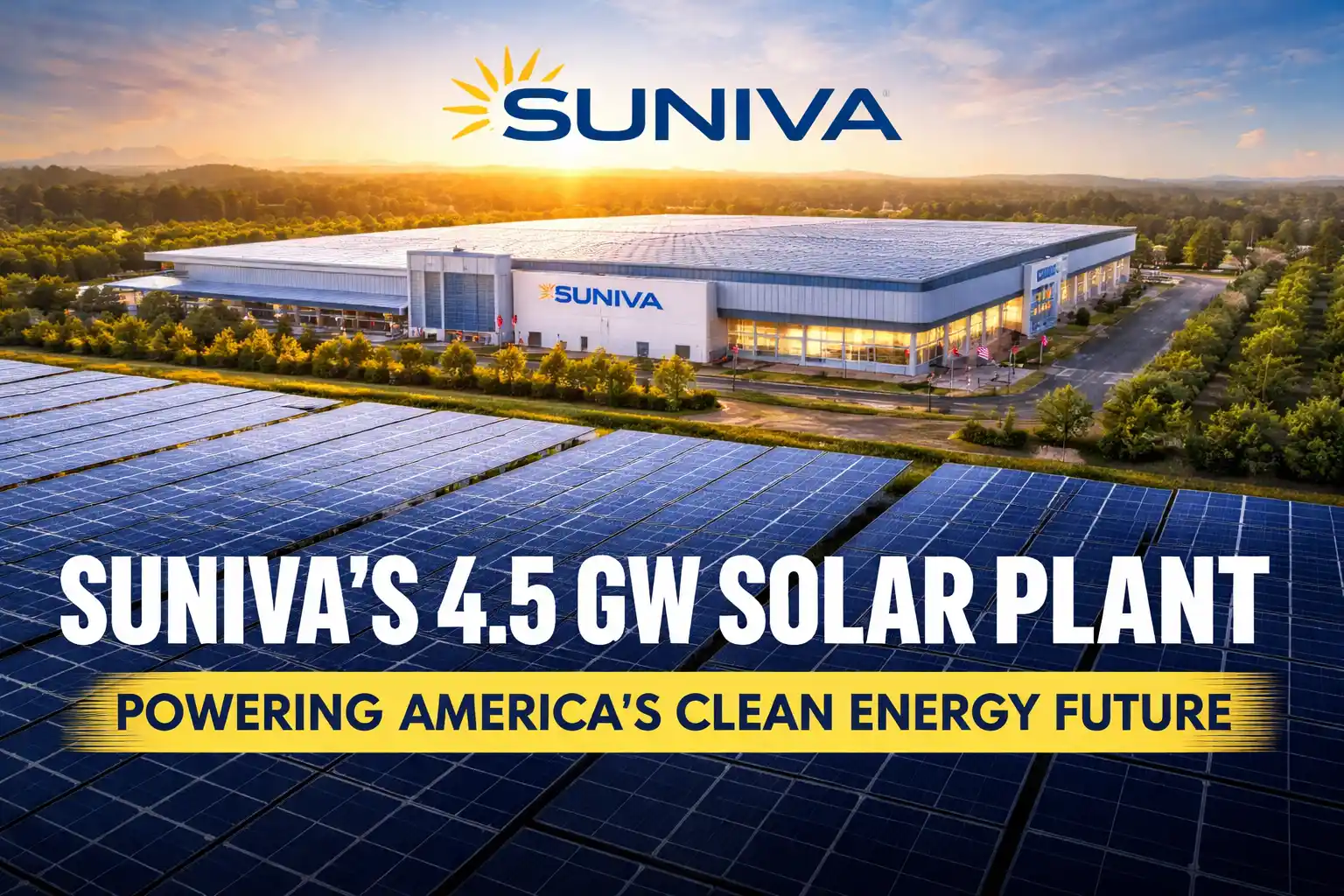
US-based solar manufacturer Suniva has announced a major expansion plan to strengthen domestic solar manufacturing. The company will build a 4.5 GW solar cell manufacturing plant in South Carolina, marking one of the largest investments in the US solar supply chain in recent years.
This move comes at a time when the United States is aggressively pushing for energy independence and clean energy adoption.
About Suniva
Suniva is a leading American solar cell manufacturer founded in 2007, with roots in research from Georgia Tech.
The company specializes in high-efficiency monocrystalline silicon solar cells and has been a key player in the US solar industry. After facing financial challenges and halting operations in 2017, Suniva restarted production in 2024, aiming to rebuild domestic solar manufacturing capacity.
Today, Suniva positions itself as a fully American-owned solar manufacturer, focusing on “Made in USA” energy solutions.
Project Details: South Carolina Solar Plant
Location
The new manufacturing facility will be set up in Laurens County, South Carolina. The plant is expected to span approximately 620,000 square feet, making it a large-scale industrial project.
Production Capacity
- New plant capacity: 4.5 GW per year
- Total Suniva capacity after expansion: 5.5 GW
This level of production is significant enough to power millions of homes annually.
Investment and Job Creation
Suniva plans to invest approximately $350 million (over ₹2900 crore) into this project.
- Expected job creation: 550+ new jobs
- Boost to local economy and industrial development
This investment is not only about energy but also about regional economic growth and employment generation.
Timeline
- Construction phase: Expected to begin soon
- Commercial production start: Second quarter of 2027
The timeline aligns with rising demand for solar energy across the US.
Why This Project Matters
1️⃣ Strengthening US Solar Supply Chain
Currently, the US has strong solar module manufacturing but relies heavily on imported solar cells.
This plant will help reduce that dependency and fill a critical gap in the supply chain.
2️⃣ Reducing Dependence on China
China dominates the global solar manufacturing sector.
By building domestic capacity, the US is taking a strategic step toward reducing reliance on Chinese imports and enhancing energy security.
3️⃣ Government Policy Support
The project aligns with US government initiatives like the Inflation Reduction Act (IRA), which offers incentives and tax benefits for local manufacturing.
Such policies are encouraging companies like Suniva to invest heavily in domestic production.
4️⃣ Rising Demand for Clean Energy
Demand for electricity is increasing rapidly due to:
- AI and data centers
- Electric vehicles
- Industrial electrification
Solar energy is emerging as the most cost-effective and scalable solution, making such investments highly relevant.
Industry Impact and Analysis
Current Scenario
- US solar module capacity: ~60 GW
- Solar cell capacity: ~3.2 GW
This shows a clear shortage of domestic solar cells.
Suniva’s Role
With a total capacity of 5.5 GW, Suniva could become one of the leading solar cell manufacturers in the US.
This project is expected to solve a major bottleneck in the industry.
Business Outlook
Strong Revenue Visibility
Reports suggest that Suniva’s production is largely pre-sold through 2030, indicating strong future demand and stable revenue potential.
Strategic Advantage
- “Made in USA” positioning
- Government support
- Limited domestic competition
These factors provide Suniva with a competitive edge in the market.
Potential Risks
- Higher manufacturing costs compared to Asia
- Dependence on government policies
- Global competition, especially from China
Outcome
Suniva’s plan to build a 4.5 GW solar cell plant in South Carolina represents a significant step toward strengthening the US solar manufacturing ecosystem.
With a $350 million investment, strong policy support, and rising demand for clean energy, this project has the potential to become a game changer for the US solar industry.
It not only boosts domestic production but also supports long-term goals of energy security, economic growth, and sustainability.
Source: suniva